By: Shelby McCullough| Published: June 24, 2026
TL;DR:
- Tree longevity depends on genetics, environment, and structural health, with some species living over 5,000 years. Proper care, such as protecting roots and correct pruning, can significantly extend a tree’s lifespan and resilience. External damage and stressors, not aging, primarily cause trees to die, emphasizing the importance of mitigating stress and maintaining healthy conditions.
Tree longevity is defined as a tree’s capacity to survive and grow across decades, centuries, or even millennia, shaped by genetics, environment, and the absence of programmed biological death. Common species live anywhere from 20 to 300+ years, while exceptional cases like the Great Basin bristlecone pine exceed 5,000 years. Understanding what drives these differences is not just a biology lesson. For property owners and anyone managing a landscape, it is the foundation for every smart tree care decision you will ever make.
What factors determine how long a tree lives?
Tree lifespan is controlled by a combination of genetics, environment, and physical structure. No single factor dominates. Instead, these forces interact constantly across a tree’s life.
Genetic factors set the ceiling. The Great Basin bristlecone pine carries 21,364 protein-coding genes and longer telomeres than most tree species. Longer telomeres slow cellular aging and strengthen disease resistance. That genetic profile is a core reason bristlecones outlive nearly every other organism on Earth.
Environmental stressors determine whether a tree reaches its genetic potential. Soil quality, water availability, climate extremes, and human activity all chip away at lifespan. Compacted soil cuts off oxygen to roots. Drought stresses the vascular system. Construction near root zones causes damage that takes years to appear on the surface.
Structural limits eventually catch up with every tree. The two primary killers are hydraulic failure and structural decay. Hydraulic failure occurs when a tree can no longer move water and nutrients from roots to crown. Structural decay weakens the trunk and major limbs until the tree cannot support its own weight. Neither process is inevitable at a fixed age. Both accelerate when a tree is stressed.
Trees also hold a biological advantage animals lack. They retain pluripotent meristematic cells, which are stem cells capable of generating new tissue indefinitely. This means a tree does not have a built-in expiration date the way most animals do.
- Soil compaction reduces root oxygen and slows growth
- Root damage from construction or landscaping creates entry points for disease
- Drought stress accelerates hydraulic failure in shallow-rooted species
- Pest and fungal infections exploit weakened structural tissue
- Air pollution and soil contamination reduce nutrient uptake over time
Pro Tip: If you are planting a new tree, choose a species native to your region. Native trees carry genetic adaptations to local soil, rainfall, and temperature patterns, giving them a natural head start on longevity.
How do different tree species compare in longevity?
Species identity is the single strongest predictor of how long a tree will live. Growth rate, wood density, and environmental adaptability all vary by species, and those differences translate directly into lifespan.
| Species | Typical Lifespan | Notable Trait |
|---|---|---|
| Flowering dogwood | 20–50 years | Short-lived ornamental understory tree |
| Red maple | 80–100 years | Fast growth, moderate lifespan |
| White oak | 200–600 years | Dense wood, slow growth, high longevity |
| Coast redwood | 1,000–2,000 years | Massive size, fire-resistant bark |
| Great Basin bristlecone pine | 5,000+ years | Extreme cold and drought tolerance |
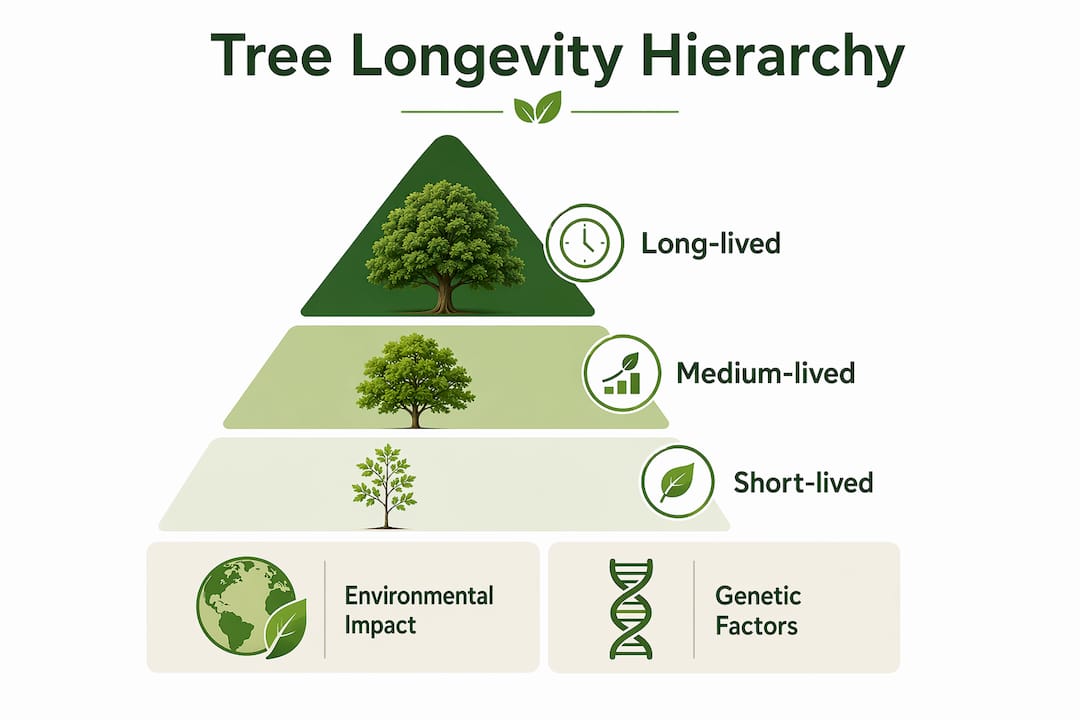
Small ornamental trees like dogwoods and ornamental cherries typically live 20–50 years. Medium trees like maples and elms reach 80–150 years under good conditions. Large dominant species like oaks and hickories regularly exceed 200 years. The outliers, bristlecones and redwoods, operate on a timescale that is genuinely difficult to comprehend.
One counterintuitive fact about tree age determination: trunk size does not reliably indicate age. A tree growing under a dense forest canopy can spend decades in near-stasis, barely adding girth while waiting for a gap in the canopy. That same tree, once it reaches full light, may look far younger than its actual age. Growth ring analysis requires careful interpretation for exactly this reason.
Bristlecone pines survive through extreme climates by maintaining stable, localized populations at high elevations. Their slow metabolism and dense, resin-saturated wood resist rot and insect damage for thousands of years. That combination of traits makes them the benchmark for studying tree longevity across all species.
Why don’t trees die of old age like animals?
Trees do not undergo programmed senescence. That distinction separates them from virtually every animal on Earth. Trees lack a genetically programmed aging process, meaning their death results from external damage or resource depletion, not a biological countdown. If conditions remain favorable and no external threat arrives, a tree can theoretically keep growing indefinitely.
Here is how that plays out in practice:
- A tree’s crown stays biologically young even as its structural core ages and hollows. The outermost growth tissue at the crown continues producing new cells at the same rate as a young tree.
- The dead heartwood at the center of an old trunk provides structural support but is no longer metabolically active. The tree does not “feel” this aging in any functional sense.
- Disease, storm damage, root failure, or drought eventually overwhelm the tree’s repair capacity. That is when death occurs, not at a predetermined age.
- Human activity accelerates this process. Soil compaction, root cutting, and improper pruning create wounds that a tree in a natural setting would rarely face.
“Interpreting tree aging as decline is a misconception. Trees function as adaptive systems, maintaining vitality despite aging structures.” — How trees push the limits of life
This reframing matters for property owners. A 200-year-old oak on your lot is not “old and dying.” It is a biologically active organism that will continue thriving if you remove the stressors threatening it.
How can property owners support tree longevity?
The most effective tree care practices target the biological mechanisms that keep trees alive. Watering is the obvious one, but the less obvious practices often matter more.
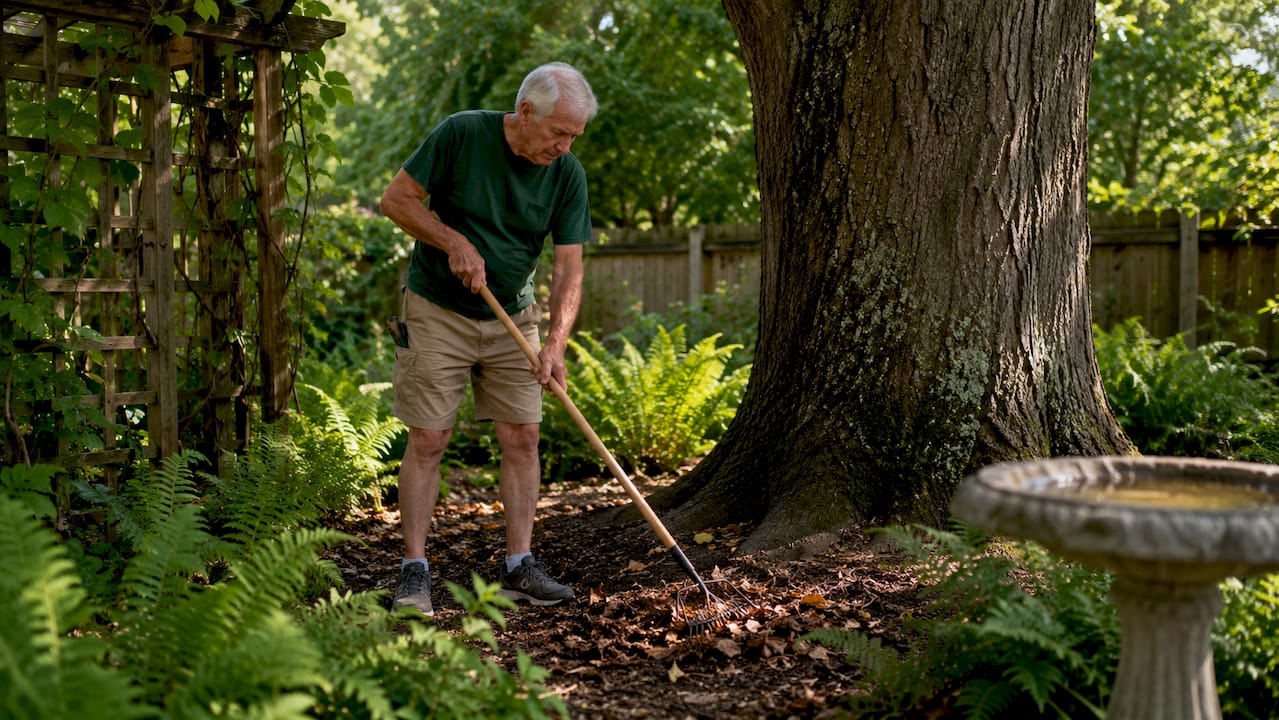
Protect the root zone. Roots extend well beyond the drip line of the canopy, often two to three times the crown radius. Parking vehicles, storing materials, or compacting soil in that zone cuts off oxygen and damages the fine feeder roots that absorb water and nutrients. Minimizing soil compaction and preserving mycorrhizal fungal networks are two of the highest-impact actions a property owner can take.
Prune correctly and at the right time. Improper cuts create large wounds that invite fungal decay. Proper pruning technique removes dead or crossing branches at the branch collar, allowing the tree to seal the wound naturally. Topping a tree, which means cutting the main trunk or large branches back to stubs, is one of the most damaging practices in residential landscaping.
Catch decline early. Trees signal stress long before they become hazardous. Sparse canopy, early leaf drop, bark cracks, and fungal growth at the base are all warning signs. Checking for signs of tree decline annually gives you time to intervene before the problem becomes irreversible.
- Mulch around the base to retain moisture and regulate soil temperature
- Avoid piling mulch against the trunk, which traps moisture and causes rot
- Water deeply and infrequently rather than shallow and often
- Keep lawn equipment away from the root flare at the base of the trunk
- Schedule a certified arborist inspection every two to three years for mature trees
Pro Tip: Mycorrhizal fungi form a network around tree roots that dramatically improves water and nutrient uptake. Avoid using broad-spectrum fungicides near the root zone, as these kill beneficial fungi along with harmful ones.
Balancing landscaping goals with tree health requires thinking about hardscape and softscape design together. Patios, walkways, and retaining walls placed too close to mature trees compress roots and redirect water away from the root zone. Planning these elements with tree biology in mind protects your investment in both the landscape and the trees themselves.
Key Takeaways
Tree longevity is primarily determined by genetics and environment, not a fixed biological clock, meaning the right care can extend a tree’s life by decades.
| Point | Details |
|---|---|
| Lifespan varies widely by species | Common trees live 20–300+ years; exceptional species like bristlecone pines exceed 5,000 years. |
| Trees have no programmed death | External damage and resource depletion cause tree death, not a biological aging countdown. |
| Root zone protection is critical | Minimizing soil compaction and preserving mycorrhizal networks directly extends tree lifespan. |
| Early decline detection saves trees | Annual checks for sparse canopy, bark damage, and fungal growth allow timely intervention. |
| Proper pruning prevents decay | Correct cuts at the branch collar let trees seal wounds naturally and resist fungal infection. |
What working with old trees has taught me about longevity
The trees that surprise me most are not the bristlecones in California. They are the 300-year-old live oaks sitting in Central Florida neighborhoods, surrounded by concrete, irrigation systems, and decades of well-meaning but damaging landscaping decisions. Those trees are still standing not because of anything anyone did for them, but because they were never quite stressed enough to tip over the edge.
That observation changed how I think about tree care. Most property owners focus on what to add: fertilizer, water, mulch. The bigger gains usually come from what you stop doing. Stop compacting the root zone. Stop topping branches. Stop planting turf grass right up to the trunk. Trees are extraordinarily resilient when you remove the stressors rather than just layering on treatments.
The ecological argument for long-lived trees is also underappreciated. A 150-year-old oak stores carbon, supports hundreds of insect species, and provides shade that measurably reduces cooling costs for nearby buildings. That value compounds over time in a way a young replacement tree cannot replicate for generations. Protecting what you already have is almost always the better investment.
The science on tree aging has shifted significantly in the past decade. Genomic research on bristlecone pines has given us a clearer picture of what genetic longevity actually looks like at the cellular level. That knowledge is now filtering into practical arboricultural guidance. The takeaway for property owners is straightforward: treat your trees as long-term assets, not short-term landscaping features.
— Mcculloughtreeservice
How Mcculloughtreeservice helps you protect your trees
Mcculloughtreeservice works with residential and commercial property owners across Orlando and Central Florida to extend tree health and prevent the structural and biological failures that cut lifespans short.
Certified arborists from Mcculloughtreeservice assess root zone health, identify early signs of hydraulic stress, and apply professional tree trimming techniques that protect wound sites and preserve the tree’s natural defense systems. Whether you need a routine inspection, targeted pruning, or help managing a tree showing signs of decline, the team brings the expertise to make the right call. Reach out to Mcculloughtreeservice for a property assessment and give your trees the conditions they need to reach their full lifespan.
FAQ
How long do trees typically live?
Average tree lifespan ranges from 20–50 years for small ornamental species to 100–300+ years for large dominant trees like oaks. Exceptional species like the Great Basin bristlecone pine exceed 5,000 years.
What is the most common cause of tree death?
Trees most often die from hydraulic failure or structural decay, not old age. Disease, storm damage, soil compaction, and root injury accelerate both processes.
How can I tell how old a tree is?
Growth ring analysis is the most accurate method, but it requires a core sample. Trunk girth can estimate age, though stasis periods in shaded environments make size a misleading indicator for many species.
Does pruning help a tree live longer?
Correct pruning removes dead and diseased wood, reduces structural failure risk, and allows the tree to seal wounds naturally. Improper cuts, especially topping, shorten lifespan by creating large decay entry points.
Why do some trees live so much longer than others?
Genetic adaptations like longer telomeres, denser wood, and stronger disease resistance explain most of the variation. Environmental fit also matters. A species adapted to its local climate and soil conditions will consistently outlive one planted outside its native range.
Recommended
- Can a Dying Tree Be Saved? Discover Solutions
- Tree preservation: boost health & beauty in Florida
- Hidden Dangers of Multi-Trunk Trees Unveiled
- The Worth of Planting Trees: A Deep Dive