By: Shelby McCullough| Published: July 8, 2026
TL;DR:
- A landscape safety workflow embeds hazard assessments, PPE checks, and documentation into daily operations. It relies on compliance with standards like ASC Z133-2026 and OSHA to reduce injuries and liability. Digital tools improve hazard tracking, evidence collection, and streamline safety enforcement across properties.
A landscape safety workflow is a systematic, step-by-step process that embeds safety, compliance, and risk management into every landscape maintenance and storm response activity. Property managers, landscape professionals, and safety officers who treat safety as a separate policy document rather than an operational habit face the highest liability exposure. The most effective approach integrates safety directly into standard operating procedures, backed by standards like ANSI ASC Z133-2026 and OSHA’s General Duty Clause. Done right, a well-built workflow for landscape safety reduces crew injuries, protects property owners from fines, and can lower insurance premiums within two years.
What does an effective landscape safety workflow require?
A landscape safety workflow requires three non-negotiable foundations: current regulatory compliance, proper personal protective equipment, and documented crew training. Without all three, the workflow has structural gaps that expose both workers and property owners to serious risk.

Regulatory compliance starts with knowing which standards apply. ASC Z133-2026 updated all safety practices to mandatory “shall” language, added a four-level electrical qualification system, and introduced structured drop-zone management. This is not optional guidance. OSHA fines for non-compliance range from $7,000 to $70,000 per violation. ANSI A300, consolidated into one document covering 14 clauses in 2024, serves as the legal benchmark in U.S. courts for professional negligence claims. Property managers who hire contractors without verifying compliance with both standards carry shared liability.
PPE and crew readiness form the second pillar. Every crew member needs task-appropriate PPE: chainsaw chaps, hard hats, eye protection, hearing protection, and cut-resistant gloves at minimum. Heat illness is a critical danger in landscaping, and most heat-related deaths occur within a new worker’s first three days on the job. Acclimatization periods are not optional accommodations. They are a documented safety requirement.
Digital management tools complete the foundation. Mobile reporting apps, standardized digital forms, and photo documentation give safety officers real-time visibility across multiple properties. These tools also create the paper trail that protects property managers during insurance audits and liability disputes.
| Prerequisite | Requirement | Purpose |
|---|---|---|
| Regulatory compliance | ASC Z133-2026, ANSI A300 | Legal protection and crew safety |
| PPE inventory | Task-specific gear per crew role | Injury prevention |
| Crew training records | Acclimatization, toolbox talks | Heat illness and incident prevention |
| Digital documentation | Mobile forms, photo logs | Insurance and liability defense |
| Communication protocol | Escape routes, hazard alerts | Storm and high-risk task safety |
Pro Tip: Build your PPE checklist directly into your daily task assignment form. When PPE verification is a required field before a job can be marked “started,” compliance becomes automatic rather than aspirational.
How to build a proactive workflow for routine maintenance
Embedding safety into daily operations means safety checks happen before the first cut, not after the first incident. The most reliable method is writing safety steps directly into the SOP for each task type.
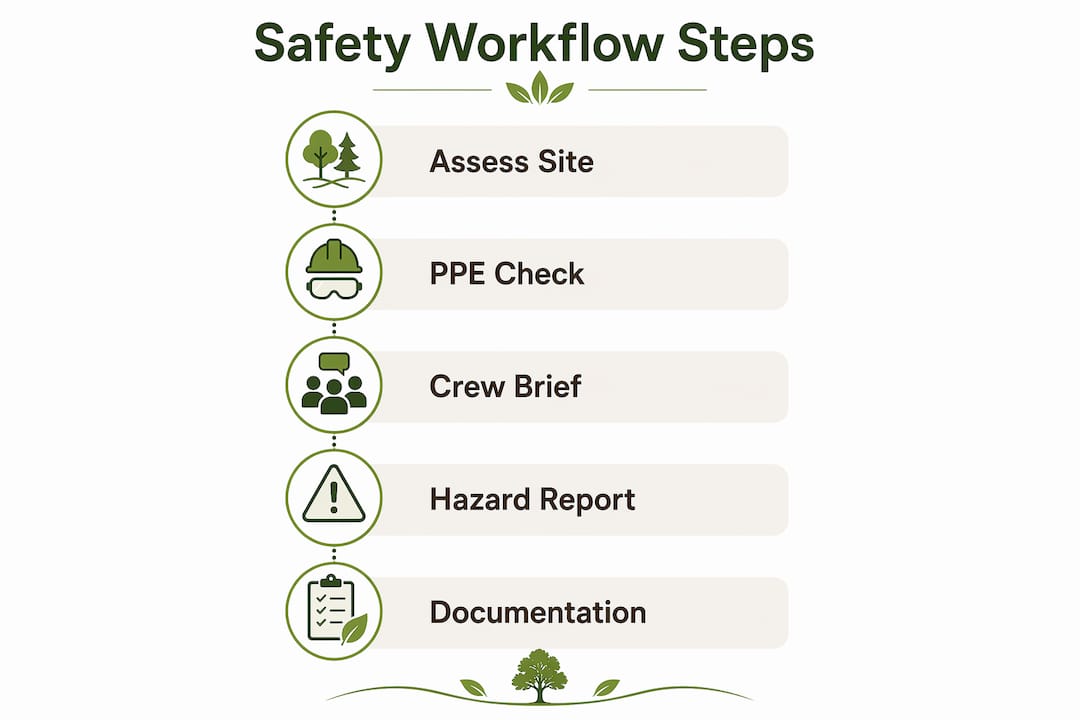
A routine maintenance workflow should follow this sequence:
- Pre-shift equipment inspection. Crew leads verify that all power tools, mowers, and hand tools are in working condition. Damaged equipment gets tagged out immediately.
- Daily toolbox talk. A five-minute, documented safety conversation before work begins. Daily toolbox talks and formal monthly trainings maintain crew safety focus and measurably reduce accidents.
- Site hazard assessment. Walk the work zone before starting. Identify overhead lines, unstable ground, pedestrian traffic, and any conditions that require work zone controls.
- Task-specific PPE confirmation. Each crew member confirms their PPE matches the assigned task before equipment starts.
- Work zone setup. Cones, barriers, and signage go up before any cutting or grinding begins.
- Near-miss and incident reporting. Any close call gets logged the same day, using a standardized digital form.
Embedding safety protocols into SOPs for each task improves protocol adherence far more than standalone safety documents. The reason is simple: when safety steps live inside the task instructions, crews cannot complete the task without completing the safety check.
Key habits to build into every routine maintenance cycle:
- Seasonal safety training at the start of each season, documented and signed
- Monthly refresher sessions covering the most common hazards for that month
- Documented near-miss reports reviewed weekly by the safety officer
- Photo documentation of any site condition that deviates from normal
Pro Tip: Rename your safety checklist. Call it the “Job Start Form” instead of the “Safety Checklist.” Crews complete job start forms without resistance. Safety checklists feel like extra paperwork. The content is identical. The compliance rate is not.
What workflow adaptations does storm response require?
Storm response demands a fundamentally different workflow from routine maintenance. The hazards are unpredictable, the pressure to act fast is intense, and the consequences of skipping assessment steps are severe.
The correct storm response sequence follows a strict triage order:
- Life-safety hazards first. Downed power lines, structures at collapse risk, and blocked emergency access routes take absolute priority over all other work.
- Structural damage assessment. Evaluate trees and large limbs for stored mechanical tension before any cutting begins.
- Access restoration. Clear paths for emergency vehicles and property access.
- Cosmetic cleanup. Debris removal and aesthetic restoration come last, regardless of client urgency.
Storm-damaged trees store mechanical tension that can release violently when cut incorrectly. Crews must establish clear escape routes before any chainsaw work begins. Prioritizing customer urgency over this assessment is the most common and most dangerous mistake in storm response. A proper site risk assessment, conducted by someone trained to read tree structure, is not optional. It is the first task.
Storm response must prioritize life-safety hazards first, followed by structural damage, access, and cosmetic cleanup. This sequence exists because the cost of getting it wrong is irreversible.
Documentation during storm response serves two purposes. First, it protects the property manager during insurance claims. Timestamped photos, damage assessments, and work logs create an evidence record that adjusters and attorneys can verify. Second, it communicates clearly with tenants and stakeholders about what was found, what was done, and what remains. Coordination with emergency personnel and other contractors also requires a clear communication protocol established before crews enter the site.
How do digital tools improve landscape safety management?
Digital landscaping management systems increase crew productivity by 20–30% and improve job margin accuracy by 25%. Those numbers reflect something more important than efficiency. They reflect fewer errors, faster hazard identification, and consistent documentation across every property in a portfolio.
The practical advantages of digital tools over paper-based systems are significant:
- Real-time hazard reporting. Crew members flag site conditions from the field the moment they are identified, not at the end of the day.
- Standardized forms. Every crew uses the same inspection format, which means safety officers can compare data across sites without interpreting different formats.
- Photo documentation. Images with timestamps and GPS coordinates create an evidence portfolio that protects property managers during insurance audits and liability disputes.
- Integration with scheduling and payroll. Safety compliance data connects directly to operational records, making it easier to identify crews or sites with recurring issues.
| Workflow element | Traditional approach | Digital approach |
|---|---|---|
| Hazard reporting | End-of-day paper log | Real-time mobile submission |
| Photo documentation | Optional, inconsistent | Timestamped, GPS-tagged, required |
| Inspection consistency | Varies by crew | Standardized across all sites |
| Deficiency closure tracking | Manual follow-up | Automated alerts and closure metrics |
| Compliance records | Filed physically | Searchable, audit-ready database |
Key metrics that digital platforms track include safety observations per site, proposal accuracy rates, deficiency closure speed, and quality condition scores. Digital platforms improve inspection consistency and accelerate deficiency closure, which directly reduces the window of liability exposure between identifying a hazard and resolving it.
What compliance pitfalls should safety officers avoid?
The most expensive mistake in landscape safety management is assuming that hiring a licensed contractor transfers all liability to that contractor. Property owners remain liable under OSHA’s General Duty Clause if they fail to maintain safe contracted work zones. That liability does not disappear with a signed contract.
Common pitfalls that create serious exposure:
- No digital evidence portfolio. Without timestamped photos, signed checklists, and inspection logs, a property manager has no defense during an insurance audit or legal claim.
- Safety as a standalone document. A safety policy that lives in a binder and never touches daily operations is not a workflow. It is a liability.
- Skipping acclimatization for new workers. Heat illness risk peaks in the first three days. Ignoring this fact is both a safety failure and a compliance violation.
- Rushing storm response. Entering a storm-damaged site without a triage assessment exposes crews to stored tension in damaged trees, which can cause sudden, violent limb release.
- Ignoring Z133-2026 mandatory requirements. The shift from “should” to “shall” language means what were previously recommendations are now enforceable requirements. OSHA fines for violations range from $7,000 to $70,000 per incident.
Small operations typically spend $5,000–$15,000 on full Z133-2026 compliance. That figure sounds significant until it is compared to a single OSHA fine or an insurance exclusion triggered by a documented violation. Insurance premiums can decrease by 10–15% within 18–24 months of verified compliance. Compliance pays for itself.
Pro Tip: Ask your contractor for their Z133-2026 compliance documentation before signing any service agreement. A contractor who cannot produce it is a liability you are absorbing.
Key Takeaways
A landscape safety workflow embedded into daily SOPs, backed by digital documentation, and adapted for storm response is the single most effective way to protect crews, reduce liability, and maintain compliance.
| Point | Details |
|---|---|
| Embed safety into SOPs | Safety steps inside task instructions produce higher compliance than standalone safety documents. |
| Follow triage in storm response | Life-safety hazards come first; cosmetic cleanup comes last, regardless of client pressure. |
| Build a digital evidence portfolio | Timestamped photos and signed checklists are your primary defense in insurance and liability disputes. |
| Know your mandatory standards | ASC Z133-2026 uses “shall” language; violations carry OSHA fines from $7,000 to $70,000. |
| Acclimatize new workers | Most heat-related deaths occur in the first three days; acclimatization is a compliance requirement, not a courtesy. |
Why integrated safety workflows outperform policy documents
After working closely with property managers and landscape crews across Central Florida, one pattern stands out clearly. The operations with the fewest incidents are not the ones with the thickest safety manuals. They are the ones where safety is invisible because it is already built into every task.
The shift from reactive to proactive safety management is not philosophical. It is structural. When a crew lead cannot mark a job as started without completing a site hazard check, safety happens automatically. When storm response crews have a pre-established triage protocol they have practiced, they do not freeze or rush when a hurricane comes through. They execute.
What I find most underestimated is the role of certified arborists in this process. A certified arborist does not just trim trees correctly. They read site conditions, identify stored tension in damaged wood, and make the call that keeps crews safe. That expertise is not replaceable by a checklist alone.
The compliance landscape is also tightening. ASC Z133-2026 made previously optional practices mandatory. Property managers who have not updated their contractor vetting process to reflect this are carrying risk they do not know about. The best practices for tree care are not static. They evolve, and the workflow must evolve with them.
The professionals who get this right treat safety as an operational system, not a seasonal reminder. That mindset is the difference between a crew that works safely and a property that stays protected.
— Results
Certified tree care that supports your safety program
Property managers and safety officers who build strong landscape safety workflows still need a field partner who executes to the same standard.

Mcculloughtreeservice provides certified arborist services across Orlando and Central Florida, covering tree trimming and storm preparation with full compliance to ASC Z133-2026 and ANSI A300 requirements. Every crew operates under documented safety protocols, and every job produces the photo documentation and signed records your evidence portfolio requires. Whether you manage a commercial property, an HOA, or a multi-site portfolio, Mcculloughtreeservice delivers the certified expertise and compliance documentation that protects you before, during, and after a storm.
FAQ
What is a landscape safety workflow?
A landscape safety workflow is a structured, step-by-step process that integrates safety checks, hazard assessments, PPE verification, and documentation into every landscape maintenance and storm response task. It replaces standalone safety policies with operational habits embedded directly into daily procedures.
What does ASC Z133-2026 require from landscape contractors?
ASC Z133-2026 makes all safety practices mandatory using “shall” language, adds a four-level electrical qualification system, and requires structured drop-zone management. Non-compliance carries OSHA fines ranging from $7,000 to $70,000 per violation.
Are property managers liable for contractor safety failures?
Property owners remain liable under OSHA’s General Duty Clause if they fail to maintain safe contracted work zones. Maintaining a digital evidence portfolio with timestamped photos and signed checklists is the primary defense against this liability.
How should storm response differ from routine maintenance safety?
Storm response requires a strict triage sequence: life-safety hazards first, then structural damage, then access restoration, and finally cosmetic cleanup. Crews must assess stored mechanical tension in damaged trees and establish escape routes before any chainsaw work begins.
How do digital tools support landscape risk assessment?
Digital platforms enable real-time hazard reporting, standardized inspection forms, and GPS-tagged photo documentation across multiple properties. They also track key metrics like deficiency closure speed and safety observation rates, which reduce the window between identifying a hazard and resolving it.
Recommended
- Commercial Tree Removal Guide for Safe Property Management
- Storm Cleanup Workflow: A Step-by-Step Recovery Guide
- Land Clearing Process Guide for Property Owners