By: Shelby McCullough| Published: July 26, 2026
Tree scaping, also called arborsculpture or tree shaping, is the deliberate, multi-year training and structural shaping of living trees for aesthetic form, function, or both. It goes well beyond routine trimming. If you have a young tree you want to grow into a specific form, a mature specimen with structural problems, or a landscape feature you want to frame with living architecture, the right next step is an on-site assessment with an ISA-certified arborist.
Key benefits homeowners and property managers gain from tree scaping:
- Stronger branch structure that reduces long-term storm damage risk
- Improved property value through intentional, well-framed canopy placement
- Better shade and solar access management without sacrificing tree health
- Reduced liability by correcting structural defects before they cause damage
Mcculloughtreeservice provides certified arborist assessments and full tree shaping services throughout Orlando and Central Florida. Schedule an assessment before the next growing season to get ahead of the work.
Table of Contents
- What is tree scaping, and how does it differ from trimming?
- Who benefits from tree scaping, and when should you start?
- How does a professional tree scaping project actually run?
- Why you should not leave stumps or large roots in place
- What does tree scaping cost, and is it worth the investment?
- How do you vet and hire the right arborist?
- Mcculloughtreeservice: certified tree shaping in Central Florida
- Key Takeaways
- Why certification and proactive care are worth the investment
- Useful sources and further reading
What is tree scaping, and how does it differ from trimming?
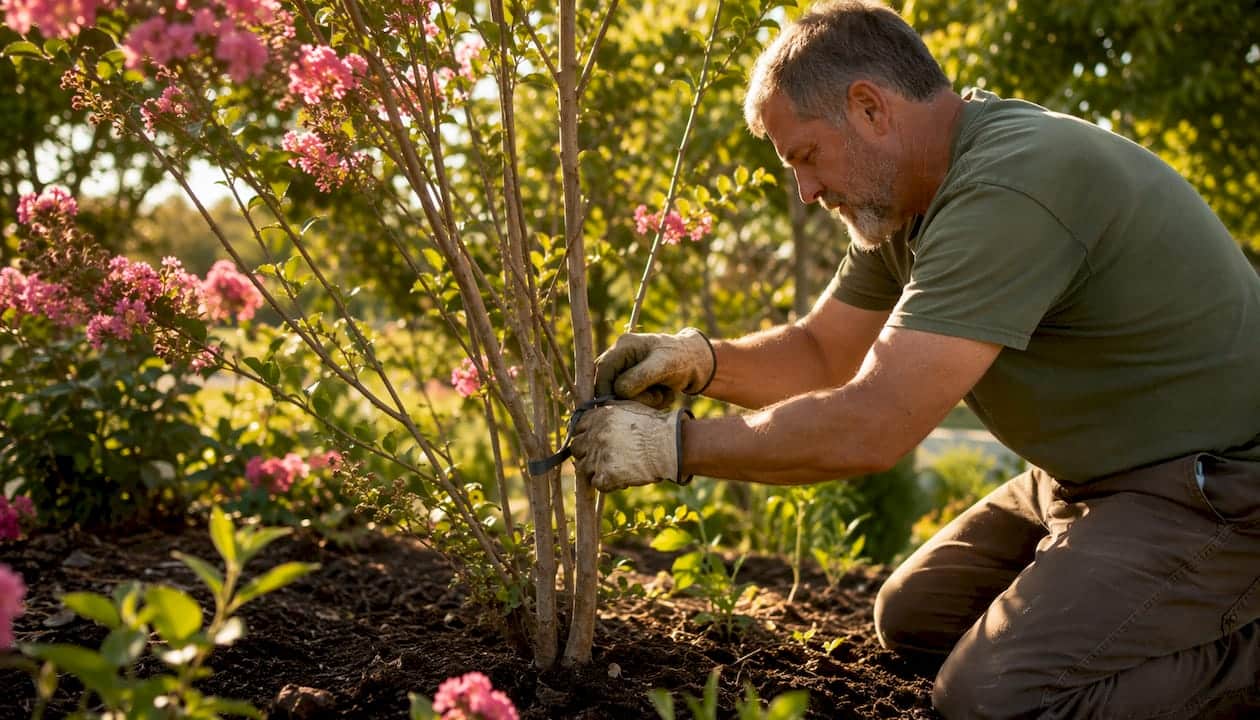
Tree shaping is a proactive, artistic, and structural process. A certified arborist designs a training plan, then guides a tree’s growth over months or years using selective cuts, training ties, cabling, grafting, and framing. The goal can be purely aesthetic, such as espalier patterns against a wall, or functional, such as a living arbor or a canopy shaped to clear a roofline.
Routine pruning and trimming are reactive. They remove dead, diseased, or hazardous branches to keep a tree safe and healthy right now. Scaping, by contrast, starts with a design intention and works forward in time.
Topping is neither. It is a damaging shortcut that removes large portions of the crown indiscriminately, leaving stubs that invite decay and dramatically increase long-term failure risk. Proper size management uses crown reduction or thinning guided by tree biomechanics, not a chainsaw run along a flat line.
Common techniques and tools used in tree shaping:
- Training ties and wire frames to guide young growth along a predetermined path
- Selective pruning cuts above specific leaf nodes to steer branch direction
- Cabling and bracing for structural support during multi-year training
- Grafting to fuse branches or trunks into permanent joints
- Gradual shaping of seedlings and saplings, which produces the strongest structural results and costs far less than corrective work on established trees
Species that graft well and grow vigorously in your region are the best candidates. In Central Florida, live oaks, crape myrtles, and ficus varieties are frequently shaped. Any species can technically be trained, but growth rate, disease resistance, and local climate all affect the outcome.
Pro Tip: Start shaping when a tree is young. A sapling trained from year one costs a fraction of what corrective shaping on a 20-year-old tree runs, and the structural result is almost always better.
Who benefits from tree scaping, and when should you start?
Tree scaping fits a specific set of goals. It is not the right call for every property, but when it fits, it fits well.
- Young specimen development. You have a newly planted tree and want it to grow into a specific canopy shape, clear a sightline, or frame an entrance.
- Living structures. You want an arbor, a pleached hedge, or a canopy tunnel grown from living trees rather than built from lumber.
- Risk reduction near buildings. A tree with a co-dominant stem or repeated limb failure needs structural correction before it becomes a removal candidate.
- Landscape framing. Shaping a tree’s canopy to highlight a garden bed, pool area, or architectural feature adds intentional visual weight to a property.
- Solar access. Strategic crown thinning or directional training can improve light to solar panels or garden beds without removing the tree entirely. Mcculloughtreeservice offers solar panel trimming services specifically for this situation.
Timing matters. The ideal window for major training cuts is late winter to early spring, just before the growth flush. In Central Florida’s mild climate, some shaping work can happen year-round, but avoid heavy cuts during peak heat stress in July and August. For trees near structures, check with your homeowners association before starting; some communities regulate tree height and canopy shape.
If you are seeing repeated limb failures, a trunk that leans toward a structure, or co-dominant stems with included bark, do not wait for the next season. Those are structural defects that warrant a specialist now.
How does a professional tree scaping project actually run?
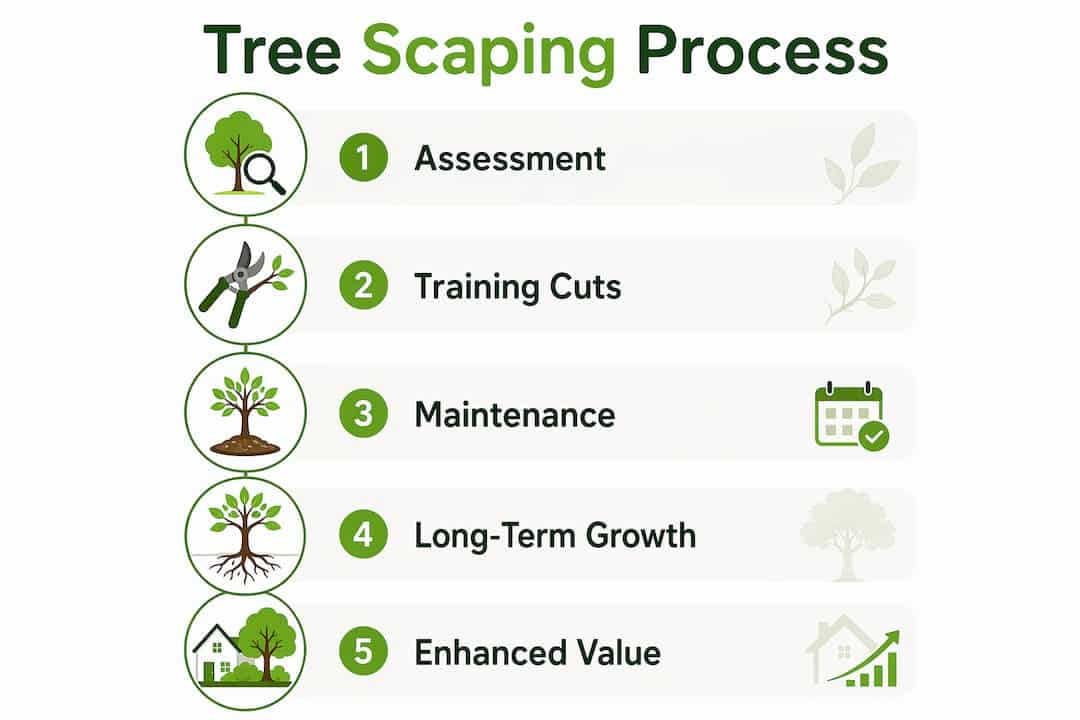
- Site assessment. An ISA-certified arborist evaluates the tree’s species, age, health, and structural condition. They identify constraints: overhead utilities, root zones, proximity to structures, and soil conditions.
- Species selection and design. For new plantings, the arborist recommends species suited to the intended shape and site. For existing trees, they map the training cuts and hardware needed.
- Initial shaping cuts. Selective pruning establishes the primary scaffold. Cabling or training ties go in where needed.
- Follow-up visits. Tree shaping is not a one-visit job. Growth must be redirected as new shoots emerge, grafts checked, and hardware adjusted.
- Ongoing maintenance. Once the desired form is established, annual or biennial inspections keep the shape and catch health issues early.
| Milestone | Typical Timing |
|---|---|
| On-site assessment | Before work begins |
| Initial training cuts | Late winter / early spring |
| Year 1 follow-up | 6–12 months after initial cuts |
| Ongoing maintenance cycle | Annual or biennial inspection |
Permits are rarely required for pruning alone, but if shaping involves removing a protected tree species or working in a regulated zone, check with your local municipality. In Orlando, certain heritage trees require a permit before any significant work.
Why you should not leave stumps or large roots in place
Leaving a stump after a removal or a failed tree creates a cluster of ongoing problems. Stumps attract insects and fungal colonies, create a tripping hazard, interfere with mowing, and block replanting in that spot. For a scaping project, a stump in the wrong place can prevent the new design from working at all.
Professional stump grinding is the recommended removal method for most residential situations. A grinder reduces the stump to wood chips below grade, eliminating the pest and safety risks while leaving the site ready for turf repair or replanting. Excavation is reserved for cases where the root system itself must be removed, such as when roots are lifting a driveway or threatening a foundation.
Root management has limits. For large, established trees, removing the entire root system is rarely practical or necessary. Selective root pruning by a certified arborist can address specific conflicts without destabilizing the remaining tree. Learn more about professional stump grinding and what the process involves before scheduling.
Post-grind checklist before replanting or turf repair:
- Confirm the grind depth is sufficient (typically 6–12 inches below grade)
- Remove wood chip debris and backfill with quality topsoil
- Allow 4–6 weeks for the area to settle before seeding or sodding
- Check for lawn damage prevention steps to protect surrounding turf
What does tree scaping cost, and is it worth the investment?
Cost depends heavily on tree size, species, site access, and the number of visits required. Arborist inspections typically run within a range that varies depending on the service provider and location., with a detailed written report at the higher end of that range. A full arborist job averages a moderate cost nationally, though complex shaping projects with multiple visits can cost more.
| Service | Typical Range |
|---|---|
| Arborist inspection / report | typically runs $100–$450 depending on service provider and specifics |
| Tree trimming / shaping (per tree) | costs vary widely based on tree size and complexity |
| Stump grinding | cost depends on stump size and site conditions |
| Full job average (national) | averages around $800, but varies depending on scope and location |
Work over structures, restricted-entry yards, and trees requiring specialized rigging all carry meaningful premiums over standard rates. When bids vary widely, the difference usually traces to how bidders handle site constraints: buried utilities, cleanup scope, and lawn protection assumptions. Ask each bidder to document those assumptions in writing.
The value side is straightforward. Well-maintained, mature trees boost residential property values and reduce energy costs through shade. Hazardous or neglected trees do the opposite. Bundling services, scheduling during the regular season rather than after storm emergencies, and getting a written estimate before any work starts are the three most effective ways to manage cost.
How do you vet and hire the right arborist?
Trust signals to request before signing anything:
- ISA certification. The International Society of Arboriculture credential confirms science-based training and adherence to current best practices.
- Proof of insurance and licensing. General liability and workers’ compensation, current and verified.
- Written estimate with scope detail. Vague scope is a red flag.
- Before/after portfolio. Photos show real results, not promises.
- On-site assessment. Any arborist who quotes without seeing the tree is guessing.
- Financing options. Legitimate companies offer them; pressure for immediate cash payment is a warning sign.
Red flags to walk away from: topping as a recommended solution, no written estimate, crews without any certification, and anyone who knocks on your door after a storm offering a deal.
Pro Tip: Ask for a multi-year maintenance plan and a simple sketch of the proposed training cuts. A professional who can draw what they intend to do understands the work. One who cannot is winging it.
Mcculloughtreeservice: certified tree shaping in Central Florida
Mccullough Tree Service offers the full scope of services a tree scaping project requires, from the initial arborist assessment through ongoing maintenance. Their ISA-certified arborists handle tree trimming and shaping, stump grinding, and post-work landscape readiness for residential and commercial properties across Orlando and Central Florida.
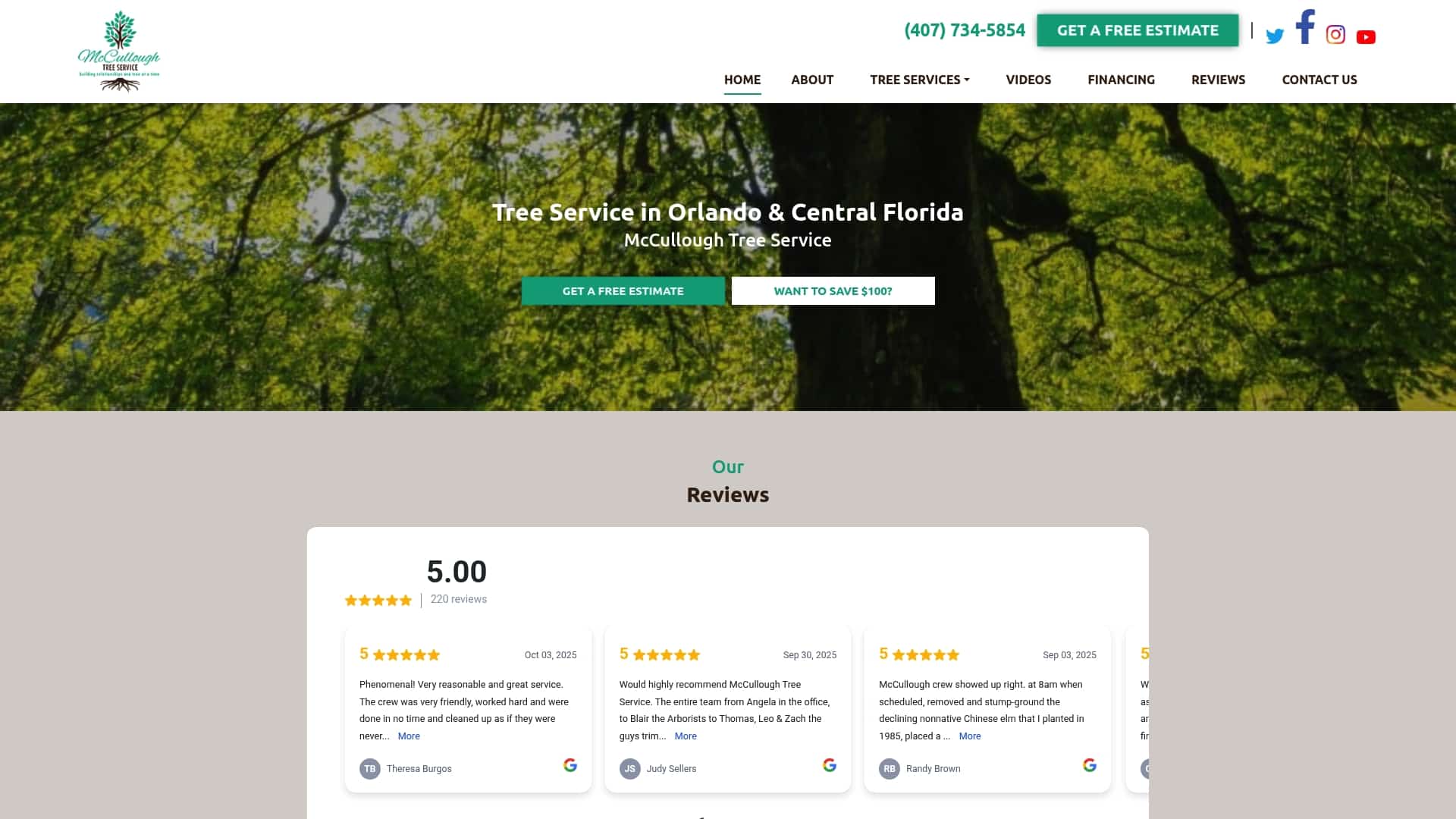
Every project starts with an on-site assessment, a written estimate, and a clear maintenance plan. Insurance, licensing, and a portfolio of completed work are available on request. For properties where a tree is beyond shaping, professional removal services are part of the same team. Contact Mcculloughtreeservice to schedule your on-site assessment and get a written plan before the next growing season.
Key Takeaways
Tree scaping is a long-term investment in tree structure and property value, and ISA-certified arborists are the only professionals equipped to plan and execute it safely.
| Point | Details |
|---|---|
| Tree scaping vs. trimming | Scaping is proactive, multi-year training; trimming is reactive health and safety maintenance. |
| Start early | Young trees shaped from the start cost far less and produce better structure than corrective work on mature trees. |
| Realistic costs | Inspections typically cost $100–$450; full jobs average around $800 nationally, with premiums for complex access. |
| Stump risks | Leaving stumps invites insects, fungal decay, and tripping hazards; professional grinding is the recommended fix. |
| Mcculloughtreeservice | Provides ISA-certified assessments, tree shaping, stump grinding, and ongoing maintenance in Orlando and Central Florida. |
Why certification and proactive care are worth the investment
The most expensive tree work we see is almost always work that could have been avoided. A co-dominant stem flagged at year three costs a cable and two follow-up visits. The same defect ignored until year fifteen costs a full removal, stump grinding, and sometimes structural repair to whatever the tree fell on.
Certified arborists are trained to read a tree the way a structural engineer reads a building. They spot reaction wood, included bark, and early decay before those issues become emergencies. Topping, by contrast, looks like a solution and creates a slow-motion failure: the stubs decay, the regrowth is weakly attached, and the tree becomes more dangerous than it was before the cut. Science-based care, planned early and maintained consistently, is simply cheaper and safer over any reasonable time horizon.
Useful sources and further reading
Industry references:
- Tree shaping overview, Wikipedia — background on arborsculpture methods and history
- Tree shaping vs. trimming differences — definition and scope distinctions
- Arborist cost guide, HomeGuide — inspection and consulting price ranges
- Arborist cost guide, LawnStarter — national job averages and service-type ranges
- Arborist hourly rates, Design Transition Studio — pricing drivers and site-access premiums
- Tree service and property value, Parker Tree Service — stump risks, certification signals, and ROI context
Mcculloughtreeservice service pages:
- ISA certified arborist guide — what certification means and why it matters
- Tree trimming and shaping services — primary service page for scaping and maintenance
- Stump grinding in Orlando and Central Florida — regional stump removal service
- Lawn damage prevention after removal — post-grind turf restoration steps
- Tree removal services — when shaping is not viable
Recommended
- Tree Trimming – McCullough Tree Service
- Tree Trimming in Florida: DIY Tips & Tricks
- Tree Care 101: Trimming vs. Pruning Guide
- Tree Pruning Importance: Key Benefits Explained