By: Shelby McCullough| Published: July 31, 2026
Tree cabling is a supplemental support system that uses high-strength cables installed in a tree’s upper crown to limit the extreme movement that causes weak limbs or co-dominant stems to fail. If you have a mature tree with a structural defect — a forked trunk, an overextended limb over your roof, or a split union — and an arborist confirms the tree is otherwise healthy, cabling is often the right call before that tree becomes a liability.
A few quick indicators that cabling might apply on your property:
- A large limb or co-dominant stem hangs over a walkway, driveway, or structure
- You can see included bark (bark pinched between two stems) at a fork
- A recent storm cracked a major limb but left viable wood intact
- A certified arborist has flagged a localized structural defect on an otherwise healthy tree
ANSI A300 (Part 3) is the industry standard governing how these systems are designed and installed in the United States. Any qualified arborist, including an ISA Certified Arborist, should reference it when scoping your job. Mcculloughtreeservice follows these standards on every cabling project in Central Florida.
Table of Contents
- What is tree cabling, and how does it differ from bracing?
- How cabling is installed and what ANSI A300 Part 3 requires
- When does a tree actually need cabling?
- What cabling actually accomplishes, and where it falls short
- How long does cabling last, and what maintenance does it need?
- Why hire a professional, and how do you choose the right arborist?
- Safety, liability, and local rules to check before work starts
- Key Takeaways
- The honest case for cabling, and where it gets oversold
- Mcculloughtreeservice offers certified cabling and arborist services in Central Florida
- Useful sources and further reading
What is tree cabling, and how does it differ from bracing?
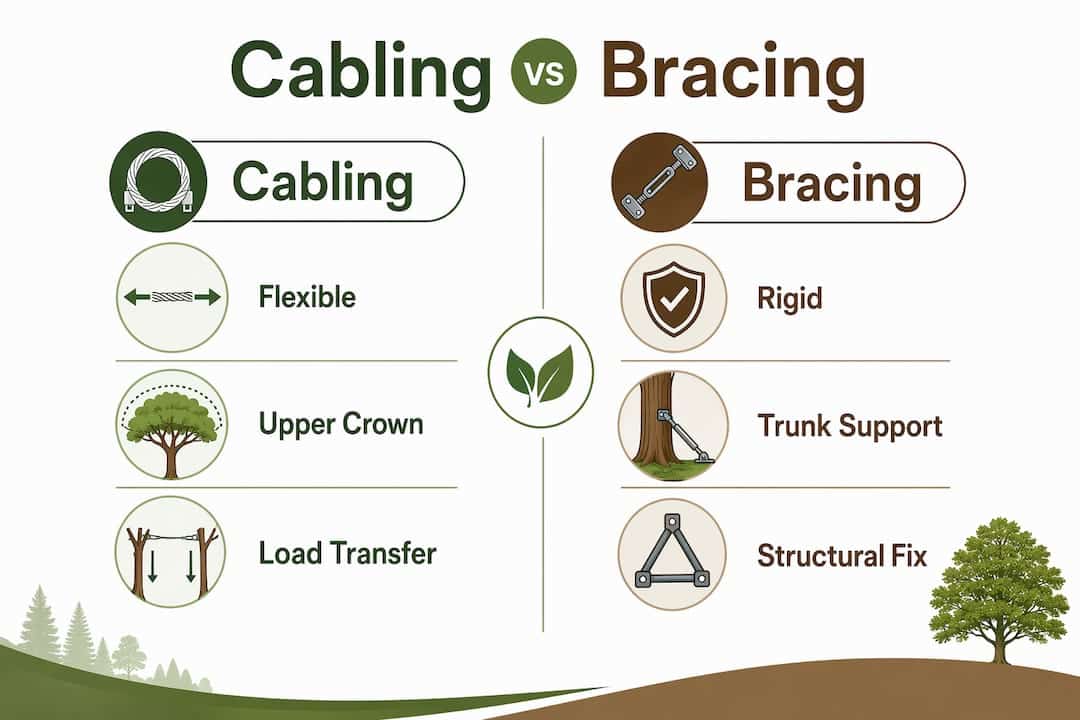
Tree cabling and tree bracing are both structural support systems, but they treat different problems and are not interchangeable.
Cabling installs flexible high-strength cables between scaffold branches in the upper crown. The cables do not lock the crown in place. They limit the extreme end-of-range motion that causes branch or stem failure under wind load or ice weight, while still allowing the crown to flex in normal wind. That flex matters: it lets the trunk continue to develop taper and strength over time.
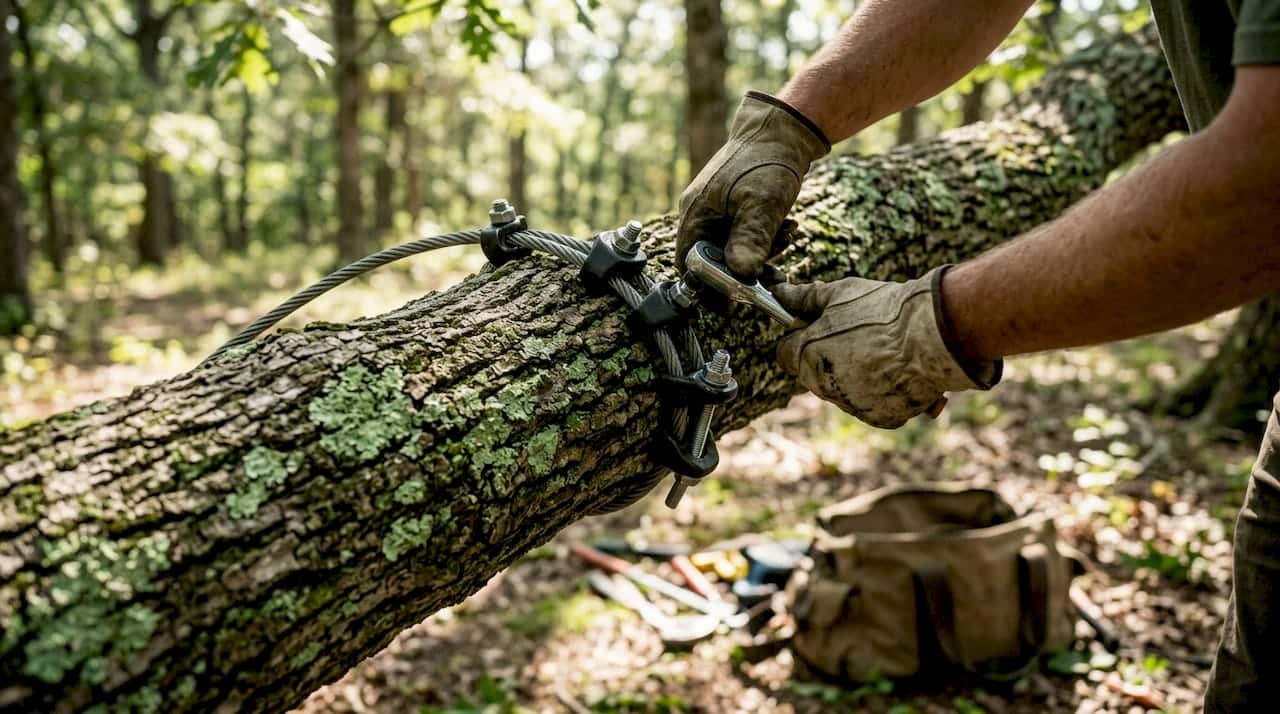
Bracing uses threaded galvanized steel rods drilled horizontally through a structural defect, such as a split union or a crack between co-dominant stems. Where cabling manages dynamic load from above, bracing provides rigid mechanical resistance at the defect itself. Most trees that need one system also need the other.
Main components you’ll see on a cabling project
- Cables: Extra-high-strength (EHS) galvanized steel for static systems, or high-strength synthetic polyester rope for dynamic systems (such as the Cobra system)
- Eye bolts / through-bolts: Anchor points drilled through scaffold branches; through-bolts use a washer and nut on each side
- Thimbles: Metal loops that protect the cable at each bend point and prevent wear
- Cable clamps: Secure the cable ends at termination points
- Protective sleeves: Wrap the cable where it contacts bark to prevent abrasion
- Brace rods: Threaded steel rods with washers and nuts, used for bracing at crotches or split unions
- Slings / wrap-style connectors: Used in dynamic systems that avoid drilling altogether
The goal across all configurations is the same: transfer load, reduce movement at the weak point, and buy the tree time without removing it.
How cabling is installed and what ANSI A300 Part 3 requires
ANSI A300 (Part 3) defines four primary cabling configurations, each suited to a different crown structure:
- Direct (two-point): A single cable between two stems. Simplest configuration; used when one weak attachment is the only concern.
- Triangular: Three anchor points connected in a triangle. Preferred for maximum support when multiple stems radiate from one union.
- Box: Four or more anchor points connected in a rectangular pattern. Used for minimal direct support across a wide crown.
- Hub-and-spoke: A central anchor with cables radiating outward. Suited to trees with multiple co-dominant stems spreading from a central point.
The standard also specifies the two-thirds rule: anchor points should be placed at roughly two-thirds of the distance from the structural defect to the top of the crown. Placing cables too low reduces their mechanical advantage; too high risks anchor failure in the smaller-diameter wood near the tips.
What the installation process looks like on your property
- Assessment: The arborist evaluates the defect, crown weight, and overall tree health to determine whether cabling is appropriate and which configuration fits.
- Pruning (often first): Reducing crown weight before installing cables lowers the load the system must carry. Structural pruning is frequently part of the same scope of work.
- Anchor placement and drilling: The arborist climbs into the crown and drills through the scaffold branches at the calculated anchor height. For static systems, through-bolts are installed with washers and nuts torqued to spec.
- Cable routing and termination: Cable runs between anchors, passing through thimbles at each bend. Ends are secured with clamps or swaged fittings.
- Tensioning: Cables are set taut but not over-tensioned. Over-tensioning can stress the anchor wood and restrict the natural movement the tree needs.
- Cleanup and documentation: A credible contractor leaves a written record of hardware used, anchor locations, and the recommended inspection date.
Static vs. dynamic systems
Static steel cables restrict movement firmly and are the traditional choice for severe structural defects. Dynamic synthetic systems allow controlled flex, are less invasive (some require no drilling), and tend to be preferred for younger trees or situations where preserving tissue at the anchor point matters. Your arborist’s choice should be driven by the defect type and the tree’s biomechanics, not by what’s cheapest to install.
ANSI A300 (Part 3) specifies that supplemental support systems be installed by qualified arborists. Homeowner-installed systems carry no structural reliability guarantee, and incorrect cable placement can create new failure points rather than prevent existing ones.
Pro Tip: When you receive a quote, ask the contractor to list the hardware brand, cable type, and anchor height on the written scope. If they can’t or won’t, that’s a red flag. Also ask: “What’s your inspection schedule after installation, and who performs the elevated checks?” A contractor who hasn’t thought about post-installation inspection hasn’t thought about your tree’s long-term safety.

When does a tree actually need cabling?
Cabling is appropriate when a tree has a localized structural defect but is otherwise healthy enough to be worth preserving. The defect must be the kind that cabling can actually address — not widespread decay or root failure.
Positive indications for cabling
- Codominant stems with included bark: Two or more stems of roughly equal size growing from one union, with bark pinched between them, creating a weak attachment
- Large overextended limbs: Heavy limbs that extend far beyond the crown’s center of gravity, especially over structures or foot traffic areas
- Storm damage with viable wood remaining: A partially split limb that still has enough sound wood to heal if supported
- Mature, high-value trees with localized defects: An old oak or magnolia that provides significant shade and property value, with one repairable weak point
- Limbs directly over people or property: Any structural weakness above a walkway, patio, roof, or fence line warrants urgent assessment
When cabling is not the answer
- Extensive internal decay in the trunk or major limbs
- Root failure or significant root damage
- Terminal decay at the trunk base
- Poor overall health (significant dieback, disease, pest damage throughout the crown)
- Trees with low structural or aesthetic value where removal is more practical
A tree health assessment by a certified arborist is the only reliable way to determine which side of this line your tree falls on. A DIY diagnosis is genuinely risky here — what looks like a surface crack can hide deep decay that makes cabling not just ineffective but dangerous.
What cabling actually accomplishes, and where it falls short
Cabling reduces the risk of branch or stem failure. It does not eliminate that risk, and it does not stop decay. University extension guidance is direct on this point: cabling is a risk-reduction strategy, not a structural cure.
Concrete benefits
- Reduced failure risk on a specific weak attachment without removing the tree
- Preserved shade, aesthetics, and property value from a mature specimen that would take decades to replace
- Targeted intervention that avoids the cost and disruption of full removal
- Cost advantage: Residential cabling typically ranges from $250 to $2,500+ depending on tree size and complexity, which is usually far less than removing a large mature tree and waiting years for a replacement to grow
Real limitations
- Not permanent. Tree growth changes the geometry of the crown over time, which can reduce cable effectiveness or cause hardware to become embedded in bark.
- Does not stop decay. A tree that is declining will continue to decline; cabling only addresses the mechanical load problem.
- Requires replacement or adjustment. Most systems need re-evaluation every 7–15 years, and some need hardware replacement sooner if growth or storm damage changes the load.
- Improper installation creates new hazards. Incorrectly placed cables redistribute load in ways that can stress previously sound wood, and a cable that fails silently gives the homeowner false confidence.
Cabling buys time for a valuable tree — it does not buy permanence. The Purdue Extension frames it well: cabling is most useful when it preserves a tree that would be more costly or less desirable to remove, and only when the tree is a genuinely viable candidate.
Professional tree care for homeowners includes knowing when cabling is the right tool and when removal is the honest answer.
How long does cabling last, and what maintenance does it need?
With proper installation and routine inspections, a cabling system commonly remains useful for 10–15 years. Some hardware lasts longer physically, but usefulness declines as the tree grows and the crown geometry shifts. Steel cables can corrode; synthetic ropes can degrade from UV exposure; anchor bolts can become enveloped by bark.
Recommended inspection schedule
- Annual homeowner visual check: Walk around the tree each fall and look for obvious problems before winter storms arrive.
- Annual professional ground-level inspection: An arborist can assess cable tension, visible corrosion, and bark condition at anchor points without climbing.
- Elevated close-up inspection every 3–5 years (or after any major storm): A climber checks the hardware directly, looking for corrosion, wood decay around the bolt holes, loose nuts, and whether the cable is still positioned correctly relative to the crown.
What to look for during your own checks
- Cable visibly sagging or slack
- Rust streaks running down the bark from anchor points
- Bark swelling or closing over hardware (the tree is growing around the bolt)
- Cracks or decay appearing at or near anchor points
- Any limb in the cabled zone that has grown significantly heavier or longer
Pro Tip: Add a 15-minute tree walk to your fall yard prep routine. Bring binoculars to check anchor points from the ground. If you see bark bulging around a bolt, rust streaking down the trunk, or a cable that looks loose, call an arborist before the first big storm of the season — not after.
Why hire a professional, and how do you choose the right arborist?
Cabling requires knowledge of tree biomechanics, crown load distribution, canopy access, and hardware installation torque. Getting it wrong does not just waste money; it can create a more dangerous tree than the one you started with.
Reasons to hire a certified arborist
- Correct diagnosis of whether cabling is even appropriate
- Proper hardware sizing and anchor placement per ANSI A300 (Part 3)
- Liability coverage if something goes wrong during installation
- A written inspection plan so the system gets maintained
Trust signals to look for
- ISA Certified Arborist credential (verifiable on the ISA website)
- Proof of general liability and workers’ compensation insurance
- Written scope of work that references ANSI A300 Part 3 and lists hardware specifications
- References or before/after photos from similar cabling projects
- A written inspection schedule included in the quote, not just mentioned verbally
Questions to ask before you hire
- What standard do you follow for cabling installations?
- What hardware brand and cable type will you use, and why?
- Who performs the elevated inspections, and how often do you recommend them?
- Does your quote include pruning to reduce crown load before installation?
- Can you provide proof of insurance before work starts?
Red flags
- Refuses to provide a written scope of work
- Uses crude hardware (wire rope clips instead of proper swaged fittings, no thimbles)
- Pressures you to approve work immediately without a diagnostic assessment
- Cannot show proof of insurance or ISA certification
A certified arborist who follows ANSI A300 practices will always assess before they install. The assessment is not a sales step; it is the only way to know whether cabling will actually help.
Safety, liability, and local rules to check before work starts
Most U.S. localities do not require a specific permit for tree cabling on private property. That said, local ordinances, historic district rules, or HOA covenants can restrict tree work, require permits for work on heritage trees, or mandate that contractors be licensed. Check with your local building department or urban forestry office before scheduling work, and review your HOA covenants if applicable.
Workday safety checklist
- Power line proximity: If any part of the crown is within striking distance of overhead lines, the utility company must be notified before work begins. This is non-negotiable.
- Traffic and pedestrian control: Cabling work involves climbers and equipment overhead; the work zone needs to be clear of foot traffic.
- Property access: Confirm the contractor has a clear path for equipment and that neighboring property access (if needed) is arranged in advance.
- Contractor insurance verification: Ask for a certificate of insurance before the crew arrives, not after. Verify it covers both general liability and workers’ compensation.
Protecting yourself legally
- Get the full scope of work, pricing, and payment terms in writing before any work starts.
- Require a certificate of insurance naming you as the certificate holder.
- For commercial properties or properties near roofing or structural assets, document the tree’s condition with photos before and after the work.
- Keep all invoices, inspection reports, and hardware documentation in your property file.
Key Takeaways
Tree cabling is a risk-reduction tool, not a permanent fix: it works best on healthy trees with localized structural defects, installed by an ISA Certified Arborist following ANSI A300 (Part 3) standards, and maintained with annual visual checks and professional inspections every 3–5 years.
| Point | Details |
|---|---|
| Cabling reduces, not eliminates, risk | It limits extreme crown movement on weak limbs but does not stop decay or guarantee the tree won’t fail. |
| ANSI A300 (Part 3) sets the standard | Four configurations (direct, triangular, box, hub-and-spoke) with the two-thirds anchor-height rule guide proper installation. |
| Inspection cadence matters | Annual homeowner visual checks, annual professional ground-level review, and elevated inspection every 3–5 years keep the system reliable. |
| Useful life is 10–15 years | Tree growth changes crown geometry over time; hardware may need adjustment or replacement before that window closes. |
| Mcculloughtreeservice is a recommended local provider | Mcculloughtreeservice performs certified arborist assessments and cabling installations in Orlando and Central Florida following ANSI A300 standards. |
The honest case for cabling, and where it gets oversold
Most homeowners who call about a “dangerous tree” are actually describing a tree with one fixable problem surrounded by decades of healthy growth. That distinction matters more than most guides acknowledge. Removing a 40-year-old oak because one co-dominant stem has included bark is like replacing a car because one tire is worn. Cabling, done right, is the targeted repair.
What gets undersold is the maintenance obligation. A cabled tree is not a solved problem. It is a managed one. The homeowners who get the most value from cabling are the ones who treat the inspection schedule the same way they treat their HVAC service: it goes on the calendar, it happens every year, and they call a professional when something looks off. The ones who get burned are the ones who assume the cable is doing its job invisibly and never look up.
The other thing worth saying plainly: cabling is not always the answer. A tree with significant internal decay, root failure, or poor overall health is not a cabling candidate, no matter how much shade it provides. An honest arborist will tell you that. If the person quoting your job is pushing cabling on a tree that clearly has systemic problems, that is a sign to get a second opinion.
Mcculloughtreeservice offers certified cabling and arborist services in Central Florida
When a tree on your property needs structural support, the difference between a safe outcome and a costly one usually comes down to who assesses it first. Mccullough Tree Service provides certified arborist assessments, cabling and bracing installation, and routine inspection services for residential and commercial properties across Orlando and Central Florida, following ANSI A300 (Part 3) standards on every job.
Every project starts with a written scope that lists the hardware, configuration, and inspection schedule, not a verbal estimate and a handshake. The team handles the full picture: structural assessment, crown pruning to reduce load before installation, cabling installation, and follow-up inspections. When cabling is not the right answer, Mcculloughtreeservice will say so and walk you through the removal options instead. Schedule an on-site assessment with a certified arborist to get a clear picture of what your tree actually needs.
Useful sources and further reading
The sources below were used in preparing this guide. Each one is worth bookmarking if you want to go deeper on a specific aspect of cabling.
| Source | Why it matters |
|---|---|
| ANSI A300 (Part 3) — Supplemental Support Systems (TCIA) | The governing U.S. standard for cabling configurations, hardware, and inspection requirements |
| FNR-550-W — Large Tree Cabling and Bracing (Purdue Extension) | University-level practical guidance on when cabling is appropriate, limits, and arborist assessment |
| Cabling, Bracing and Other Support Systems for Trees (UT Extension) | Detailed technical overview of hardware, installation steps, and inspection expectations |
| ANSI A300 Part 3 Full Text (West Chester) | Full text of the ANSI A300 Part 3 standard for readers who want the original specification |
| Cabling and Bracing: Hardware and Installation (StumpIQ) | Practical field guide covering installation steps and hardware homeowners will see on site |
| Dynamic Cabling System — Cobra (Sherrill Tree) | Technical documentation for the Cobra dynamic synthetic cabling system |
| Tree Cabling and Bracing Cost Guide (Landscapio AI) | Cost range reference for residential cabling projects by tree size and complexity |
| How Long Do Tree Cabling and Bracing Systems Last? (Precision Tree Care) | Inspection cadence guidance and useful-life expectations for installed systems |
Recommended
- Protect Your Trees: The Risk of Included Bark
- Tree Care 101: Trimming vs. Pruning Guide
- Tree Pruning Importance: Key Benefits Explained
- Identify a Dangerous Tree: Signs & Solutions