By: Shelby McCullough| Published: August 2, 2026
TL;DR:
- Tree canopy reduces urban heat, manages stormwater, and improves air quality, offering health and economic benefits. Low-income neighborhoods have less canopy, leading to greater climate-related health risks and inequities. Investing in strategic planting and maintenance can boost urban resilience, public health, and property values.
Tree canopy is essential urban infrastructure. It cools cities, filters air and water, stores carbon, supports wildlife, and delivers measurable health and economic benefits that compound over decades. The USDA Forest Service, EPA, and tools like i-Tree have quantified these effects at every scale, from a single yard to an entire metropolitan area.
Here is what the evidence shows at a glance:
- Heat reduction: Shade and evapotranspiration can lower surface temperatures by up to 20–45°F on shaded surfaces.
- Stormwater management: Canopy intercepts rainfall and reduces runoff pressure on city drainage systems.
- Air quality: Trees remove particulate matter and ground-level ozone precursors through dry deposition.
- Biodiversity: Canopy provides habitat, food, and movement corridors for urban wildlife.
- Health: A national study estimated that an ambitious urban reforestation scenario could avoid roughly 464 deaths and 80,785 illness cases per year.
- Economics: Even a modest 5% canopy increase is estimated to deliver $2.5 billion in annual benefits nationally.
Table of Contents
- Why tree canopy is important for the environment
- How canopy improves public health and social well-being
- The economic case for investing in tree canopy
- How canopy cools cities and manages stormwater
- How to measure and map your neighborhood’s tree canopy
- Canopy inequity: who gets the benefits and who does not
- How to protect and expand canopy in your community
- When should you hire a certified arborist?
- Common concerns about trees: what is real and what is overstated
- Key Takeaways
- A practitioner’s perspective on what actually moves the needle
- Professional tree care in Central Florida from Mcculloughtreeservice
- Authoritative sources and tools for deeper reading
Why tree canopy is important for the environment
The ecological case for canopy starts with physics. A tree crown intercepts solar radiation before it hits pavement, rooftops, and parked cars. Those impervious surfaces would otherwise absorb heat and re-radiate it overnight, driving the urban heat island effect. Shade alone cuts surface temperatures dramatically, and evapotranspiration, the process by which trees release water vapor through their leaves, converts solar energy into latent heat rather than sensible heat. The net effect is cooler air, not just cooler surfaces.
Stormwater is the other big mechanism. When rain hits a tree canopy, a significant portion is intercepted and either evaporates or drips slowly to the ground. That slower delivery gives soil time to absorb water, reducing the peak runoff that overwhelms storm drains and causes localized flooding. The USDA Forest Service documents this canopy-soil-infiltration pathway as one of the core functions urban trees perform.
Carbon sequestration gets the most press, but the energy-savings angle is often larger in urban settings. When trees shade buildings, they reduce cooling demand, which means less electricity burned at power plants. That avoided electricity translates directly into avoided greenhouse-gas emissions, often more carbon-efficiently than sequestration alone.
Biodiversity depends on canopy in ways that are easy to overlook in a city. A mature oak supports hundreds of insect species; those insects feed birds; birds disperse seeds. Canopy connectivity, meaning trees close enough that wildlife can move between them, matters as much as total coverage. A single isolated tree in a parking lot contributes far less than the same tree in a linked street corridor. The role of tree canopy as habitat and movement infrastructure is why urban ecologists track canopy as a network, not just a percentage.
Scale matters here. A single tree cools the immediate sidewalk. A street of trees lowers the block’s ambient temperature. A neighborhood with 30% canopy cover measurably reduces peak electricity demand and stormwater runoff at the utility and municipal level. Effects aggregate, and that aggregation is what makes canopy a public-infrastructure question, not just a landscaping preference.
How canopy improves public health and social well-being
The health benefits of tree cover are not soft or speculative. A 2024 national study published in npj Urban Sustainability modeled the impacts if U.S. cities pursued an ambitious urban reforestation program. The result: an estimated 0.38°C mean summer temperature reduction, with roughly 464 avoided deaths and 80,785 fewer illness cases per year. Those numbers reflect heat-related mortality and morbidity, the most direct pathway from canopy to human health.
Air quality adds another layer. Trees remove fine particulate matter, nitrogen dioxide, and ozone precursors through dry deposition on leaf surfaces. Lower ambient temperatures also reduce the chemical reactions that form ground-level ozone, so canopy attacks air pollution through two routes simultaneously. For people with asthma or cardiovascular conditions, that matters in ways that show up in hospital admission data.
Mental health and social cohesion are harder to quantify but well-documented:
- Green spaces with tree cover are consistently linked to lower cortisol levels and reduced self-reported stress.
- Neighborhoods with more canopy see higher rates of outdoor physical activity, which carries its own health dividend.
- Tree-lined streets encourage social interaction, which correlates with stronger community ties and lower crime rates in some studies.
The equity dimension cuts through all of this. Canopy is not distributed evenly. Low-income neighborhoods and communities of color in U.S. cities consistently have less tree cover than wealthier, predominantly white neighborhoods, a pattern documented by the USDA Forest Service’s environmental justice research. Less canopy means more heat exposure, worse air quality, and fewer mental health benefits, all concentrated in communities that already face greater health burdens. That is not a coincidence of geography; it reflects decades of disinvestment.
The economic case for investing in tree canopy
The financial returns on canopy investment are real and measurable at both the household and municipal scale. On the energy side, modeling shows that a well-placed 25-foot shade tree can reduce a home’s cooling peak demand by 0.3–0.5 kW, with annual cooling savings of 8–12% during peak periods in some cities. In Central Florida, where air conditioning runs for eight or more months a year, that figure compounds quickly.
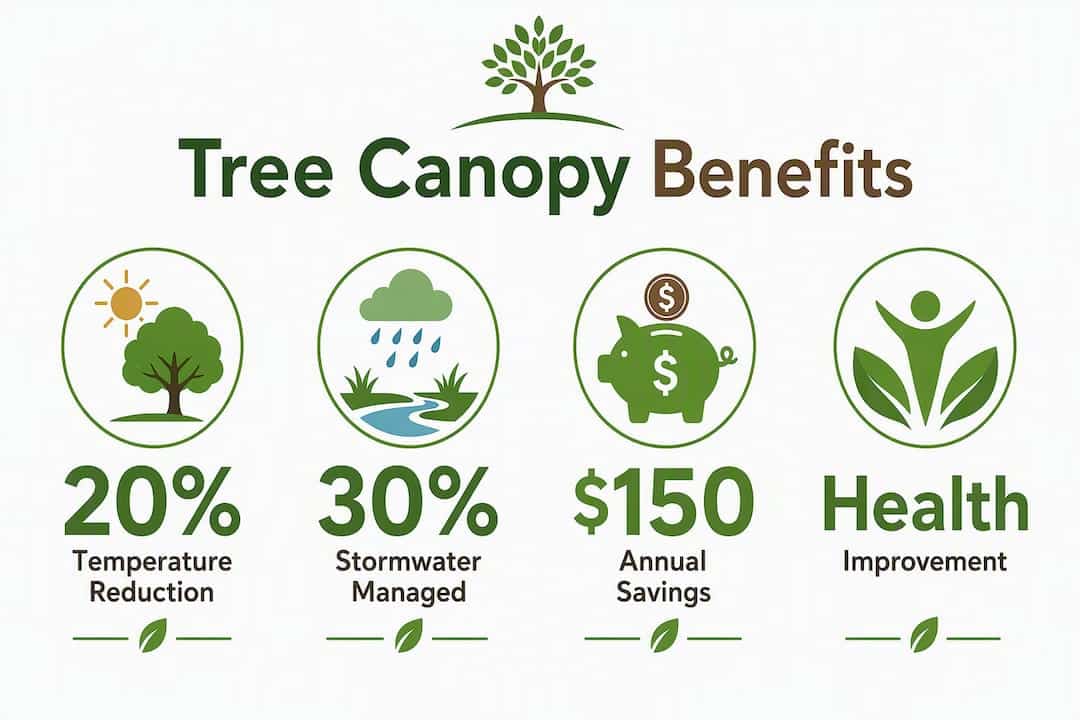
Property values tell a similar story. Hedonic studies consistently find that neighborhood tree cover increases residential property values, though the effect is nonlinear. The implicit value peaks at roughly 30% canopy cover on or near a property and 38% at the county level. Interestingly, buyers tend to value nearby canopy, the trees they can see from their windows and walk under on their street, more than trees on their own lot. That finding has direct implications for how municipalities should frame public planting programs.
| Benefit type | Scale of impact | Time to realize | Approximate cost and who pays |
|---|---|---|---|
| Cooling energy savings | Household | 5–10 years (tree maturity) | $150/tree; resident or utility rebate |
| Stormwater reduction | Street/neighborhood | 3 years | Municipal program or resident |
| Property value increase | Neighborhood | 10–20 years | Shared; resident planting + municipal canopy |
| Air quality improvement | City | 5–15 years | Municipal planting programs, grants |
| Heat-related health savings | City/region | 10–30 years | Public health system, avoided costs |
At the municipal scale, avoided stormwater infrastructure costs and lower peak electricity demand translate into real budget savings. A San Antonio study documented multiple co-benefits, including reduced runoff, pollutant removal, and lower greenhouse-gas emissions via avoided electricity, all attributable to urban canopy. Cities that treat trees as depreciating infrastructure assets, budgeting for planting and maintenance the way they budget for roads, consistently outperform those that treat canopy as a discretionary amenity.
Pro Tip: When calculating the return on a shade tree, include avoided cooling costs, not just the purchase price. A $150 tree planted on the west side of a house in a warm climate can pay back its cost in energy savings within a decade, before accounting for any property value premium.
How canopy cools cities and manages stormwater
The cooling mechanism works in three overlapping ways. First, shade blocks direct solar radiation from reaching pavement and building surfaces, cutting the heat absorbed at ground level. Second, evapotranspiration releases water vapor that absorbs heat as it changes phase, effectively acting as a natural air conditioner. Third, tree canopies alter wind patterns and surface roughness, which affects how heat mixes and disperses at the neighborhood scale.
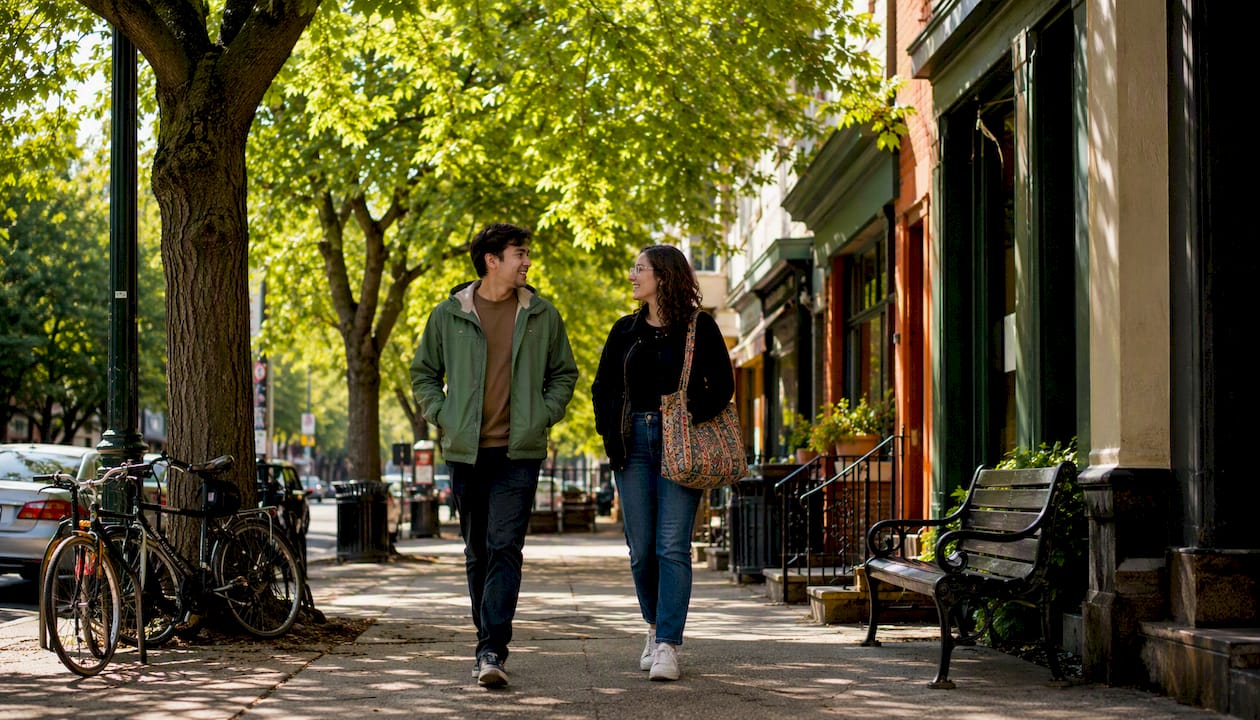
On the stormwater side, the sequence is: canopy intercepts rainfall, slows its delivery to the ground, and the permeable soil beneath trees absorbs what does reach the surface. Compacted urban soils under pavement cannot do this. A mature tree with a broad crown can intercept a meaningful fraction of a moderate rain event before a single drop reaches a storm drain.
A few practical observations from city programs:
- Palo Alto, California has used canopy mapping to identify heat-vulnerable corridors and prioritize street tree planting in those zones, with measurable reductions in peak surface temperatures.
- Toronto’s urban forestry program tracks canopy cover by ward and uses i-Tree modeling to estimate annual stormwater interception and energy savings, publishing the results as part of its municipal sustainability reporting.
One important limitation: a single tree on an otherwise paved block does relatively little for neighborhood-scale cooling. The benefits scale with coverage. Research consistently shows that neighborhood-level effects, lower ambient air temperatures, reduced stormwater peaks, become significant only when canopy cover reaches roughly 20–30% of the land area. Below that threshold, individual trees still matter for shade and aesthetics, but the systemic benefits are modest.
How to measure and map your neighborhood’s tree canopy
Tree canopy cover is expressed as a percentage: the share of land area covered by tree crowns when viewed from above. A neighborhood at 15% canopy cover has trees shading 15% of its surface. That number can be measured at the parcel, block, neighborhood, or city level, and the scale matters for interpreting what it means.
Three tools are worth knowing:
i-Tree (developed by the USDA Forest Service) is the standard for urban forest analysis in the U.S. i-Tree Canopy lets anyone estimate canopy cover using aerial imagery and random sampling. i-Tree Eco goes further, modeling the dollar value of ecosystem services a city’s trees provide. Both are free.
Healthy Places Index maps health-relevant environmental conditions, including tree canopy, at the census tract level. It is particularly useful for identifying equity gaps, where canopy is lowest relative to heat and health vulnerability.
Municipal canopy inventories exist in many U.S. cities and counties. Los Angeles County’s sustainability resources, for example, provide neighborhood-level canopy guidance that residents can use to understand their local baseline and find planting programs.
For a quick neighborhood check: open i-Tree Canopy, drop a polygon around your block or neighborhood, run the random-point sample, and you will have a canopy percentage estimate in under ten minutes. For a more precise figure, your city’s urban forestry department may maintain a higher-resolution inventory.
One data nuance worth knowing: aerial canopy measurements vary by season. Deciduous trees measured in summer show much higher cover than the same trees in winter. Most official inventories use leaf-on imagery, so summer measurements are the standard for comparisons.
Canopy inequity: who gets the benefits and who does not
The pattern is consistent across U.S. cities: lower-income neighborhoods and communities of color have less tree canopy than wealthier, predominantly white neighborhoods. This is not random. It reflects historical land-use decisions, redlining, disinvestment in public green space, and the fact that private tree planting correlates with household income.
The consequences are concrete. Less canopy means higher surface and air temperatures, which means greater heat-related illness risk. It means worse air quality from higher ozone and particulate concentrations. It means fewer mental health benefits and less access to green space for physical activity. The national modeling study found that the health gains from increased canopy are largest precisely in the neighborhoods that currently have the least, making equity-first planting the highest-return public health investment.
Key policy levers cities are using to close the gap:
- Priority planting zones: Mapping low-canopy, high-heat, high-vulnerability census tracts and directing municipal planting budgets there first.
- Resident incentive programs: Subsidized or free trees for homeowners in underserved neighborhoods, paired with planting and watering support.
- Maintenance funding: Planting without maintenance is a waste. Equity programs that include multi-year care commitments have much higher survival rates.
- Community engagement: Involving residents in species selection and site planning increases long-term stewardship.
The USDA Forest Service’s environmental justice research makes the case clearly: canopy distribution is a health equity issue, and treating it as one changes both the urgency and the targeting of investment.
How to protect and expand canopy in your community
Expanding canopy takes time, but the steps are straightforward. The biggest mistake most homeowners and community groups make is planting the wrong species in the wrong place and then under-watering during establishment.
For homeowners:
- Choose species suited to your climate and soil. In Central Florida, native oaks, bald cypress, and Southern magnolia provide large canopies and tolerate local conditions well.
- Place deciduous trees on the west and southwest sides of your home for maximum summer cooling. Strategic placement on those sides yields the largest energy savings in warm climates.
- Water deeply and infrequently during the first two to three years. Most young trees die from drought stress, not pests.
- Keep mulch 3–4 inches deep in a ring around the base, but away from the trunk, to retain moisture and moderate soil temperature.
- After establishment, schedule a professional tree health assessment every few years to catch structural problems early.
For community groups and municipalities:
- Conduct a canopy inventory before planting to identify gaps and prioritize high-heat, low-canopy areas.
- Partner with local utilities, which often fund shade-tree programs because of peak-demand savings.
- Build maintenance budgets into planting programs from day one. A tree that dies in year three delivered zero benefit.
- Use i-Tree modeling to estimate and communicate the dollar value of proposed plantings, which strengthens grant applications.
| Timeline | What happens | Benefit realized |
|---|---|---|
| Year 1–3 | Establishment phase; tree focuses on root growth | Minimal shade; stormwater interception begins |
| Year 4 | Canopy expands; shade increases | Measurable cooling on shaded surfaces; some energy savings |
| Year 8–15 | Significant canopy coverage | Noticeable energy savings; property value effects begin |
| Year 15+ | Mature canopy | Full ecosystem services: cooling, stormwater, habitat, air quality |
Costs vary widely. A bare-root or small-container tree from a municipal program can cost $25–$75. A nursery-grown 3-inch caliper tree installed by a professional runs $300–$800 or more depending on species and site. Grants from programs like USDA Urban and Community Forestry, state forestry agencies, and utility rebate programs can offset a significant share of those costs. For seasonal cleanup and establishment support after planting, a landscape service can handle debris and mulching during the critical first growing season.
Pro Tip: Avoid planting large-canopy trees directly under power lines. The inevitable conflict leads to disfiguring utility pruning that eliminates most of the canopy benefit and creates structural hazards. Choose smaller species for those spots and save the oaks and maples for open areas.
When should you hire a certified arborist?
Not every tree question requires a professional, but some absolutely do. The risk of getting it wrong, a falling limb, a structurally compromised tree near a structure, or a misdiagnosed disease, is too high to guess.
Hire a certified arborist when you see:
- Large dead or hanging limbs, especially over structures, driveways, or play areas.
- Significant storm damage: split crotches, uprooted root flares, or bark stripped by impact.
- Visible decay, fungal growth at the base, or hollow sections in the trunk.
- A tree that has leaned noticeably after a storm or wet season.
- Any work requiring climbing or equipment near utility lines.
- A formal risk assessment for insurance, permitting, or property sale purposes.
A certified arborist holds credentials from the International Society of Arboriculture (ISA), which requires passing a comprehensive exam and ongoing continuing education. That credential signals training in tree biology, diagnosis, and safe work practices. It is not the same as a general landscaper with a chainsaw. Mcculloughtreeservice’s certified arborist services cover health assessments, risk evaluations, and complex removal work for residential and commercial clients in Central Florida.
Before the arborist arrives, prepare: photograph the tree from multiple angles, note any recent changes (new lean, bark damage, die-back), identify nearby utilities, and pull any relevant permit history if the tree is in a protected zone.
Pro Tip: Ask any arborist you hire for their ISA certification number and proof of liability insurance before work begins. A legitimate professional will provide both without hesitation. If they cannot, keep looking.
For a deeper look at what a professional assessment covers, Mcculloughtreeservice’s guide to tree health assessments explains the process and what to expect.
Common concerns about trees: what is real and what is overstated
Trees are not without legitimate downsides. Acknowledging them honestly is how you plan well.
Myth vs. reality:
- “Trees always increase property values.” Not always. Trees near structures with a history of root damage, or in fire-prone areas, can reduce values. The hedonic research shows the relationship is nonlinear and context-dependent.
- “Any tree is better than no tree.” Wrong species in the wrong place creates problems: invasive roots near foundations, excessive shade that kills grass and promotes mold, or a species prone to storm breakage.
- “Mature trees are low maintenance.” Mature trees require regular assessment. A large, neglected tree is a liability, not an asset.
Real risks and how to manage them:
- Falling limbs and structural failure: Regular professional assessments catch decay and structural defects before they become emergencies. Tree risk assessment is the standard tool for this.
- Root heave: Aggressive-rooted species planted too close to sidewalks, driveways, or foundations cause costly damage. Species selection and placement solve this before it starts.
- Pests and disease: Emerald ash borer, laurel wilt, and other pathogens can kill trees rapidly. Early diagnosis by a certified arborist is the only effective response.
- Allergies and leaf litter: High-pollen species (male ginkgo, certain oaks) can be avoided in favor of lower-pollen alternatives. Leaf litter is manageable with routine yard cleanup and mulching.
Permitting is a real consideration in many Florida municipalities. Removing or significantly pruning a protected tree without a permit can result in fines. Check your local ordinance before any major canopy work.
Key Takeaways
Tree canopy delivers cooling, clean air, stormwater control, biodiversity, and measurable health and economic benefits that make it essential infrastructure for any community, not optional greenery.
| Point | Details |
|---|---|
| Canopy cools and cleans | Shade and evapotranspiration cut surface temperatures up to 20–45°F and remove air pollutants through dry deposition. |
| Health benefits are quantified | A national study estimated roughly 464 avoided deaths and 80,785 fewer illness cases annually under an ambitious reforestation scenario. |
| Economic returns are real | A 5% national canopy increase is estimated to deliver $2.5 billion in annual benefits; household energy savings of 8–12% are achievable with strategic placement. |
| Equity gaps demand targeted action | Low-income and BIPOC neighborhoods consistently have less canopy, amplifying heat and health burdens; equity-first planting delivers the highest public-health return. |
| Mcculloughtreeservice | Provides certified arborist assessments, tree planting, trimming, and storm cleanup in Central Florida to help homeowners protect and expand their canopy. |
A practitioner’s perspective on what actually moves the needle
The conversation about tree canopy tends to stay abstract: percentages, modeling scenarios, national estimates. What gets lost is the practical reality of what actually determines whether a tree delivers its promised benefits or becomes a liability.
The single biggest gap between what homeowners expect and what actually happens is establishment. A tree planted and then ignored for two summers in Central Florida’s heat is likely dead or severely stressed by year three. The research on energy savings and stormwater interception assumes a healthy, growing tree. A stressed, stunted tree delivers a fraction of those benefits. Watering during establishment is not optional; it is the whole ballgame.
The second thing worth saying plainly: species choice matters more than most people realize. A fast-growing invasive planted for quick shade will create structural problems within a decade. A well-chosen native oak, slower to establish, will provide canopy for a century and support local wildlife in ways an ornamental never will. The short-term thinking that drives bad species choices is the same thinking that turns a canopy asset into a removal job.
Finally, the equity point deserves more urgency than it typically gets. The neighborhoods that need canopy most, because they are hottest, most polluted, and most health-burdened, are also the ones least likely to get it through private investment alone. Municipal programs that target those areas first are not charity; they are the highest-return public health investment a city can make. Every dollar spent planting and maintaining trees in a heat-vulnerable neighborhood avoids real medical costs and real deaths.
Professional tree care in Central Florida from Mcculloughtreeservice
Knowing why tree canopy matters is the first step. Acting on it, planting the right trees, keeping existing ones healthy, and removing hazards before they become emergencies, is where Mcculloughtreeservice comes in.
Mccullough Tree Service serves residential and commercial property owners across Orlando and Central Florida with a full range of certified arborist services: tree trimming and canopy maintenance, tree removal for hazardous or storm-damaged trees, health assessments, stump grinding, land clearing, and emergency storm cleanup. Every job is backed by ISA-certified arborist credentials and full licensing, so you know the work meets professional standards. If you have a tree you are unsure about, a planting project you want done right, or storm damage that needs immediate attention, contact Mcculloughtreeservice for a free estimate and get a clear, honest assessment of what your property needs.
Authoritative sources and tools for deeper reading
These are the primary resources cited in this article and the best starting points for further research or neighborhood-level canopy work.
- USDA Forest Service — Urban Tree Canopy Research: The foundational source for urban tree canopy functions, including heat mitigation, stormwater interception, and carbon sequestration. Use this for mechanism-level detail.
- EPA — Trees and Vegetation (Heat Island Compendium): Comprehensive summary of how trees reduce urban heat islands, with data on surface temperature reductions and cooling energy savings.
- i-Tree (USDA Forest Service tool): Free suite of tools for estimating canopy cover (i-Tree Canopy) and modeling ecosystem service values (i-Tree Eco). The standard for U.S. urban forest analysis.
- Healthy Places Index: Maps health-relevant environmental conditions, including canopy, at the census tract level. Best for identifying equity gaps and prioritizing planting investments.
- Canopy.org: A nonprofit focused on urban tree planting and canopy equity, with practical resources for community planting programs and advocacy.
- USDA Forest Service — Environmental Justice and Urban Tree Canopy: Peer-reviewed research documenting canopy inequity and its health consequences across U.S. cities.
- npj Urban Sustainability — US Urban Tree Cover Study (2024): National-scale modeling of canopy increase scenarios, with quantified health and economic outcomes. The source for the 464 avoided deaths and $2.5 billion annual benefits figures.
- LA County Sustainability — Putting Down Roots: An example of municipal canopy guidance with neighborhood-level resources; useful as a model for what local programs look like.
For local canopy inventories, check your city or county urban forestry department’s website. Many U.S. cities publish canopy data by neighborhood, and some offer free or subsidized trees through community planting programs.
Recommended
- Tree Canopy Restoration Explained: Techniques and Benefits
- The Role of Trees in Urban Planning: A 2026 Guide
- Tree Pruning Importance: Key Benefits Explained
- The Importance of Tree Pruning