By: Shelby McCullough| Published: August 5, 2026
For most Birmingham property owners, stump grinding is the right call. It costs less, takes less time, and leaves your lawn in workable shape. Industry data shows grinding is the correct choice for most residential jobs, and the cost difference is real: full removal typically runs multiple times more once excavation, debris haul-off, and backfill are factored in.
Here’s what to expect in Birmingham:
- Single stump, standard residential job: expect $150–$800 depending on stump diameter, species, and site access
- Large or multiple stumps: higher per visit cost, with per-stump pricing dropping when you bundle
- Minimum mobilization charge: many local contractors have a minimum fee regardless of stump count
When you contact a contractor, send a photo with something for scale (a tape measure or your foot), the stump’s diameter at ground level, your gate width, and whether you’ve called 811 to locate buried utilities. That single step prevents the most common quote-day surprises. McCullough Tree Service is a certified, insured option serving the region and is worth including in your comparison.
Table of Contents
- What does stump grinding cost in Birmingham?
- What changes the price: the variables contractors check
- Stump grinding vs. full removal: which one do you actually need?
- How long does a stump grinding job take?
- How do you get accurate quotes and choose a reliable contractor?
- What happens on job day and how is the site left?
- DIY vs. hiring a pro: is renting a grinder worth it?
- When grinding isn’t enough: edge cases that need expert input
- Key Takeaways
- The case for grinding: a contractor’s perspective
- Useful sources for deeper research
- Mcculloughtreeservice: professional stump grinding with certified oversight
What does stump grinding cost in Birmingham?
National averages from Thumbtack put single-stump grinding at $307–$426, with a low-end range of $220–$253 and a high end of $498–$544. Birmingham pricing generally tracks the national mid-range, though rural lots with tight access or rocky red-clay soil can push costs toward the upper band.
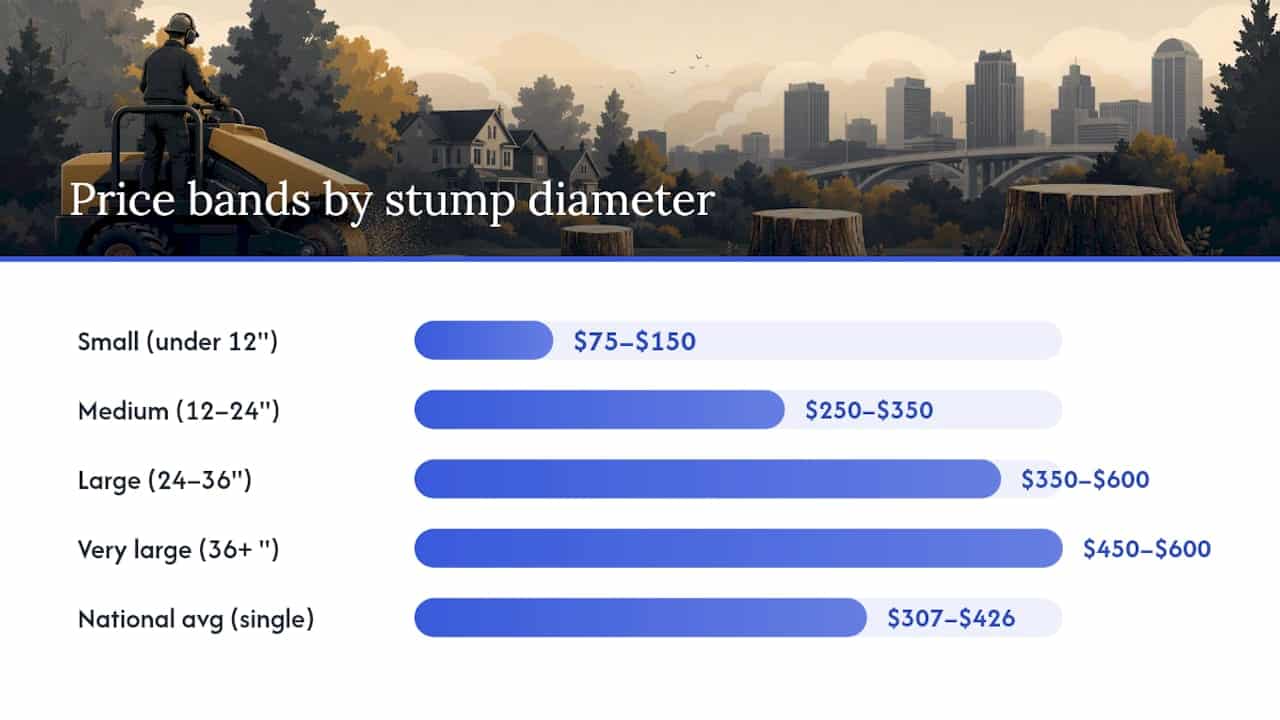
The table below shows typical price bands by stump diameter and the billing models you’ll encounter.
| Stump diameter | Per-stump estimate | Per-inch rate | Notes |
|---|---|---|---|
| Small (under 12″) | $75–$150 | $2–$5/inch | Often subject to minimum job fee |
| Medium (12″–24″) | $250–$350 | $2–$5/inch | Most common residential size |
| Large (24″–36″) | $350–$600 | $2–$5/inch | Hardwood species add cost |
| Very large (36″+) | $450–$600 | $2–$5/inch | May require multiple grinder passes |
Common billing models:
- Per-stump flat rate — the most common for single jobs; price is set after the contractor measures diameter and assesses access.
- Per-inch diameter — rates typically run $2–$5 per inch, with a minimum fee around $100 regardless of stump size.
- Hourly rate — less common but used for complex multi-stump jobs; expect $75–$150/hour depending on equipment and crew size.
- Per-job bundled pricing — the best deal for multiple stumps; contractors discount per-stump rates when mobilization costs are spread across several units.
Quick calculations using local-band assumptions:
- A 12″ pine stump at $3/inch = $36 base, but the minimum job fee applies, so expect $100–$150 total.
- A 24″ oak stump at $4/inch = $96 base, likely quoted as a flat $250–$350 with cleanup included.
- A 36″ water oak at $5/inch = $180 base, but size, hardwood density, and root complexity typically push the final quote to $450–$600.
Birmingham’s summer heat and storm season can create demand spikes from June through September. Scheduling in late fall or winter often means faster availability and occasionally lower rates.
What changes the price: the variables contractors check
The primary cost drivers are stump diameter, tree species, site accessibility, and number of stumps. Every other variable flows from those four.
- Stump diameter at grade — the single biggest factor; a 36″ stump can take four times as long to grind as a 12″ one.
- Species (hardwood vs. softwood) — oak, hickory, and sweetgum are dense and wear down grinder teeth faster; pine and poplar cut quickly. Hardwood jobs cost more.
- Site access — narrow gates, steep slopes, and soft ground after rain limit which equipment can reach the stump. A walk-behind grinder on a tight lot takes longer than a self-propelled unit on open ground.
- Number of stumps — mobilization and setup often make up a large portion of the total cost; bundling three stumps into one visit cuts per-stump cost significantly.
- Grind depth requested — standard depth is 6–12 inches below grade. Deeper grinds (12–18 inches) for replanting or hardscape add time and cost.
- Buried utilities or rock — hitting a buried irrigation line or ledge rock mid-job stops work immediately. Disclosing these upfront lets contractors price the risk correctly.
- Surface root complexity — a stump with large lateral roots spreading 6–8 feet in every direction takes longer to chase and grind flush.
- Cleanup and disposal preference — leaving chips on-site is cheapest; having them hauled off adds meaningful cost (more on this in the job-day section).
Pro Tip: Measure the stump diameter at ground level with a tape measure and take two photos: one overhead and one from the side with something for scale. Send both with your inquiry. Contractors who can see what they’re quoting give you a tighter, more accurate number.
Multi-stump jobs are where you can negotiate. If you have four stumps scattered across your property, ask for a bundled quote. The contractor’s truck and equipment are already on-site; the incremental cost of grinding stump two, three, and four is far lower than the first.
Stump grinding vs. full removal: which one do you actually need?
Grinding leaves the root system in the ground to decompose. Removal extracts everything, including the tap root and major laterals, which means excavation, a larger equipment footprint, and significantly more backfill work. Full removal costs two to four times more than grinding.
| Scenario | Grinding | Full removal |
|---|---|---|
| Re-sodding or planting a flower bed | ✓ Works well | Overkill for most cases |
| Replanting a new tree in the same hole | Not ideal | Recommended |
| Construction or hardscape over the spot | Not sufficient | Required |
| Root disease (Armillaria, root rot) | Risky — leaves infected material | Recommended to reduce spread |
| Aesthetic cleanup, mowing hazard | ✓ Best choice | Unnecessary cost |
| HOA compliance, quick turnaround | ✓ Faster | Slower, more disruptive |
When to call for a certified arborist opinion before deciding:
- The tree was removed because of suspected root rot or fungal disease.
- You plan to replant a tree in the same footprint.
- A structure, driveway, or hardscape is planned directly over the stump location.
- The root system is visibly damaging a foundation or utility line.
An ISA Certified Arborist consultation costs less than the mistake of grinding a diseased stump and replanting into infected soil. For the vast majority of Birmingham residential lots, though, grinding is faster, cheaper, and leaves the lawn in re-sodable condition within days.
How long does a stump grinding job take?
Setup and mobilization often take longer than the actual grinding, especially on small single-stump jobs. A contractor may spend 20–30 minutes getting equipment off the trailer, positioning it, and clearing the area before the grinder touches wood.
- Small ornamental stump (under 12″) — 10–20 minutes of active grinding; total on-site time 30–45 minutes including setup and cleanup.
- Medium stump (12″–24″) — 20–45 minutes of grinding; total on-site time 45–75 minutes.
- Large stump (24″–36″) — 45–90 minutes of grinding; total on-site time 1.5–2.5 hours.
- Very large stump (36″+) or dense hardwood — 1.5–3+ hours of grinding; full-day jobs are possible for multiple large stumps.
- Multi-stump jobs (3–5 stumps, mixed sizes) — plan for a half-day; 10+ stumps on a commercial lot can run a full day or require a return visit.
Pro Tip: When requesting a written quote, ask the contractor to include a start-to-finish time estimate. This matters for scheduling around work hours, HOA quiet periods, or neighboring properties. A contractor who can’t give you a rough ETA hasn’t assessed the job properly.
The biggest scheduling variable in Birmingham is soil condition. After a heavy rain, soft ground can prevent a large self-propelled grinder from reaching a backyard stump without tearing up the lawn. Contractors may reschedule or switch to a smaller walk-behind unit, which takes longer.
How do you get accurate quotes and choose a reliable contractor?
The quality of your quote depends almost entirely on the quality of the information you send. Contractors who are quoting blind add a buffer for unknowns; give them specifics and the price tightens.
What to include in your inquiry:
- Two photos of the stump (overhead and side view, with a tape measure for scale)
- Stump diameter at ground level
- Gate width and access path to the stump
- Whether you’ve called 811 and confirmed no buried utilities in the grind zone
- Desired grind depth (standard 6–12 inches, or deeper for replanting/hardscape)
- Cleanup preference: chips left on-site, redistributed as mulch, or hauled off
Eight questions to ask every contractor:
- Are you licensed and insured in Alabama? Can you provide a certificate of insurance?
- Do you have a certified arborist on staff or on call?
- What exactly is included in the quoted price (grind depth, surface roots, cleanup)?
- Who handles chip disposal, and is there an additional fee?
- Do you offer a warranty or guarantee on the work?
- What size equipment will you use, and can it reach my stump given the access I described?
- What’s your estimated start-to-finish time on-site?
- Will you provide a written estimate with scope details before any work begins?
Red flags to watch for:
- No written quote, or a quote given verbally with no scope details
- Unusually low price with vague language about what’s included
- Cash-only payment required upfront before work starts
- No proof of insurance when asked
- No before/after photos or references from past jobs
Trust signals that matter:
- Licensed and insured contractor with verifiable Alabama credentials
- Certified arborist on staff or available for consultation
- Written estimate that specifies grind depth, surface root treatment, and cleanup scope
- Before/after photos or a work portfolio
- Customer references willing to speak by phone
- Clear warranty or workmanship guarantee in writing
Including clear scope items in your quote request — diameter, access notes, grind depth, and cleanup preference — is the single most effective way to get comparable bids. Without those details, two quotes for the “same job” may include completely different scopes.
What happens on job day and how is the site left?
A professional stump grinding visit follows a predictable sequence, and knowing it helps you verify the crew is doing the job right.
- Arrival and site walk — the crew confirms stump location, checks access, and marks any hazards (irrigation heads, landscape lighting, buried utility flags).
- Safety perimeter setup — cones or barriers are placed; bystanders and pets are cleared from the grind zone. Flying debris from a grinder can travel 30+ feet.
- Grinding sequence — the operator works the cutting wheel across the stump in overlapping passes, grinding down in layers. Surface roots are chased outward from the stump base.
- Depth check — the operator measures grind depth to confirm it meets the agreed spec (typically 6–12 inches below grade).
- Backfill and chip management — chips are either left in the hole as natural backfill, redistributed on-site, or loaded for haul-off depending on what was quoted.
- Final cleanup — the area is raked, loose chips are cleared from surrounding lawn or hardscape, and the crew does a debris walk before leaving.
Finish options and their cost impact:
| Finish option | What you get | Relative cost |
|---|---|---|
| Chips left in hole | Hole filled with wood chips; chips mound slightly above grade | Base price |
| Chips redistributed on-site | Chips spread as mulch in beds or elsewhere on property | Adds ~30–50% to base |
| Chips hauled off + backfill | Clean hole, filled with soil; ready for sod or seed | Adds 50–100% to base |
| Chips hauled off + topsoil + sod | Finished lawn surface, seamless appearance | Highest cost; get a separate quote |
Moving chips on-site adds roughly 30–50% to the base price; full haul-off can add 50–100% depending on volume. If you’re re-sodding, budget for the haul-off and backfill option. If you’re converting the area to a mulch bed, leaving chips in place is free and functional.
On permits and utility locates: Birmingham does not typically require a permit for stump grinding on private residential property, but calling 811 before any grinding deeper than 6 inches is a legal requirement in Alabama. HOA properties may require advance notification; check your CC&Rs before scheduling.
DIY vs. hiring a pro: is renting a grinder worth it?
Renting a stump grinder is a real option for small stumps on accessible, flat ground. National rental costs range from about $90 to $400 depending on model and duration, with many homeowners spending around $300 for a project.
What renters often underestimate:
- Transport costs — most rental grinders require a trailer; add $50–$100 for trailer rental if you don’t own one.
- Fuel — grinders burn through fuel on large stumps; budget $20–$40 extra.
- Safety gear — eye protection, hearing protection, steel-toed boots, and heavy gloves are non-negotiable. If you don’t own them, add $30–$60.
- Debris handling — you’re responsible for chip disposal; renting a debris trailer or making dump runs adds time and cost.
- Physical demand — a walk-behind rental grinder on a 24″ oak stump is exhausting work. Underestimating this is the most common renter complaint.
Pro Tip: Before renting, call 811 and mark your utilities. A rental grinder operator who hits a buried gas line has no professional insurance coverage for the damage. That single risk is why most property managers default to hiring a licensed, insured crew for anything near structures or utility corridors.
DIY makes sense when the stump is small (under 10″ diameter), softwood, on flat open ground, and you have solid experience with power equipment. For large stumps, limited access, stumps near structures or fences, or any job where a mistake has real consequences, hiring a professional is the straightforward call. You can read more about safe stump grinding practices before deciding.
When grinding isn’t enough: edge cases that need expert input
Most stumps grind without complications. A few situations genuinely require more than a grinder and a crew.
Disease situations:
When a tree was removed because of root rot or fungal pathogens like Armillaria (honey fungus), grinding can leave infected root material in the soil. The fungus survives on buried wood and can spread to adjacent healthy trees. In those cases, professional arborists recommend full removal to reduce the pathogen reservoir, not just grinding the visible stump.
- Signs that disease may be a factor: mushroom clusters at the stump base, white mycelial mats under bark, or a history of sudden decline in the removed tree.
- If you’re unsure, a soil and root sample sent to the Alabama Cooperative Extension System can confirm fungal presence before you decide on grinding vs. removal.
Construction and replanting:
- Replanting a new tree in the same hole requires full removal or a very deep grind (12–18 inches minimum) to clear enough root-free soil for the new root ball.
- Pouring a concrete pad, driveway, or foundation over a ground stump is a long-term problem; decomposing wood creates voids that cause settling. Full removal is the only safe option here.
- For hardscape within 3–4 feet of a stump, ask the contractor to grind surface roots to grade and confirm grind depth before any concrete work begins.
Pro Tip: If the tree was removed for health reasons, or if you’re planning any structural work within 5 feet of the stump, get a certified arborist consultation before scheduling grinding. A 30-minute consult costs far less than redoing a driveway or losing a neighboring tree to the same disease.
Key Takeaways
For Birmingham property owners comparing stump grinding services, grinding is the right choice for most residential jobs, costs significantly less than full removal, and leaves the site ready for re-sodding within days.
| Point | Details |
|---|---|
| Grinding vs. removal | Grinding suits most residential jobs; full removal costs two to four times more. |
| Local price range | Most single residential stump grinding jobs in Birmingham fall between $150–$800, depending on size, species, and site access; small stumps may be under $150, while large or bundled jobs can approach $800 or more. |
| Biggest cost drivers | Stump diameter, species (hardwood costs more), site access, and cleanup level drive the final price. |
| Quote accuracy | Send stump photos, diameter, gate width, and 811 utility-locate status with every inquiry. |
| Mcculloughtreeservice | A certified, insured option for stump grinding and removal in the region, with arborist credentials and a proof-of-work gallery. |
The case for grinding: a contractor’s perspective
The most consistent pricing mismatch in stump grinding comes from cleanup expectations. A property owner gets a quote for grinding, pictures a clean, level lawn, and then discovers that “grinding” meant chips left in a mound above grade. The contractor wasn’t wrong; the scope just wasn’t defined. That gap accounts for more post-job disputes than any other single factor.
The fix is simple: standardize your inquiry. Every quote you request should specify the same grind depth (say, 8 inches below grade), the same cleanup option (chips hauled off, or chips left), and the same surface-root treatment (flush to grade, or not). When all three are identical across bids, you’re comparing the same job, and price differences reflect actual contractor efficiency and overhead, not scope variations.
Grinding also gets undersold as a lawn-restoration tool. A properly ground and backfilled stump site, given two to three weeks of watering, is ready for sod. Full removal leaves a crater that requires significant soil amendment and grading before anything grows. For Birmingham lots where the goal is a clean, usable yard, grinding almost always gets you there faster and cheaper; consider using the best biostimulant for arborists to support soil and plant health after grinding.
The one scenario where I’d push back on the default grinding recommendation is disease. If the tree came down because it was sick, grinding and walking away is a gamble. The root system stays in the ground, and so does whatever was killing the tree. That’s worth a conversation with a certified arborist before the grinder arrives.
Useful sources for deeper research
These are the sources used to build this guide. Each one is worth bookmarking if you want to go deeper on a specific question.
- 2026 Tree Stump Grinding Cost (Thumbtack) — national average cost data with low-end and high-end ranges; good for benchmarking quotes.
- Pricing Guide: How Much Does Stump Grinding Cost? (LawnStarter) — covers per-inch billing rates and minimum job fees in detail.
- Stump Grinding vs. Removal: Which Is Better? (Angi) — side-by-side cost comparison with practical guidance on method selection.
- Stump Grinding vs. Stump Removal: When to Grind and When to Remove (Waterbury Tree Care) — the best source on disease scenarios and when grinding leaves a problem behind.
- Stump Grinder Rental Cost (Angi) — current rental rate ranges for homeowners considering the DIY route.
Mcculloughtreeservice: professional stump grinding with certified oversight
Hiring a local contractor from a directory listing gets you a grinder on-site. What it doesn’t guarantee is a certified arborist reviewing the job, a written scope that protects you if something goes wrong, or a team that knows when grinding isn’t the right answer.

Mccullough Tree Service offers stump grinding and full stump removal backed by certified arborist credentials, a proof-of-work gallery, and written estimates that specify grind depth, surface root treatment, and cleanup scope. For Birmingham-area property owners who want a single contractor handling the assessment, the grind, and the aftercare conversation, that combination is harder to find than the price comparison suggests. Request a written quote, include your stump photos and diameter measurement, and ask specifically about grind depth and cleanup options. That’s the fastest path to a number you can actually compare.
Recommended
- Stump Grinding in Orlando & Central Florida
- Why Choose Professional Stump Grinding for Your Property
- Tree Service Company with Professional Stump Grinding