By: Shelby McCullough| Published: August 11, 2026
Keep trees at least 10 feet from distribution lines and well clear of transmission lines, which carry higher voltage and require larger clearances set by the utility. If a tree or branch is already touching a line, do not approach it. Stay back at least 30 feet, keep everyone else away, and call your local electric utility’s outage line immediately. Call 911 only if there is fire, injury, or an immediate life threat.
Three immediate actions when you spot a tree threatening a power line:
- Call your utility’s outage or emergency line and report the exact address and location of the conflict.
- Mark the area with tape, cones, or verbal warnings to keep children, pets, and bystanders away.
- Do not attempt to cut, move, or touch any branch that is in contact with or within reach of a line.
Key Takeaways
Keeping trees at safe distances from power lines requires knowing your line type, planting the right species in the right zone, and calling a qualified professional for any work near energized conductors.
| Point | Details |
|---|---|
| Minimum approach distance | Unqualified people must stay at least 10 feet from many overhead lines per OSHA standards. |
| Planting zones | Low zone under 20 ft from line, max ~25 ft mature height; medium 20–50 ft, max ~40 ft. |
| Who is responsible | Utilities manage vegetation in their easement; homeowners hire certified arborists for work outside it. |
| Emergency rule | Stay 30 feet back from any tree contacting a line; call the utility, not a contractor. |
| Mcculloughtreeservice | Provides certified arborist assessments and line-clearance trimming for Central Florida homeowners. |
Table of Contents
- Why trees near power lines are so dangerous
- How line types and regulators shape the rules
- Clearance distances and planting zones you should know
- Which trees work well near utility lines
- Who is responsible for trees near power lines
- How trees near power lines should be pruned
- What a quality line-clearance pruning job looks like
- What to expect from your utility’s trimming program
- If a tree touches a power line: step-by-step emergency response
- Hiring a contractor for work near utilities
- The view from the field
- Certified line-clearance tree care in Central Florida
- Sources
Why trees near power lines are so dangerous
Contact between trees and power lines creates three distinct hazards: electrocution, fire, and outages. Each one is serious on its own; together they make vegetation management one of the most safety-critical tasks in utility operations.
Electrocution happens because wood and wet bark conduct electricity well enough to kill. A person who touches a tree in contact with an energized line can receive a fatal shock without touching the wire directly. Current can also travel through the root system into the surrounding soil, making the ground itself dangerous.
Fire is the second hazard. A branch rubbing against a conductor generates heat and sparks. In dry conditions, that is enough to ignite bark, leaf litter, or nearby structures. The USDA Forest Service documents how tree contact with lines has contributed to regional fires and large-scale outages, noting that trees planted without regard to mature size become liabilities rather than assets.
Outages are the most common consequence. Trees are among the leading causes of overhead line damage in the United States, particularly during storms when branches fail or whole trees fall across conductors. A single fallen oak can knock out power to hundreds of homes and delay restoration for hours.
Two less obvious hazards are worth knowing:
- Energized tree conduction: A tree growing into a line may be energized for days before anyone notices, especially on a rural stretch. Neighbors, hikers, or children playing nearby face a hidden risk.
- Equipment access obstruction: Overgrown vegetation around pad-mounted transformers and ground-level electrical equipment can delay repair crews during outages, extending the time your neighborhood is without power. Keeping a clear zone around ground-level equipment is just as important as managing overhead clearance.
For Central Florida homeowners, hurricane season tree preparation is especially relevant, since storm winds dramatically increase the chance of branch failure near lines.
How line types and regulators shape the rules
Three categories of overhead lines run through most American neighborhoods, and the rules for each are different enough that mixing them up leads to real mistakes.
Service drops are the low-voltage lines that run from the utility pole to your house. They typically consist of two or three bundled, insulated conductors and are the lines closest to your roof and yard trees. Because they are lower voltage, some utilities use covered (but not fully insulated) wire, which reduces but does not eliminate shock risk.
Distribution lines run along neighborhood streets and rural roads, usually on wooden poles at 4 kV to 35 kV. These are the lines most homeowners interact with when managing trees. State public utility commissions regulate distribution-level vegetation management, which means clearance requirements and notification rules vary by state.
Transmission lines carry high voltage (often 69 kV to 500 kV or more) across long distances, usually on tall steel towers or large wooden H-frame structures. FERC and NERC reliability standards require minimum clearances for transmission facilities under the FAC-003 vegetation standard, but they do not mandate specific trimming methods. The transmission owner sets the actual clearance distances, which are larger than distribution clearances and non-negotiable.
How to tell which type runs near your property:
- Service drop: runs directly to your home’s weatherhead; usually bundled and relatively low.
- Distribution: wooden poles along the street, typically with three conductors and a neutral wire.
- Transmission: tall steel towers or large H-frame poles, multiple conductors per phase, large ceramic or glass insulators.
When in doubt, call your utility and ask which line type runs along your property boundary. They will tell you, and it takes two minutes.
Clearance distances and planting zones you should know
OSHA’s line-clearance standards set a 10-foot minimum approach distance for unqualified people near many overhead systems. That is the floor, not the target. Utilities typically maintain clearances larger than the minimum distances to account for conductor sag, wind movement, and seasonal growth.
Virginia Cooperative Extension planting zone guidance defines three practical zones for distribution lines:
| Zone | Distance from line | Recommended max mature height | Example species |
|---|---|---|---|
| Low | Under 20 ft | ~25 ft | Crape myrtle, dogwood, redbud |
| Medium | 20–50 ft | ~40 ft | Red maple, sweetgum, ornamental pear |
| Tall | Over 50 ft | Unrestricted | Live oak, loblolly pine, tulip poplar |
A few points that the table alone does not capture:
- Conductor sag matters. Lines sag more in summer heat and under ice load in winter. Utilities trim beyond the visible clearance to account for this movement, which is why a tree that looks clear in January may be flagged in August.
- Fast-growing species close in faster than you expect. A water oak planted 15 feet from a distribution line can reach the conductor within five to seven years. Slow-growing, strong-wooded species are always the better choice near lines.
- The 10-foot rule applies to you, not the line. OSHA’s minimum approach distance governs how close an unqualified person may get to an energized conductor. It does not mean a tree at 10 feet is safe to leave untrimmed.
For homeowners wondering whether a specific tree should come down rather than be pruned, the reasons to remove trees near your house guide covers the decision criteria in detail.
Which trees work well near utility lines
The Arbor Day Foundation’s “right tree, right place” principle is the single most useful frame for planting decisions near lines. Choose a species whose mature height fits the zone, and you largely eliminate the future conflict before it starts.
Planting checklist before you put anything in the ground:
- Identify which zone the planting site falls in (low, medium, or tall) using the distances above.
- Call 811 (the national “Call Before You Dig” line) to locate underground utilities before digging.
- Check with your utility for any additional setback requirements specific to your area.
- Choose a species whose mature height stays within the zone’s recommended limit.
- Confirm the species is appropriate for your soil type, sun exposure, and climate zone.
- Plant at least 3 feet from any sidewalk, curb, or structure to allow for root spread.
Species by zone (guidance, not exhaustive):
Low zone (under 20 ft from line, max ~25 ft mature height):
- Crape myrtle (Lagerstroemia spp.) — drought-tolerant, slow to moderate growth
- Flowering dogwood (Cornus florida) — native, wildlife value, tops out around 20–25 ft
- Eastern redbud (Cercis canadensis) — compact, early spring color
Medium zone (20–50 ft from line, max ~40 ft):
- Red maple (Acer rubrum) — fast-growing, so plant toward the outer edge of this zone
- Serviceberry (Amelanchier spp.) — multi-season interest, moderate growth
- Crape myrtle standards (larger cultivars) — still manageable with routine pruning
Avoid near lines regardless of zone:
- Water oak, laurel oak, and other fast-growing oaks with weak wood
- Eucalyptus (especially in Florida) — fast, tall, and prone to branch failure
- Any species with a documented history of brittle wood or storm damage
Purdue Extension recommends narrow, columnar, or fastigiate cultivars for tight low-zone plantings, since their upright growth habit naturally limits lateral spread toward conductors.
Pro Tip: When space is genuinely tight under a distribution line, consider ornamental shrubs rather than trees. A well-chosen shrub like beautyberry or native azalea gives you year-round interest, never needs line-clearance trimming, and costs nothing to maintain from a utility-conflict standpoint.
Who is responsible for trees near power lines
The short answer: you own the tree, but the utility usually has the legal right to manage vegetation within its easement or right-of-way, including trees on your property that threaten the line.
Most utility easements are recorded in your property deed or in county records. The easement grants the utility access to a corridor along the line, typically 10–50 feet wide depending on the line type and state. Within that corridor, the utility can prune or remove vegetation without your permission, though most will notify you in advance for scheduled work. FirstEnergy’s homeowner guidance confirms that utilities prioritize public safety and reliability, and that emergency hazards can trigger immediate action without prior notice.
Who to call and when:
- Your electric utility first. For any tree that is touching, leaning toward, or likely to fall on a line, call the utility’s vegetation management or outage line. They will assess whether it falls within their easement and schedule work if it does.
- A certified arborist second. For trees outside the easement or for work the utility will not cover, hire an ISA-certified arborist with line-clearance training. They can assess risk, recommend pruning or removal, and coordinate with the utility if needed.
- Your state public utility commission third. If you have a dispute about what the utility trimmed or removed, your state’s public utility commission handles complaints about distribution-level vegetation management. The Ohio Office of the Consumers’ Counsel fact sheet is a good model for what state-level guidance looks like; check your own state’s commission for local rules.
What to have ready when you call the utility:
- Your service address and account number
- A description of the tree’s location relative to the line (which side of the pole, approximate distance)
- Whether the tree is actively touching the line or just growing toward it
- Any photos you can safely take from ground level
Utilities typically notify homeowners before scheduled trimming cycles. Emergency hazards, however, allow crews to act immediately. You generally cannot stop utility crews from working within a valid easement, even if you disagree with the scope.
How trees near power lines should be pruned
Only OSHA 1910.269-qualified line-clearance arborists are trained and legally permitted to work within the minimum approach distance of energized lines. If a branch is within 10 feet of a conductor, a qualified professional must handle it. Full stop.
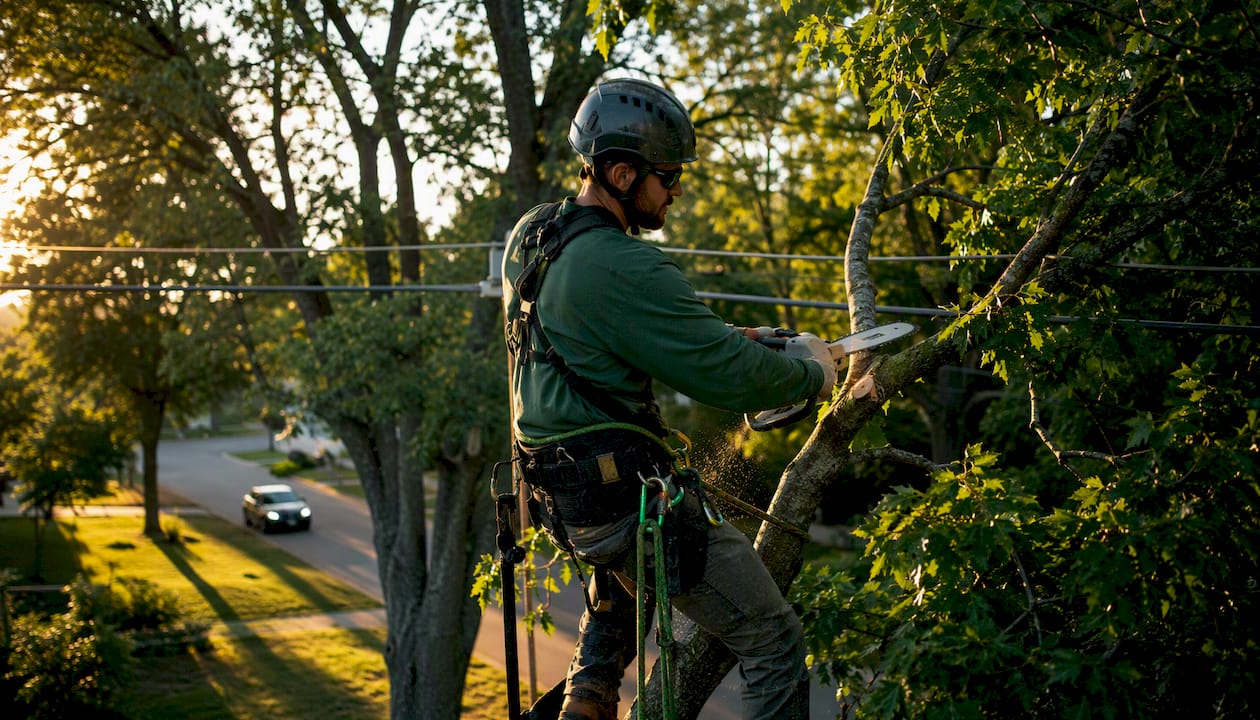
Directional pruning is the accepted method for trees near lines. Rather than cutting a tree back to a stub (topping), directional pruning removes branches at their point of origin or redirects growth away from the conductor by cutting to a lateral branch growing in a safe direction. The result is a tree that retains its structural integrity and natural form while keeping clearance. FPL’s line-clearing program uses directional pruning as its standard approach, removing trees only when pruning would cause severe damage to the tree or fail to maintain adequate clearance.
Topping is harmful and counterproductive. Cutting a tree’s main stem or large scaffold branches back to stubs triggers rapid, weakly attached regrowth called epicormic shoots. These shoots grow faster than the original branch and are structurally weaker, meaning a topped tree often requires more frequent trimming and poses greater storm-damage risk than an untopped one.
What homeowners can safely do:
- Prune small branches well away from lines, on the side of the tree opposite the conductor
- Remove dead wood at ground level or in the lower canopy, away from any line
- Schedule routine maintenance trimming with a certified arborist for branches growing toward lines
What homeowners must not do:
- Climb toward or into a tree that is near an energized line
- Use a ladder, pole saw, or any tool that could bring you within 10 feet of a conductor
- Cut any limb that is touching or resting on a line
- Assume a covered wire is safe to contact
Pro Tip: Ask your utility when your street is next scheduled for cycle trimming. If it is within 12–18 months, coordinate your own pruning work to happen just before the utility’s visit. You get the benefit of a fresh trim, and the utility’s crew can focus on the clearance work rather than removing healthy wood you just paid to keep.
What a quality line-clearance pruning job looks like
Directional pruning preserves tree structure by removing branches at natural attachment points, never leaving stubs, and always cutting to a lateral that is at least one-third the diameter of the removed branch. That ratio matters because a lateral too small to sustain the remaining branch will die back, leaving the same stub problem topping creates.
Certification and credentials to require:
- OSHA 1910.269 / line-clearance tree trimming training (ask for documentation)
- ISA Certified Arborist credential (verify at the ISA’s online directory)
- Proof of general liability insurance and workers’ compensation
- References from utility or municipal line-clearance contracts, not just residential work
What a professional contractor’s workflow should include:
- Pre-job site assessment and written scope of work identifying specific branches and trees
- Notification to the utility if work will be within the minimum approach distance
- Marked trees and branches before cutting begins, with homeowner walkthrough
- Proper equipment: aerial lift or bucket truck for high work, not a ladder near lines
- Complete cleanup of debris, with chip pickup or haul-away included in the scope
- Post-job documentation showing what was removed and why
Questions to ask before hiring anyone for work near lines:
- “Are you OSHA 1910.269-trained and ISA-certified?”
- “Do you carry workers’ comp and general liability? Can I see the certificates?”
- “Will you coordinate with the utility before working near the conductors?”
- “What is your cleanup plan, and is it included in the quote?”
- “Can you provide references from utility or municipal line-clearance work?”
Pro Tip: Ask to see the written scope of work before signing anything. A contractor who cannot produce a written scope describing which branches will be removed and why is not operating at a professional standard for line-clearance work.
What to expect from your utility’s trimming program
Utilities run two types of vegetation management: scheduled cycle trimming and targeted or emergency work. Cycle trimming covers entire line segments on a rotating schedule, typically every three to five years for distribution lines. Targeted work addresses specific conflicts identified between cycles. Emergency response happens after storms or when a hazard is reported.
Typical program elements:
- Cycle trimming: Crews inspect the full line length, identify conflicts, and prune or remove as needed. FPL’s program uses directional pruning as the default and removes trees only when pruning would severely damage them or fail to maintain clearance.
- Mid-cycle spot work: A crew responds to a reported conflict or a hazard flagged during a patrol flight or ground inspection.
- Emergency response: Activated after storms; crews prioritize restoring power, not aesthetics.
- Herbicide application: Some utilities apply herbicides to cut stumps or low-growing vegetation in transmission rights-of-way to slow regrowth. This is more common on transmission corridors than in residential distribution areas.
What notifications look like:
- A door hanger or mailed notice stating the scheduled trimming date and general scope
- A utility representative may walk the line and mark trees before the crew arrives
- Some utilities offer chip pickup or wood chip delivery to homeowners who want the material
How to respond or dispute scope:
- Contact your utility’s vegetation management department (not the general customer service line) with your account number and the specific concern.
- If the utility trimmed beyond what you believe the easement allows, file a complaint with your state’s public utility commission.
- Transmission-line vegetation management is governed by FERC/NERC standards and is generally less negotiable than distribution work.
If a tree touches a power line: step-by-step emergency response
Step-by-step emergency checklist:
- Stay at least 30 feet away from any tree or branch contacting a line. If you are closer, move away in small, shuffling steps to avoid a ground-gradient shock.
- Keep all bystanders, children, and pets away from the area. Do not let anyone approach to “take a look.”
- If you are in a vehicle that has come into contact with a downed line, stay inside. Drive away if you can do so without running over the line. If you cannot drive away, stay in the car and call 911. Exit only if the car catches fire, and if you must exit, jump clear without touching the car and the ground simultaneously.
- Call 911 if there is fire, injury, or a person in immediate danger.
- Call your electric utility’s outage or emergency line for all other situations. Report your exact address, the nearest cross street, and the location of the contact (which pole, which side of the road).
- Do not attempt to move the tree, cut branches, or use any tool near the line.
- Wait for utility crews to confirm the line is de-energized before allowing anyone near the area.
What information the utility will need:
- Your service address and the nearest cross-street or pole number
- Whether the line is sparking, smoking, or on the ground
- Whether anyone is injured or trapped
- Your callback number
Most utilities have an online outage map and reporting portal in addition to a phone line. Both work; the phone line is faster for active emergencies.
Hiring a contractor for work near utilities
Require proof of line-clearance training, ISA certification, and current insurance before any contractor starts work near a power line. A low bid without written scope is a red flag, not a deal.
Numbered checklist for hiring:
- Confirm OSHA 1910.269 line-clearance training and ask to see documentation.
- Verify ISA Certified Arborist status at the ISA’s online directory (treesaregood.org links to the lookup tool).
- Request certificates of general liability insurance and workers’ compensation, naming you as additionally insured.
- Ask for references from utility or municipal line-clearance contracts specifically.
- Get a written scope of work identifying which trees and branches will be addressed and why.
- Confirm the contractor will notify the utility if work falls within the minimum approach distance.
- Clarify the cleanup plan in writing before signing.
Red flags to walk away from:
- Offers to work on or near live lines without utility coordination or a written safety plan
- Asks you to sign a waiver releasing them from liability before work begins
- Cannot produce insurance certificates on request
- Provides a verbal quote only, with no written scope
- Uses topping as the standard approach for trees near lines
For a detailed contractor selection checklist, Mcculloughtreeservice’s guide to choosing a tree trimming service covers the credential checks and questions to ask in plain language. For work specifically near energized lines, the tree trimming safety tips for homeowners page outlines what you can and cannot safely do yourself.
The view from the field
Working around energized lines in Central Florida for years, one pattern stands out: most of the dangerous situations we see were preventable at the planting stage. A homeowner planted a laurel oak 12 feet from a distribution line in 1995, and by 2010 it was a recurring liability, requiring line-clearance work every two to three years and eventually full removal. The cost of that removal, plus the repeated trimming cycles, far exceeded what a crape myrtle or dogwood in the same spot would have cost over the same period.
The safety rules are not bureaucratic obstacles. The 10-foot minimum approach distance exists because people have died touching trees that were in contact with lines. Directional pruning exists because topping creates structurally weak regrowth that fails in the next storm. These practices are grounded in real consequences.
If you have a tree that is already in conflict with a line, call your utility first. If the tree is outside the easement or the utility will not address it, call a certified arborist for an assessment before the next storm season. Mcculloughtreeservice’s certified arborists serve residential and commercial properties across Central Florida and can assess line-clearance risk, recommend the right course of action, and coordinate with your utility when needed.
Certified line-clearance tree care in Central Florida
When a tree is growing toward a power line, the cost of waiting is always higher than the cost of acting. Mccullough Tree Service brings ISA-certified arborists and line-clearance-trained crews to residential and commercial properties across Orlando and Central Florida, handling everything from a single hazardous branch to full removal of trees that cannot be safely pruned back from conductors.
The difference between a qualified line-clearance crew and a general landscaper is not just credentials on paper. It is the written scope of work, the utility coordination, the proper equipment, and the pruning cuts that preserve your tree’s structure rather than triggering a flush of weak regrowth. For homeowners who want the job done right the first time, Mcculloughtreeservice’s professional tree trimming services and hazardous tree removal cover the full range of line-clearance needs. Request a free estimate today and get a certified assessment before the next storm season arrives.
Sources
Each source below covers a different slice of the topic. Use them together for a complete picture.
- eTool : Electric Power Generation, Transmission, and Distribution – Overhead Line Work – Line-Clearance Tree Trimming Operations | Occupational Safety and Health Administration
- Selecting and Managing Trees to Avoid Conflicts With Overhead Utility Lines
- Tree trimming and vegetation management — landowners FAQ
- Treesaregood
State commissions regulate distribution lines; FERC and NERC set the floor for transmission reliability. When the two appear to conflict, the higher-voltage line follows the federal standard.
Recommended
- Neighbor’s Tree Liability: Know Your Responsibilities
- Signs of Unhealthy Trees: What Every Florida Owner Should Know
- 7 Essential Tree Trimming Safety Tips for Homeowners