By: | Published: August 18, 2026
Once a palm frond turns yellow, it stays yellow. The chlorophyll is gone for good in that tissue, so that specific frond will never turn green again. Your job now is protecting the green fronds you still have and setting up the palm to grow healthy new ones.
Do this today:
- Check which fronds are yellow: oldest (bottom of the canopy) or newest (center spear and top)? That single detail points to the cause.
- Push a finger into the soil 2 inches down. Soggy or bone dry both matter.
- Flip a frond and look at the underside for scale insects or fine webbing.
Older fronds yellowing usually means a mobile-nutrient shortage or a watering problem. New growth yellowing usually points to an immobile nutrient or a soil pH issue affecting iron uptake.
Pro Tip: Take one close-up photo of an affected frond and one photo of the whole canopy today. Retake them in a month. That side-by-side comparison tells you more than staring at the tree ever will.
Key Takeaways
Yellow palm fronds never turn green again, so effective treatment depends entirely on reading the pattern correctly before applying any fix.
| Point | Details |
|---|---|
| Location tells the story | Older-frond yellowing suggests potassium, magnesium, or water issues; new-growth yellowing points to manganese, iron, or pH. |
| Fix drainage before fertilizer | Overwatered roots can’t absorb nutrients even when they’re present, so check soil moisture first. |
| Use palm-specific fertilizer | Choose slow-release blends built for palms and skip high-nitrogen turf products, which can worsen potassium deficiency. |
| Don’t rush the timeline | Recovery only shows in new fronds and can take several months to years depending on the deficiency. |
| Get a professional opinion when patterns are unclear | Mcculloughtreeservice offers certified arborist inspections that combine soil sampling, canopy assessment, and a written treatment plan. |
Where to Read More on Palm Nutrition and Diagnosis
- Palm Nutrition and Fertilization – Gardening Solutions: university extension guidance on deficiency timelines and mobility.
- Mineral Deficiencies and Toxicities in Palms – UC IPM: peer-reviewed diagnostic photos and toxicity thresholds.
- EP273 Palm Nutrient Symptoms – IFAS Extension: species-specific symptom breakdowns for accurate diagnosis.
Table of Contents
- What Pattern of Yellowing Points to Which Cause?
- Common Causes of Yellow Palm Leaves
- How to Fix Yellow Palm Leaves by Cause
- Building a Care Routine That Prevents Yellowing
- When to Test Soil and Call a Certified Arborist
- Getting a Professional Diagnosis for Your Palm
- Sources
What Pattern of Yellowing Points to Which Cause?
Palms show their problems in fairly predictable spots, and once you know where to look, most homeowners can narrow the cause in about two minutes.
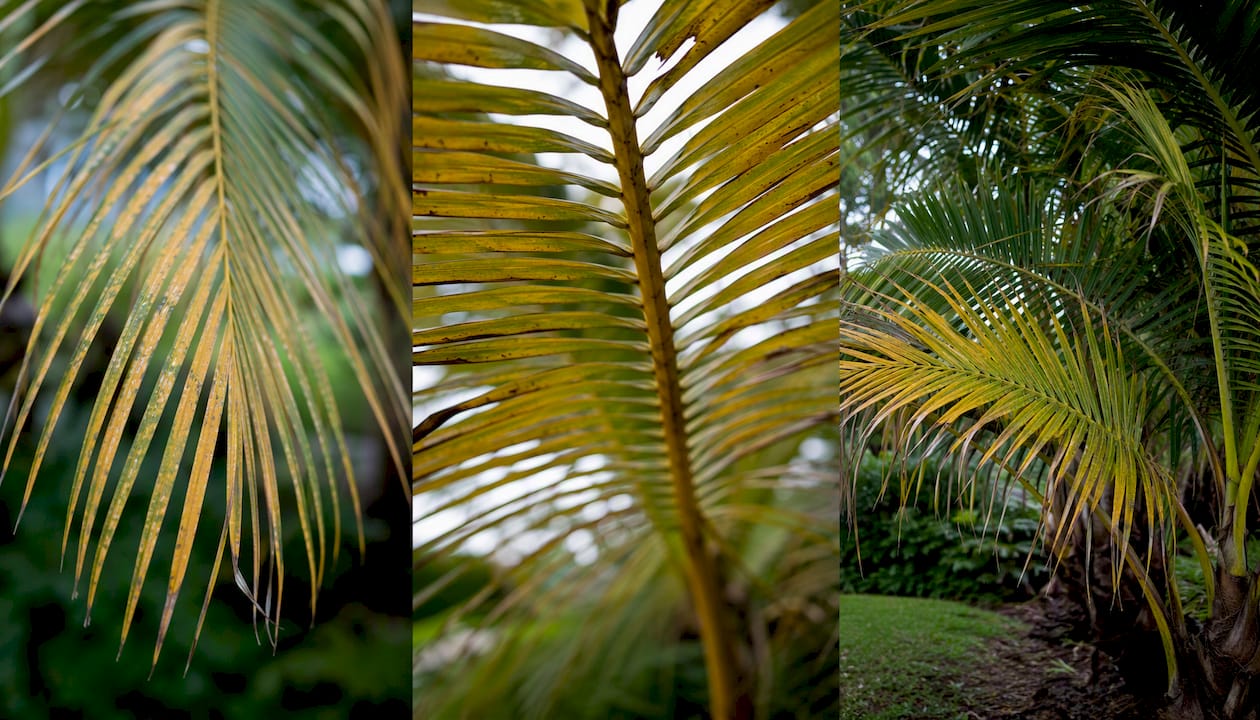
- Oldest fronds yellow first, newer growth stays green: Almost always potassium or magnesium deficiency, or an underlying water issue. This is the most common pattern arborists see.
- Newest fronds and the spear yellow while older ones stay green: Points to manganese or iron deficiency, often tied to soil pH or poor drainage.
- Whole canopy yellows evenly, all levels at once: Usually cold stress, transplant shock, or a sudden root problem rather than a slow nutrient drain.
- Yellow or orange margins with green centers, sometimes necrotic tips: Classic potassium deficiency signature.
- Fine yellow speckling or translucent spots on the leaf surface: Often spider mites feeding on the underside, not a nutrient issue at all.
The pattern matters because nutrients move through a palm differently. Mobile nutrients like potassium and magnesium get pulled from old fronds and shipped to new growth when supply is short, which is why deficiency shows up on the oldest leaves first. Immobile nutrients like iron and manganese can’t relocate that way, so a shortage always shows on the newest tissue instead. This mobility rule is the fastest diagnostic shortcut available to a homeowner standing in their yard.
If you’re sending photos to a professional or posting in a plant forum, get three shots: a close-up of the leaf margin and veins, a shot of the frond’s underside, and a wide shot of the whole canopy. Our unhealthy tree indicators guide breaks down more visual cues that separate a nutrient problem from something structural.
Common Causes of Yellow Palm Leaves
Most yellowing traces back to one of five buckets: nutrients, water, pests, disease, or environmental stress. Here’s how to tell them apart.
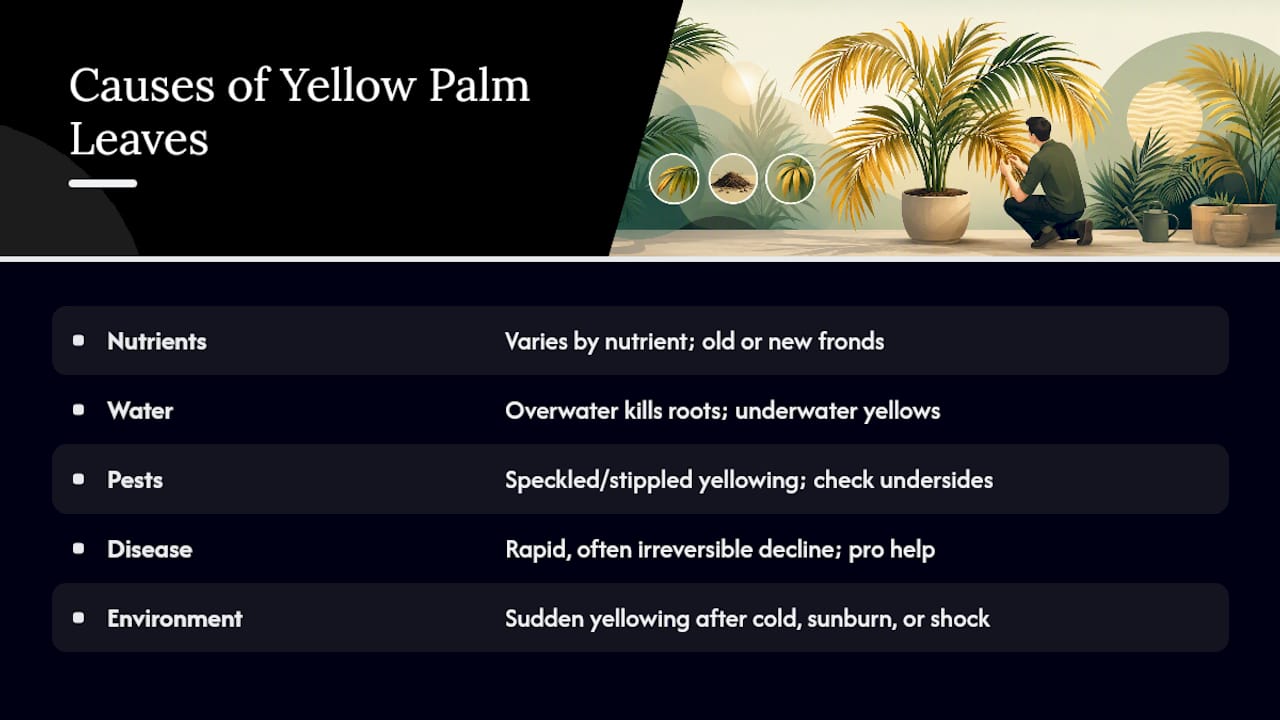
Nutrient deficiencies account for the majority of cases arborists diagnose. Potassium deficiency is the single most common nutritional disorder in palms and typically shows up on the oldest leaves first, often as yellow-orange spotting or tip burn, though the exact look varies by species. Magnesium deficiency produces a wide yellow band along the leaf margin with a green center stripe, also on older fronds. Manganese shows on new growth as weak, frizzled, or streaked leaflets, sometimes called “frizzle top.” Iron deficiency looks similar but stays more uniformly yellow-green on new fronds, usually tied to high soil pH or waterlogged roots. Nitrogen deficiency produces a paler, overall yellow-green canopy rather than a sharp pattern. Boron deficiency is rarer and shows as hooked or stunted new leaves.
Water problems mimic nutrient issues constantly. Overwatered palms suffocate their own roots, which then can’t take up nutrients even when the soil has plenty, and that root decline produces yellowing that looks identical to a deficiency. Underwatered palms wilt and yellow more uniformly across the canopy. Salt buildup, common in potted palms or coastal soil, shows as browning leaf tips first, then progressive yellowing inward.
Pests and disease need a different response entirely. Scale insects and spider mites cause speckled or stippled yellowing you can confirm by checking leaf undersides. Ganoderma butt rot and lethal yellowing disease cause faster, often irreversible decline and need professional confirmation.
Environmental stress like cold snaps, sunburn on a recently exposed palm, or transplant shock can trigger sudden yellowing tied to a specific recent event.
Sandy, fast-draining soils leach potassium and magnesium quickly, while alkaline soils commonly lock up manganese and iron regardless of how much is actually in the ground.
How to Fix Yellow Palm Leaves by Cause
- Fix drainage and watering first. If soil stays soggy, stop watering and check that the root zone actually drains. Overwatering-driven yellowing won’t respond to fertilizer until the roots recover.
- Correct potassium and magnesium with a palm-specific slow-release fertilizer. Formulations like an 8-0-12+4Mg blend, applied several times a year during the growing season, are built for exactly this deficiency pattern. Avoid standard high-nitrogen turf fertilizer, which can worsen potassium deficiency instead of fixing it.
- Address manganese or iron issues with a targeted soil drench or foliar spray, since new-growth deficiencies often respond faster to foliar application while the root system catches up. Epsom salt (magnesium sulfate) can help correct a confirmed magnesium shortfall, but it does nothing for potassium, manganese, or iron problems, so confirm the deficiency before reaching for it.
- Check for scale or mites before treating for nutrients. Wipe a leaf underside with a white cloth. If it comes away with residue or fine webbing, treat with horticultural oil or insecticidal soap first.
- Call a professional if you see trunk lesions or rapid canopy collapse, since those signs suggest root disease that fertilizer can’t touch.
Pro Tip: Start with the lowest labeled rate on any fertilizer product. Over-application builds up salts in the root zone and can cause toxicity that looks a lot like the deficiency you were trying to fix.
Never pull off yellow fronds to “clean up” the tree before treating the actual cause. Removing fronds prematurely strips the palm of nutrients it’s actively recycling from that tissue.
Building a Care Routine That Prevents Yellowing
A little routine maintenance heads off most of the yellowing homeowners deal with; for more on exterior property care and seasonal challenges, check out this homeowner’s guide to Florida exterior cleaning.
- Water deeply and less often rather than a light daily sprinkle, which encourages shallow roots more prone to stress.
- Use well-draining potting mix for container palms, and confirm pots have real drainage holes, not just a saucer.
- Keep a 2 to 3 inch mulch ring around the base, pulled back from the trunk itself.
- Fertilize with a palm-specific slow-release product carrying potassium and micronutrients from spring through early fall, then stop for winter since dormant palms can’t use the extra nutrients anyway.
- Leave fronds on the tree until they’re fully yellow or brown. Our guide on when to trim palm trees in Florida covers exactly how much green tissue to leave and why cosmetic over-pruning backfires.
Pro Tip: Rainy season floods roots and can trigger sudden yellowing that looks nutritional but isn’t. Check drainage before you reach for fertilizer any time yellowing shows up right after heavy rain.
When to Test Soil and Call a Certified Arborist
If a fertilizer round hasn’t shown improvement in new growth after a couple of months, it’s worth confirming the cause with real data instead of guessing again.
- Pull a soil sample from the root zone at 6 to 8 inches deep, and a leaf tissue sample from a mid-canopy frond.
- Send both to a university extension service or a certified soil testing lab, and ask specifically for micronutrient availability, not just total nutrient content, since uptake problems from compacted or poorly aerated soil often mimic an outright deficiency.
- Ask the lab to flag soil pH, since high pH is a common hidden cause of manganese and iron lockup.
Call a certified arborist immediately if you see trunk lesions, conks (shelf fungi) at the base, dieback spreading across multiple fronds at once, or a canopy that’s declining faster than a season would explain. Our Ganoderma palm disease guide walks through what that specific fungal threat looks like.
Set your timeline expectations now: yellow tissue stays yellow, and visible recovery only shows up in new fronds, often taking six months to two years depending on the deficiency.
An Arborist’s Perspective on Patience and Patterns
We check pattern, roots, soil, and pests before ever recommending a chemical fix. Homeowners often want an instant answer, but nutrient corrections show up in new growth over months, not by “greening” the old fronds. A real inspection includes soil probing, a canopy walk, and photo documentation, so have your watering history and any recent fertilizer applications ready when you call one in.
Getting a Professional Diagnosis for Your Palm
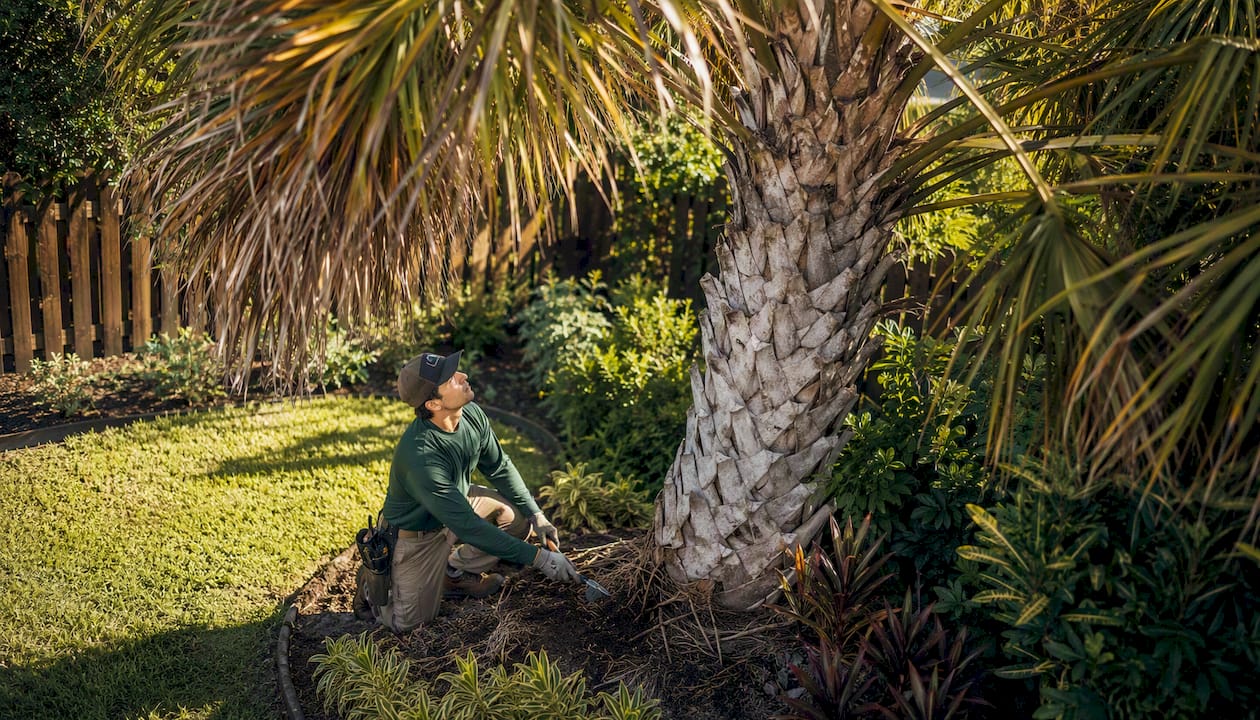
Guesswork with fertilizer costs you time the palm doesn’t have, especially when the real problem is root suffocation or early-stage Ganoderma that no amount of potassium will fix. Mcculloughtreeservice sends a certified arborist to walk your property, photograph the canopy pattern, pull soil and tissue samples when needed, and evaluate the root zone before recommending anything.
A typical visit ends with a written report: the likely cause, prioritized recommendations, and a cost estimate for whatever comes next, whether that’s a fertilizer correction, a drainage fix, or structural trimming to remove dead tissue safely. Hiring a pro makes the most sense when decline spans the whole canopy, when you suspect root disease, or when a soil test comes back with confusing or contradictory numbers. If a palm is beyond saving, our team also handles tree removal so a hazardous trunk doesn’t sit on your property waiting to fail. Request a certified arborist inspection and get a straight answer on what’s actually happening below the canopy.
Sources
- Why Are My Palm Tree Leaves Turning Yellow? 8 Causes and How to Fix
- Palm Nutrition and Fertilization – Gardening Solutions
- Mineral Deficiencies and Toxicities in Palms / UC IPM
- EP273 (IFAS Extension publication) – Palm nutrient symptoms (PDF)
- Why is My Palm Yellow? – UF/IFAS Extension Polk County
Recommended
- Unhealthy Tree Indicators: Expert Tips for Diagnosis
- When to Trim Palm Trees in Florida: A Homeowner’s Guide
- Ganoderma Palm Disease: What Property Owners Must Do
- Signs of a Dying Tree: What to Look For