By: | Published: August 21, 2026
If a tree is on or touching a power line, keep everyone at least 35 feet back, treat every wire as energized, and call 911 immediately if you see sparks, fire, or a downed line blocking a road — and after the storm, consider storm damage restoration services to recover safely and properly. If there’s no active danger but a branch or trunk is resting on the wire, call your electric utility right away instead of 911. Never touch the tree, the wires, or anything connected to either one. Line-clearance work near energized conductors falls under OSHA 1910.269, which is exactly why this isn’t a job for a homeowner with a pole saw. Certified arborists, including crews like Mcculloughtreeservice, train specifically for this kind of hazard.
- Fire, sparks, injury, or a line down across a road: call 911 first.
- Tree resting on a wire with no visible danger: call your utility’s emergency line immediately.
- Stay back at least 35 feet from any downed or sagging line, and assume it’s live even if it looks dead.
Key Takeaways
Safety near a tree touching a power line depends on distance, quick reporting to the right party, and hiring line-clearance qualified professionals rather than a general tree crew.
| Point | Details |
|---|---|
| Stay back, call the right number | Keep 35 feet of distance; call 911 for fire or downed lines, your utility for contact without sparking. |
| Know who’s responsible | Utilities maintain distribution and transmission lines; homeowners usually own service-drop issues. |
| Never DIY near a line | OSHA 1910.269 requires line-clearance training within 10 feet of energized conductors. |
| Plan ahead with setbacks | Match mature tree height to planting distance and inspect trees near lines every 3 to 5 years. |
| Hire certified, insured crews | Mcculloughtreeservice provides ISA certified arborists trained for utility coordination and safe removal. |
Table of Contents
- What to Do When a Tree Is on Power Lines
- Who Pays: The Utility or the Homeowner?
- How to Report a Hazard and What Happens Next
- When Should You Hire a Certified Arborist?
- How Do You Prevent This From Happening Again?
- What Does Removal Near Power Lines Actually Cost and Take?
- What a Certified Arborist Looks for Near Power Lines
- Get a Certified Arborist on the Job Before a Storm Makes the Decision for You
- Frequently Asked Questions
- Sources
What to Do When a Tree Is on Power Lines
The first few minutes matter more than anything else you’ll do in this situation, and the right moves are almost all about restraint.
- Assess from a distance. Look for sparking, smoke, or a wire that’s clearly snapped and lying on the ground. That’s a 911 call, no exceptions.
- If it’s just contact, no fire, no sparks, call your utility’s emergency number. Most electric companies list this on the account portal or the back of your bill.
- Keep people and pets away from the tree, the wire, and anything touching either. Water, wet grass, and metal fences can all conduct electricity if a line is live.
- Warn neighbors if the tree or line crosses a shared property line or sidewalk.
While you wait for a crew, resist the urge to do anything productive. Do not touch the tree, do not bring out a ladder, do not try to cut a branch free, and do not attempt to move a fallen line with a stick or tool of any kind, insulated or not.
You can still be useful. From a safe distance, photograph the tree, the wire, and the surrounding area, and note the exact address or nearest utility pole number. Pro Tip: Keep a running photo log on your phone labeled with the date and time. If the utility or your insurance company asks for a timeline later, you’ll have it ready instead of trying to reconstruct it from memory.
- No DIY trimming near the wire.
- No climbing the tree or a ladder to get a closer look.
- No attempting to drag or lift a fallen branch off the line.
Who Pays: The Utility or the Homeowner?
Responsibility splits along the type of line involved, and that distinction decides who shows up and who gets billed. Transmission lines are the tall towers carrying high voltage across long distances. Distribution lines are the lower poles running down your street. The service drop is the single wire running from the pole to your house.
Utilities generally maintain transmission and distribution lines and the rights-of-way around them, since FERC’s vegetation-management guidance makes clear this work is driven by reliability and safety, not landscaping requests. The service drop to your house is usually your responsibility as the homeowner, similar to how National Grid frames it for its own customers.
- Utilities will typically cut a tree off a main line to restore power.
- Utilities usually will not haul away debris, grind the stump, or repair equipment mounted on your house.
- Near high-voltage transmission corridors, WAPA notes utilities often remove trees rather than repeatedly trim them, since a tall tree can arc voltage or bring a line down entirely.
Pro Tip: Before you call, find your account number and, if you can see it safely from the ground, the pole ID number stamped near the base. It shaves real time off the utility’s response.
How to Report a Hazard and What Happens Next
Give the utility a clear picture the first time you call, so a dispatcher doesn’t have to call back for basics.
What to report:
- Your address or the nearest cross street and pole number.
- Whether wires are down, sparking, or simply resting against branches.
- Photos, if you can safely take them from a distance.
Utilities triage by severity. Fire risk, injuries, and downed lines across roadways jump the queue; a branch quietly resting on a service drop with no active hazard gets scheduled.
- Emergency crews respond first to active danger, often within hours.
- Non-emergency reports get slotted into the utility’s vegetation-management cycle, which can mean days or weeks.
- Storms push everything back. Widespread outages mean your non-urgent branch waits until the emergency backlog clears.
Many utilities, as Eversource explains, will arrange a temporary disconnect on the service drop so a licensed contractor can remove a tree safely. Expect to coordinate that scheduling yourself, and know the utility won’t cover debris hauling once the wire is clear.
When Should You Hire a Certified Arborist?
Any time a tree is within striking distance of a power line, this stops being a weekend project. OSHA’s 1910.269 standard requires specialized line-clearance training before anyone works within 10 feet of an energized conductor at 50 kV or below, and unqualified workers have to keep a wider berth than that. A general tree-cutting crew without that training legally cannot get close enough to finish the job.
Before you hire anyone, ask for:
- An ISA certified arborist credential, not just a business card that says “tree expert.”
- Proof of general liability insurance and worker’s compensation coverage.
- Documented line-clearance training specific to work near energized lines.
- Local business licensing and at least a few verifiable references.
Questions worth asking on the phone before you sign anything:
- Have you coordinated with [utility name] on jobs like this before?
- Will you contact the utility directly, or is that on me?
- Do you request a temporary disconnect, and who arranges it?
- Is debris removal and stump grinding included, or billed separately?
- Can I get a written estimate before work starts?
Insurance usually splits the same way responsibility does. The utility typically repairs its own lines and equipment at no cost to you. Your contractor’s insurance covers damage from the removal itself. Anything involving your house, your fence, or your yard is generally on you. Mcculloughtreeservice works from that same framework, with ISA certified arborist credentials and a documented hazardous tree removal process built around utility coordination rather than guesswork.
How Do You Prevent This From Happening Again?
Most tree-on-power-line calls are preventable years in advance, at the moment someone decides where to plant.
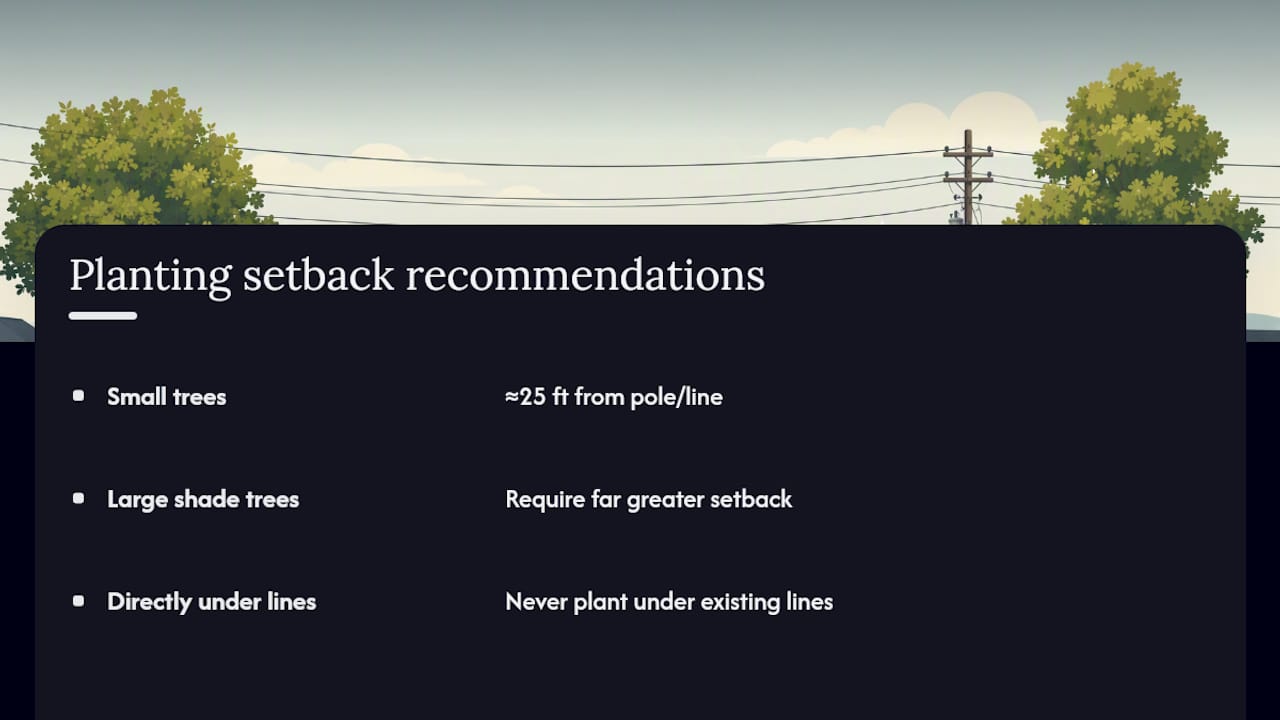
Match the tree to the space. A tree that tops out under 25 feet can go within about 25 feet of a pole or line. Anything that will grow taller, oaks, sycamores, most shade trees, needs far more setback, and nothing should go directly under an existing line regardless of its mature height.
Once a tree is established near a line, inspection matters more than pruning frequency. Walk your yard once a year and look for dead limbs, a noticeable lean, or exposed or damaged roots, any of which can turn a stable tree into a hazard fast. If a tree sits near a distribution line or service drop, bring in a certified arborist for a closer look every three to five years, not just after a storm.
Utilities like Entergy use directional pruning, cutting to encourage growth away from conductors rather than shaping for looks. You can apply the same logic on your own property. Keep sightlines to the pole and your service drop clear, and call the utility before you plant anything near a right-of-way.
Pro Tip: If you’re already planning trim work this year, pair it with hurricane-season prep. A tree that’s structurally sound in June can become a liability after one strong storm surge, and Mcculloughtreeservice’s storm preparation guidance walks through what to check first.
What Does Removal Near Power Lines Actually Cost and Take?
The process generally runs in a predictable sequence, even though the timeline varies with how urgent the hazard is.
- Assessment. A certified arborist evaluates the tree, the line voltage, and accessibility.
- Utility coordination. The utility may de-energize the line or install rubber sleeves so crews can work safely.
- Line-clearance trimming or removal. Only trained crews handle work inside the minimum approach distance.
- Utility repair. If the line itself was damaged, the utility fixes its own equipment.
- Reconnection. If your service drop or weatherhead was affected, power gets restored once everything is cleared.
Cost responsibility tends to follow the same lines as everything else in this guide. Utilities generally absorb the cost of clearing their own main lines, but homeowners commonly pay for service-drop work, debris hauling, stump grinding, and any repair to equipment mounted on the house. Tree size, site access, and whether a crane or traffic control is needed all push costs up or down.
Timeline expectations vary sharply by urgency. Consumers Energy treats active hazards as same-day priorities, while non-urgent vegetation trimming follows a scheduled cycle that can stretch to weeks or months, longer during storm season when crews are stretched thin across the whole service area. One thing utilities almost never cover: hauling debris off your property or grinding the stump once the line is clear.
What a Certified Arborist Looks for Near Power Lines
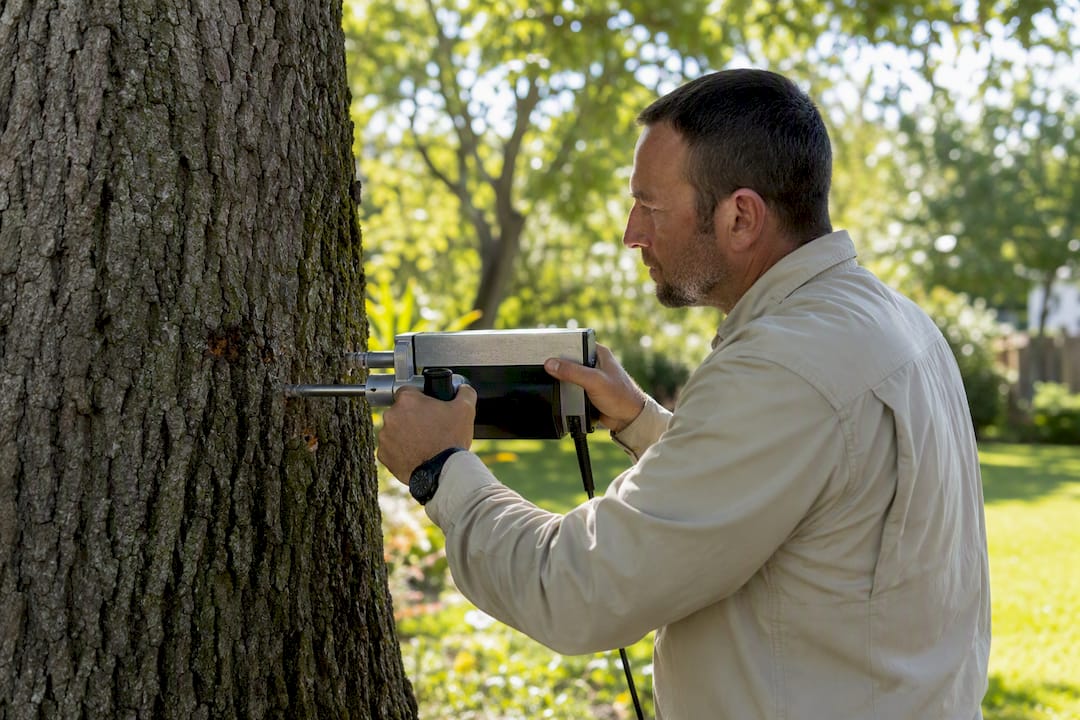
We don’t treat every tree near a line the same way. Species matters. So does lean, visible rot, root damage, and how close the canopy sits to the conductor. A leaning water oak fifteen feet from a distribution line gets a different response than a healthy crepe myrtle brushing a service drop. Voltage and accessibility decide whether we coordinate a utility disconnect before we ever pick up a saw. That judgment call, more than any tool, is what separates a trained crew from a guy with a chainsaw and good intentions.
Get a Certified Arborist on the Job Before a Storm Makes the Decision for You
A tree brushing a power line doesn’t wait for a convenient weekend, and neither should the fix. Mcculloughtreeservice handles the parts of this process that carry real risk: hazardous removal, line-clearance trimming, coordinating temporary disconnects with your utility, and cleaning up the debris a utility crew won’t touch.

Every job runs through ISA certified arborists trained to OSHA’s line-clearance standards, backed by liability insurance and worker’s compensation coverage, so you’re not the one holding the risk if something goes wrong mid-job. If a tree is already resting on your service drop, don’t wait for it to become an emergency. Request an emergency tree removal assessment today, or schedule line-clearance trimming before the next storm turns a manageable problem into a 2 AM phone call.
Frequently Asked Questions
Who do I call if a tree branch is touching a power line but nothing is sparking?
Call your electric utility’s emergency line directly. Reserve 911 for active fire, injury, or a line down across a roadway.
Is a tree on a power line always the utility’s responsibility?
Not always. Utilities generally maintain distribution and transmission lines, but the service drop connecting the line to your house is usually your responsibility as the homeowner.
Can I trim branches away from a power line myself?
No. OSHA 1910.269 requires specialized training to work within 10 feet of an energized conductor, and unqualified work near a line is dangerous even with insulated tools.
Will the utility remove the tree debris after clearing the line?
Usually not. Most utilities clear the line itself but leave debris removal and stump grinding to the property owner.
How long does it take for a utility to respond to a tree on a power line?
Active hazards like sparking or downed lines get same-day emergency response. Non-urgent vegetation issues follow scheduled cycles that can take weeks, longer after major storms.
Sources
These sources back up nearly everything in this guide, and they’re worth bookmarking if you deal with this issue more than once.
- Overhead line work — line‑clearance tree trimming operations | OSHA eTools
- Tree trimming and vegetation management — landowners FAQ | FERC
- Trees and power lines | Western Area Power Administration (WAPA)
Recommended
- Trees Near Power Lines: What Every Homeowner Must Know
- Check Out Our Videos – McCullough Tree Service
- Identify a Dangerous Tree: Signs & Solutions
- Tree Removal – McCullough Tree Service