By: | Published: August 28, 2026
Lichens on trees are not parasites and almost never cause harm; they’re using the bark as a place to live, not as food. If you spot lichen on your tree’s trunk or branches, the right move is usually to do nothing. The exception is when lichen coverage explodes seemingly overnight or your tree shows other signs of decline, in which case a professional tree health assessment is worth requesting.
TL;DR:
- Lichen growth on trees results from slow, non-parasitic colonization that reflects environmental conditions and often indicates good air quality.
- Heavy or sudden increases in lichen coverage, combined with signs like canopy thinning or fungal growth, suggest underlying tree health issues requiring professional assessment.
- Removing lichens is unnecessary and can harm the tree; improving overall tree vigor and pruning dead wood are more effective management steps.
- Chemical treatments and aggressive removal efforts are ineffective since lichens do not harm trees and are protected by current regulations.
- Consulting an arborist is advised when lichen growth coincides with rapid changes in tree condition or structural instability.
Table of Contents
- What Is Lichen on Trees, Exactly?
- What Types of Lichen Grow on Trees?
- Is It Lichen, Moss, or Algae?
- Do Lichens Harm Trees, or Are They Just Along for the Ride?
- Should You Remove Lichen, and How?
- When Should You Call an Arborist About Lichen?
- How Mcculloughtreeservice Evaluates Lichen-Covered Trees
- Why We Push Back on the “Just Scrape It Off” Advice
- Sources
What Is Lichen on Trees, Exactly?
Lichen is not one organism. It’s two, sometimes three, living together in a partnership biologists call symbiosis: a fungus paired with an alga or a cyanobacterium (sometimes both). The fungus builds the structure, called a thallus, and the alga or cyanobacterium photosynthesizes inside it, producing food for both partners. Neither one taps into your tree’s sap, roots, or vascular system to survive.
That’s the key distinction homeowners miss. Lichens pull their water and nutrients straight from the air and rainwater, using bark purely as a landing pad, according to University of Maryland Extension. This is why lichen shows up on fence posts, rocks, and roof shingles just as readily as on tree bark. It needs a stable surface, not a living host to feed on.
Lichens also run on a moisture switch. During dry spells they shrivel, go dormant, and can look gray, crusty, or nearly dead. After rain, they rehydrate within hours and turn green or vivid again as photosynthesis kicks back in, per UMD Extension. Growth is glacially slow, often just a millimeter or two per year, which means the patch on your oak took years, not weeks, to reach its current size.
A few things worth remembering about lichen biology:
- It gets nutrients from the atmosphere, not from the tree’s tissue.
- It cycles between dormant (dry) and active (wet) states.
- It grows at a rate of roughly 1 to a few millimeters annually.
- Many species are sensitive to air pollution, so their presence often signals decent air quality.
What Types of Lichen Grow on Trees?
Lichen identification isn’t complicated once you know what to look for. There are three basic growth forms, and learning to tell them apart takes about thirty seconds of close observation.
- Crustose lichen looks painted onto the bark, flat and tightly fused to the surface, often in gray, white, or pale green patches. It’s the toughest to peel off because it has essentially bonded with the outer bark layer.
- Foliose lichen has a leafy, lobed appearance with visible edges that lift slightly away from the bark, almost like small flattened leaves stuck on with glue. It’s easy to slide a fingernail under the margin.
- Fruticose lichen grows in a shrubby, branching form, sometimes hanging in strands (think of the beard-like lichens you see draped on oak limbs in humid climates). It has the most three-dimensional structure of the three.
Color and texture help too. Gray-green and pale blue-green are the most common shades. Rough, older, or slow-shedding bark tends to host the heaviest lichen growth because the surface stays stable long enough for a colony to establish, per UMD Extension. Smooth-barked or fast-growing trees that shed bark regularly usually carry less. If you’re trying to identify what’s on your tree, a gentle touch test tells you most of what you need: flat and stuck means crustose, leafy and liftable means foliose, branching and bushy means fruticose.
Is It Lichen, Moss, or Algae?
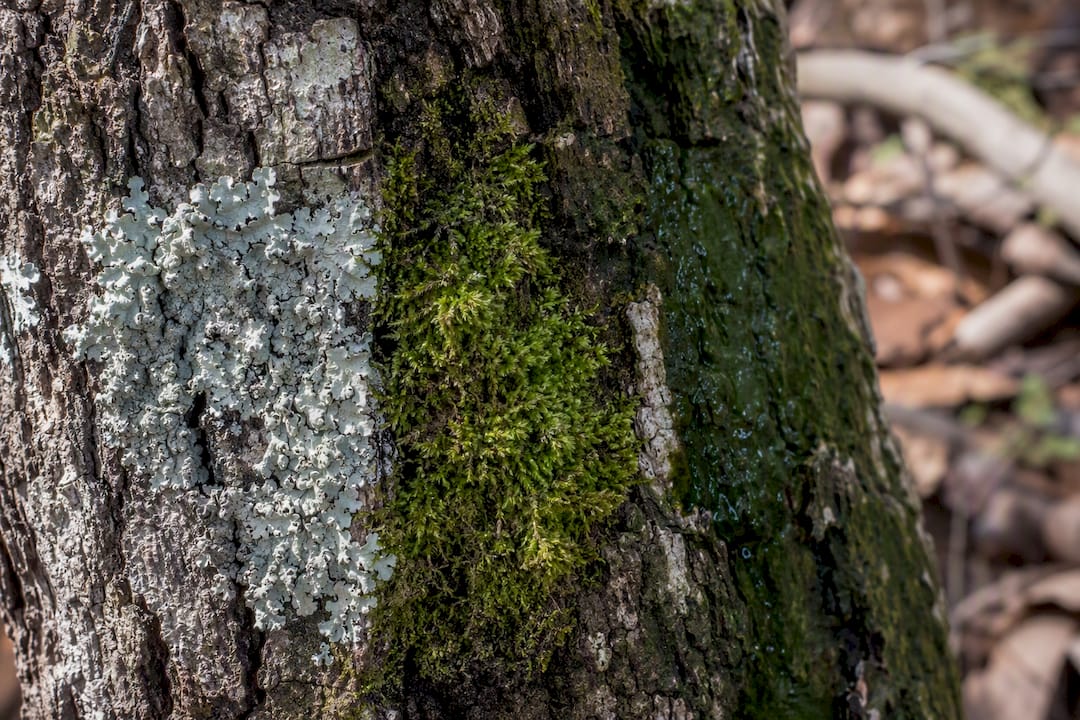
These three get lumped together constantly, and mixing them up leads to the wrong management approach.
Lichen is a fungus-algae partnership with no roots, stems, or leaves, forming the crusty, leafy, or branching thallus described above. Moss is a true plant, non-vascular but still a plant, with tiny stem-and-leaf structures that give it a soft, carpet-like texture rather than a crusty or leafy one. Algae, when it shows up separately on bark, tends to look like a slick greenish or orange-green film, often on the shaded or moisture-retaining side of the trunk.
Here’s why the distinction matters for what you do next:
- Lichen: leave it alone; it’s not competing with the tree for anything.
- Moss: can trap excess moisture against bark in some conditions, and management (like tree demossing) sometimes makes sense for aesthetic or moisture-control reasons.
- Algae: usually a sign of a consistently damp, shaded spot rather than a tree health issue on its own.
Treating a mossy trunk with lichen-removal advice, or vice versa, wastes effort and can misdirect your attention from what’s actually going on with the tree.
Do Lichens Harm Trees, or Are They Just Along for the Ride?
They’re along for the ride. Lichens are not parasites, and extension research is blunt about it: they don’t take nutrients or water from living tree tissue, and no chemicals are labeled for lichen control on trees anywhere in the United States, according to Clemson’s Home & Garden Information Center. There’s simply nothing to spray for, because there’s nothing here that’s attacking the tree.
So why do declining trees so often seem to be covered in it? The lichen isn’t causing the decline, it’s exploiting an opportunity created by it. A thinning canopy lets more sunlight reach the bark, and slower growth means the tree isn’t shedding its outer bark layer as quickly, giving lichen colonies more time to establish and spread, per Rutgers NJAES. Healthy, vigorously growing trees actually shed bark fast enough that lichen struggles to gain a foothold in the first place.
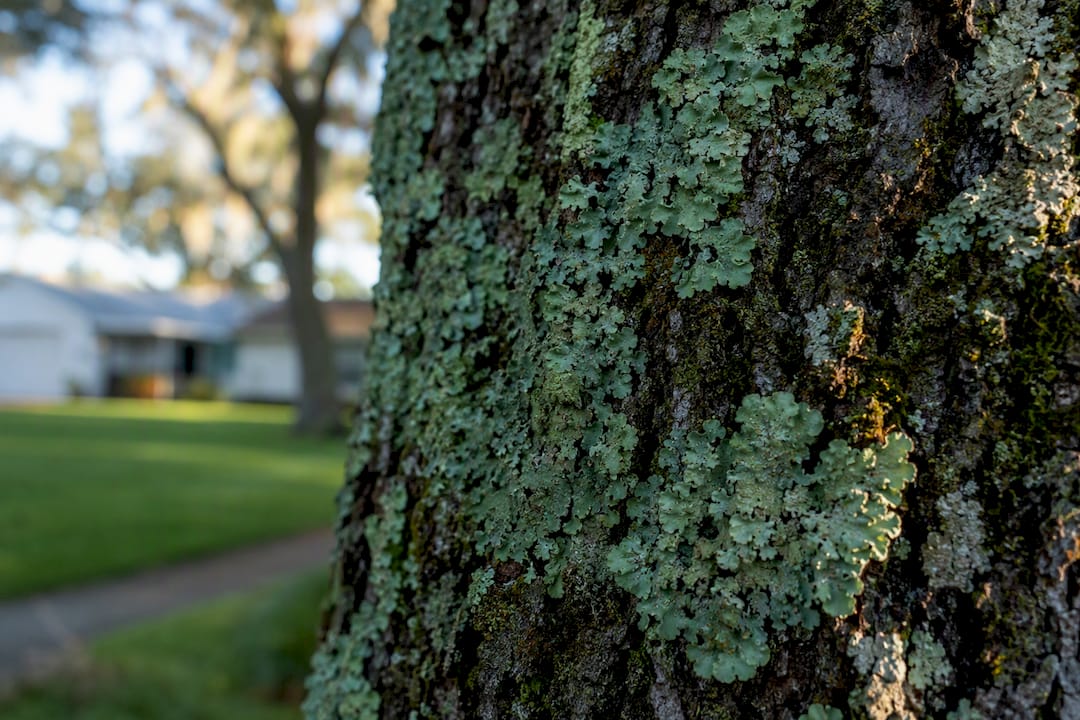
Growth rate context: lichens typically add just 1 to a few millimeters of growth per year. A thick, well-established colony covering large sections of trunk likely represents years, sometimes decades, of relatively stagnant bark turnover, not a sudden infestation.
A few reasons heavy lichen coverage often lines up with older or stressed trees:
- Slower bark shedding gives colonies more time to anchor and expand.
- Thinning canopies let more light reach the trunk, which some lichen species favor.
- Reduced vigor from drought, root damage, or disease tends to slow both bark turnover and new growth, indirectly favoring lichen.
Should You Remove Lichen, and How?
For the vast majority of trees, the answer is no. Extension specialists consistently advise directing your energy toward tree health rather than lichen removal, since the lichen itself isn’t the problem, according to Clemson HGIC. If your tree looks otherwise healthy, full canopy, good leaf color, normal growth, the lichen is cosmetic.
If you still want to address it, or if you’re correcting the underlying stress that let it flourish, here’s the safe sequence:
- Improve tree vigor first. Adjust watering to match the species’ needs, refresh mulch rings (kept away from the trunk flare), and correct any obvious drainage or compaction issues in the root zone.
- Prune dead or declining wood. Removing dead branches improves airflow and light distribution and can be handled through professional tree trimming rather than DIY climbing.
- Use gentle physical removal only if needed. A soft brush or hand removal works on small, accessible patches. Never scrape aggressively or use a pressure washer, since damaged bark opens the door to wood-decay fungi that are a real threat, unlike the lichen itself.
- Skip chemical treatments entirely. No pesticide is labeled for lichen control on trees in the United States, so applying one is both ineffective and potentially harmful to the tree and surrounding plants.
Pro Tip: If you’re tempted to power wash lichen off a shade tree, don’t. You’ll likely strip protective outer bark and create wounds that decay fungi exploit far more readily than any lichen ever would.
When Should You Call an Arborist About Lichen?
Lichen itself never justifies an emergency call. What justifies one are the changes happening around it. Watch for these together with lichen growth, not the lichen alone:
- A noticeable jump in lichen coverage over a single season rather than gradual spread over years.
- Canopy dieback, thinning leaves, or branches that fail to leaf out in spring.
- Mushroom-like fungal growths at the trunk base or on major roots, a possible sign of internal decay.
- Soil heaving, exposed roots, or a trunk that seems to rock at the base.
A certified arborist evaluates the whole picture: canopy density and color, root flare and soil conditions, pest and disease signs, and structural stability, not just the bark surface. That workflow catches signs of a dying tree long before they become obvious to an untrained eye, and it tells you whether the tree needs targeted pruning, soil correction, or simply time.
How Mcculloughtreeservice Evaluates Lichen-Covered Trees
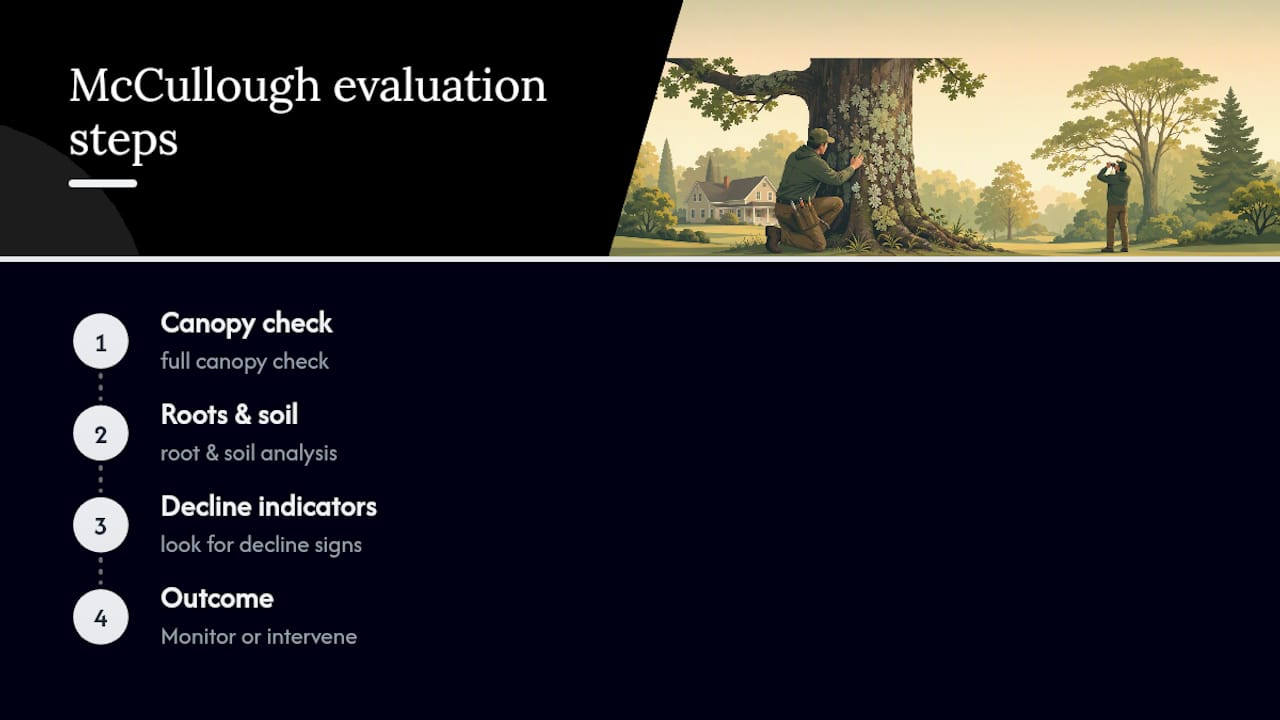
Mcculloughtreeservice’s certified arborists treat lichen as a clue, not a diagnosis. A standard visit includes a full canopy evaluation, a check of root and soil conditions, and a look for the actual unhealthy tree indicators that matter. If the tree checks out, the recommendation is simple: monitor it. Intervention only happens when the inspection turns up real decline.
Why We Push Back on the “Just Scrape It Off” Advice
The most common bad advice about lichen is also the most satisfying to act on: grab a wire brush and scrub the trunk clean. It feels productive. It’s also backwards. You’re spending effort on the one part of this equation that was never a threat while ignoring the part that might be.
The extension research on this is remarkably consistent across institutions in Maryland, South Carolina, New Jersey, and beyond, and that consistency is itself worth noting. When multiple university extension programs converge on the same conclusion using different research, that’s a strong signal, not a coincidence.
What gets underrated is the diagnostic value of lichen. A sudden explosion in coverage is slow-growing evidence, quite literally, given how many years it takes to accumulate a heavy colony, that something changed in your tree’s growth pattern years before you noticed. Treat it as an invitation to look closer at soil, water, and canopy health, not as a target for removal. If you want that closer look done properly, request a tree health assessment and let an arborist tell you what the lichen is actually pointing at.
— Results
Sources
For readers who want the primary research: Clemson HGIC debunks the lichen-kills-trees myth directly, University of Maryland Extension covers identification and biology in depth, and Rutgers NJAES explains lichen’s role as an air-quality indicator.
- Gardening myths: Lichens kill trees | HGIC (Clemson)
- Lichen, algae, and moss on trees | University of Maryland Extension
- Tree-dwelling lichens | Rutgers NJAES
Recommended
- Certified Arborist
- Identify a Dangerous Tree: Signs & Solutions
- Why Hire an Arborist in 2026: What You Must Know