By: | Published: September 1, 2026
If tree roots are damaging your driveway, stabilize any trip hazards right away and get a certified arborist to assess the tree before you touch a shovel or call a paving crew. Don’t cut large roots yourself. Fix the root problem first, whether that’s targeted pruning, a root barrier, or removal, then repair the surface. Repaving before addressing the roots almost always means paying for the same fix twice.
TL;DR:
- Address root damage before repaving, as failing to do so often results in repeated repairs and ongoing structural issues.
- Roots grow toward moisture and loose soil under driveways, causing heaving and cracking in concrete, asphalt, and pavers, especially during moisture cycles.
- Inspection should focus on cracks running toward trees, visible roots near the surface, and soil probing; avoid DIY work on roots thicker than two inches or near utilities.
- A certified arborist can map root systems, assess tree health, and recommend targeted pruning, barriers, or removal, ensuring long-term driveway stability.
- Choosing species with deep root systems and installing proactive root barriers during planting helps prevent future driveway damage and reduces repair costs.
Table of Contents
- How Tree Roots Cause Driveway Damage
- How to Inspect and Map Driveway Root Damage
- Assessing Severity and Deciding When to Call an Arborist
- Root Control and Surface Repair Options
- Preventing Future Tree Root Damage to Your Driveway
- Should You Save the Tree or Prioritize the Driveway?
- How a Certified Arborist Approaches Driveway Root Conflicts
- What Homeowners Consistently Get Wrong About Root Damage
- Get a Professional Assessment Before You Repair Anything
- Sources
How Tree Roots Cause Driveway Damage
Roots don’t attack driveways on purpose. They grow toward whatever combination of moisture, oxygen, and loose soil is easiest to exploit, and a compacted driveway base packed against soft, watered turf is exactly that. The area under a slab often stays cooler and more consistently damp than open yard soil, which draws feeder roots and eventually larger structural ones straight underneath it. Once a root wedges under a hard surface, it doesn’t stop growing. It thickens every year, and that steady radial growth is what generates the upward force known as heaving.
Different driveway materials fail in different ways once a root gets underneath them.
- Poured concrete tends to crack in defined lines and lift in whole panels, because the slab has almost no flexibility.
- Asphalt is more forgiving early on, bulging into a hump rather than cracking outright, but it eventually splits once the root gets thick enough.
- Pavers shift individually, so you’ll see corners popping up or gaps opening between units, but the surrounding units usually stay intact and reusable.
Soil moisture swings make everything worse. In the wet season, expansive clay and organic soils absorb water and swell, adding pressure on top of what the root is already doing. During dry stretches, the same soil contracts, and gaps form beneath the slab that let it settle unevenly the next time weight is applied. Add a poorly compacted base, which is common on older residential driveways, and you get a surface that was already vulnerable before a single root arrived. That combination, an aggressive root, an unstable base, and moisture cycling, is what turns a small trip hazard into a driveway that needs full panel replacement within a couple of seasons.
How to Inspect and Map Driveway Root Damage
You can safely gather most of the evidence yourself before calling anyone. Work through this in order, and stop the moment you hit something that looks structural.
- Walk the full length of the driveway in daylight and mark every ridge, lifted corner, or crack with chalk or spray paint. Photograph each spot next to a tape measure so you have a record of how much it changes over time.
- Trace the cracks back toward the nearest tree. Cracks that run in a fairly straight line from a trunk toward the driveway edge, or that repeat at a consistent spacing, are a strong indicator of a root running underneath rather than settling from poor drainage.
- If you have a paver or brick section, gently lift one displaced unit near the worst spot. This lets you look at what’s underneath without any real digging. Seeing a visible root within a few inches of the surface confirms what you already suspected.
- Probe the soil at the driveway edge with a small hand trowel, not a shovel, to feel for root mass just beneath the surface, and note the approximate diameter of anything you find.
- Stop immediately if you uncover a root thicker than about two inches, if it’s within a few feet of the trunk, or if you hit anything that could be a utility line. That’s the point where a certified arborist needs to take over, both for your safety and the tree’s.
Cracks that appear randomly across the whole driveway, with no relationship to nearby trees, usually point to base failure or drainage problems instead of roots. It’s worth ruling that out before you assume every crack is root related.
Assessing Severity and Deciding When to Call an Arborist
A few red flags mean you should stop DIY diagnosis and call a certified arborist immediately: roots thicker than two to three inches near the trunk, any sign the tree itself is declining (thinning canopy, dead branches, fungal growth at the base), or a crack that’s widened noticeably in a matter of weeks rather than months. Roots that large are usually structural, meaning they help anchor the tree, and removing them without professional judgment carries unpredictable risk to the tree’s stability, especially in regions that see regular high wind events.
A proper professional assessment goes well beyond eyeballing the cracks. An arborist will map where the major roots actually run, often using air excavation or careful hand digging instead of a shovel or mini excavator, since aggressive digging can sever fine feeder roots the tree depends on. They’ll evaluate the tree’s overall health and stability, then lay out real options with the tradeoffs spelled out: what happens if you prune a specific root, what a barrier buys you in time, and what full removal would cost against ongoing repair.
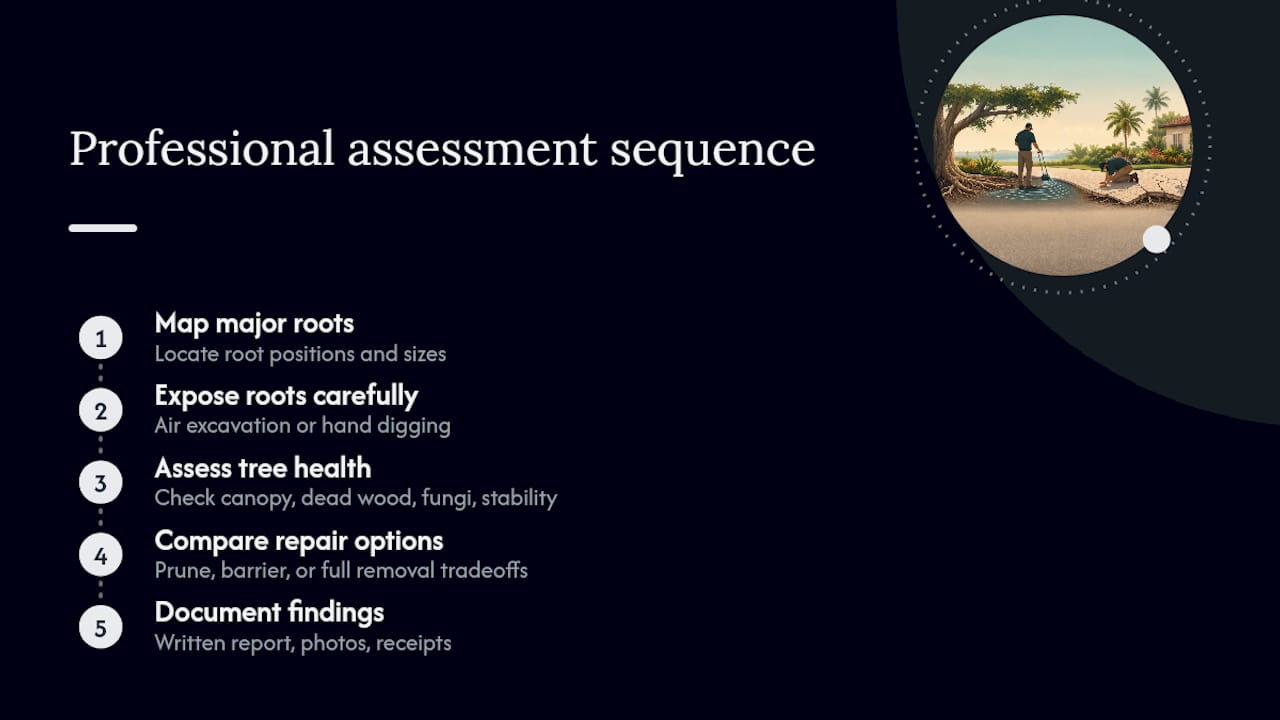
That written assessment is also worth keeping on file even if you’re not currently in a dispute. If a shared property line is involved, or your municipality requires a permit before major root work near a protected species, dated photos and a professional report are what settles disagreements. Save receipts and reports together. A neighbor dispute over a root that crossed a property line, or a permit review for removing a heritage tree, moves a lot faster with documentation than with a verbal description of “it’s been getting worse.”
Root Control and Surface Repair Options
The order matters more than the method. A reliable workflow for this kind of problem is inspect the root system, choose a root control approach, then repair the surface in that order. Skip straight to repaving without dealing with the root, and you’re very likely paying for the same repair again within a few years.
Root control comes first, and it has three realistic paths:
- Selective root pruning. Removing smaller, non-structural roots is usually low risk, but cutting more than a fraction of a large tree’s root mass without a plan is where things get dangerous for the tree’s stability. Deep knowledge on this is consistent: management strategies should favor redesigning the hardscape over cutting a substantial portion of root mass near the trunk without an arborist-guided plan.
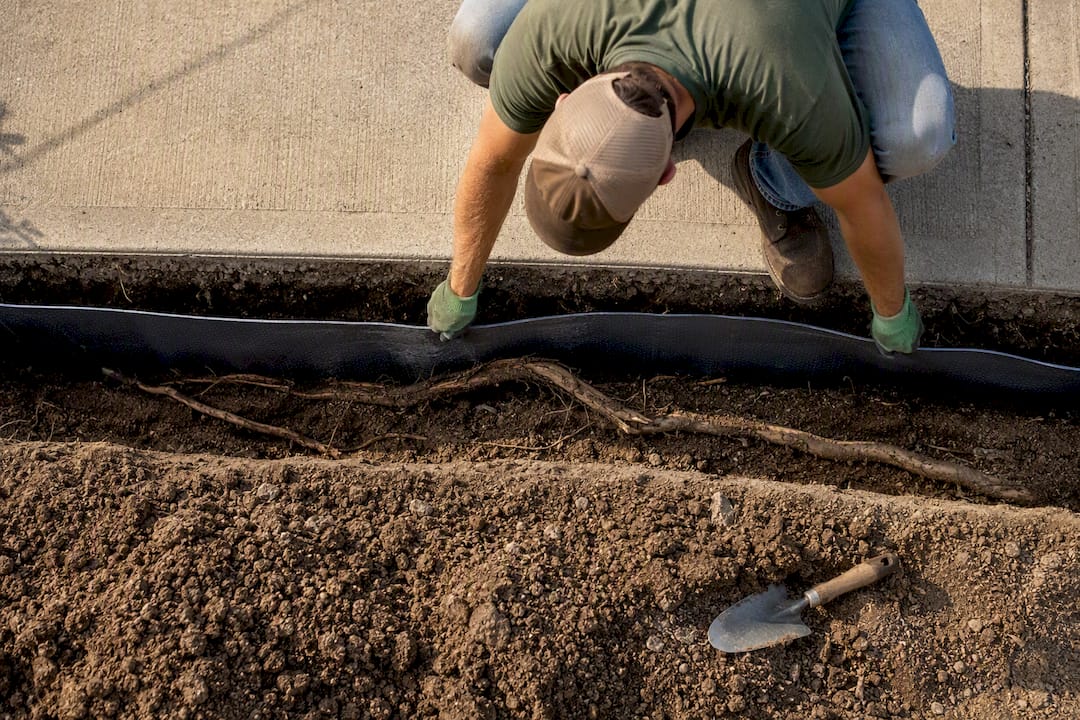
- Root barriers. Physical barriers installed alongside the driveway redirect new root growth downward or away from the surface. They work, but they’re a delaying tactic, not a permanent fix. Barriers buy time and need correct placement depth paired with sensible surface design, not a standalone solution you install and forget.
- Stump grinding or full removal. When a tree’s root system is already too large or too close to be managed any other way, removal followed by stump grinding clears the way for a genuinely permanent driveway fix. This is the option that trades the tree for long-term surface stability, and it’s often the right call when the tree is already declining or the root conflict is severe.
Surface repair follows, and the right method depends on both material and how much root activity remains:
- Relaying pavers is the least invasive option, since individual units lift out, the base gets releveled, and the same pavers usually go back down.
- Localized panel replacement works for concrete when only one or two sections are affected and the rest of the slab is sound.
- Asphalt patching handles smaller bulges and cracks but won’t hold if a root underneath is still actively growing.
- Full slab or driveway replacement becomes the realistic option once damage is widespread or the base itself has failed.
One repair mistake shows up constantly: pouring new concrete directly over a root you’ve already cut or one that’s still present. Large roots can take years to decompose, and as they break down underground, they leave voids that cause the new slab to settle unevenly, sometimes worse than the original damage. Skip the shortcut and either remove the root properly first or design around it.
Pro Tip: Get a written scope before any surface work begins, and confirm in writing whether root control was performed first. A contractor who quotes a driveway repair without ever mentioning the tree is setting you up for a repeat job.
Warranty realities follow the same logic. A paving contractor’s warranty on a slab poured over an unresolved root is close to meaningless, because the root, not the workmanship, causes the next failure. Combined root control plus surface repair, done in the right order, is what actually gets you a driveway that lasts a normal service life rather than three or four years.
Preventing Future Tree Root Damage to Your Driveway
Prevention is cheaper than any repair on this list, and it starts before you plant anything. Species matters more than most homeowners realize. Trees with aggressive, shallow, spreading root systems (many maples, willows, and some fig varieties) are far more likely to cause hardscape conflicts than species with deeper, less lateral root habits like most oaks and many ornamental pears.
- Match species to available space. A tree that naturally wants a 40 foot canopy spread shouldn’t go in a 15 foot side yard next to the driveway.
- Follow minimum planting distances when you can. A rough rule many arborists use is planting distance roughly equal to the tree’s expected mature height, though smaller lots often require compromise; in that case, lean toward smaller-statured species instead of shrinking the distance on a large one.
- Plan for root barriers at planting time, not after damage appears. Installing one proactively along the driveway edge is far cheaper than retrofitting one after excavation and repair.
- Improve drainage before it becomes a driveway problem. Grading that channels water away from both the tree’s root zone and the driveway base reduces the moisture swings that accelerate heaving.
- Consider segmented paving or a tree well design near existing trees. Design choices like segmented paving, raised platforms, and tree wells let you keep hardscape close to a tree while giving roots room to move without lifting a rigid surface.
For driveways with existing surface wear unrelated to roots, routine driveway maintenance practices around sealing, drainage, and base care extend the life of any repair you make, root related or not.
If you’re retrofitting an established property rather than planting fresh, a root barrier installed along the problem stretch combined with proper base preparation on the new surface is usually the most cost-effective middle ground between doing nothing and removing a healthy, otherwise valuable tree.
Should You Save the Tree or Prioritize the Driveway?
Some situations genuinely come down to a binary choice, and pretending otherwise wastes money on repairs that won’t hold. Run through this before committing to a direction:
Cost. Repeated partial repairs on a driveway with an active root problem often add up to more than a single removal and rebuild within five to ten years. If you’ve already repaired the same section twice, that’s a strong signal removal may be the more economical long-term path.
Safety and permits. A declining tree with exposed structural roots near a driveway used daily is a liability question, not just a cosmetic one. If the tree shows canopy dieback, fungal growth, or lean, that tips the decision toward removal regardless of cost, and many municipalities require documentation either way before major root work or removal near a protected species.
Tree value. A mature shade tree that cools a home and adds real property value deserves more effort to preserve than a fast-growing, short-lived species that was a poor planting choice from the start.
Pro Tip: Write your reasoning down before you decide, even in a simple note: what the arborist found, what it would cost to repair versus remove, and why you chose the path you did. That record protects you in any future neighbor or insurance conversation.
How a Certified Arborist Approaches Driveway Root Conflicts
McCullough Tree Service handles this exact conflict regularly across Central Florida properties, where fast-growing species and shallow water tables make root related driveway damage especially common. As certified arborists, the team’s process for a case like this typically starts with a site visit to map root location and size, assess overall tree health, and identify whether structural roots are involved before recommending any cutting.
From there, the deliverable is a phased plan: root management first (targeted tree trimming or root work where appropriate), then a clear recommendation on whether the tree can be preserved or whether stump grinding and removal makes more sense given the tree’s condition and the extent of driveway damage. Homeowners get a documented assessment they can hand to a paving contractor, so the surface repair is designed around what’s actually happening underground instead of guessing.
What Homeowners Consistently Get Wrong About Root Damage
The biggest misjudgment in root and driveway problems isn’t ignorance about roots. It’s underestimating how fast a “small crack” becomes a structural problem once you factor in Florida’s wet season swings and how quickly certain species pack on root diameter in a single growing season. Homeowners wait for a second or third crack before calling anyone, by which point the cheap fix, selective pruning or a barrier, is often off the table.
The conventional advice to “just repave it” also deserves more skepticism than it gets. Repaving without addressing the root is a temporary cosmetic fix dressed up as a permanent one, and it tends to fail on the same timeline as the first repair. The research on this is consistent: sequence matters more than material choice.
What actually deserves priority is the assessment step, not the repair step. Get the root situation mapped and understood first. Every good decision downstream, whether that’s a barrier, selective pruning, or removal, depends on information you don’t have until an arborist has looked underground.
— Results
Get a Professional Assessment Before You Repair Anything
McCullough Tree Service gives Central Florida homeowners something a paving contractor alone can’t: a certified arborist’s read on what’s actually happening underground before a single yard of concrete or asphalt goes down. That sequence, root assessment first, surface repair second, is what keeps you from paying for the same fix twice.
When you request an estimate, expect a site visit where the team inspects the tree, maps root location and severity, and lays out real options, whether that’s targeted root management, stump grinding after removal, or a phased plan that protects a tree worth saving. You’ll get a documented assessment you can act on immediately or hand straight to a paving contractor. If the driveway damage is severe enough that removal is the more sensible long-term path, the tree removal process is handled start to finish, cleanup included. Schedule a site assessment with McCullough Tree Service and find out exactly what’s happening under your driveway before you spend a dollar on repairs.
Sources
- Nola
- Can You Fix Concrete On Tree Roots: Help, I Poured Concrete Patio Over Tree Roots Accidentally | Gardening Know How
- Concrete Patio Around Trees: Safe Design Guide
- Tree roots damaging driveways: your options in Sydney
Recommended
- Tree Roots in Your Sewer Line: Fix It for Good
- Tree Trimming in Florida: DIY Tips & Tricks
- Role of Arborists in Landscaping Success for Florida
- Tree root management: protect your property and trees