By: | Published: September 7, 2026
Sabal palm, live oak, baldcypress, gumbo limbo, and southern magnolia consistently rank as the toughest performers in post-storm surveys across Florida. Species choice matters, but where and how a tree is planted matters just as much: correct siting, enough root space, and structural pruning decide whether a strong species actually stays standing. If you’re unsure about a large or aging tree on your property, get a certified arborist to look at it before hurricane season, not after.
TL;DR:
- Native species like sabal palm, live oak, and baldcypress consistently outperform many exotic trees in hurricane resilience due to their flexible wood and deep root systems.
- Proper siting, adequate root space, and structural pruning are critical factors that influence a tree’s ability to withstand strong winds, regardless of species.
- Grouping trees and mixing species can improve wind resistance and reduce the risk of catastrophic failure during storms.
- Species with shallow roots, brittle wood, or rapid growth like queen palm, melaleuca, and Australian pine tend to have higher failure rates post-storm.
- Engaging a certified arborist for pre-storm assessments and proper planting or pruning can significantly increase a tree’s storm resilience and protect property.
Table of Contents
- Top Hurricane-Resistant Trees for Florida
- How to Choose the Right Hurricane-Resistant Tree for Your Site
- Planting and Pruning Steps That Increase Wind Resistance
- Which Trees and Planting Mistakes Increase Hurricane Risk?
- When to Hire a Certified Arborist: What to Expect
- What Are UF/IFAS’s Highest-Rated Wind-Resistant Species?
- How Fast Do These Trees Grow, and How Big Do They Get?
- Should You Group Trees Together to Reduce Storm Damage?
- Are Native Trees Really More Hurricane-Resistant Than Non-Natives?
- Protecting Trees Without Sacrificing Your Canopy
- Get Your Property Storm-Ready with McCullough Tree Service
- Sources
Top Hurricane-Resistant Trees for Florida
UF/IFAS has spent decades surveying tree damage after major storms, and the pattern holds up across hurricanes as different as Andrew, Ivan, and Michael. Some species shed limbs and keep standing. Others snap at the trunk or uproot entirely. The list below reflects UF/IFAS wind-resistance rankings, which grade species from highest to lowest based on measured survival and expert field ratings.
Sabal palm (Sabal palmetto) tops nearly every list, and for good reason. Florida’s state tree bends dramatically in high wind without breaking, and even when it loses most of its fronds, the terminal bud at the crown stays protected. That single growing point is the palm’s entire survival strategy. As long as it’s intact, the tree recovers. Sabal palms tolerate salt spray, drought, and poor soil, which makes them a reliable choice for coastal yards and inland lawns alike. They grow slowly to 40 to 60 feet and need very little rooting space compared to a broadleaf tree of similar height.
Live oak (Quercus virginiana) is the workhorse of Florida’s storm-resistant canopy. Live oaks can reach 60 to 80 feet with a canopy spread just as wide, so they need serious room to mature. They handle both coastal salt exposure and inland clay soils, which is part of why you see them anchoring old neighborhoods across the state.
Baldcypress (Taxodium distichum) is arguably underused in residential landscaping given its performance record. The species evolved in wet floodplains, so it handles Florida’s saturated soils during storm season better than almost anything else on this list. It grows tall and narrow, 50 to 70 feet, with a flared trunk base that anchors it firmly. It’s not salt tolerant, so keep it away from brackish coastal sites.
Gumbo limbo (Bursera simaruba) is a south Florida native sometimes called the “tourist tree” for its peeling red bark. It’s flexible-wooded and drops leaves readily in high wind, shedding load rather than fighting it. UF/IFAS surveys found native species like gumbo limbo held up better than many exotic ornamentals in south Florida storms. It tops out around 30 to 40 feet, tolerates salt air well, and fits comfortably into smaller coastal lots.
Southern magnolia (Magnolia grandiflora) brings dense wood and a naturally strong branch structure to the list, though it grows large, often 60 to 80 feet with a wide canopy. For smaller properties, the Little Gem cultivar caps out around 20 to 25 feet while keeping the same structural strength, making it a practical substitute where a full-size magnolia won’t fit.
Sand live oak (Quercus geminata), a close relative of live oak often found on coastal dunes and sandy inland ridges, showed some of the highest survival rates recorded after Hurricane Ivan. It tolerates drought and sandy soil better than standard live oak and rarely exceeds 40 feet, which makes it a strong fit for beachside properties with limited planting space.
Sea grape (Coccoloba uvifera) is built for exactly the punishment coastal Florida delivers. Thick, leathery leaves and a low, sprawling form let it shrug off salt spray and wind that would shred more delicate foliage. It typically stays under 25 feet in residential settings and works well as a windbreak planted in groups along a property line.
Crape myrtle (Lagerstroemia indica) doesn’t have the raw wind rating of a live oak, but its small mature size, usually 15 to 25 feet, and flexible branching keep damage minor even in strong gusts. It’s a smart pick for tight urban lots and areas near power lines where a large canopy tree isn’t practical.
Dahoon holly (Ilex cassine) is a native that tolerates wet soil and moderate salt exposure, growing to about 30 feet with a narrow, upright form. It rarely causes storm damage precisely because it stays modest in size and density.
Slash pine (Pinus elliottii) rounds out the list as Florida’s most storm-adapted conifer. It has deep taproots and flexible trunks suited to sandy, well-drained soil, though it performs best away from dense residential clusters where falling limbs could reach structures.
- Sabal palm: highest wind rating, tolerates salt and drought, slow growth to 40 to 60 feet
- Live oak: 91% survival in Hurricane Ivan surveys, needs wide canopy space
- Baldcypress: up to 95% survival in some storms, thrives in wet soil, avoid salt exposure
- Gumbo limbo: strong native performer in south Florida, sheds leaves under wind load
- Southern magnolia: dense wood and strong structure, Little Gem cultivar for smaller yards
- Sand live oak: excellent coastal and sandy-site performer, compact at 40 feet
- Sea grape: built for salt spray, ideal as a coastal windbreak
- Crape myrtle: small size limits damage potential, good for tight lots
- Dahoon holly: tolerates wet soil, modest size keeps risk low
- Slash pine: deep taproot system, best sited away from structures
How to Choose the Right Hurricane-Resistant Tree for Your Site
Picking a species from a list is the easy part. Matching that species to your actual yard is where most landscaping mistakes happen. Start with the soil. Compacted clay, poor drainage, or a planting strip squeezed between a driveway and a fence will undercut even the toughest species on the UF/IFAS rankings.
Rootable soil volume is the factor most homeowners skip entirely. UF/IFAS research recommends roughly 3 by 3 meters of unobstructed soil for small trees and up to 10 by 10 meters for large canopy trees like live oak or southern magnolia. A tree squeezed into a narrow strip between sidewalk and street, no matter how storm-hardy the species, is fighting with one hand tied behind its back when 100 mile-per-hour winds arrive.
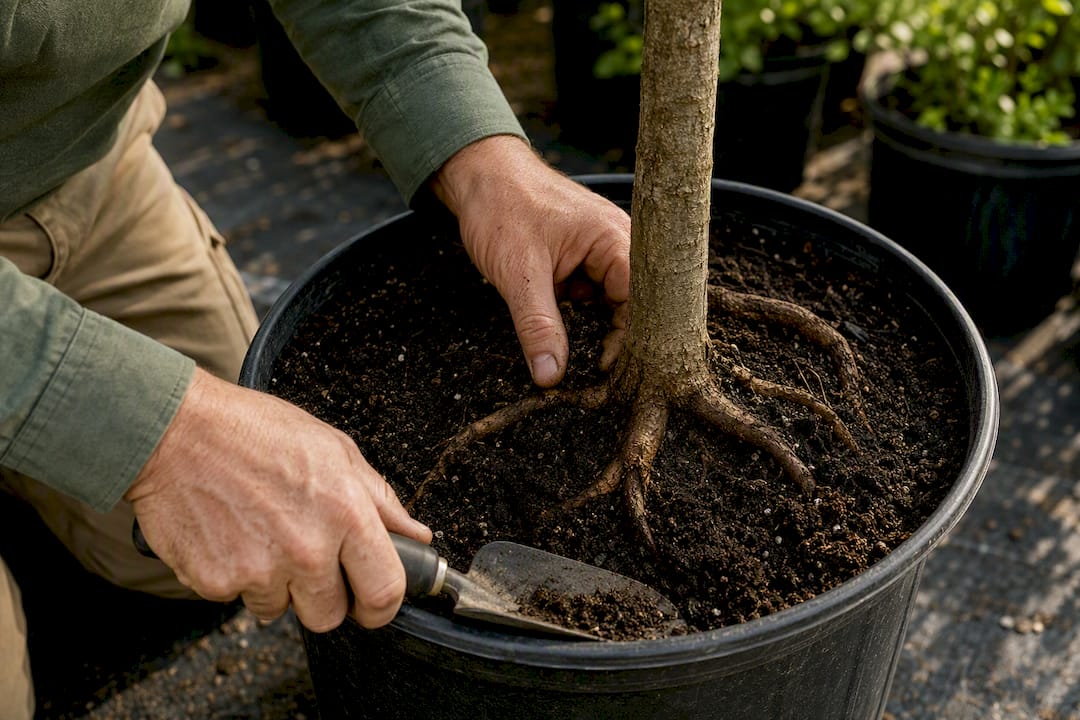
At the nursery, inspect before you buy. Look for a trunk that flares naturally at the base rather than going straight into the soil like a pole, which often signals the root flare is buried too deep in the container. Check for a single dominant leader instead of competing co-dominant stems. Gently probe the top few inches of soil in the pot for circling or kinked roots, a defect that will eventually strangle the tree or leave it prone to toppling.
Mixing species and planting in loose groups rather than a single showpiece specimen also pays off. If one tree in a cluster fails, the others usually still stand, and group plantings genuinely increase collective wind resistance compared to isolated trees standing alone against full wind exposure.
Before you commit to a purchase or hire a crew to plant, run through this short checklist:
- What is the tree’s mature height and canopy spread, and does my planting site actually have that much clear space above and below ground?
- Is the rootable soil area at least the minimum UF/IFAS recommends for this tree’s eventual size?
- Does the trunk show a single central leader, or will it need corrective pruning early to prevent a weak, split structure?
- Is this species salt tolerant, if my property sits within a few miles of the coast?
- Will nearby structures, power lines, or other trees restrict its canopy as it matures?
Pro Tip: Take a photo of the root ball before backfilling any planting hole. If you ever suspect the tree is declining years later, that photo helps an arborist judge whether it was planted too deep, a common and often invisible cause of slow decline.
Planting and Pruning Steps That Increase Wind Resistance
Storm resistance starts at planting, not at pruning time. Dig the hole only as deep as the root ball and at least twice as wide, keeping the root flare, where the trunk widens at its base, level with or slightly above the surrounding soil. Trees planted even a few inches too deep develop weaker root systems and are measurably more prone to toppling in saturated ground.
Skip the temptation to stake rigidly for months on end. A short staking period, generally no more than one growing season, lets the trunk flex slightly and build the trunk taper and root strength it needs. Mulch three inches deep in a ring around the base, but keep it off the trunk itself, and water deeply and infrequently rather than a quick daily sprinkle. Deep watering pushes roots downward instead of keeping them shallow and vulnerable.
Structural pruning is where most homeowners either win or lose the storm-resistance battle. UF/IFAS Extension guidance recommends training young trees toward a single dominant leader with well-spaced scaffold branches, starting within the first two to three years after planting.
- Remove crossing, rubbing, or weakly attached branches while the tree is young and cuts are small.
- Avoid lions-tailing, stripping interior branches and leaving foliage only at limb tips, which increases wind load on branch ends and weakens the whole structure.
- Watch for V-shaped, tight branch unions instead of wide U-shaped ones; V-crotches are a known failure point in high wind.
- Schedule a structural inspection every two to three years for young trees, and annually for mature trees over 30 feet.
Large trees, anything over roughly 15 feet, or any tree showing signs of trunk decay, dead wood, or a lean that’s gotten worse, is a job for a certified arborist rather than a homeowner with a pole saw. Climbing gear, rigging, and the judgment to read internal decay are not optional extras on a 40-foot oak.
Pro Tip: If a storm just passed and a tree looks ragged but is still standing, resist the urge to “clean it up” immediately. UF/IFAS advisories note that aggressive post-storm pruning can reduce a stressed tree’s ability to recover by cutting into its remaining energy reserves. Wait, assess, and let a professional guide the timing.
Which Trees and Planting Mistakes Increase Hurricane Risk?
Some species show up on the wrong end of UF/IFAS survival data again and again. Queen palm, melaleuca, Australian pine, sand pine, and laurel oak have all posted poor survival numbers in post-hurricane surveys, and the failure patterns are consistent: shallow or weak root systems, brittle wood, or rapid growth that outpaces trunk strength. Australian pine in particular is notorious for uprooting wholesale in saturated soil, taking large sections of root plate with it.
Species aside, certain site conditions raise risk regardless of what’s planted. Multiple competing trunks, visible internal decay, root systems confined to a narrow planting strip, and any tree crowding a roofline or power line all compound storm danger.
- Multiple trunks emerging from a single base point often signal a structurally weak union prone to splitting.
- Fungal fruiting bodies at the trunk base are a red flag for internal rot and warrant an immediate professional look.
- Trees planted in soil compacted by construction or foot traffic develop shallower, weaker root systems.
- Any large tree with a canopy overhanging a roof deserves a removal or crown-reduction conversation now, not during a storm warning.
If you’ve got one of these problem species or a high-risk setup on your property, the fix is usually removal, crown reduction, or a professional evaluation, not a wait-and-see approach.
When to Hire a Certified Arborist: What to Expect
A standard arborist inspection checks the root plate for heaving or soil cracking, the trunk for decay signs and cavities, branch unions for weak V-crotches, and overall soil compaction around the root zone. Each of these tells a different part of the failure story: root plate issues predict toppling, trunk decay predicts snapping, and weak unions predict limb failure.
Professional services tied directly to the guidance above typically include:
- Structural pruning to establish a strong central leader in young trees
- Hazardous limb or whole-tree removal where decay or lean has progressed too far
- Planting with properly calculated soil volume for the tree’s mature size
- Storm cleanup and debris removal after major weather events
What Are UF/IFAS’s Highest-Rated Wind-Resistant Species?
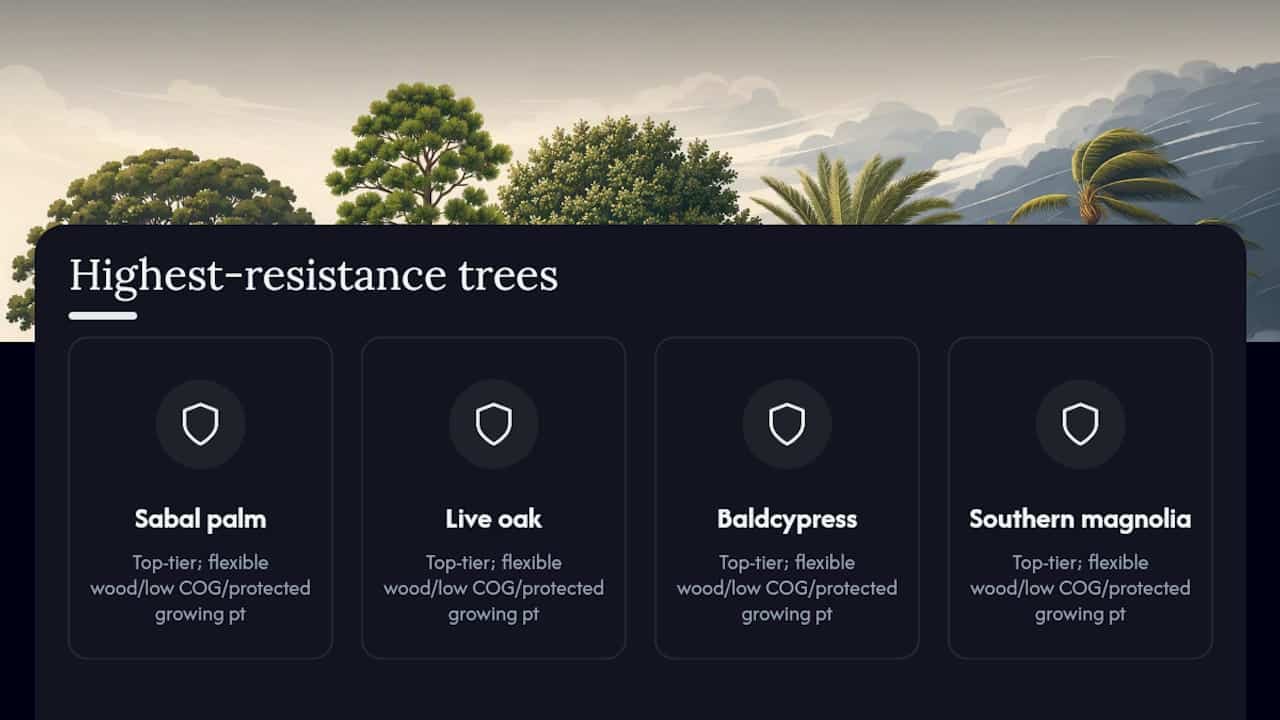
UF/IFAS groups tree species into resistance tiers based on measured survival across multiple hurricanes rather than guesswork or general reputation. The highest-resistance category includes sabal palm, live oak, baldcypress, and southern magnolia, species that combine flexible wood, low center of gravity, or a protected growing point.
The medium-high category includes gumbo limbo, sand live oak, dahoon holly, and slash pine, trees that perform well in most conditions but show more variability depending on soil type, planting depth, and local wind exposure during a given storm. A slash pine on deep sandy soil, for instance, holds up far better than one squeezed into compacted urban fill.
Lower-rated categories cover the species flagged earlier, queen palm, melaleuca, Australian pine, sand pine, and laurel oak, where failure rates climb even under moderate wind conditions. The gap between the top and bottom tiers isn’t small: some low-rated species have failed at rates several times higher than sabal palm or live oak in the same storm events, according to the UF/IFAS wind-resistance publication. That tier list is worth checking before you plant anything new on a Florida property, coastal or inland.
How Fast Do These Trees Grow, and How Big Do They Get?
Growth rate and mature size drive almost every placement decision on this list, and getting it wrong now creates a wind hazard decades later. Sabal palm grows slowly, often just a few inches a year once established, topping out around 40 to 60 feet with a narrow footprint that fits tight urban lots. Crape myrtle and dahoon holly grow at a moderate pace and stay under 30 feet, making them low-risk choices near driveways, patios, or utility lines.
Live oak and southern magnolia are the long-game investments. Both grow moderately fast when young, then slow as they mature into 60 to 80 foot canopies with an equally wide spread. Plant one 15 feet from your house today and in 20 years you’ll have a serious clearance problem. Baldcypress grows at a similar moderate rate but stays narrower, which is why it suits sites with less horizontal room.
Gumbo limbo and sand live oak grow reasonably fast for their final size, 30 to 40 feet, and reach useful maturity within a decade or two. The practical rule: always plant for the tree’s size at 30 years, not its size at the nursery. A five-gallon sapling that looks harmless six feet from a foundation can become a structural liability once its canopy and root plate mature.
Should You Group Trees Together to Reduce Storm Damage?
Yes, in most cases. Clustering trees in loose groups rather than planting isolated specimens spreads wind load across multiple root systems and trunks instead of concentrating stress on one. UF/IFAS research has found that grouped plantings tend to increase collective wind resistance compared to solitary trees standing exposed on all sides.
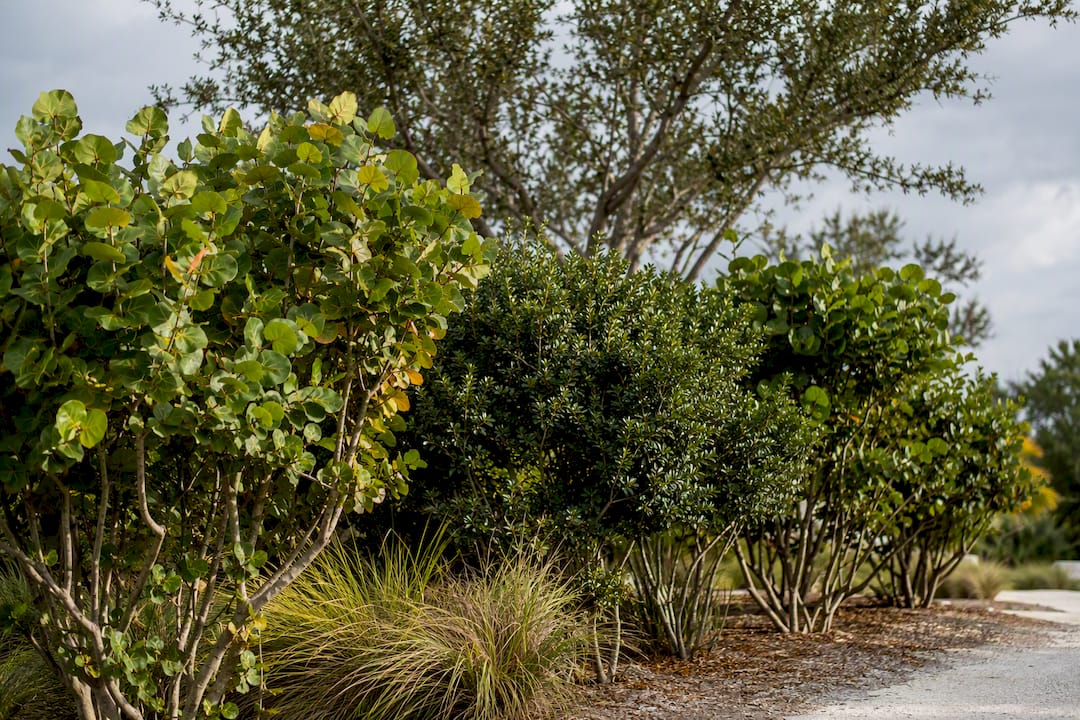
There’s a design logic behind this beyond raw wind physics. A cluster of sea grape or dahoon holly along a property line acts as a windbreak, slowing gusts before they hit a taller specimen tree planted behind it. Mixing species within that cluster matters too: a single-species row is vulnerable to the same pest, disease, or structural weakness taking out the whole planting at once, while a mixed group spreads that risk.
The Urban Forest Hurricane Recovery Program takes this a step further at the neighborhood scale, recommending species diversity and adequate group soil space as core strategies for resilient urban canopies. Some individual tree loss during an extreme storm is expected and even normal. The goal isn’t a zero-failure yard. It’s a landscape where losing one tree doesn’t take out your roof, your fence, and your power line all at once.
Are Native Trees Really More Hurricane-Resistant Than Non-Natives?
Generally, yes, though with real regional caveats. UF/IFAS post-hurricane surveys found that native species, particularly in south Florida, survived at notably higher rates than many introduced ornamentals. Gumbo limbo, sea grape, and sabal palm evolved under the exact wind and soil conditions Florida storms create, so their root architecture and wood flexibility are already matched to local hurricane patterns.
Non-native species aren’t automatically doomed. Southern magnolia, technically native to a broader southeastern range rather than being a strict Florida native, still performs well because its wood density and branch structure happen to suit high wind. The real predictor isn’t native status alone. It’s whether the species evolved traits, deep or wide root systems, flexible wood, protected growing points, that match Florida’s specific combination of sandy or waterlogged soil and repeated tropical wind loading.
That said, the clearest failures on the “avoid” list, Australian pine and melaleuca, are both non-native species introduced without regard for how they’d perform in a hurricane. Local soil and storm characteristics vary enough across the state that a species doing fine in the Panhandle might struggle in a low-lying south Florida yard. When in doubt, natives remain the safer default bet.
Protecting Trees Without Sacrificing Your Canopy
Homeowners often treat storm prep and canopy value as opposing goals, cut hard now or risk losing the tree later. That framing misses the point. A well-sited, properly pruned tree is not a liability you’re managing. It’s an asset that pays you back every summer in shade and every year in property value, and the two goals, safety and canopy, reinforce each other rather than compete.
The practical path is simple: pick species suited to your site, prune for structure while trees are young, and get a professional set of eyes on anything large or aging before storm season, not during storm warnings.
— Results
Get Your Property Storm-Ready with McCullough Tree Service
Professional tree service companies provide Central Florida homeowners options for structural pruning to build strong, wind-resistant canopy shapes, hazardous tree removal for species and site conditions flagged above, proper planting for new trees that need adequate soil volume from day one, and full storm cleanup when a hurricane causes damage.
The process is straightforward: we inspect your trees on-site, walk you through what we find, and provide an estimate before any work begins. If you’ve got a live oak crowding your roofline, a queen palm that’s seen better days, or you just want peace of mind before the next storm system tracks toward Central Florida, schedule a tree trimming assessment and get ahead of it while the skies are still clear.
Sources
- Selecting Tropical and Subtropical Tree Species for Wind Resistance (UF/IFAS)
- Preparing trees for hurricanes – Gardening Solutions (UF/IFAS)
Recommended
- 7 Essential Tree Care Tips for Homeowners in Florida
- Expert storm prep tips for Central Florida trees
- Protect Your Home with Hurricane Season Tree Preparation
- Tree Planting Guide Central Florida for Homeowners