By: Shelby McCullough| Published: June 23, 2026
TL;DR:
- The cost of commercial tree removal depends on tree size, site access, equipment use, and emergency circumstances. Proper site preparation and detailed quotes help property managers avoid unexpected expenses and budget accurately. Emergency removals and utility-related work significantly increase overall costs.
Commercial tree removal cost factors are the specific variables that determine why one job costs $500 and another costs $35,000. Tree size, site access, equipment requirements, emergency status, and regional labor rates all interact to produce the final quote. Property managers who understand these variables negotiate better contracts, avoid budget surprises, and evaluate bids with confidence. This guide breaks down every major pricing driver so you can plan accurately before the first crew arrives on site.
1. Commercial tree removal cost factors: how tree size and species drive pricing
Tree height is the first number every contractor quotes, and it sets the pricing tier for the entire job. Small trees under 30 feet typically cost $200–$500 to remove. Medium trees in the 30–60 foot range run $500–$1,000. Large trees between 60 and 80 feet climb to $1,000–$1,800. Trees exceeding 80 feet regularly reach $1,800–$3,500 or more, depending on conditions.
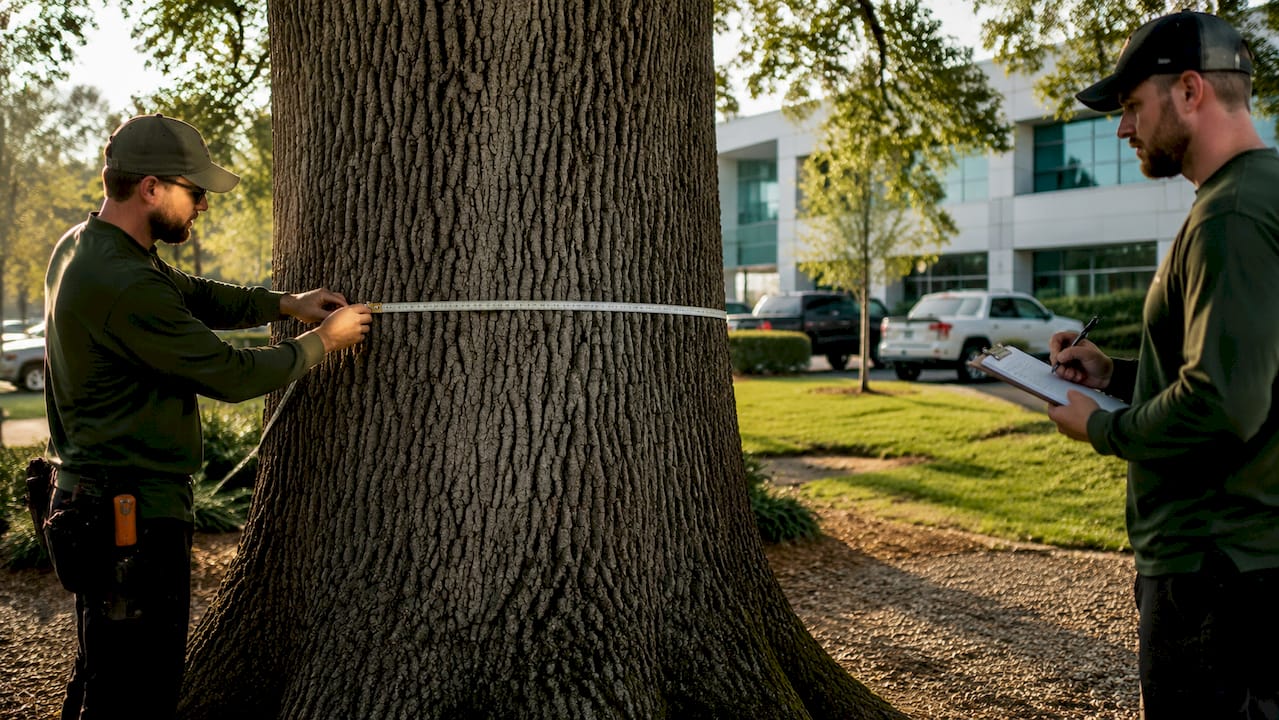
Height alone does not tell the full story. Trunk diameter critically affects rigging complexity and the total wood volume a crew must process. A 70-foot oak with a 36-inch trunk requires heavier rigging, more cuts, and longer processing time than a 70-foot pine with a 20-inch trunk. Always request a diameter measurement alongside height when reviewing any quote.
Species density adds another layer to the pricing calculation. Hardwoods like live oak and laurel oak are significantly denser than softwoods like slash pine. Denser wood means slower cutting, heavier log sections, and more wear on equipment. In Central Florida, mature live oaks are among the most expensive trees to remove because of their wide canopy spread combined with dense wood.
| Tree height | Typical diameter range | Typical cost range |
|---|---|---|
| Under 30 ft | Under 12 in | $200–$500 |
| 30–60 ft | 12–24 in | $500–$1,000 |
| 60–80 ft | 24–36 in | $1,000–$1,800 |
| Over 80 ft | Over 36 in | $1,800–$3,500+ |
Pro Tip: Ask your contractor to measure trunk diameter at breast height (4.5 feet from ground level) and include that figure in the written quote. Contractors who skip this step often revise their price upward once the crew arrives.
2. Site access and proximity challenges that raise your quote
Site conditions are the single biggest source of price variation in commercial tree removal. Commercial removal costs run 30%–50% higher than residential jobs by default, and difficult access pushes that premium even higher. A tree growing in an open parking lot costs far less to remove than an identical tree wedged between a building facade and a utility easement.
Drop zone availability can reduce costs by 20%, while the absence of a clear drop zone forces crews into time-consuming piece-by-piece rigging that can increase costs by 50% or more. Property managers should walk the site before requesting quotes and identify where cut sections can safely land. That single preparation step directly affects the price you receive.
Common access issues that add cost premiums include:
- Trees within 10 feet of a structure: Requires controlled lowering of every section, adding rigging time and crew hours.
- Proximity to active power lines: Triggers utility coordination requirements with a 4–7 day lead time and specific certifications, adding scheduling delays and cost.
- Narrow gate access under 10 feet wide: Prevents standard chippers and bucket trucks from entering, forcing hand-carry of debris or smaller equipment with lower efficiency.
- Sloped or uneven terrain: Increases equipment setup time and crew risk, both of which appear in the final price.
- Paved surfaces with no staging area: Requires protective mats and slower equipment movement to avoid property damage claims.
Utility line clearance is a category of its own. Coordinating with the utility provider, scheduling a line drop or protective cover, and meeting certification requirements all add cost and lead time. Budget for this separately if any tree on your property sits within the utility right-of-way.
3. How emergency and after-hours removal escalates pricing
Emergency tree removal carries a price premium that surprises most property managers the first time they face it. Emergency services add 50%–100% to the base removal cost. When a storm drops a 60-foot oak across a commercial entrance at 2 a.m., the crew mobilization, after-hours labor rates, and equipment dispatch all compound quickly.
Crane-assisted emergency removals are the most expensive scenario. When storm damage leaves a tree leaning against a building or blocking critical infrastructure, crane use becomes necessary. Crane-required emergency jobs typically add $1,500–$5,000 to the base removal cost, depending on crane size and hours on site. That figure sits on top of the standard removal price, not in place of it.
Scheduling is the most effective tool for avoiding emergency premiums. Trees showing signs of decay, structural weakness, or storm damage should be removed during normal business hours before they become an emergency. A certified arborist can assess risk and prioritize removal timing, which is a far cheaper intervention than a 3 a.m. crane call.
Pro Tip: Negotiating fixed annual fees with contingency buffers for emergency response gives commercial property managers predictable capital expenditure instead of unpredictable per-incident billing. Ask your tree service provider whether they offer annual maintenance contracts with emergency response provisions.
4. Equipment, labor, and insurance: the hidden cost drivers
Equipment selection drives a large portion of commercial tree service rates. A standard residential job uses a chainsaw, chipper, and pickup truck. A commercial job on a developed property often requires a bucket truck, industrial chipper, crane, and multiple crew members working simultaneously. Each piece of equipment carries a daily operating cost that appears in your quote whether it is itemized or not.
Commercial jobs require $5 million or more in general liability insurance, which is a hard requirement from most commercial property owners and managers. That insurance premium is a real operating cost for the tree service company, and it is built into every commercial quote. Contractors who quote significantly below market rates often carry inadequate coverage. That gap in coverage becomes your liability if something goes wrong on your property.
Crew size scales directly with tree complexity. A straightforward removal might need two people. A large oak near a building with utility proximity can require five or six crew members, a ground supervisor, and a certified arborist on site. Labor overhead, including workers’ compensation insurance, payroll taxes, and training costs, contributes heavily to the final price.
| Equipment type | Typical use case | Cost impact |
|---|---|---|
| Bucket truck | Canopy access without climbing | Adds $300–$800 per day |
| Industrial crane | Controlled removal near structures | Adds $1,500–$5,000 per job |
| Industrial chipper | High-volume debris processing | Adds $200–$500 per day |
| Stump grinder | Post-removal stump elimination | Adds $100–$400 per stump |
Full itemized quotes that separate labor, equipment, insurance, and disposal costs are the standard for professional commercial tree service. If a contractor provides only a single lump-sum number, ask for the breakdown. Itemization lets you compare bids accurately and identify where costs differ between contractors.
5. Stump grinding, debris hauling, and regional cost variations
Stump grinding is almost always a separate line item, and property managers frequently overlook it when budgeting. Stump grinding costs $2–$5 per inch of diameter, or $100–$400 per stump for typical commercial trees. A property with multiple mature trees can accumulate $1,000 or more in stump grinding costs alone. Factor this into your initial budget, not as an afterthought.
Debris hauling follows a similar pattern. Some contractors include haul-off in their base price. Others charge separately based on truckload volume or disposal fees at the local facility. In Central Florida, disposal costs vary by county, and some municipalities charge tipping fees that contractors pass through directly.
Regional labor rates affect the average cost of tree removal in ways that are easy to underestimate. Urban markets like Orlando carry higher labor and insurance costs than rural areas. Seasonal demand also shifts pricing. Hurricane season preparation in june through november drives up demand for commercial tree services across Central Florida, which tightens crew availability and pushes rates upward.
Common add-ons that increase your total bill include:
- Root barrier installation: Relevant when a removed tree’s root system threatens pavement or foundations.
- Permit fees: Some municipalities require removal permits for trees above a certain diameter, with fees ranging from $50 to several hundred dollars.
- Soil remediation: Filling and grading the area after stump grinding, especially on commercial properties where appearance matters.
- Multiple mobilization trips: If a job requires returning to complete work, each mobilization carries a separate charge.
Understanding codominant trunk structures also matters for cost planning. Trees with two or more competing leaders present higher structural risk and require more careful dismantling, which adds labor time and cost to the removal.
Key takeaways
Commercial tree removal pricing is determined by tree size, site access, equipment needs, emergency status, and add-on services working together, not by any single variable in isolation.
| Point | Details |
|---|---|
| Tree size sets the base price | Height and trunk diameter together determine rigging complexity and labor hours. |
| Site access is the biggest variable | Difficult access near structures or power lines adds 25%–100% to base costs. |
| Emergency removals cost significantly more | Expect 50%–100% premiums, with crane jobs adding $1,500–$5,000 on top. |
| Insurance requirements are non-negotiable | Commercial jobs require $5M+ liability coverage, which is built into every legitimate quote. |
| Stump grinding and debris hauling are usually separate | Budget $100–$400 per stump and confirm whether haul-off is included in the base price. |
What I’ve learned from watching property managers get burned on tree quotes
The most expensive mistake I see property managers make is accepting a single-number quote without asking what it includes. A $2,000 bid that excludes stump grinding, debris hauling, and a second mobilization trip can easily become a $3,500 job by the time the invoice arrives. The contractor is not necessarily being dishonest. The property manager simply did not ask the right questions.
The second mistake is underestimating utility coordination. A tree near a power line is not just a harder removal. It is a scheduling event that requires utility company involvement, sometimes a line drop, and specific crew certifications. That process takes 4–7 days minimum. Property managers who need a tree gone by a specific date for a construction project or tenant requirement often discover this constraint too late.
ANSI A300 pruning and safety standards exist specifically to limit liability in commercial tree service contracts. Contractors who follow these standards cost more than those who do not. That cost difference is worth paying. A contractor who cuts corners on safety standards creates liability that lands on your property, not theirs.
My strongest recommendation is to conduct a full site walkthrough with your contractor before any quote is finalized. Walk the drop zones. Identify every overhead line. Measure gate widths. That 30-minute walkthrough prevents the majority of budget surprises I have seen derail commercial tree projects.
— Mcculloughtreeservice
Mcculloughtreeservice: transparent quotes for commercial tree removal
Property managers in Orlando and Central Florida trust Mcculloughtreeservice for commercial tree removal because every quote is itemized, every crew is insured, and every job is supervised by a certified arborist.
Mcculloughtreeservice handles the full scope of commercial removal, from single-tree extractions near structures to multi-tree land clearing projects. The team brings industrial cranes, bucket trucks, and chippers to every job that requires them, with no hidden equipment fees. Whether you are managing a retail center, office park, or apartment complex, you can request a commercial removal quote and receive a fully itemized breakdown covering labor, equipment, insurance, stump grinding, and debris hauling. Budget planning starts with an accurate number, and that is what Mcculloughtreeservice delivers.
FAQ
What is the average cost of commercial tree removal?
Commercial tree removal typically costs $500–$3,500+ per tree, depending on size, species, and site conditions. Commercial jobs run 30%–50% higher than residential removals due to equipment and insurance requirements.
Why do commercial tree removal costs vary so much?
Tree height, trunk diameter, site access, proximity to structures or power lines, and emergency status all affect the final price. Each variable adds labor time, equipment needs, or risk that contractors price into the quote.
Is stump grinding included in tree removal quotes?
Stump grinding is usually a separate charge, ranging from $2–$5 per inch of diameter or $100–$400 per stump. Always confirm whether it is included before signing a contract.
How much does emergency tree removal cost for commercial properties?
Emergency removal adds 50%–100% to the standard removal price. Jobs requiring crane use for storm damage response typically add $1,500–$5,000 on top of the base removal cost.
How can property managers reduce commercial tree removal costs?
Schedule removals during normal business hours before trees become emergencies, ensure clear drop zones are available on site, and request fully itemized quotes from multiple certified contractors. Fixed annual maintenance contracts with emergency provisions also provide more predictable budgeting than per-incident pricing.
Recommended
- Commercial Tree Removal Guide for Safe Property Management
- Cost-Effective Tree Debris Removal Solutions
- Tree Removal and Property Value in Orlando
- Commercial Tree Removal Explained: Ensuring Safety and Compliance