By: Shelby McCullough| Published: August 31, 2026
Most Orlando homeowners pay somewhere between $400 and $2,500 for hurricane-related tree cleanup, with full-property jobs involving multiple trees and stump work sometimes topping $5,000. Emergency work after a storm carries a premium, often $100 to $150 more per hour than standard scheduling. The right first move is a call to a certified arborist for a written, staged estimate, not a same-day contract with whoever knocks on your door. McCullough Tree Service handles that kind of phased assessment across Central Florida.
TL;DR:
- Storm damage access issues, proximity to power lines, and need for specialized rigging often increase costs by 25 to 50 percent beyond simple size-based pricing.
- Emergency stabilization usually costs more per hour and is performed immediately, while full cleanup and stump grinding are scheduled days or weeks later at a lower rate.
- An accurate quote depends on detailed property information and proof of certification and insurance, with quotes clearly specifying included services and potential extra charges.
- Not all storm-damaged trees need full removal, as many can be preserved through restoration pruning, which saves significantly on costs.
- Prices in Orlando spike during storm seasons due to demand, and phased assessments by certified arborists help prevent unnecessary expenses.
Table of Contents
- How Much Does Hurricane Cleanup Cost in Orlando?
- What Actually Drives Your Quote Up or Down?
- How Storm Cleanup Gets Staged After a Hurricane
- Getting an Accurate Quote Without Getting Overcharged
- Why the “Remove Everything” Instinct Costs You More
- Certified Arborist Cleanup From a Local Central Florida Crew
- Sources
How Much Does Hurricane Cleanup Cost in Orlando?
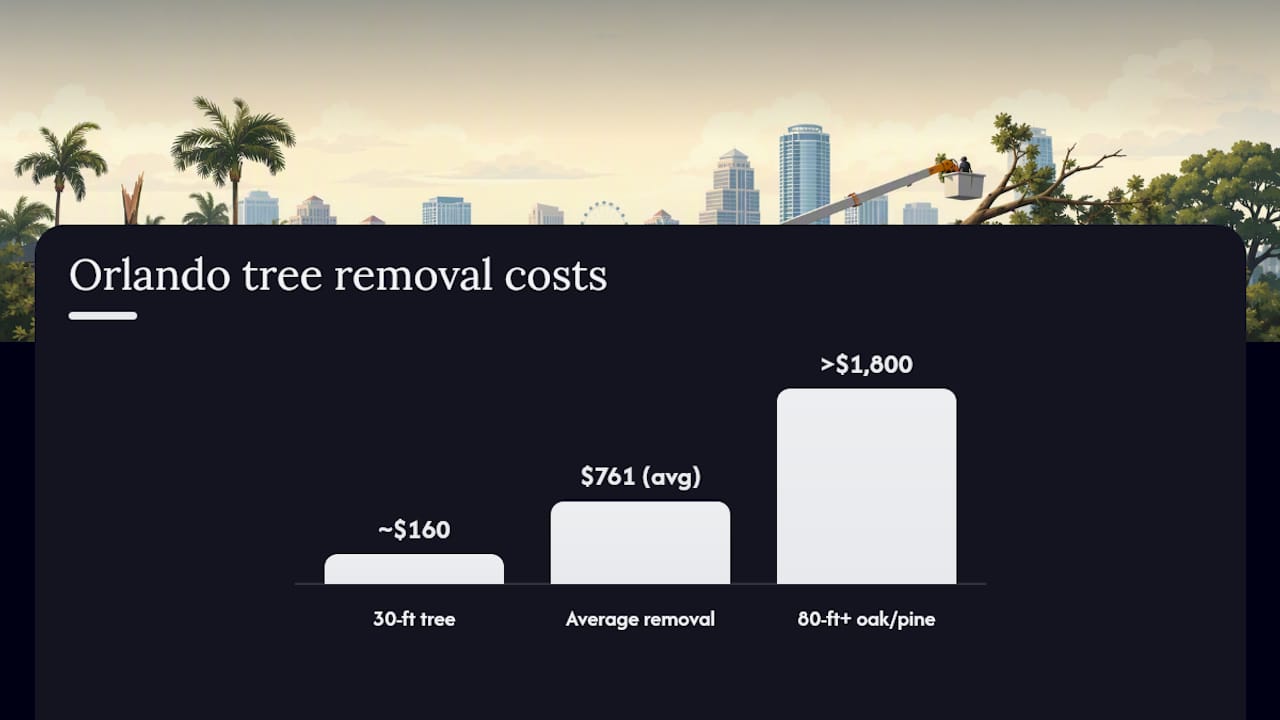
Price depends heavily on tree size, and Orlando data makes that spread obvious. A 30-foot tree removal might run around $160, while an 80-foot-plus oak or pine can climb past $1,800. Across the metro area, the average homeowner pays roughly $761 for a standard removal job, though that figure assumes decent access and no major complications.
Most Orlando tree companies bill one of three ways: a flat per-tree rate, an hourly crew rate, or a per-job quote that bundles removal, hauling, and cleanup. Hourly emergency work commonly falls in the $100 to $150 per hour range, and after-hours or immediate-hazard calls can add another $100 to $150 on top of that. Statewide emergency estimates back this up: TreeOps USA lists Florida averages of about $624 for emergency limb removal and $2,080 for a full storm-damaged tree removal, with after-hours call-outs averaging around $1,560.
Reality check: a single downed limb removed the morning after a storm can cost less than a full tree removal scheduled two weeks later, simply because of what’s involved in the rigging and hauling. Size alone doesn’t set the price. Complexity does.
Beyond the tree itself, expect these common line items on an Orlando storm cleanup invoice:
- Stump grinding, usually priced separately from removal and based on stump diameter
- Debris hauling charged per dump trip, typically $75 to $250 per load
- Wood chipping or log splitting as an alternative to full haul-away
- Emergency or after-hours surcharges during active storm response
- Surge pricing in the days immediately following a hurricane, when demand spikes across the region
That last point matters more than people expect. Prices in Orlando genuinely move with storm season demand, the same way hotel rates spike before a hurricane makes landfall.
What Actually Drives Your Quote Up or Down?
Size gets the blame, but it’s rarely the real cost driver. According to ProTreeTrim’s breakdown of storm-damage pricing, position, instability, and access shape the bid far more than trunk diameter does.
Here’s what tends to move the number:
- Active instability — a tree leaning on your roof or fence needs careful rigging, not a straight cut-and-drop
- Proximity to power lines — crews often need coordination with the utility company before touching anything nearby
- Access limitations — pool cages, narrow side yards, or fenced-in backyards can block equipment entirely
- Equipment needs — a crane or bucket truck adds real cost versus a job a crew can handle with chainsaws and a chipper
- Hauling volume — a single fallen limb costs far less to clear than a canopy’s worth of debris
- Permits and municipal rules — some Orlando neighborhoods and HOAs require documentation before removal
- Timing — booking during peak storm-response week costs more than scheduling once the initial surge passes
Jobs requiring specialized rigging, crane work, or power-line coordination commonly run 25 to 50 percent higher than a comparable tree in open, easy-access terrain. Meanwhile, a tree down in an open backyard with no structures nearby can be one of the cheapest jobs on a crew’s schedule that week.
Pro Tip: A tree that looks like minor damage from the ground, a few broken limbs resting against your roofline, often requires more careful rigging than a fully downed tree in an open yard. Don’t assume “small” damage means a small bill.
How Storm Cleanup Gets Staged After a Hurricane
Reputable Orlando tree companies don’t treat hurricane cleanup as one job. They split it into phases, and understanding that split explains a lot about your final bill.
- Emergency stabilization (same day to 48 hours). Crews prioritize immediate hazards, trees on roofs, blocked driveways, limbs threatening power lines. This work costs more per hour because it’s urgent, often after-hours, and requires rapid mobilization.
- Final cleanup and hauling (days to weeks later). Once the immediate danger is gone, debris removal, stump grinding, and full site cleanup get scheduled. Booking this phase after the initial surge passes often costs less, since crews aren’t stretched thin across the whole region.
- Site restoration. This includes grinding stumps, hauling final debris loads, and addressing any restoration pruning UF/IFAS recommends for trees that survived but need shaping.
Full timelines vary with storm severity. A Category 1 event might mean your yard is fully cleared within a week. A major hurricane that hits the whole metro area can stretch final cleanup out several weeks, especially where municipal debris pickup or utility line work competes for the same road access.
Getting an Accurate Quote Without Getting Overcharged
The fastest way to a fair price is giving contractors enough detail to quote remotely, and knowing what separates a legitimate crew from a storm chaser working out of a pickup truck.
Before you call anyone, gather this:
- Approximate tree height and trunk diameter at chest height
- Photos showing the tree’s relationship to your house, fence, and any power lines
- Notes on access, gated yard, pool cage, narrow side entry
- Whether the tree is fully down, leaning, or has broken limbs still hanging
When you talk to a company, ask directly about ISA certification, proof of both liability and workers’ compensation insurance, and whether the written estimate spells out exactly what’s included, hauling, stump grinding, permit handling, versus what costs extra. UF/IFAS specifically recommends hiring a certified arborist rather than assuming every damaged tree needs to come down; a qualified assessment can save you the cost of an unnecessary removal.
Watch for red flags: door-to-door solicitors immediately after a storm, cash-only demands, no written estimate, or pressure to sign on the spot. Legitimate Orlando companies, including general restoration contractors who coordinate with tree crews on larger jobs, put their scope and price in writing before work starts.
Pro Tip: If you’re willing to keep the wood for firewood or let the crew chip it on-site instead of hauling it away, mention that upfront. Skipping the dump-trip fee can shave real money off your total.
Why the “Remove Everything” Instinct Costs You More
The instinct after a hurricane is to clear everything that looks damaged, and that instinct is often wrong. UF/IFAS Extension has made this point for years: not every storm-damaged tree is a hazard, and plenty can be saved with restoration pruning instead of a full removal that costs several times more.
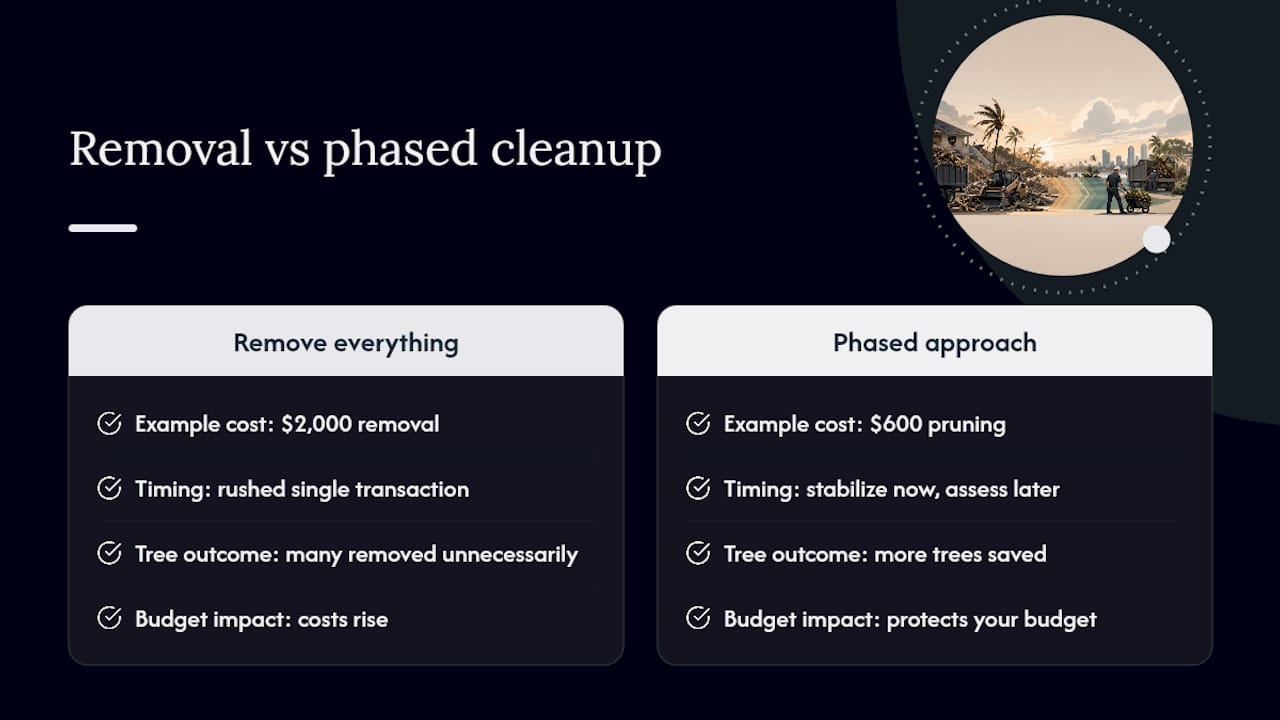
The gap in most cost guides is that they treat storm cleanup like a single transaction. It isn’t. Treating emergency stabilization and final cleanup as one rushed job is exactly what drives up costs and leads to trees coming down that didn’t need to. A phased approach, secure the hazard now, assess and clean up properly once things calm down, protects your budget and your trees.
What I’d prioritize first: get a certified arborist’s eyes on the property before you sign anything. A five-minute assessment can be the difference between a $600 pruning job and a $2,000 removal you didn’t actually need.
— Results
Certified Arborist Cleanup From a Local Central Florida Crew
McCullough Tree Service runs hurricane cleanup the same way this guide recommends: hazard stabilization first, full cleanup second, nothing rushed or oversold in between. Our ISA certified arborists assess what actually needs removal versus what can be saved with restoration pruning, and every job comes with proof of insurance and a written estimate before a chainsaw starts.
Our crews handle the full range Orlando properties need after a storm: emergency limb and hazard removal, full tree removal, debris hauling, and stump grinding once the initial rush has passed. We work with residential homeowners, commercial property managers, and municipalities, and we offer financing options for property owners facing multiple damaged trees at once. If you’ve got storm damage right now, request a written estimate and we’ll walk you through what’s urgent, what can wait, and what it’s actually going to cost.
Sources
- FOR 116/FR171: Cleaning Up After a Hurricane: Get the Right Tree Care Professional
- FOR-117/FR172: Assessing Hurricane-Damaged Trees and Deciding What to Do
- How much does tree removal cost in Orlando, FL? | Angi
- Storm-Damaged Tree Removal: What Changes the Price and Timeline? | ProTreeTrim™ Florida
- Best Emergency Tree Service in Florida – 2026 Directory & Cost Guide | TreeOps USA
Recommended
- How to Plan Storm Cleanup: A Central Florida Guide
- Storm Cleanup Guide 2025: Central Florida Homeowners
- Storm Damage Cleanup Tips for Central Florida Property Owners
- Examples of Storm Cleanup Services for Central Florida