By: | Published: August 10, 2026
After a storm hits Central Florida, your first call should go to a licensed, ISA Certified Arborist® — not a chainsaw. Here is what to do in the first hour:
- Secure the scene. Stay clear of downed lines, leaning trees, and anything touching a power line. Treat every downed wire as live.
- Call your utility company if lines are down. Florida Power & Light and Duke Energy both have 24/7 outage lines.
- Photograph everything before touching a single branch. Wide shots establish context; close-ups capture split trunks, root heave, and hanging limbs. Timestamp is automatic on most phones.
- Separate vegetative waste (limbs, branches, palm fronds) from construction debris at the curb. Most Central Florida municipalities require this separation for pickup equipment to work efficiently. Keep piles away from storm drains, fire hydrants, and utility poles.
- Contact a licensed local arborist for an immediate hazard assessment before any tree work begins.
Pro Tip: Request a certificate of insurance (COI) sent directly from the contractor’s insurance agent — not a photocopy handed to you on-site. Licensed tree care companies carry both general liability and workers’ compensation; without that COI, you could be financially responsible for any on-site injury.
Key takeaways
After a storm, your safest path is to document damage immediately, verify credentials before hiring, and let a licensed arborist lead the hazard assessment before any tree work begins.
| Point | Details |
|---|---|
| Safety comes first | Stay clear of downed lines and leaning trees; call your utility before anything else. |
| Verify COI and ISA credentials | Request the COI from the insurer directly; confirm the ISA Certified Arborist® credential before signing. |
| Get a written remediation plan | The estimate must name specific trees, methods, equipment, disposal, and timeframe. |
| Separate debris at curbside | Keep vegetative waste apart from construction debris; avoid blocking drains and hydrants. |
| Mcculloughtreeservice | Provides ISA-certified, ANSI-compliant emergency storm response across Central Florida with written estimates and full COI. |
Table of Contents
- How to verify insurance, licensing, and ISA credentials
- What you can safely handle versus what belongs to the pros
- PPE and chainsaw safety basics
- Working with municipal authorities and utilities
- How to evaluate written estimates beyond price
- What a trained arborist actually does when responding to your call
- Mcculloughtreeservice responds to storm emergencies across Central Florida
- Authoritative resources for storm-damaged tree assessment and hiring
- Sources
How to verify insurance, licensing, and ISA credentials
After major storms, demand for emergency tree care spikes and unlicensed crews follow the storm path. Before signing anything, confirm three things: the COI (general liability plus workers’ comp, sent agent-to-owner), an active ISA Certified Arborist® credential (searchable at isa-arbor.com), and a Florida contractor license. Low bids are a warning sign — licensed operators carry real overhead from insurance, equipment, and training. A suspiciously cheap quote often means one of those costs is missing.
What you can safely handle versus what belongs to the pros
Small, ground-level debris — scattered branches under four inches in diameter, palm fronds, loose mulch — is reasonable homeowner territory. Anything involving a leaning trunk, a limb hung up in a canopy (a “widow-maker”), root heave, or contact with a structure belongs to a professional. An ISA Certified Arborist® can assess whether a storm-damaged tree can be saved or requires removal, and experienced crews can sometimes stabilize a tree through cabling or targeted pruning rather than removing it outright — preserving your landscape while managing the hazard. See signs your tree needs removal before making that call yourself.
PPE and chainsaw safety basics
Chainsaws rank among the most dangerous tools used in hurricane cleanup. If you do use one for small ground-level cuts, the minimum PPE is: cut-resistant chaps, steel-toed boots, a hard hat with face shield, hearing protection, and heavy gloves. Keep both hands on the saw, cut at waist level or below, and never work overhead or from a ladder. If you are not trained and physically fit for it, stop and call a pro.

Working with municipal authorities and utilities
Report downed lines to your utility immediately and document the call time. For debris pickup, contact your county’s public works department — Orange, Osceola, and Seminole counties each publish post-storm debris schedules. Ask specifically whether a debris removal contractor has been pre-authorized for your area, which can speed curbside haul-away. Municipal pre-arranged debris plans and staging sites reduce recovery time considerably, so the earlier you register your address in the county’s system, the better.
How to evaluate written estimates beyond price
Get at least two written estimates. Each should name the specific trees or limbs to be addressed, the method (removal vs. pruning vs. cabling), equipment required, debris disposal plan, and a realistic timeframe. Ask contractors which ANSI standards they follow — ANSI Z133 covers worker safety; ANSI A300 covers pruning and management practices. A contractor who cannot name either standard has not been trained to them. Also confirm the written remediation plan includes a post-work site inspection, not just a cleanup crew and a bill.
What a trained arborist actually does when responding to your call
The conventional wisdom after a storm is “get the debris gone fast.” That instinct is understandable, but it is the wrong priority order. A three-stage assessment — situational safety first, then hazard remediation, then crown-loss evaluation — exists precisely because rushing to debris removal before identifying structural failures creates secondary injuries. In Central Florida specifically, saturated soils after heavy rain dramatically increase the risk of root-plate failure in otherwise healthy-looking trees. A tree that is standing but leaning slightly after a storm on wet ground is not stable. Palms present their own challenge: they shed fronds as a survival mechanism, which looks dramatic but rarely signals structural failure, while a cracked palm trunk is the opposite — easy to miss, genuinely dangerous.
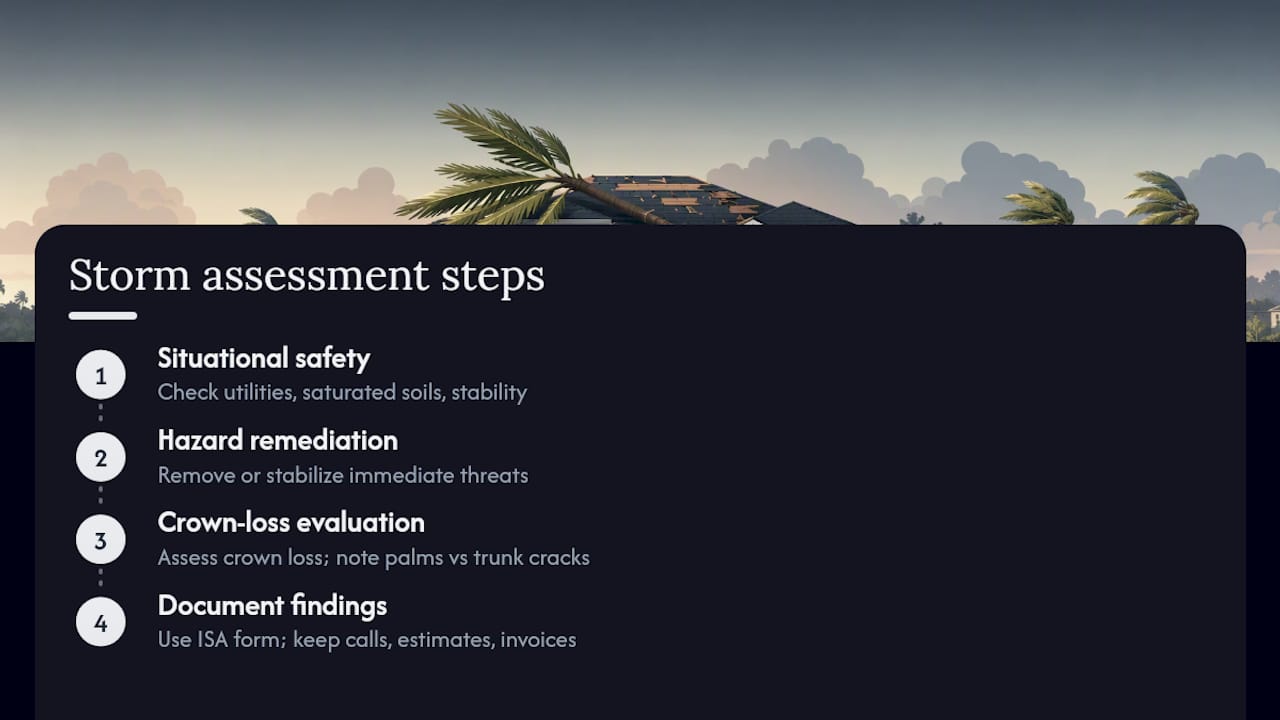
Using a standardized ISA tree risk assessment form to document visible defects, failure likelihood, and mitigation recommendations gives you a paper trail that matters for both insurance and FEMA reimbursement. Document every call, every estimate, and every invoice from day one.
Mcculloughtreeservice responds to storm emergencies across Central Florida
When a storm hits Orlando or the surrounding counties, Mcculloughtreeservice deploys ISA Certified Arborist®-led crews for emergency hazardous tree removal and full storm cleanup — bucket trucks, crane-enabled removals, stump grinding, and debris hauling included. Every job follows ANSI Z133 and A300 standards. Before work begins, you receive a written estimate, a remediation plan, and a COI sent from the insurer. Avoid contractors who ask for full payment upfront; a reasonable deposit is standard, but full prepayment before work is a red flag. Call to request an urgent site assessment and have your photos, property access details, and any known hazards ready. Keep all documentation for your insurance claim or FEMA application.
Authoritative resources for storm-damaged tree assessment and hiring
- NCSU Extension — How to Choose a Tree Care Company: COI verification steps and hiring red flags after storm events.
- UF/IFAS FR170 — Hurricane Cleanup Safety: PPE requirements and chainsaw safety rules for homeowners.
- UF/IFAS FR171 — Proper Tree Care and Hiring an Arborist: ANSI Z133 and A300 standards explained for property owners.
- ISA Basic Tree Risk Assessment Form: Standardized form for documenting defects, failure likelihood, and mitigation — use this as your insurance/FEMA paper trail template.
- NCTS Storm Tree Assessment BMP: Three-stage assessment framework and FEMA debris-management documentation guidance.
Documentation checklist for insurance and FEMA:
- Timestamped photos (wide shots and close-ups of every damaged tree or limb)
- Written estimates from at least one licensed, insured contractor
- COI from the contractor’s insurance agent (general liability + workers’ comp)
- Signed remediation plan with scope, method, and timeline
- All invoices and payment receipts
- Record of utility and municipal notifications (date, time, confirmation number)
Sources
- How to Choose a Tree Care Company to Aid in Disaster Clean-Up
- Hiring an Emergency Tree Removal Company After Severe Weather: What You Need to Know – Arborist Website Blog Articles – Arborist of America
- Storm-Related Tree Damage
- Cleaning Up After a Hurricane: Safety Comes First! (UF/IFAS publication FR170)
- Proper tree care and hiring an arborist (UF/IFAS FR171)
- NCTS Storm Tree Assessment Best Management Practices (BMP)
- Tree storms and municipal recovery resources
Recommended
- Storm Cleanup Guide 2025: Central Florida Homeowners
- How to Plan Storm Cleanup: A Central Florida Guide
- Storm Damage Tree Cleanup in Orlando & Central Florida
- Storm Damage Cleanup Workflow for Central Florida