By: Shelby McCullough| Published: June 1, 2026
TL;DR:
- Tree canopy restoration involves rehabilitating and expanding tree cover to enhance ecological functions and climate resilience. Effective long-term results depend on selecting appropriate methods, ongoing maintenance, and strategically planting in high-need areas. Combining natural regeneration, direct planting, and active treatments maximizes success while requiring committed care and ecological awareness.
Tree canopy restoration is the deliberate process of increasing and rehabilitating tree cover to improve ecosystem health, climate resilience, and community well-being across urban and rural landscapes. The practice draws on methods ranging from direct planting to assisted natural regeneration, and its outcomes touch everything from air temperature to biodiversity corridors. For property owners in Central Florida, municipalities managing heat-vulnerable neighborhoods, and land stewards working at scale, understanding how canopy restoration works is the first step toward doing something meaningful with it.
What is tree canopy restoration and why does it matter?
Tree canopy restoration is defined by ecologists as the targeted recovery of overhead tree cover to restore ecological function, reduce environmental stressors, and support long-term land health. The industry also uses the term canopy rehabilitation when the focus is on improving existing degraded cover rather than establishing new growth from scratch. Both terms describe the same strategic goal: more functional tree cover, maintained over time.
The stakes are real. Urban tree cover reduces 41 to 49% of the urban heat island air-temperature effect, cooling summer air by roughly 0.15°C and benefiting approximately 914 million people globally. That figure represents a measurable public health outcome, not just an aesthetic preference. Beyond cooling, restored canopies filter particulate matter, slow stormwater runoff, stabilize soil, and create habitat corridors for pollinators and wildlife.
In rural settings, forest canopy restoration rebuilds the structural complexity that supports biodiversity. In cities, it addresses equity gaps. Low-income and high-heat-vulnerability neighborhoods consistently have the least tree cover, which means canopy restoration is also a social infrastructure decision. New York City’s commitment to a 30% urban canopy target by 2040 reflects exactly this logic, with current coverage in the city’s hottest zones sitting at roughly 19%.
How does tree canopy restoration reduce urban heat and improve climate resilience?
The urban heat island effect occurs when impervious surfaces like asphalt and concrete absorb and re-emit solar radiation, raising local temperatures well above surrounding rural areas. Trees interrupt this cycle through shade, evapotranspiration, and wind modification. The cooling effect is real, but its distribution is uneven.
Research analyzing European cities found that a 15% increase in urban tree coverage can neutralize local land surface temperature rises linked to non-residential building expansion by up to 40%, particularly in warmer climates. This means strategic canopy expansion in the right zones, not just citywide averages, drives the most meaningful outcomes.
That said, canopy restoration is not a standalone solution. Tree canopy cooling offsets only about 10% of median mid-century warming projections, which means it must integrate with complementary climate adaptation strategies such as reflective surfaces, green roofs, and reduced emissions. Treating trees as the only answer sets up restoration programs for disappointment.
Cities that have made the most progress combine canopy goals with targeted planting in dense, low-income areas where both heat exposure and tree deficits are greatest. The lesson is clear: where you plant matters as much as how many trees you plant.
Key climate benefits of restored tree canopy:
- Reduces ambient air temperature through shade and evapotranspiration
- Intercepts stormwater, reducing runoff volume and flood risk
- Sequesters carbon in biomass and soil
- Filters airborne pollutants including nitrogen dioxide and particulate matter
- Moderates wind speeds, reducing building energy loads
What are the main tree canopy restoration methods?
Tree canopy restoration methods fall into three broad categories: assisted natural regeneration, direct planting strategies, and active restoration treatments. Each suits different site conditions, budgets, and ecological starting points.
Assisted natural regeneration
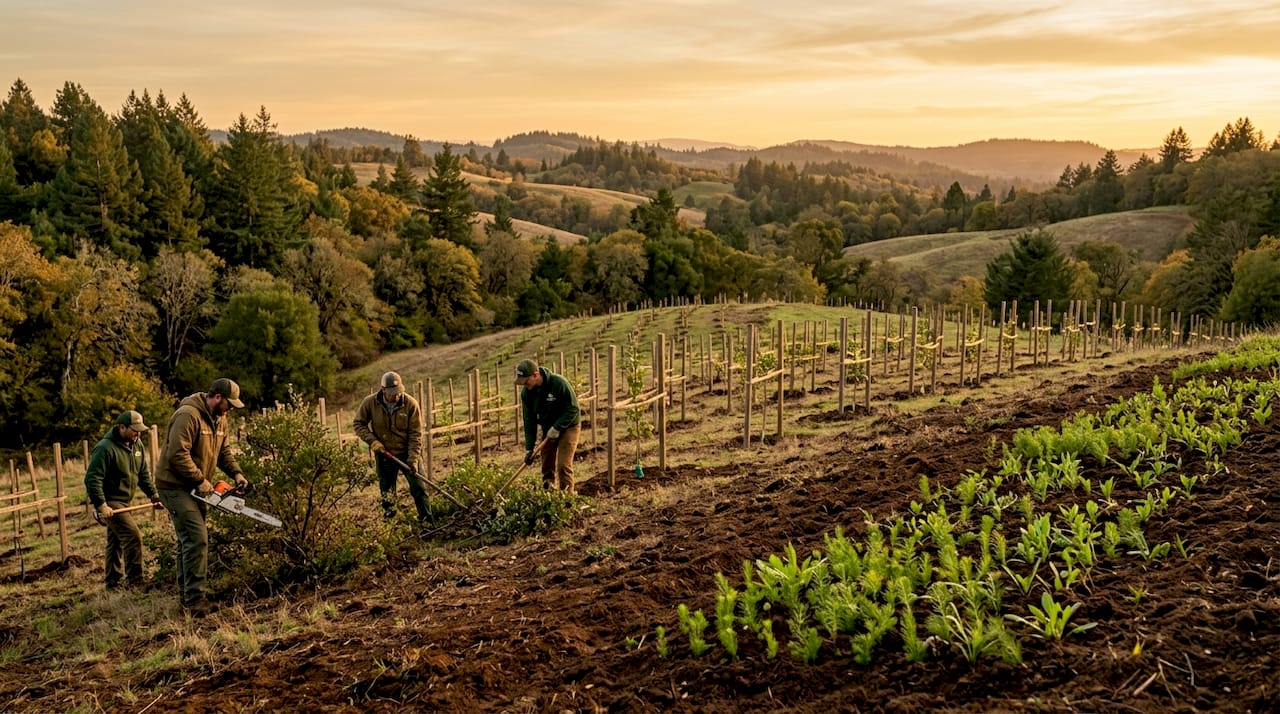
Assisted natural regeneration (ANR) restores native tree cover by removing barriers to natural growth rather than relying on planting alone. Practitioners prune competing vegetation, manage fire, and protect existing seedlings from grazing or trampling. Farmer-managed natural regeneration (FMNR) applies the same logic at the farm scale, allowing trees to regrow from existing root systems and seed banks. ANR works best where seed sources are nearby, soil conditions are adequate, and land tenure allows for multi-year management. It is often the most cost-effective and ecologically sensitive starting point.
Direct planting strategies
Direct planting becomes necessary when seed banks are depleted or site conditions prevent natural regeneration. Research from Aotearoa New Zealand found that big-canopy native trees planted early alongside nurse species at 2-meter spacing, with protective ground cover, achieve high survival rates over three-year monitoring periods. This challenges the conventional staged approach of waiting for pioneer species to establish before introducing large-canopy trees. Planting the target species early, with the right support structure around them, compresses the restoration timeline significantly.
Active restoration treatments
Restoration treatments such as thinning and prescribed burning alter competitive dynamics in existing stands, improving soil moisture availability and accelerating growth. Long-term tree-ring data shows treated units grew 133.1% faster in basal area increment after treatment, with improved drought resilience. These benefits can decline over time, which means adaptive management and repeat treatment cycles are part of the plan, not optional add-ons.
| Method | Best context | Cost level | Key benefit |
|---|---|---|---|
| Assisted natural regeneration (ANR) | Degraded farmland, tropics, subtropics | Low | Ecologically sensitive, low input |
| Direct planting with nurse species | Depleted seed banks, urban sites | Medium to high | Faster canopy establishment |
| Thinning and prescribed burning | Existing forest stands with competition | Medium | Improved growth and drought resilience |
| Maintenance pruning and inspection | All restored sites | Ongoing | Prevents canopy loss and hazards |
Pro Tip: Mix ANR with direct planting of big-canopy natives on the same site. ANR handles the understory and fills gaps cheaply, while the large-canopy species drive the structural restoration you actually need.
How to plan and sustain an effective canopy restoration project
Setting a realistic canopy target is the starting point for any restoration project. NYC’s 30% goal by 2040 is a useful benchmark, but your site’s baseline, land use constraints, and maintenance capacity all shape what is achievable. Start with a site assessment that maps existing canopy cover, soil conditions, moisture availability, and proximity to seed sources.
Follow these steps to build a project that lasts:
- Assess baseline conditions. Map current canopy cover using aerial imagery or GIS tools. Identify soil type, compaction, drainage, and existing vegetation. Note any invasive species that will compete with restoration plantings.
- Select species appropriate to the site. Native species adapted to local climate and soil conditions outperform exotic selections in survival and ecological function. In Central Florida, species like live oak, bald cypress, and Southern magnolia are proven performers.
- Design your planting layout. Use 2-meter spacing for big-canopy species planted alongside nurse species. Include protective ground cover to reduce heat and moisture stress on young trees.
- Build a maintenance schedule before you plant. Urban canopy restoration requires planned pruning, watering, and inspection cycles to persist. Tampa’s Tree-Mendous program commits to pruning cycles every three years over 12 years, with deadwood removal and structural pruning built into the schedule.
- Engage community stewards. Projects tied to neighborhood ownership and volunteer maintenance programs show higher long-term survival rates than those managed solely by contractors.
Pro Tip: Do not skip the soil assessment. Compacted or degraded urban soils are the leading cause of tree failure in restoration projects. Decompaction and organic matter amendment before planting can double survival rates.
What are the benefits and challenges in urban vs. rural restoration?
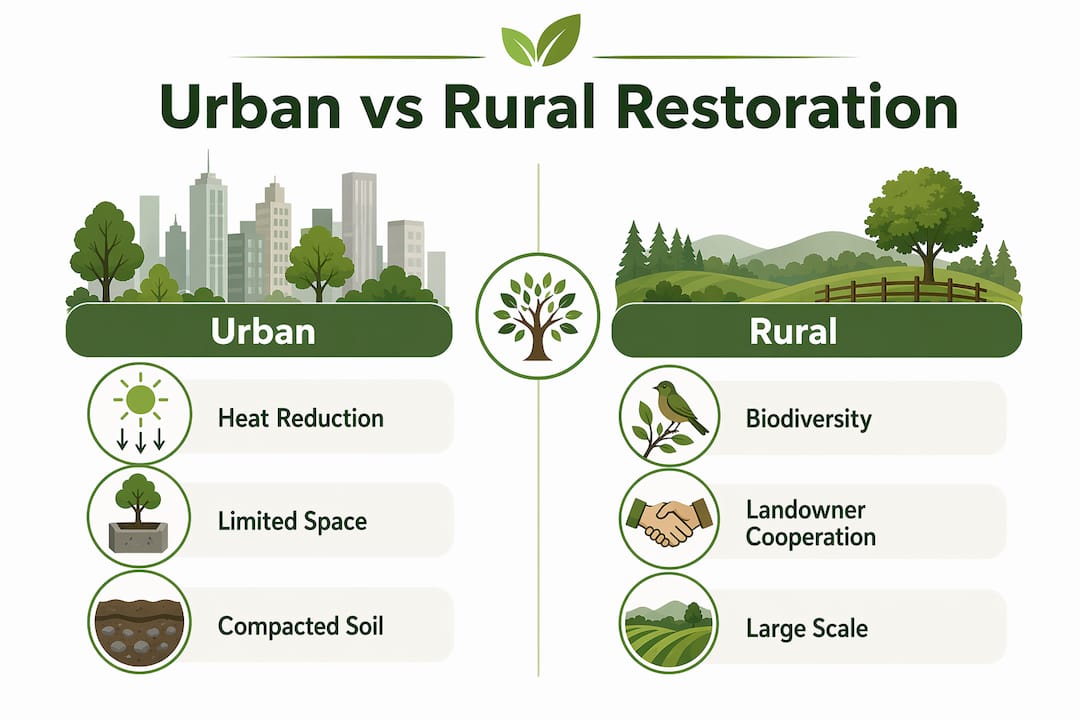
Urban and rural canopy restoration share the same ecological goals but face fundamentally different constraints.
In cities, the primary challenges are physical. Space is limited, soils are compacted and often contaminated, and competing land uses create political friction around planting sites. The social benefits are correspondingly high: urban canopy reduces heat exposure in vulnerable communities, improves mental health outcomes, increases property values, and creates green corridors that support pollinators even in dense neighborhoods.
Rural canopy restoration operates at larger scales but depends on landowner cooperation and long-term land tenure security. Forest canopy restoration on agricultural land requires farmers to accept reduced productive area in exchange for ecosystem services like erosion control, water filtration, and carbon sequestration. Policy instruments like conservation easements and payment-for-ecosystem-services programs are often necessary to make this trade-off viable.
| Setting | Primary benefit | Key challenge | Typical method |
|---|---|---|---|
| Urban | Heat reduction, public health, equity | Space, soil quality, competing uses | Direct planting, maintenance programs |
| Rural | Biodiversity, carbon, watershed health | Landowner cooperation, scale | ANR, FMNR, agroforestry integration |
| Peri-urban | Habitat corridors, stormwater | Fragmented ownership, development pressure | Mixed planting and ANR |
Both settings require long-term commitment. A restored canopy that receives no maintenance after year three will lose structural integrity, become a hazard, and ultimately fail to deliver the benefits that justified the investment. Proper tree pruning practices are not optional maintenance. They are the mechanism by which restoration outcomes persist.
Key takeaways
Tree canopy restoration succeeds when it combines the right method for site conditions with a long-term maintenance commitment, not when it treats planting as a one-time event.
| Point | Details |
|---|---|
| Define your method by site conditions | ANR suits sites with intact seed banks; direct planting works where seed sources are depleted. |
| Plant big-canopy natives early | Co-planting with nurse species at 2-meter spacing compresses restoration timelines significantly. |
| Maintenance is non-negotiable | Pruning cycles every three years and regular inspections prevent canopy loss and hazards. |
| Urban placement drives outcomes | Targeting high-heat, low-income zones multiplies the public health return on every tree planted. |
| Integrate with broader climate strategy | Canopy cooling alone offsets roughly 10% of mid-century warming. Pair it with other adaptation measures. |
What I’ve learned from watching restoration projects succeed and fail
Most canopy restoration failures I have seen come down to one of two problems: underestimating maintenance or ignoring what the site is actually telling you. Organizations plant trees, celebrate the milestone, and then walk away. Three years later, the canopy is compromised by deadwood, structural failures, and drought stress that a basic inspection schedule would have caught.
The second failure mode is ecological overconfidence. Practitioners arrive with a species list and a planting plan without first asking whether the soil can support it, whether seed sources exist nearby, or whether invasive species will outcompete every seedling within two seasons. ANR is underused precisely because it requires reading the site carefully rather than imposing a plan on it.
What works is combining methods. Use ANR where the biology supports it, direct planting where it does not, and active treatments like thinning where existing stands need structural improvement. Then build a maintenance program before the first tree goes in the ground. The trimming and pruning distinction matters more than most people realize: trimming manages shape and clearance, while pruning drives structural health and longevity. Both belong in your restoration maintenance plan.
The projects that last are the ones that treat restoration as ecological management, not a planting event.
— Mcculloughtreeservice
How Mcculloughtreeservice supports your canopy restoration goals
Restored tree canopies require expert care to deliver on their promise. Mcculloughtreeservice provides certified arborist services across Orlando and Central Florida, including professional tree trimming designed to support canopy health and structural integrity over the long term. Whether you are maintaining newly planted trees or rehabilitating an existing canopy, the right pruning and trimming schedule makes the difference between a thriving restoration and a liability.
Mcculloughtreeservice also offers stump grinding and land clearing to prepare sites for new planting, and tree removal services for managing hazardous or dead trees that compromise canopy health. Contact Mcculloughtreeservice for a customized tree care consultation and a free estimate tailored to your restoration project.
FAQ
What is tree canopy restoration?
Tree canopy restoration is the deliberate process of increasing and rehabilitating overhead tree cover to restore ecological function, reduce heat, and improve biodiversity. It includes methods like direct planting, assisted natural regeneration, and active forest management treatments.
How long does canopy restoration take to show results?
Visible canopy closure typically takes three to ten years depending on species, site conditions, and planting method. Planting big-canopy native species early alongside nurse species can compress this timeline compared to staged approaches.
What is assisted natural regeneration in canopy restoration?
Assisted natural regeneration removes barriers to natural tree regrowth, such as competing vegetation and grazing pressure, rather than relying on new planting. It works best where seed sources are nearby and soil conditions support seedling establishment.
How much can tree canopy reduce urban heat?
Urban tree cover reduces 41 to 49% of the urban heat island air-temperature effect. A 15% increase in coverage can neutralize land surface temperature rises from building expansion by up to 40% in warmer climates.
Why is maintenance critical after canopy restoration?
Without scheduled pruning, watering, and structural inspections, restored trees develop hazards and lose canopy integrity within a few years. Programs like Tampa’s Tree-Mendous commit to pruning cycles every three years over 12 years precisely because maintenance is what makes restoration outcomes durable.
Recommended
- Tree Pruning Importance: Key Benefits Explained
- Pruning Trees: Essential Tips and Benefits
- Tree preservation: boost health & beauty in Florida
- The Comprehensive Benefits of Tree Trimming