By: Shelby McCullough| Published: December 30, 2025
More than eighty percent of American homeowners in Orlando face storm-related tree risks every year. Beyond maintaining healthy landscapes, compliance with local regulations and disaster readiness is now essential for protecting property and curb appeal. If you want peace of mind that your trees are hurricane-ready and your yard stays beautiful, understanding certified tree care unlocks trusted solutions for both safety and aesthetics.
Table of Contents
- What Is Tree Care Certification?
- Major Certification Types For Tree Work
- How Florida’s Regulations Shape Certification
- Education, Testing, And Ongoing Requirements
- Risks Of Uncertified Tree Services In Florida
- Benefits For Homeowners And Property Safety
Key Takeaways
| Point | Details |
|---|---|
| Importance of Certification | Tree care certification ensures arborists are skilled in safe and effective tree management, crucial for Florida’s subtropical environment. |
| Types of Certifications | Key certifications, like Certified Arborist and Master Arborist, validate expertise across different areas of tree care and management. |
| Impact of Regulations | Florida’s regulations enforce stringent certification standards, emphasizing tree risk assessment and safety in urban forestry. |
| Value for Homeowners | Hiring certified arborists provides homeowners with proactive risk assessments and expert care strategies for their trees, enhancing property safety. |
What Is Tree Care Certification?
Tree care certification represents a professional credentialing process that validates an arborist’s expertise, skills, and commitment to safe tree management practices. In Florida, these certifications have become increasingly critical as property owners seek qualified professionals who understand the unique challenges of maintaining trees in a complex subtropical environment.
The International Society of Arboriculture (ISA) provides rigorous certifications that go beyond basic training, requiring professionals to demonstrate comprehensive knowledge in tree care. These certifications cover essential skills like proper pruning techniques, disease diagnosis, safety protocols, and advanced tree health management strategies. Certified arborists must pass comprehensive examinations that test their theoretical understanding and practical capabilities in managing diverse tree species and addressing complex landscape challenges.
In Florida, tree care certification isn’t just a professional credential – it’s a critical safeguard for property owners. The certification process ensures that professionals understand regional challenges like hurricane preparedness, pest management specific to subtropical environments, and sustainable tree care practices. For homeowners in storm-prone regions like Orlando, working with a certified tree care professional means receiving expert services that protect both the trees and the surrounding property.
Pro Tip: Always request to see a professional’s current certification credentials before hiring them for tree care services, as this ensures you’re getting qualified, up-to-date expertise.
Major Certification Types for Tree Work
Tree care professionals in Florida can pursue multiple specialized certification types that validate their expertise across different domains of arboriculture. The International Society of Arboriculture (ISA) offers comprehensive certification programs designed to recognize and validate professionals’ skills in various tree management contexts.
The primary certification types include Certified Arborist, which serves as a foundational credential for tree care professionals. This certification demonstrates a comprehensive understanding of tree biology, maintenance, and care techniques. Additional specialized certifications like Utility Specialist focus on managing trees near power lines and electrical infrastructure, while the Municipal Specialist certification addresses the unique challenges of urban forest management and public space tree maintenance.
More advanced credentials such as the Board Certified Master Arborist represent the highest level of professional achievement in the field. These advanced certifications require extensive practical experience, rigorous examinations, and a proven track record of expertise. Advanced arborist credentials provide professionals with the opportunity to distinguish themselves and offer sophisticated tree care services that go beyond basic maintenance.
Here’s a summary comparing major tree care certifications in Florida:
| Certification Type | Focus Area | Main Benefit |
|---|---|---|
| Certified Arborist | General tree care practices | Validates core arboricultural skills |
| Utility Specialist | Trees near power lines | Ensures safe management by infrastructure |
| Municipal Specialist | Urban forest management | Addresses city trees and public spaces |
| Master Arborist | Advanced expertise | Highest recognition of professional skill |
Pro Tip: Research the specific requirements and continuing education credits needed to maintain each certification level, as requirements can change annually and demonstrate an ongoing commitment to professional development.
How Florida’s Regulations Shape Certification
Florida’s unique environmental challenges have driven the development of stringent tree care certification standards that go far beyond traditional credentialing requirements. Local tree care ordinances establish comprehensive legal frameworks that mandate specific training, expertise, and professional qualifications for arborists working in the state’s complex subtropical landscape.
The state’s regulatory approach emphasizes public safety and urban forest management through rigorous certification requirements. Tree Risk Assessment has become a critical component of professional tree care, with regulations specifically encouraging certified arborists to conduct comprehensive evaluations. These standards require professionals to demonstrate advanced knowledge of tree biology, structural integrity, potential hazards, and environmental interactions unique to Florida’s diverse ecosystem.
Local municipalities across Florida have implemented detailed ordinances that directly link professional certification to permissible tree maintenance activities. Professionals must now possess specialized credentials that validate their understanding of regional challenges such as hurricane preparedness, pest management, and sustainable urban forestry practices. Tree risk assessment protocols have become particularly critical in determining the qualifications necessary for tree removal, pruning, and maintenance operations.
Pro Tip: Always verify a tree care professional’s current certifications with local municipal authorities, as requirements can vary significantly between different Florida counties and cities.
Education, Testing, and Ongoing Requirements
Tree care certification programs represent a comprehensive journey of professional development that goes far beyond simple credential acquisition. Aspiring arborists must navigate a rigorous path that combines formal education, practical experience, and continuous learning to demonstrate their expertise in tree care and management.
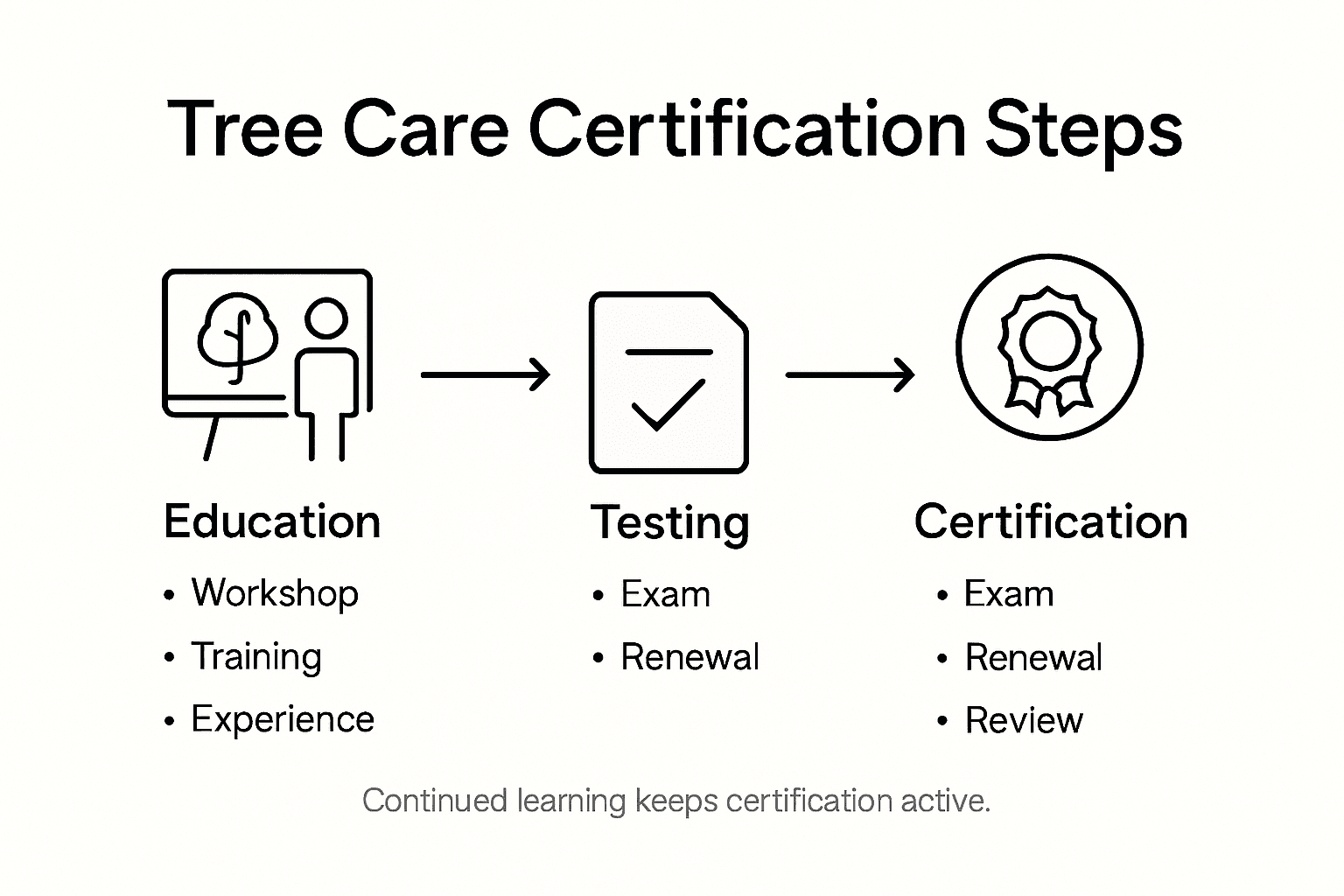
The certification process typically involves multiple critical components. Candidates must first accumulate substantial field experience, demonstrating practical knowledge of tree biology, maintenance techniques, and safety protocols. Written Examinations serve as a crucial gateway, testing candidates’ theoretical understanding across complex domains such as tree physiology, risk assessment, pruning techniques, and environmental management. These assessments are designed to be comprehensive, challenging professionals to showcase deep, nuanced understanding of arboricultural science.
Continuing education represents the most dynamic aspect of professional certification. Certified professionals must consistently earn continuing education units (CEUs) to maintain their credentials, ensuring they remain current with emerging research, technological advancements, and evolving industry standards. This ongoing requirement prevents stagnation and compels arborists to stay engaged with the latest scientific developments, safety innovations, and best practices in tree care management.
Pro Tip: Document every training session, workshop, and professional development activity, as these can often count toward your required continuing education credits and demonstrate your commitment to professional growth.
Risks of Uncertified Tree Services in Florida
Tree risk assessment in Florida demands specialized knowledge that uncertified professionals often lack, creating significant potential for property damage and personal safety hazards. The subtropical environment of Florida presents unique challenges that require sophisticated understanding of tree biology, structural integrity, and regional environmental stressors.
Uncertified tree services frequently make critical errors that can compromise both tree health and property safety. Improper Pruning Techniques can cause long-term damage to trees, creating structural weaknesses that increase the likelihood of branch failure during hurricane season. These professionals may remove critical branches, disrupt tree growth patterns, or fail to recognize early signs of disease and pest infestation that could lead to catastrophic tree failure.
Beyond immediate physical risks, uncertified tree services can create substantial financial liabilities for property owners. Inadequate safety protocols and poor assessment practices can result in unnecessary tree removals, inappropriate maintenance interventions, and increased long-term maintenance costs. In a state prone to extreme weather events, the consequences of uninformed tree management can be particularly devastating, potentially leading to significant property damage during storms or unexpected tree collapses.
Below is a quick reference showing how certified arborists reduce risks for Florida homeowners:
| Risk Factor | How Certification Helps | Impact on Property |
|---|---|---|
| Tree damage in storms | Applies proper pruning and safety | Reduces breakage risk |
| Pest and disease issues | Early diagnosis and intervention | Prevents costly losses |
| Improper tree removal | Follows legal and safety protocols | Avoids fines and hazards |
Pro Tip: Always request and independently verify a tree service professional’s current certification credentials before allowing any work on your property, as this simple step can prevent costly mistakes and potential safety hazards.
Benefits for Homeowners and Property Safety
Tree care certification provides critical protections for homeowners by establishing rigorous professional standards that directly impact property safety and landscape health. In Florida’s challenging subtropical environment, certified arborists deliver comprehensive services that go far beyond basic tree maintenance, offering strategic insights into long-term tree management and risk mitigation.
Certified professionals bring advanced diagnostic capabilities that can prevent potential property damage before it occurs. Risk Assessment becomes a proactive process, where experts identify structural weaknesses, disease indicators, and potential hazards that untrained workers might overlook. These detailed evaluations help homeowners make informed decisions about tree preservation, strategic pruning, and when removal might be necessary to protect structures, power lines, and personal safety.
Professional tree care credentials ensure comprehensive landscape management that extends well beyond immediate visual appearance. Certified arborists understand complex interactions between tree health, soil conditions, regional climate challenges, and potential environmental stressors specific to Florida. This holistic approach means homeowners receive expert guidance that considers not just individual tree health, but the entire ecosystem’s long-term sustainability and resilience.
Pro Tip: Request a detailed written assessment from certified professionals that outlines potential risks, recommended interventions, and a comprehensive tree management strategy for your specific property.
Ensure Your Florida Property’s Safety with Certified Tree Care Experts
Florida’s evolving tree care certification standards highlight a critical problem many homeowners face: trusting uncertified professionals risks tree damage, unsafe practices, and costly mistakes. You want proven expertise in specialized skills like risk assessment, hurricane preparedness, and pest management. McCullough Tree Service stands ready to deliver this peace of mind with fully certified arborists who understand the unique challenges of Orlando and Central Florida’s subtropical environment.
Experience the difference of working with experts who prioritize your property’s health and safety. Our certified team offers comprehensive services including tree trimming, removal, storm cleanup, and more—all following up-to-date certification protocols to protect your trees and minimize risks. Ready to secure your home with trusted, professional tree care? Visit McCullough Tree Service to learn how our certified arborists bring unmatched skill and compliance to every project.
Don’t wait for storm season or costly damage to act. Contact us today for a detailed tree health assessment or emergency storm response by professionals who meet Florida’s new certification standards. Discover how certified arborist expertise can safeguard your investment and enhance your landscape’s long-term vitality.
Frequently Asked Questions
What is tree care certification?
Tree care certification is a professional credentialing process that verifies an arborist’s knowledge, skills, and commitment to effective and safe tree management practices.
Why is certification important for tree care professionals?
Certification ensures that tree care professionals possess the necessary expertise to manage trees safely, especially in complex environments like Florida, where factors such as hurricane preparedness and pest management are critical.
What types of certifications are available for arborists?
Key certifications include Certified Arborist, Utility Specialist, Municipal Specialist, and Board Certified Master Arborist. Each focuses on different areas of tree care and management.
How do regulations impact tree care certification in Florida?
Florida’s regulations emphasize public safety and effective urban forest management, driving rigorous certification requirements that address unique environmental challenges such as hurricane readiness and tree risk assessment.
Recommended
- McCullough Tree Service
- Be smart heading into storm season with Florida trees – McCullough Tree Service
- Tree Removal Maitland FL
- Tree Removal Orlando FL
- Tree Service DeBary FL