By: Shelby McCullough| Published: June 5, 2026
TL;DR:
- Tree pest control in Central Florida relies on IPM practices involving regular monitoring, precise timing, and cultural care to maintain tree health. Targeted treatments like horticultural oils during crawler emergence windows and trunk injections for EAB provide effective, environmentally responsible solutions. Consistent tree maintenance and early detection are essential for preventing severe damage and ensuring long-term survival.
Tree pest control is defined as the systematic management of insects, mites, and pathogens that damage trees, with Integrated Pest Management (IPM) recognized as the most effective framework for achieving lasting results. IPM does not default to pesticides on a schedule. It requires monitoring, pest identification, and targeted treatment only when pest populations cross a threshold that threatens tree health. In Central Florida, where scale insects, Emerald Ash Borer (EAB), and spider mites thrive in the warm, humid climate year-round, understanding this science-driven approach is the difference between trees that recover and trees that decline. IPM limits pest populations using compatible, minimally toxic tactics, with pesticides as a last resort. Cultural practices like proper watering, pruning, and mulching form the foundation that chemical treatments build on.
What are the common tree pests in Central Florida and how are they identified?
Central Florida’s subtropical climate creates year-round pressure from a short list of high-impact pests. Knowing what you are looking for is the first step in any tree pest management plan.
Scale insects are among the most destructive pests on ornamental and shade trees in the region. Armored scales, like Florida red scale, form a hard waxy shell and feed by piercing bark. Soft scales, like brown soft scale, produce sticky honeydew that coats leaves and branches, leading to sooty mold growth. Both types cause yellowing foliage, branch dieback, and general decline if left unchecked. You can spot early infestations by looking for crusty or waxy bumps along stems and the undersides of leaves.
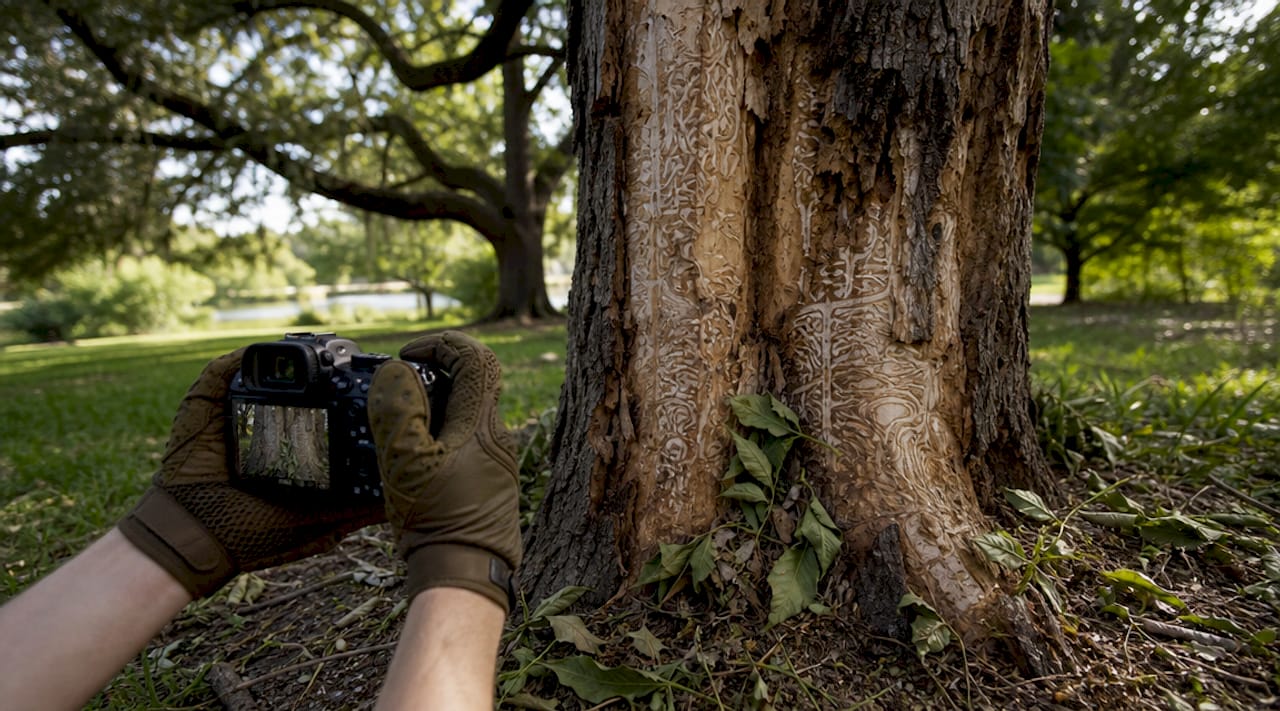
Emerald Ash Borer is a wood-boring beetle that attacks ash trees by tunneling beneath the bark, cutting off the tree’s ability to move water and nutrients. Exit holes shaped like a capital “D” on the bark surface are the clearest sign of an active infestation. Canopy dieback starting at the top of the tree, S-shaped galleries under the bark, and increased woodpecker activity are all reliable indicators. Because EAB damage is internal, early detection through inspections is critical since visible symptoms often appear only after significant damage has already occurred.
Spider mites and other mite species cause stippled, bronze, or silvery discoloration on foliage, particularly during dry periods. A quick way to confirm mites is to hold a white sheet of paper under a branch and tap it. If tiny moving specks appear, mites are present.
Common signs to watch for across pest types include:
- Yellowing or premature leaf drop
- Sticky residue or sooty mold on leaves and surfaces below the tree
- Bark cracks, lesions, or unusual discoloration
- D-shaped exit holes or sawdust-like frass at the base of the trunk
- Visible crawlers or insects on stems and leaf undersides
- Thinning canopy or dieback starting from branch tips
Pro Tip: Place yellow sticky tape around stems in spring to trap scale crawlers. The presence of crawlers on the tape tells you exactly when to time your first treatment, which is far more reliable than treating by calendar date.
Checking your trees as part of a routine inspection, ideally every four to six weeks during the growing season, gives you the best chance of catching problems before they require aggressive intervention. The tree disease prevention guide from Mcculloughtreeservice covers regional pest identification in more detail.
How does Integrated Pest Management work for trees and why is timing critical?
IPM treats pest control as a dynamic process that adjusts based on what monitoring reveals, not a fixed spray schedule. For tree owners in Central Florida, this distinction matters because treating at the wrong life stage wastes money and leaves the infestation intact.
The core components of an IPM program for trees follow a clear sequence:
- Monitor regularly. Inspect trees on a set schedule and record what you find. Note pest species, population size, and tree condition.
- Identify the pest and its life stage. Treatment timing depends entirely on the pest’s biology. Crawlers, pupae, and adults each respond differently to the same product.
- Set action thresholds. Not every pest sighting requires treatment. A low population of scale insects on a healthy tree may be managed by natural predators without intervention.
- Select the least toxic effective treatment. Horticultural oils and insecticidal soaps target crawlers without broad environmental impact. Systemic insecticides are reserved for situations where contact treatments are insufficient.
- Evaluate results. After treatment, monitor again to confirm efficacy. If populations rebound, adjust the approach.
For scale insects specifically, timing is the single most important variable. Multiple timed treatments spaced 7 to 10 days apart are needed because crawlers do not all emerge at once. Treating only once almost always leaves a second wave untouched. Degree-day (GDD) tracking tools, which calculate accumulated heat units from a base temperature, give you a precise window for when crawlers will emerge based on local weather data rather than guesswork.
Cultural controls are not optional extras in IPM. They are structural components. Removing ant colonies that protect soft scales from natural predators is one example. Sticky barriers that exclude ants from climbing tree trunks can reduce scale populations by 50 to 80 percent by allowing beneficial insects like parasitic wasps to do their work unimpeded. That is a significant reduction without a single pesticide application.
Pro Tip: Use a free GDD tracking tool from your state’s extension service to predict crawler emergence windows for scale insects in your zip code. Timing your first horticultural oil application to the early crawler stage cuts the number of follow-up treatments you need.
What are effective treatment options for major pests like scale insects and Emerald Ash Borer?
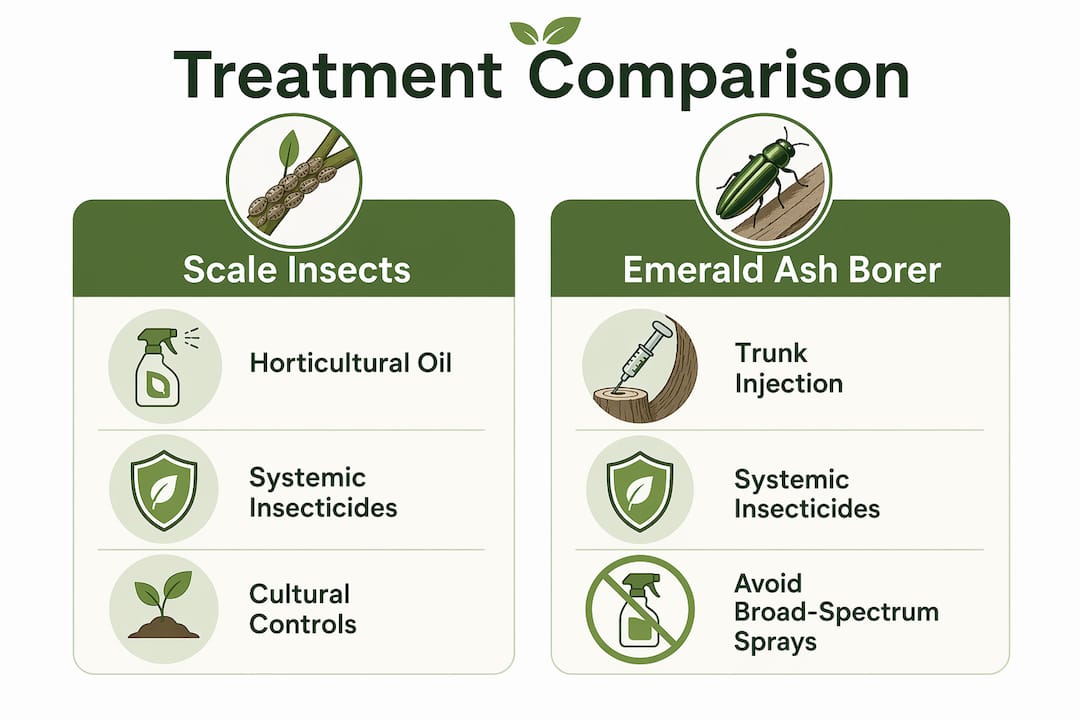
Treatment selection depends on the pest, the tree’s condition, and the timing of the application. The table below compares the primary options used in Central Florida.
| Treatment type | Best use case | Key limitation |
|---|---|---|
| Horticultural oil | Scale crawlers, mites, early infestations | Must contact pest directly; ineffective on settled adults |
| Insecticidal soap | Soft-bodied crawlers and mites | Short residual; requires repeat applications |
| Systemic soil drench (dinotefuran) | Soft and armored scales on accessible root zones | Slower uptake on stressed or dry-soil trees |
| Trunk injection (emamectin benzoate) | Emerald Ash Borer on large or high-value trees | Higher upfront cost; requires professional equipment |
Horticultural oil works by suffocating scale crawlers and overwintering eggs on contact. Dormant-season applications in late winter target overwintering populations before they hatch. Follow-up applications during crawler emergence in spring are equally important. The settled adult stage is protected by its waxy shell and does not respond well to contact sprays, which is why catching the crawler window is non-negotiable.
For systemic insecticides, dinotefuran outperforms imidacloprid against both soft and armored scales because of its superior mobility through the tree’s vascular system. The critical precaution: apply only after bloom to protect pollinators. Treating a flowering tree with a systemic insecticide exposes bees to contaminated nectar and pollen. This is not a minor concern in Central Florida, where many ornamental trees bloom in spring alongside peak scale crawler activity.
Trunk injection of emamectin benzoate is the gold standard for Emerald Ash Borer control. Injections deliver insecticide directly into the tree’s vascular system, bypassing soil uptake issues entirely. Timing is post full leaf emergence, when active transpiration pulls the product through the tree efficiently. A single treatment provides two to three years of protection. Research published in Arboriculture & Urban Forestry found 98 to 99 percent larval control in treated trees, making trunk injection the most cost-effective option for high-value ash trees when compared to removal and replacement costs.
Avoid broad-spectrum contact sprays as a default. They kill beneficial insects alongside pests, remove the natural predator pressure that IPM depends on, and often require more frequent reapplication than targeted alternatives.
What cultural practices reduce pest susceptibility in Central Florida trees?
Healthy trees resist pest pressure better than stressed ones. This is not a vague principle. Proper maintenance including watering, pruning, and inspections directly reduces the likelihood of severe infestations by keeping trees in a condition where they can respond to pest attack with their own defenses.
In Central Florida’s sandy soils, consistent soil moisture is harder to maintain than in other regions. Trees that experience repeated drought stress produce less resin, have thinner bark, and attract wood-boring beetles like EAB more readily. Water deeply and infrequently rather than shallowly and often, targeting the root zone rather than the trunk base.
Fertilization timing matters as much as the product. Applying high-nitrogen fertilizer in late fall pushes tender new growth that scale insects and mites find highly attractive. Fertilize in early spring and again in early summer to support growth during periods when trees can harden off new tissue before pest populations peak.
Routine pruning removes dead and weakened wood that serves as entry points for borers and fungal pathogens. It also opens the canopy to airflow, which reduces the humid microclimate that mites and soft scales prefer. Prune outside the branch collar, never flush to the trunk, and avoid heavy pruning in late summer when wounds heal slowly.
Pro Tip: Apply a 3-inch layer of organic mulch in a ring around the tree, keeping it 6 inches away from the trunk. Mulch retains soil moisture, moderates root temperature, and reduces the mechanical damage from lawn equipment that creates entry wounds for pests.
Additional practices that support pest resistance include:
- Removing heavily infested branches before pest populations spread to the rest of the tree
- Avoiding wounding the bark with string trimmers or mowers
- Planting species suited to Central Florida’s soil and climate to reduce baseline stress
- Scheduling professional inspections annually, particularly for mature or high-value trees
Key takeaways
Effective tree pest control in Central Florida requires IPM-based monitoring, precise treatment timing, and consistent cultural care to protect tree health and prevent costly damage.
| Point | Details |
|---|---|
| IPM is the core framework | Monitor first, treat only when pest populations cross a damage threshold. |
| Timing drives treatment success | Target scale crawlers with horticultural oil during the 7 to 10 day emergence window, not on a fixed calendar date. |
| Trunk injection protects EAB targets | Apply emamectin benzoate post full leaf emergence for 2 to 3 years of systemic protection. |
| Cultural care reduces pest pressure | Proper watering, mulching, and pruning lower tree stress and make infestations less severe. |
| Pollinator safety is non-negotiable | Apply systemic insecticides only after bloom to avoid contaminating nectar and pollen. |
What years of working with Central Florida trees have taught me
The most common mistake I see from homeowners and property managers is treating on a schedule rather than on evidence. A spray applied two weeks too early misses the crawler window entirely. The homeowner sees no improvement, applies more product, and still gets poor results. The pest was never the problem. The timing was.
The second mistake is treating pests in isolation from tree health. A scale infestation on a drought-stressed live oak in Orlando is a different problem than the same infestation on a well-watered, properly mulched tree. The stressed tree needs cultural correction first. Without it, you are managing symptoms rather than causes, and the infestation returns every season.
What actually works is the combination: IPM-aligned monitoring, culturally healthy trees, and treatments timed to pest biology rather than convenience. Local knowledge matters here too. Central Florida’s pest pressure does not follow the same calendar as Georgia or the Carolinas. Degree-day accumulation happens faster in our climate, which compresses the treatment window for scale crawlers. If you are using a pest management guide written for a northern climate, your timing will be off.
The trees that survive and look good long-term belong to property owners who treat pest control as an ongoing practice, not a one-time fix. Invest in annual inspections. Learn to recognize the early signs of infestation. And when a problem exceeds what cultural care and targeted sprays can address, bring in a certified arborist before the damage becomes irreversible.
— Mcculloughtreeservice
How Mcculloughtreeservice supports your tree pest control program
Mcculloughtreeservice provides certified arborist services across Orlando and Central Florida, including pest monitoring, IPM-aligned treatments, and professional tree trimming that removes pest harborage and improves canopy health. The team handles trunk injection for Emerald Ash Borer, targeted scale treatments timed to crawler emergence, and routine inspections designed to catch problems before they escalate. Every recommendation is grounded in local knowledge of Central Florida’s pest calendar and climate conditions. If your trees are showing signs of stress, dieback, or visible pest activity, contact Mcculloughtreeservice for an assessment and a treatment plan built around your specific trees and property.
FAQ
What is tree pest control and how does it work?
Tree pest control is the management of insects and mites that damage trees, using IPM as the primary framework. It combines monitoring, pest identification, cultural care, and targeted treatments timed to pest life cycles.
How do I identify scale insects on my trees?
Scale insects appear as waxy or crusty bumps on stems and leaf undersides, often accompanied by sticky honeydew and sooty mold. Yellow sticky tape placed around stems during spring will trap crawlers and confirm an active infestation.
When is the best time to treat Emerald Ash Borer?
Trunk injection of emamectin benzoate is most effective after full leaf emergence in spring, when active transpiration pulls the insecticide through the tree’s vascular system. This timing delivers the strongest uptake and provides two to three years of protection.
Are systemic insecticides safe to use around pollinators?
Systemic insecticides like dinotefuran are safe when applied after bloom, once flowers have dropped and bees are no longer foraging on the tree. Applying during bloom contaminates nectar and pollen and poses a direct risk to bee populations.
How often should I inspect my trees for pests?
Inspect trees every four to six weeks during the growing season, and schedule a professional arborist inspection at least once per year. Many pest and structural problems are not visible until damage is advanced, making early detection the most cost-effective form of pest management.
Recommended
- Tree Planting Guide Central Florida for Homeowners
- Tree Disease Prevention Guide for Central Florida
- Termite treatment is a phone call away. Is your tree showing signs? – McCullough Tree Service