By: | Published: August 7, 2026
Yes, tree roots in sewer pipes are a serious problem, and they will not resolve on their own. Roots enter through cracked joints or leaking seams, then grow inside the pipe until they cause a full blockage. The short-term fix is clearing the line; the permanent fix is sealing or replacing the damaged pipe so roots have no way back in.
Here is the fastest path through this problem:
- Emergency clear (mechanical rodding or hydro-jetting) to restore flow
- Camera inspection to locate entry points and assess pipe condition
- Permanent repair decision: trenchless lining (CIPP), pipe bursting, or dig-and-replace
Your short-term and permanent options at a glance:
- Mechanical rodding: cuts roots, restores flow fast, temporary
- Hydro-jetting: high-pressure flush, clears debris and fine roots, temporary
- Chemical root killers: slows regrowth, not a structural fix
- CIPP lining: trenchless, seals joints permanently, no digging
- Pipe bursting: replaces pipe without a full trench, for moderate damage
- Dig-and-replace: full excavation, required for collapsed or severely offset pipe
Key Takeaways
Tree roots enter sewer pipes through existing leaks and gaps, and the only permanent fix is sealing or replacing the damaged pipe — temporary clearing alone will not stop regrowth.
| Point | Details |
|---|---|
| Camera inspection first | A video inspection locates entry points and determines whether trenchless lining or excavation is needed before any permanent repair. |
| Roots cause most blockages | US Forest Service research finds roots are responsible for over 50% of sewer blockages; small-diameter pipes often need clearing every 1–2 years without pipe renewal. |
| Clearing is temporary | Short-term methods restore flow but leave the entry point open; roots typically return within 6–24 months if the pipe defect is not repaired. |
| Check your insurance | Standard homeowners policies exclude root intrusion; a service-line or sewer endorsement can cover underground pipe repairs and is worth adding for older systems. |
| Mcculloughtreeservice | Certified arborist evaluations in Central Florida, coordinated with plumbing contractors, to address both the tree and the pipe in one plan. |
Table of Contents
- How do tree roots get into sewer pipes?
- What are the signs of root intrusion in your sewer?
- How professionals diagnose root intrusion in sewer lines
- Short-term root removal methods: what works and what does not
- Permanent repair options: which one fits your situation?
- How much does it cost, and when should you stop clearing and just replace?
- How to prevent tree roots from reaching your sewer line
- Who pays for sewer line root damage?
- Plumber or arborist: who do you call first?
- An arborist’s perspective on managing roots and sewer lines
- Get a certified arborist assessment in Central Florida
- Sources
How do tree roots get into sewer pipes?
Roots do not attack intact pipes. According to municipal guidance on root behavior, roots follow moisture gradients and only enter pipes that already leak or have gaps at joints. A perfectly sealed PVC lateral is far less vulnerable than a 40-year-old clay tile line with dozens of bell-and-spigot joints.
The structural risk factors that matter most:
- Clay tile and vitrified clay pipe: common in homes built before the 1980s, prone to joint separation and cracking
- Cast iron: corrodes over time, creating pinholes and joint gaps
- Jointed pipe systems: every joint is a potential entry point as rubber gaskets age and shrink
- Shallow laterals: pipes close to the surface sit in the same moisture zone as feeder roots
- Small-diameter laterals (4-inch): fill faster once roots enter and are harder to clear
Once a root tip finds moisture escaping from a crack or loose joint, it grows through the opening, branching inside the pipe. Over time, that root mass expands radially, pressing against pipe walls and trapping debris. In severe cases, the structural pressure from expanding roots accelerates pipe deterioration and can lead to collapse. Modern plastic pipe with solvent-welded joints dramatically reduces this risk because there are simply fewer places for moisture to escape.
Species matter too. Willows, silver maples, and cottonwoods have shallow, aggressive root systems that can reach a lateral 20–30 feet from the trunk. Oaks and pines tend to root deeper and are less likely to colonize a lateral at typical planting distances.
What are the signs of root intrusion in your sewer?
The highest-probability signs are slow drains across multiple fixtures, recurring backups, a gurgling sound from toilets or floor drains, a sewage smell in the yard, and a strip of unusually green or soggy grass directly above the sewer line. Any one of these warrants a call; two or more together make root intrusion the likely culprit.
Quick checks you can run before calling a pro:
- Do multiple fixtures drain slowly, or just one? Multiple fixtures point to the main lateral, not a local clog.
- Does the problem get worse right after laundry or a heavy water use event? Root-restricted pipes back up under surge flow.
- Is there a gurgling sound in the toilet when you run the bathroom sink? That is air being pushed back through a partial blockage.
- Is there a soggy patch or a depression in the lawn above the sewer path even without recent rain?
Symptoms that mean call immediately:
- Raw sewage backing up into a tub or floor drain
- Multiple fixtures backing up at the same time
- A sinkhole or sudden ground depression above the sewer line
- Sewage smell inside the house, not just in the yard
These last four indicate a blockage that is at or near complete, or a pipe that has already partially collapsed. Do not wait on these.
How professionals diagnose root intrusion in sewer lines
The definitive diagnostic is a video camera inspection. A plumber feeds a waterproof camera through a cleanout access point, records footage in real time, and uses a sonde transmitter to pinpoint the fault location from above ground. This step tells you exactly where roots entered, what the pipe material is, how much structural damage exists, and whether a trenchless liner can bond to the host pipe or whether excavation is the only option.
What a professional inspection report typically covers:
- Distance from cleanout to each entry point
- Pipe material and diameter
- Type and severity of defect (joint gap, crack, offset, partial collapse)
- Root mass density and extent
- Recommended remedy with reasoning
Pro Tip: Ask for the raw footage file and a written scope of work, not just a verbal summary. If you plan to get multiple bids or file an insurance claim, that footage is your primary evidence. A contractor who will not provide footage is a red flag.
The camera inspection should always come before any permanent repair. A camera inspection determines whether a CIPP liner can bond to the host pipe or whether structural collapse requires bursting or excavation. Skipping it and going straight to lining a pipe that has offset joints or a partial collapse is a common and expensive mistake.
Short-term root removal methods: what works and what does not
Short-term methods restore flow quickly but do not stop re-entry unless the structural defect is repaired. Think of them as buying time, not solving the problem.
Mechanical cutters, cable machines, and hydro-jetting are the established professional options for clearing roots from a sewer line.
Mechanical rodding and root cutters use a rotating cable with a cutting head to shred roots inside the pipe. They work well on moderate root masses and can restore full flow in an hour or two. The limitation: they cut roots flush with the pipe wall but leave the entry point open, so regrowth begins almost immediately.
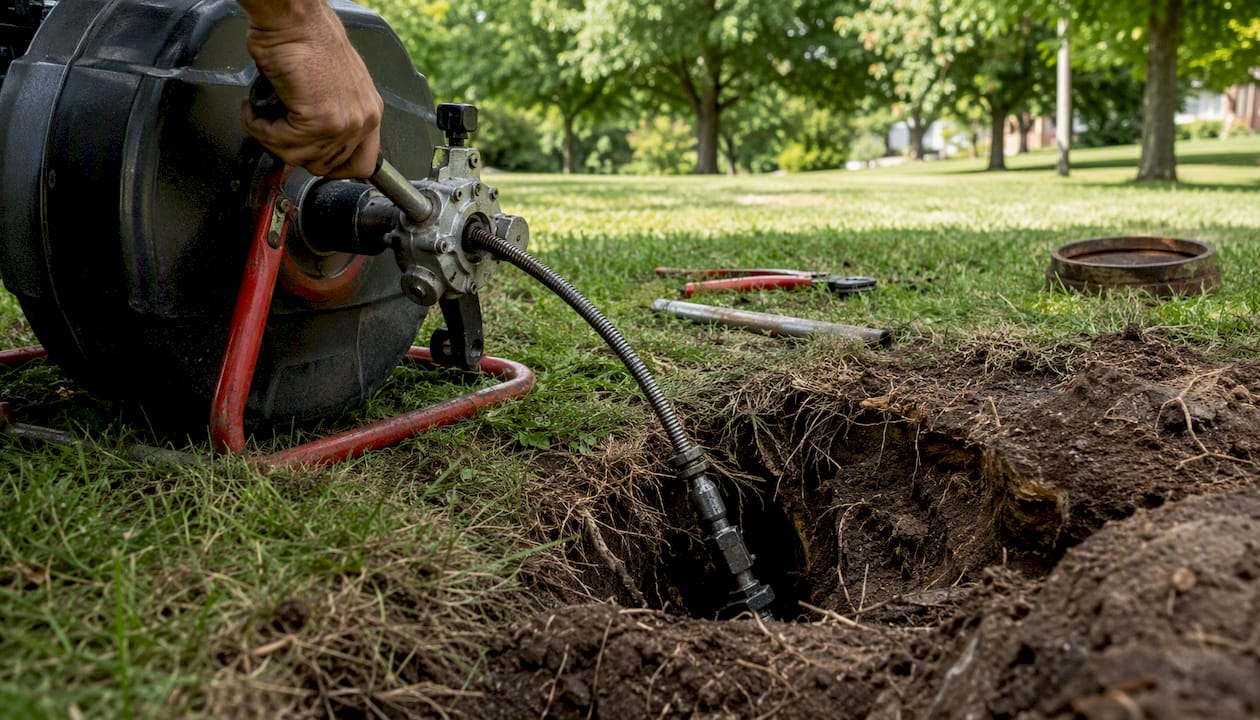
Hydro-jetting uses water at pressures typically between 1,500 and 4,000 PSI to scour the pipe interior. It removes fine root hairs, grease, and debris more thoroughly than a cutter alone. For heavy root masses, a cutter pass first followed by hydro-jetting gives the best result. Hydro-jetting is not appropriate for pipes that are already structurally fragile, since the pressure can worsen existing cracks.
Chemical root killers (copper sulfate crystals and foaming dichlobenil products) slow regrowth by killing root tissue at the pipe wall. They are not a standalone fix and carry environmental caveats: copper sulfate can harm aquatic life if it reaches waterways, and both products require careful handling. Professional application is the safer route, and some municipalities restrict their use.
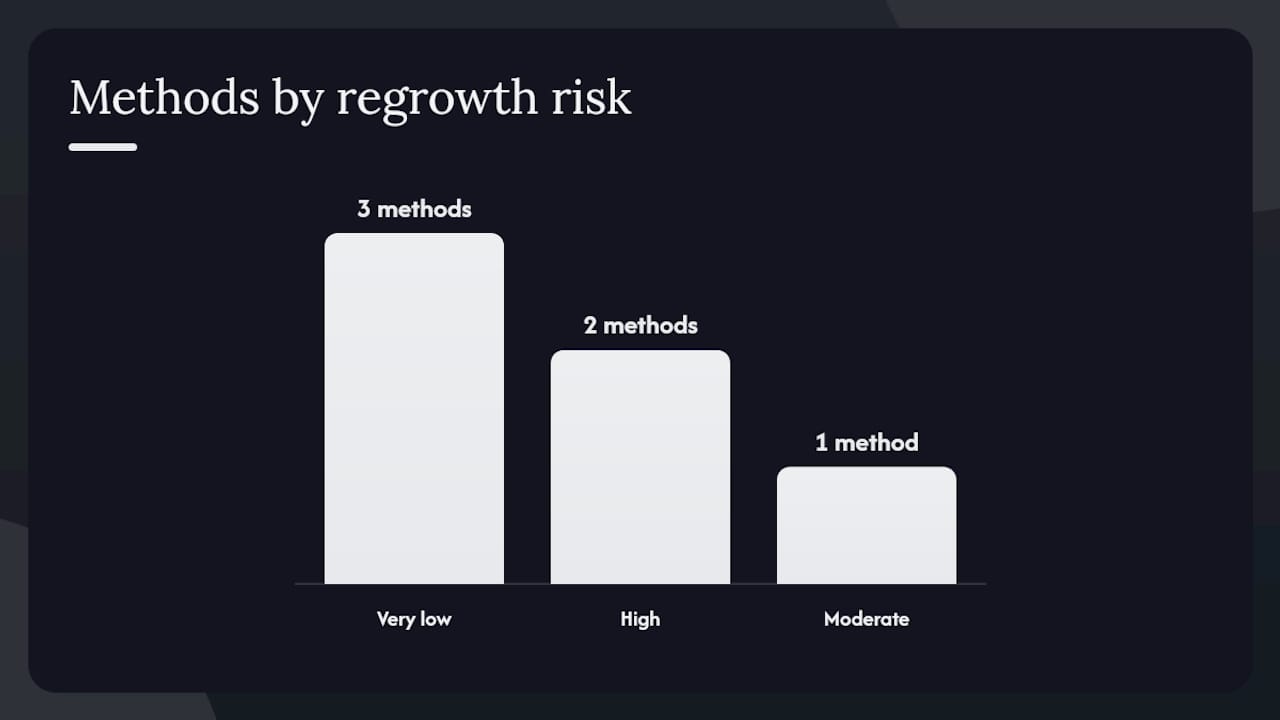
| Method | Speed | Typical Cost | Durability | Regrowth Risk | Environmental Note |
|---|---|---|---|---|---|
| Mechanical rodding | Same day | Low | Months | High | Minimal |
| Hydro-jetting | Same day | Low-moderate | Months | High | Minimal |
| Chemical root killer | Days to weeks | Low | 6–12 months | Moderate | Copper sulfate: aquatic risk |
| CIPP lining | 1–3 days | High | Permanent | Very low | Minimal |
| Pipe bursting | 1–3 days | High | Permanent | Very low | Minimal |
| Dig-and-replace | 3–7 days | Highest | Permanent | Very low | Site disruption |
According to US Forest Service research, roots cause over 50% of sewer blockages, and in small-diameter pipes, root removal every year or every other year is common when the pipe infrastructure is not replaced. That statistic alone makes the case for treating temporary clearing as a bridge, not a destination.
Permanent repair options: which one fits your situation?
The permanent fix is repairing the structural defect, not trimming the roots. Until the entry point is sealed, roots will return.
CIPP (cured-in-place pipe) lining is the most common trenchless option. A resin-saturated liner is pulled into the existing pipe and inflated against the walls, then cured with heat or UV light. The result is a smooth, jointless pipe inside the old one. It works well on pipes that are cracked or have separated joints but still retain their basic shape. It does not require digging up your yard, and the liner seals every joint along the run. The limitation: a pipe with severe offset joints, root-caused collapse, or significant diameter loss may not accept a liner.
Pipe bursting pulls a new pipe through the old one while simultaneously fracturing the host pipe outward. It replaces the pipe entirely without a full trench, making it a good option when the pipe is too damaged for lining but the soil conditions allow it. It requires access pits at each end of the run.
Spot repair makes sense when damage is limited to a short section, say 2–4 feet, and the rest of the pipe is in good condition. A small excavation exposes the defect, the damaged section is cut out and replaced, and the trench is backfilled. Faster and cheaper than full replacement when the problem is genuinely localized.
Dig-and-replace is the fallback for collapsed pipe, severe offset, or a lateral that has deteriorated beyond what any trenchless method can address. It is the most disruptive and expensive option, but it gives you a brand-new pipe with a known lifespan.
When tree removal is part of the plan, a certified arborist should be involved alongside the plumber. Removing a large tree after a pipe repair can disturb the repair zone, and the arborist can advise on root pruning risks and the safest removal sequence. For guidance on when a tree’s condition warrants removal, see signs your tree needs removal.
How much does it cost, and when should you stop clearing and just replace?
Temporary clearings are cheaper up front but can recur every 6–24 months. Lining or replacement costs significantly more initially but ends the cycle. Infrastructure research suggests root removal may cost roughly one-sixth the price of full pipe renewal, which means six or more clearing visits can approach or exceed the cost of a permanent fix.
Ranges reflect national averages; Central Florida pricing varies by access, depth, and pipe length.
When to stop clearing and commit to a permanent repair:
- You have had two or more clearing calls within 18 months
- The camera shows structural defects (cracks, offsets, partial collapse), not just root intrusion
- The pipe is clay tile or cast iron and more than 30 years old
- Multiple entry points are visible along the lateral
- Aggressive-rooting species (willow, silver maple) are within 20–30 feet of the line
Timeline from diagnosis to finished repair:
- Camera inspection: same day or next day
- Contractor quotes: 3–7 days
- Permit (if required by municipality): 1–2 weeks
- Cleaning and prep: same day as repair
- CIPP lining or pipe bursting: 1–3 days
- Dig-and-replace: 3–7 days plus site restoration
How to prevent tree roots from reaching your sewer line
Prevention centers on three things: reducing moisture leaks from the pipe, keeping aggressive species at a safe distance, and using barriers where planting near a lateral is unavoidable.
Planting distance and species selection:
- Keep willows, silver maples, and cottonwoods at least 30 feet from any lateral; their root systems routinely extend well beyond that at maturity
- For smaller ornamental trees, a 10-foot minimum is a reasonable starting point, but check mature root spread for the specific species
- Deep-rooting species (certain oaks, crape myrtles) are lower-risk near laterals than shallow-rooting ones
Root barriers:
- Vertical root barriers (solid or permeable fabric panels installed 18–24 inches deep) can redirect roots away from a lateral when installed at the time of planting
- They are far less effective retrofitted around an established tree because the root system already extends past the barrier zone
- Root barriers slow intrusion; they do not eliminate it if the pipe already leaks
Maintenance steps that actually reduce risk:
- Annual or biannual camera inspection for homes with clay tile or cast iron laterals, or with mature trees in the yard. Preventive inspections let homeowners fix small leaks before roots colonize the line
- Coordinate your plumber and arborist when replacing a lateral or planting new trees; the two plans need to account for each other
- After a root clearing, schedule a follow-up inspection at 12 months to catch regrowth before it causes another backup
Root pruning alone is not a reliable long-term strategy. Cutting surface roots does not stop the underground feeder roots that reach the lateral, and aggressive pruning can stress the tree without meaningfully reducing sewer risk. For a broader look at balancing tree health and property protection, tree root management guidance covers the trade-offs in detail.
Pro Tip: If you must plant a tree within 15 feet of a lateral, choose a deep-rooting, slow-growing species and install a vertical root barrier at planting time. Retrofitting a barrier around a mature tree rarely works.
Who pays for sewer line root damage?
The sewer lateral on your property is your responsibility, and standard homeowners policies generally exclude gradual damage like root intrusion. Most standard homeowners policies exclude damage from gradual causes such as tree root intrusion; the utility is only responsible for the main line in the street.
Homeowners should expect standard insurance to exclude root damage unless they purchase a specific sewer or service-line endorsement. These endorsements expand coverage to underground utility repairs and may carry their own deductible and coverage caps. Multiple insurance guidance sources consistently list root intrusion and gradual deterioration as excluded causes without an endorsement.
Steps to take if you are filing a claim or evaluating coverage:
- Pull your current policy and look for “service line,” “sewer backup,” or “underground utility” endorsements
- If you do not have one, ask your insurer what a service-line endorsement costs; for many homeowners with older pipes or mature trees, the annual premium is modest relative to a $10,000 repair
- Document everything: save the camera inspection footage, get at least two contractor estimates, and photograph any yard damage
- Check whether the endorsement has a separate deductible from your main policy
Insurance specialists recommend service-line endorsements particularly for homeowners with older pipes or mature trees, since base policies routinely exclude exactly this type of gradual damage.
Plumber or arborist: who do you call first?
Call a licensed plumber first for camera diagnosis and temporary clearing. Bring in a certified arborist when the tree itself needs to be managed, pruned, or removed as part of the solution. For anything beyond a simple clearing, you often need both.
Questions to ask your plumber:
- Does the service call include a camera inspection, or is that a separate charge?
- Will I receive the footage and a written scope of work?
- What is the warranty on the clearing or repair?
- Is the pipe a candidate for trenchless lining, or do you recommend excavation and why?
- Do you coordinate with arborists when tree removal is part of the plan?
Questions to ask a certified arborist:
- What is the likely root spread of this tree species at its current size?
- Can root pruning reduce sewer risk without seriously harming the tree?
- If the tree needs to come down, what is the safest sequence relative to the pipe repair?
- Are there lower-risk replacement species I could plant in the same location?
When to require a written scope that coordinates both trades:
- The repair plan includes CIPP lining or pipe bursting AND a tree within 15 feet of the lateral
- Tree removal is planned after a pipe repair (excavation or root disturbance can compromise a fresh liner)
- A large tree is being root-pruned; the arborist should sign off before the plumber cuts anything underground
Contractor red flags:
- No camera inspection offered before recommending a repair
- Unwilling to provide footage or a written scope
- Vague timeline with no permit discussion
- Pressure to decide on the spot without a second bid
A video inspection should be the starting point for any contractor you hire. If they skip it, so should you.
An arborist’s perspective on managing roots and sewer lines
The most durable outcomes come from managing the tree and the pipe together, not treating them as separate problems.
In Central Florida, the species that show up most often in sewer calls are laurel oaks, water oaks, and ficus varieties, all of which have shallow, wide-spreading root systems well suited to finding moisture in aging clay laterals. What most homeowners do not realize is that by the time they get a backup, the root mass inside the pipe has usually been growing for a year or more. The pipe was already leaking; the tree just found it.
The plumber clears the line and the homeowner assumes the problem is solved. Six months later, the drain slows again. That cycle ends only when the pipe is sealed. A certified arborist’s role in that process is to assess whether the tree can stay, whether strategic root pruning is viable without destabilizing it, and whether removal is the cleaner long-term answer. Those are not decisions a plumber is trained to make, and they are not decisions a homeowner should make without a site assessment.
Mcculloughtreeservice works alongside plumbing contractors on exactly these situations: camera inspection identifies the structural defect, we assess the tree, and the repair plan accounts for both. That coordination is what prevents a $6,000 lining job from being undermined by a root system that was never addressed.
Get a certified arborist assessment in Central Florida
When your sewer line has a root problem, the pipe repair is only half the answer. Mcculloughtreeservice provides certified arborist evaluations in Orlando and Central Florida, coordinated with your plumbing contractor so the tree side of the plan does not undo the pipe side.
Before the arborist visit, have these ready: the camera inspection footage (or schedule one first), the location of your cleanout and sewer path, the names or photos of trees within 30 feet of the lateral, and any previous service records. That information lets the arborist give you a specific recommendation rather than a general one.
From there, the plan may include root pruning, tree removal, crown trimming to reduce root vigor, or stump grinding after removal to eliminate the remaining root system. Every recommendation is backed by ISA-certified credentials. Request a site visit or estimate at Mcculloughtreeservice.
Sources
The recommendations in this article draw on infrastructure research, municipal guidance, insurance industry guidance, and plumbing trade resources. The most useful primary sources:
- Tree Roots in Your Sewer Line: Signs & How to Fix It | Contour
- Does Homeowners Insurance Cover Sewer Line Replacement? Plus Other Protection Options | GEICO
- Does Homeowners Insurance Cover Sewer Line Replacement? (2026) | MoneyGeek
- How to Get Rid of Roots in Your Sewer Pipes | Oatey
Recommended
- Deep Root Fertilization: Boost Your Tree’s Health Today
- Check Out Our Videos – McCullough Tree Service
- Tree root management: protect your property and trees
- Check Out Our Videos – McCullough Tree Service