By: Shelby McCullough| Published: August 29, 2026
Require proof of active general liability and workers’ compensation coverage before any crew touches your trees, and get that proof directly from the insurance carrier, not a PDF the contractor emails you. Ask for a Certificate of Insurance on the ACORD 25 form, confirm limits of at least $1 million per occurrence, and call the issuing agent to verify it’s real. Commercial or municipal jobs often demand higher limits and specific endorsements, and McCullough Tree Service builds its paperwork around exactly this standard.
TL;DR:
- Verify the contractor’s insurance directly with the insurer using the ACORD 25 form to ensure coverage limits meet or exceed $1 million per occurrence for general liability.
- Confirm that a valid endorsement, such as additional insured or primary and non-contributory wording, is included to protect against third-party claims.
- Ensure coverage dates are current, the policy explicitly covers tree work, and the company’s name matches the insured on the certificate before authorizing work.
- Beware of red flags like expired policies, refusal from insurers to send certificates directly, vague coverage language, or claims that its climbers are independent contractors.
- For high-risk or larger jobs, push for higher coverage limits, especially around structures, roads, utilities, or when heavy equipment is involved.
Table of Contents
- What insurance should a tree service have at minimum?
- How do you verify a certificate of insurance?
- Why endorsements matter more than the certificate alone
- How much coverage is enough for the job?
- What are the red flags that mean you should walk away?
- Why we verify our own paperwork before every job
- Get your certificate of insurance before the crew arrives
- Where to double-check the details yourself
- Sources
What insurance should a tree service have at minimum?
Four types of coverage matter, and each one protects you from a different kind of financial exposure. Skip any of them and you’re the one holding the bag if something goes wrong.
General liability covers third-party property damage and bodily injury caused by the crew’s work. If a falling limb cracks your neighbor’s fence or a rigging line snaps and shatters a window, this policy pays the claim instead of you. Most reputable tree services carry at least substantial general liability coverage per occurrence, and you should treat anything lower as a warning sign.
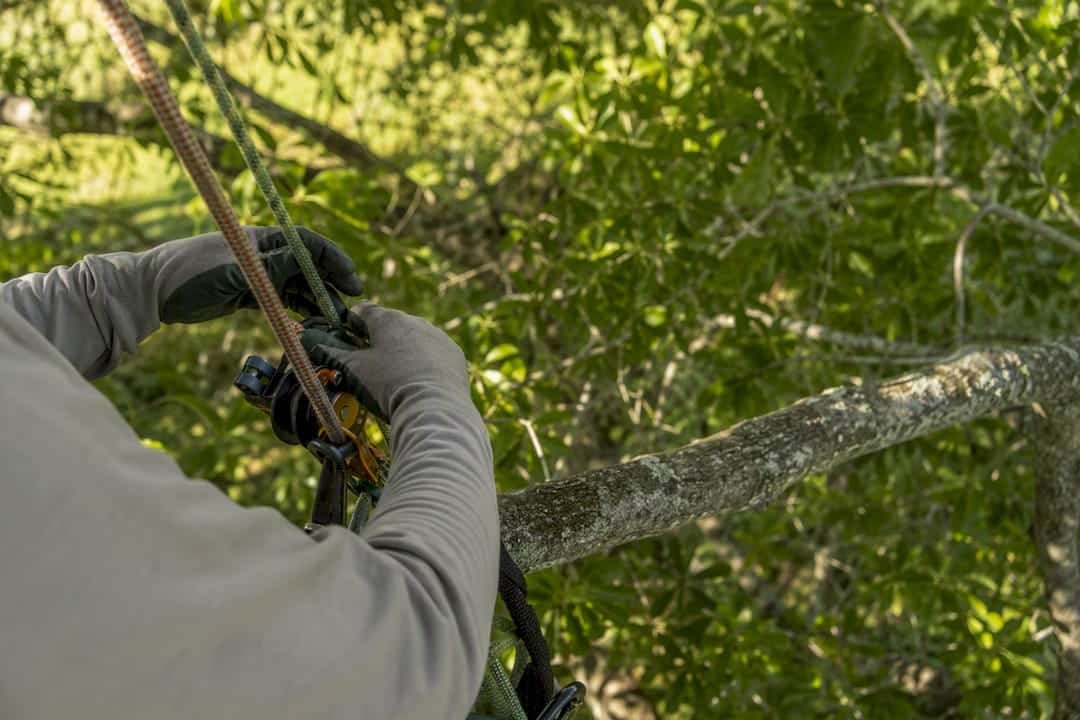
Workers’ compensation protects you from liability if a crew member gets hurt on your property. Tree work involves chainsaws, wood chippers, and people working 60 feet up in a canopy, so injuries happen more often than in most trades. Without workers’ comp, an injured worker (or their family) can potentially sue the property owner directly. Most states require this coverage for any business with employees, and a company claiming its climbers are “independent contractors” to dodge it should raise immediate concern.
Commercial auto insurance matters when the crew drives company trucks, chip trucks, or trailers onto your property or public streets. Personal auto policies typically exclude business use, so this isn’t optional for any legitimate operation.
Umbrella or excess liability, along with inland marine coverage for cranes, bucket trucks, and stump grinders, becomes relevant on larger or higher-risk jobs. A homeowner trimming one oak tree may not need to ask about umbrella coverage. A property manager hiring a crew to remove five mature pines near a parking structure absolutely should.
- General liability: minimum coverage per occurrence
- Workers’ compensation: required wherever the crew has employees
- Commercial auto: required if vehicles operate on-site
- Umbrella/excess: worth requiring for complex or high-value jobs
How do you verify a certificate of insurance?
A Certificate of Insurance means nothing if you can’t confirm it’s current, accurate, and tied to a real policy. Fraudulent and expired certificates circulate in the tree care trade more often than homeowners realize, which is exactly why the ACORD 25 form exists as a standardized way to check.
- Request the COI directly from the insurer or agent, not from the contractor’s inbox. Ask the company for its agent’s name and phone number, then have the agent email the certificate to you. Most agents can turn this around within hours during business hours.
- Check the named insured. The business name on the certificate must match the legal name of the company you’re hiring, word for word. A mismatch often means you’re looking at someone else’s policy.
- Confirm the policy dates. Look at the effective and expiration dates. A certificate that expired last month is worthless, no matter how official it looks.
- Review coverage lines and limits. The COI should list general liability, workers’ compensation, and auto coverage with dollar limits spelled out, not just checked boxes.
- Read the Description of Operations field. This section should specifically reference tree work or arboricultural services. A policy written for generic landscaping may exclude aerial tree operations entirely.
- Call the agent and confirm the policy is active. Ask directly: “Does this policy cover tree trimming and removal, including work performed above ground level?” A hesitant or vague answer is itself useful information.
Pro Tip: Keep the agent’s direct contact information on file even after the job is booked. If a claim ever comes up, you want a real person to call, not a customer service line that has never heard of your job.
Why endorsements matter more than the certificate alone
A COI is a summary. The endorsement is the actual contract language that extends coverage to you, and one without the other leaves you exposed.
- Additional insured: this endorsement adds you or your property to the contractor’s policy so you’re covered if a third party sues over damage the crew caused. A note in the Description of Operations field is not the same thing. The underlying endorsement has to actually exist, and you’re entitled to ask for a copy.
- Primary and non-contributory (P&NC) wording means the contractor’s policy pays first, before your own homeowner’s or commercial policy gets touched. Without it, insurers can fight over who pays, and you get stuck in the middle.
- Waiver of subrogation stops the contractor’s insurer from turning around and suing you to recover what it paid out on a claim.
- Common ISO forms worth recognizing include CG 20 10 and CG 20 37 (ongoing and completed operations, respectively), plus CG 20 12 and CG 20 26, which define how broadly the additional insured protection extends.
Ask your contractor’s agent which forms back their policy. If they can’t answer, that’s your answer.
How much coverage is enough for the job?
Coverage limits should scale with what’s actually at risk on the property, not a flat number every contractor quotes.
- Residential jobs: $1 million per occurrence and $2 million aggregate is the common industry baseline, and it covers the overwhelming majority of homeowner situations.
- Commercial property or larger crews: push for higher limits, especially when heavy equipment, cranes, or multiple trucks are on-site at once.
- Municipal or utility line-clearance work: these contracts frequently require $1 million to $5 million in limits, along with specific endorsements tied to work near power lines or public infrastructure.
- Jobs near structures, roads, or utilities: treat this as a trigger to ask for higher limits regardless of whether the property itself is residential or commercial.
What are the red flags that mean you should walk away?
Some warning signs show up before a saw ever starts. Trust them.
- The contractor refuses to have the insurer send the COI directly and only offers a forwarded PDF.
- Coverage language is vague, or the company can’t name its insurance carrier.
- Policy dates are expired or set to expire mid-project.
- The company claims its climbers are independent contractors to avoid carrying workers’ comp.
- A crew shows up unsolicited after a storm offering cash deals and quick cleanup.
If any of these show up, don’t sign anything. Ask for insurer verification in writing, request a different crew, and get a scope of work on paper before committing. An uninsured worker injured on your property can become your legal and financial problem, not the contractor’s.
Pro Tip: If a contractor tells you “we’ve never needed insurance for a job like this,” treat that sentence as a full stop, not a negotiating point.
Why we verify our own paperwork before every job
Tree work sits among the most hazardous occupations tracked by federal labor data, and that reality shapes how McCullough Tree Service operates. We carry active general liability and workers’ compensation, our agents send COIs directly to clients on request, and our crews include ISA certified arborists trained for exactly the elevated, high-risk work this article covers. Use the checklist above before you hire anyone, including us.
— Results
Get your certificate of insurance before the crew arrives
McCullough Tree Service builds every estimate around the same paperwork this article just walked through: an insurer-sent ACORD 25, active general liability and workers’ compensation that specifically cover tree operations, and additional insured status added whenever a contract calls for it. That’s the difference between a company that hands you a certificate and one that lets you verify it directly with the agent.
If you’re weighing bids for tree trimming or a larger tree removal project, request a Certificate of Insurance and proof of certified arborist credentials before you sign anything. Central Florida homeowners and property managers can schedule an on-site assessment, get a written scope of work, and confirm coverage limits match the size of the job, all before a single branch comes down.
Where to double-check the details yourself
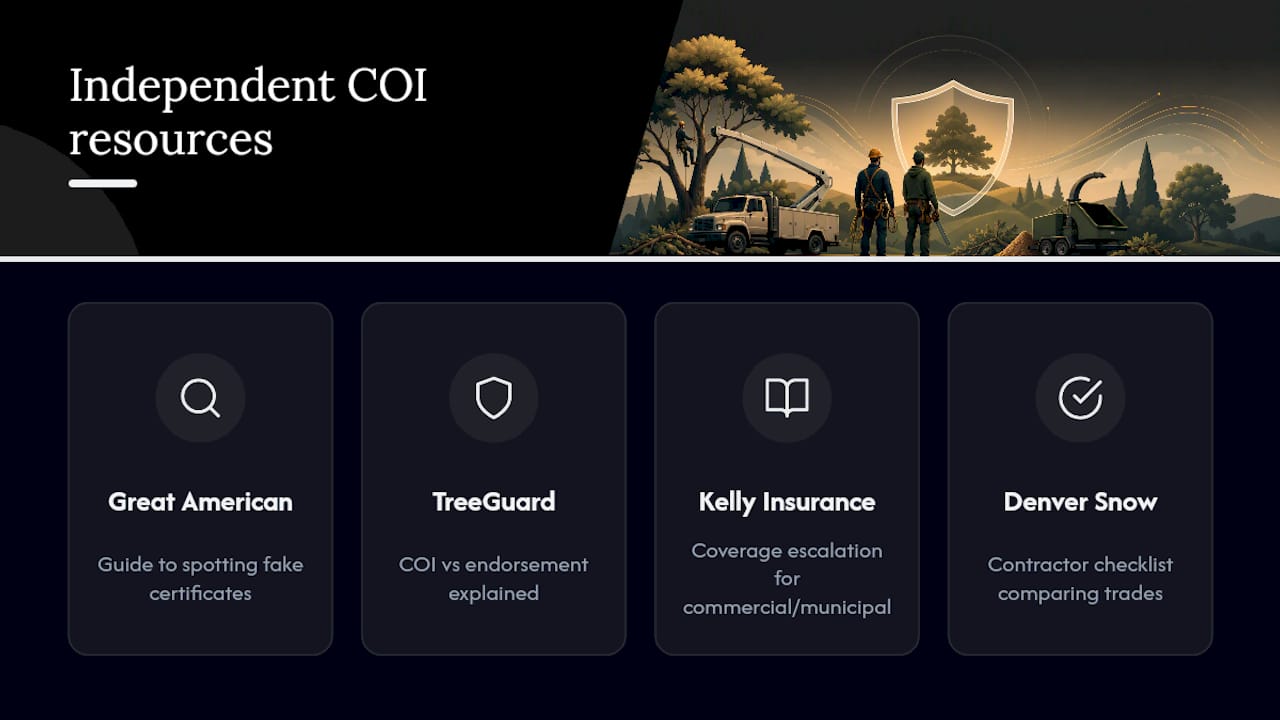
A few outside resources are worth bookmarking if you want to verify any of this independently. Great American Insurance Group’s guide to spotting fake certificates walks through common COI fraud patterns. TreeGuard Insurance’s COI breakdown explains the difference between a certificate and an endorsement in more detail, and Kelly Insurance Group’s coverage guide covers how commercial and municipal requirements typically escalate. For a broader look at how insurance verification works across other property-service trades, Denver Snow Removals’ contractor insurance checklist offers a useful comparison point.
Sources
- How to spot a fake certificate of insurance | Great American Insurance Group
- Tree service certificate of insurance (COI) guide | TreeGuard Insurance
- Tree service insurance requirements | Kelly Insurance Group
Recommended
- Insured Tree Service – Why It Protects Orlando Homeowners
- Tree Service Financing for Tree Removal & Trimming
- Commercial Tree Removal Documentation Tips for Managers