By: Shelby McCullough| Published: May 30, 2026
TL;DR:
- Many homeowners mistakenly believe that arborists only trim trees, which can lead to costly issues without proper assessments. An arborist consultation involves a detailed evaluation of tree health, structure, and risk, providing documented recommendations to prevent storm damage and unsafe conditions. Certified arborists deliver proactive property management advice, helping homeowners make informed decisions and avoid unnecessary tree removal or emergency repairs.
Most homeowners assume an arborist just trims trees. That assumption costs people money every year. An arborist consultation, formally known as a tree risk assessment or consulting arborist evaluation, is a structured professional process where a certified arborist inspects your trees, documents their health and structural condition, and gives you a clear plan for what to do next. It goes far beyond aesthetics. Understanding what this service actually covers, and when to use it, is the difference between proactive property management and expensive emergency calls after the next storm.
Table of Contents
- Key takeaways
- What is arborist consultation, step by step
- The real benefits of getting an arborist consultation
- Signs you should schedule an arborist consultation
- How to prepare for your consultation and what to expect
- Understanding arborist reports and documentation
- What most homeowners get wrong about consultations
- Work with certified arborists who know Central Florida trees
- FAQ
Key takeaways
| Point | Details |
|---|---|
| More than a visual check | Consultations include structural integrity assessment, disease diagnosis, and formal risk ratings. |
| Written report included | You receive documented findings and prioritized recommendations, typically within 3 to 5 business days. |
| Prevention saves money | Early identification of hazards through proactive assessment avoids costly emergency removals and storm damage. |
| Timing matters | Schedule a consultation after storm damage, before construction work, or when you notice symptoms like dead branches or discolored foliage. |
| Certification counts | Always work with an ISA-certified arborist to get accurate, defensible assessments for your property. |
What is arborist consultation, step by step
A consulting arborist evaluation is a formal service, not a sales call. The distinction matters. When a tree service company sends someone to quote you on trimming, that is a sales visit. A true arborist consultation is an independent or professionally structured assessment designed to give you accurate information, not upsell you on work you may not need.
The consultation process typically begins with an on-site visit where the arborist inspects each tree you want evaluated. According to the ISA Certified Arborist consulting framework, the initial inventory covers species identification, health evaluation, structural integrity review, and proximity to structures or utilities.
Here is what happens during a standard on-site visit:
- Species and age assessment: The arborist identifies the tree species and estimates its age and growth stage, which directly affects risk levels and care recommendations.
- Health evaluation: This includes looking for fungal growth, root damage, discolored or dropping foliage, cavities in the trunk, and signs of pest infestation.
- Structural integrity check: The arborist examines branch attachment angles, co-dominant stems, included bark, and any visible cracks or decay.
- Site context review: Proximity to your home, utility lines, driveways, and fences factors into the risk picture. A tree with decay that leans toward open lawn is different from one leaning toward your roof.
- Risk rating assignment: Assessments assign a risk rating based on the likelihood of failure and the consequences if failure occurs. This is not a pass/fail system. It is a spectrum.
The entire on-site inspection takes roughly 1 to 2 hours depending on property size and tree count. After the visit, you typically receive a written report within 3 to 5 business days outlining findings, risk ratings, and recommended mitigation steps.
Pro Tip: Ask upfront whether your consultation includes a written report. Some informal visits do not. If you need documentation for insurance, permitting, or a real estate transaction, you need a decision-grade report with photos and formal risk ratings, not just verbal advice.
The real benefits of getting an arborist consultation
A lot of property owners treat tree care reactively. They call someone only after a branch falls or a tree looks dramatically sick. Here is why that approach is costly, and what you gain by getting ahead of it.
- Hazard identification before failure: Proactive minor interventions that catch dead or decaying branches early are considered the gold standard in professional arborist care. You address a small problem with a small fix, instead of dealing with a fallen limb through your fence.
- Cost savings over time: Proactive assessment and maintenance reduces the risk and expense tied to emergency removals and storm-related property damage. Emergency work costs significantly more than scheduled maintenance.
- Species-specific care advice: Not every tree responds the same way to pruning or treatment. An arborist gives you recommendations tailored to the specific species on your property, not generic advice.
- Informed decision making: When a tree looks concerning, you have two options without professional advice: do nothing or cut it down. A consultation gives you a third option, which is knowing exactly what is happening and what proportionate response makes sense.
- Peace of mind: If a large oak sits 15 feet from your living room, knowing its structural condition and risk level is genuinely useful. Property safety concerns are real in Central Florida, especially heading into hurricane season.
The arborist services explained in a formal consultation extend well beyond what most homeowners expect. Think of it as a medical checkup for your trees. You do not wait until someone is in an ambulance to see a doctor.
Signs you should schedule an arborist consultation
There are two reasons to call an arborist. Either you noticed something that concerns you, or you have not and you should check anyway. Both are valid. Recognizing the specific triggers helps you act at the right time rather than too late.
- Dead or dying branches: Visible deadwood, especially large limbs in the upper canopy, is a structural hazard waiting to become a yard incident or a roofing repair bill.
- Discolored or sparse foliage: Yellow leaves outside of fall, brown patches, or abnormally thin canopy cover can signal nutrient deficiency, root stress, disease, or pest activity.
- Fungal growth at the base: Mushrooms or conk growth around the root flare or on the trunk signal internal decay. This one is often more serious than it looks.
- After major storm damage: Following a hurricane or severe thunderstorm, trees that appear structurally sound from the outside can have hidden splits or root disturbance. A post-storm evaluation is a smart call in storm-prone regions like Orlando.
- Before construction or landscaping work: If you are planning to add a pool, extend a driveway, or build a structure near existing trees, a consultation helps you understand the impact on root systems and whether preservation or removal is the better path.
- Routine property safety inspections: Scheduling regular checkups with a certified arborist, even when no visible symptoms are present, is the professional standard for long-term property management.
Pro Tip: Do not wait until a tree looks like a problem. Florida’s storm season runs June through November. Getting a consultation in the spring gives you time to act on any recommendations before the weather turns.
How to prepare for your consultation and what to expect
Walking into a consultation prepared makes the whole visit more useful. The arborist gets better context, and you get more specific answers.
Before your appointment, gather a few things:
- A list of the trees you want evaluated, including approximate location on the property. If you have a site map, even a rough hand-drawn one, that helps.
- Any known history of the trees, such as previous trimming work, past storm damage, or treatments applied. Even rough timelines help the arborist interpret what they see.
- Your specific concerns and questions written down. Clients who come prepared with questions get significantly more value from their consultation than those who leave it open-ended.
- Documentation needs, meaning whether you need the report for personal use, insurance purposes, a property sale, or a permit application.
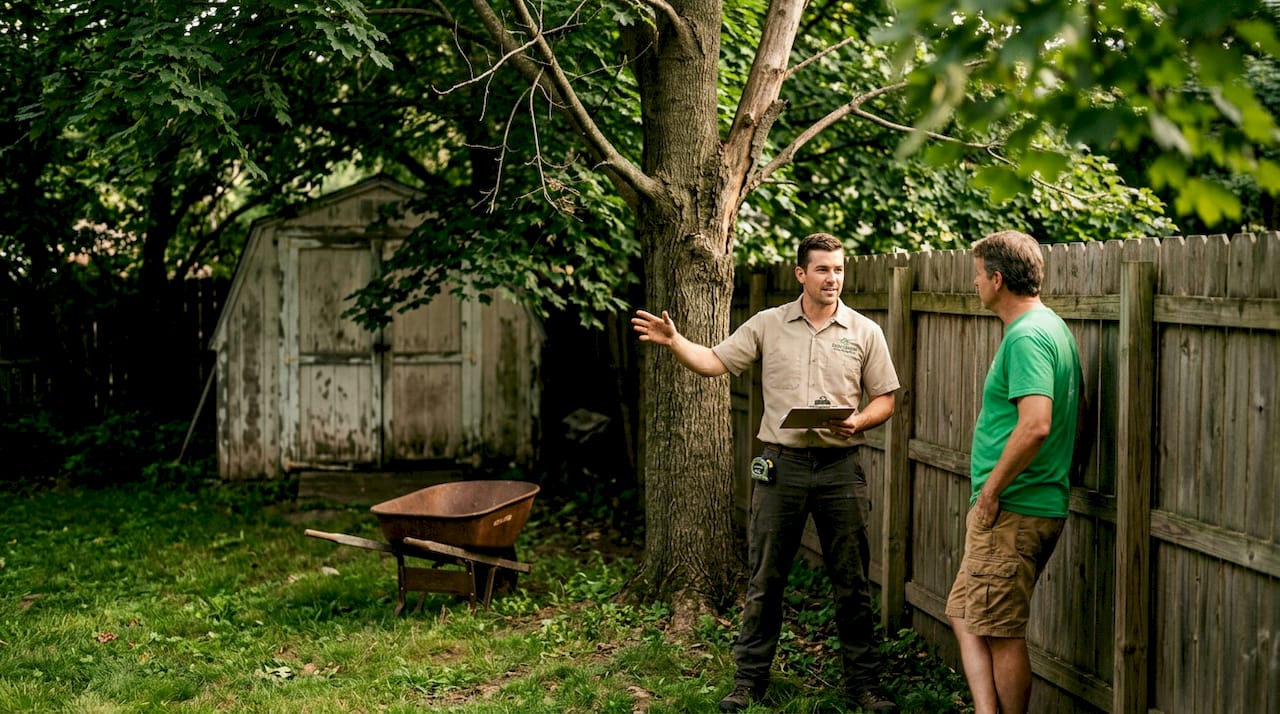
During the visit, walk the property with the arborist rather than leaving them to work alone. Ask questions in real time. Good questions include: What is the biggest risk you see here? What would you do if this were your property? Is there anything I can do myself to support tree health between visits?
After the visit, you will receive a formal written report with findings and recommendations. Read it carefully and ask for clarification on anything you do not understand before authorizing any work.
Understanding arborist reports and documentation
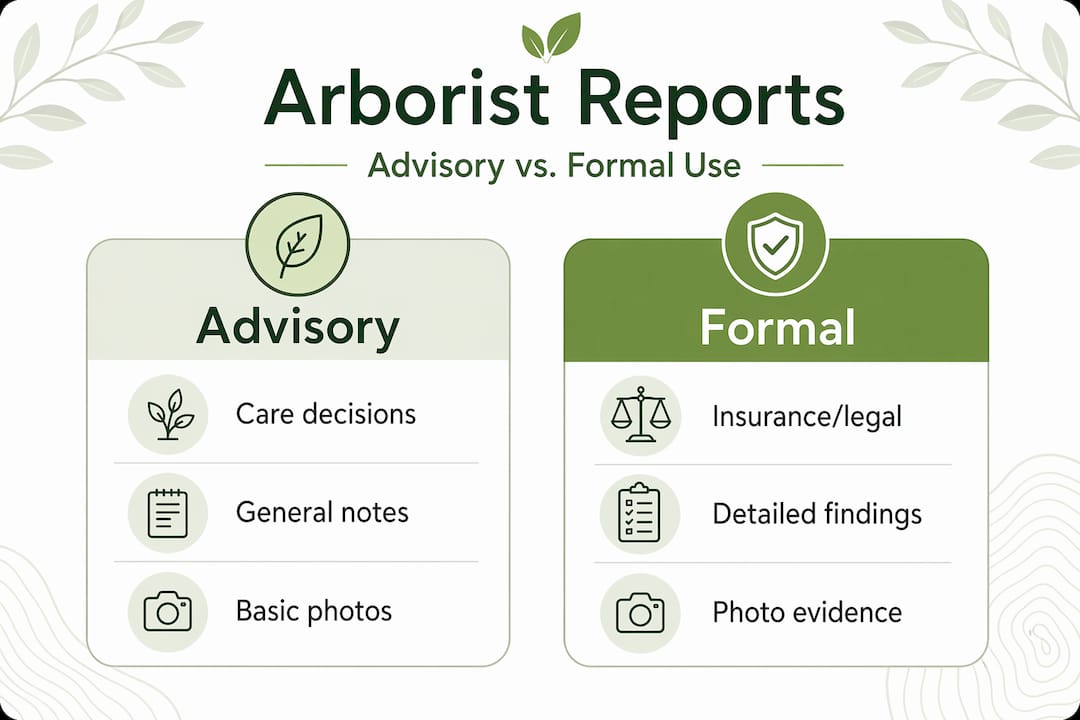
Not all arborist reports are the same, and understanding the difference prevents confusion and frustration.
| Report Type | Purpose | Level of Detail |
|---|---|---|
| Basic advisory report | Personal tree care decisions | Summary of findings, general recommendations |
| Risk assessment report | Safety and maintenance planning | Risk ratings, mitigation priorities, condition photos |
| Legal or insurance grade report | Insurance claims, litigation, permits | Formal methodology, photographic evidence, detailed risk analysis |
| Tree inventory report | Property management or permitting | Species data, regulatory implications, preservation planning |
Formal reports for insurance or legal purposes are more detailed and require decision-grade documentation, including photos and standardized risk ratings. If you are purchasing a property with mature trees, involved in a neighbor dispute, or filing an insurance claim, a basic advisory summary will not be enough.
Professional arborist inventories go beyond simple tree counts. They include species identification, condition evaluation, and regulatory implications, which is exactly what you need for permitting and preservation planning on larger properties or land development projects.
What most homeowners get wrong about consultations
I have seen two patterns repeat themselves in this industry. The first is homeowners who panic over a tree that looks a little rough and immediately want it removed. The second is homeowners who genuinely have a hazardous tree and convince themselves it is fine because it has been there for 30 years.
Both of those instincts lead to bad outcomes. What I have learned from seeing hundreds of assessments is that alarm-driven tree cutting is counterproductive. Aggressive pruning weakens trees over time. A certified arborist focuses on proportionate interventions that preserve what can be preserved and remove what genuinely needs to go.
The other thing I see underestimated is how much a good consultation prevents. Not just storm damage or injury, but the financial and emotional cost of losing a mature tree you could have saved with a targeted treatment two years earlier. Trees are long-term assets. A 40-year-old oak adds real value to your property and your neighborhood. Treating it as a liability the moment it shows a symptom is short-sighted.
A consultation does not always result in work being recommended. Sometimes the answer is just monitor it and check back in a year. That outcome is worth the consultation fee on its own.
— Mcculloughtreeservice
Work with certified arborists who know Central Florida trees
If you have read this far, you already understand more about the arborist consultation process than most property owners in Orlando. The next step is putting that knowledge to work with professionals who can actually assess your specific trees.
Mccullough Tree Service has ISA-certified arborists on staff who perform formal tree risk assessments and provide written documentation for both residential and commercial properties. Whether you need a routine safety evaluation, are recovering from storm damage, or want to plan proactive care before hurricane season, the team can help. From professional tree trimming to full tree removal services, every service starts with an honest, expert assessment of what your trees actually need. Reach out to schedule a certified arborist consultation and get a clear picture of where your property stands.
FAQ
What does an arborist consultation include?
A standard arborist consultation includes an on-site tree inspection covering health, structural integrity, species identification, and risk evaluation. You typically receive a written report with findings and prioritized recommendations within 3 to 5 business days after the visit.
How much does an arborist consultation cost?
Fees vary based on property size, number of trees, and report type required. Some arborists offer free initial consultations for existing clients during slower periods, while formal legal or insurance-grade assessments carry higher fees due to documentation requirements.
How do I choose a qualified arborist?
Look for ISA (International Society of Arboriculture) certification, which confirms the arborist has passed standardized competency testing and maintains ongoing education. Verify their license and insurance before any work is authorized on your property.
When should I get a tree risk assessment?
Schedule an assessment after storm damage, before construction near trees, when you notice symptoms like dead branches or discolored foliage, or as part of routine annual property maintenance. Spring is ideal in Florida, ahead of hurricane season.
Is an arborist report the same as a tree removal quote?
No. An arborist report is an independent professional assessment of tree health and risk. A removal quote is a pricing document for a specific service. Mixing up the two often leads homeowners to authorize unnecessary removals when a targeted treatment or minor pruning would have been sufficient.
Recommended
- Defining Arborist Reports: What Property Owners Need to Know
- Certified Arborist – McCullough Tree Service
- Role of Arborists in Landscaping Success for Florida