By: Shelby McCullough| Published: May 28, 2026
TL;DR:
- Tree bracing is a structural support technique involving rigid steel rods to reinforce weak or damaged tree sections, extending their safe lifespan. It is most effective when combined with proper installation, ongoing inspections, and professional assessment by ISA-certified arborists; bracing does not eliminate risk entirely. Regular maintenance and understanding the limitations of bracing help property owners make informed decisions about preserving valuable trees.
Tree bracing is one of the most misunderstood tools in arboriculture. Many property owners assume that what is bracing in tree care is essentially a guarantee against failure. It isn’t. Bracing is a structural support method that reinforces weak or damaged tree sections using rigid hardware, buying time and reducing risk rather than eliminating it entirely. If you have a large tree with a splitting crotch, a codominant stem, or storm damage you don’t want to lose, understanding how bracing works will help you make smarter decisions about protecting it.
Table of Contents
- Key takeaways
- What is tree bracing: definition and components
- When and why you would brace a tree
- Installation standards and mistakes to avoid
- Maintenance and lifespan of bracing systems
- Comparing bracing with other tree support methods
- My take on what most homeowners get wrong about bracing
- Protect your trees with McCullough Tree Service
- FAQ
Key takeaways
| Point | Details |
|---|---|
| Bracing vs. cabling | Bracing uses rigid steel rods at the defect; cabling uses flexible cables higher up to limit movement. |
| Not a permanent fix | Properly installed bracing extends safe tree life 10 to 20 years but requires regular inspection. |
| Certified arborists only | ISA-certified professionals follow ANSI A300 standards to avoid redirecting stress or creating new hazards. |
| Common use cases | Codominant stems, split crotches, storm-damaged trees, and high-value trees where removal isn’t preferred. |
| Maintenance matters | Hardware has a limited lifespan and must be incorporated into your annual tree care schedule. |
What is tree bracing: definition and components
Tree bracing is the practice of installing rigid steel rods through a weak union, split crotch, or structurally compromised section of a tree’s trunk or limbs to hold those parts together and resist the forces that would otherwise pull them apart. Think of it as internal hardware for your tree, the way a surgeon might use screws and plates to stabilize a fractured bone.
Here is what bracing in tree care actually involves:
- Threaded steel rods drilled through the defective union perpendicular to the split, anchored with large washers and nuts on both sides
- Lag bolts used in some configurations to attach external support brackets to the trunk
- Dead-end or through-bolts depending on the diameter of the stem and the severity of the defect
- Documentation of rod placement so future inspectors and arborists understand the load path and can assess changes over time
One thing that trips up a lot of property owners is the distinction between bracing and cabling. They are related but not the same. Bracing addresses the defect directly, working at the point of weakness. Cabling, by contrast, uses flexible high-strength cables installed higher in the canopy to redistribute stress across larger limbs and limit how far they can move during wind or heavy loading. Both are legitimate tree bracing techniques, but they solve different problems. A tree with a splitting crotch near the base needs bracing. A tree with a heavy lateral limb that’s prone to breaking during storms may need cabling, or both.
Pro Tip: If you see a tree with a visible crack running vertically through a union and the two stems are spreading apart, that’s a split crotch. That tree needs a bracing assessment before the next storm season, not just a trim.
When and why you would brace a tree
Not every tree needs bracing, and not every weak tree should be braced. Bracing is most appropriate for codominant stems, split crotches, large overextended limbs, and trees recovering from storm damage where the structural defect is significant but the tree is otherwise healthy and worth preserving.
Here are the most common situations where bracing makes sense:
- Codominant stems. Two main stems growing at roughly equal diameter from the same point create a weak union. As each stem grows and expands, they push against each other and can split violently during a storm. Bracing ties them together at the union.
- Split crotches. A crotch that has already begun to crack open is an active failure in progress. A rod through the split doesn’t reverse the damage, but it slows or stops further separation.
- Storm-damaged trees. After a significant weather event, trees can fracture partially without fully breaking. If the rest of the tree is structurally sound and the damaged section is worth saving, bracing can stabilize it while the tree responds biologically. McCullough Tree Service handles this kind of assessment regularly as part of storm damage recovery in Central Florida.
- High-value or heritage trees. When a tree has significant aesthetic, ecological, or sentimental value and removal would be a major loss, bracing extends the viable lifespan even when the structure isn’t perfect.
The benefits of tree bracing are real, but so are the limits. Bracing reduces the probability of failure. It does not eliminate it. Trees are living organisms that continue to grow, respond to stress, and change over years. A brace rod installed today will eventually be surrounded by expanding wood tissue and will need reassessment. Property owners who treat bracing as “done and forgotten” are the ones who end up surprised when a problem returns.
Installation standards and mistakes to avoid
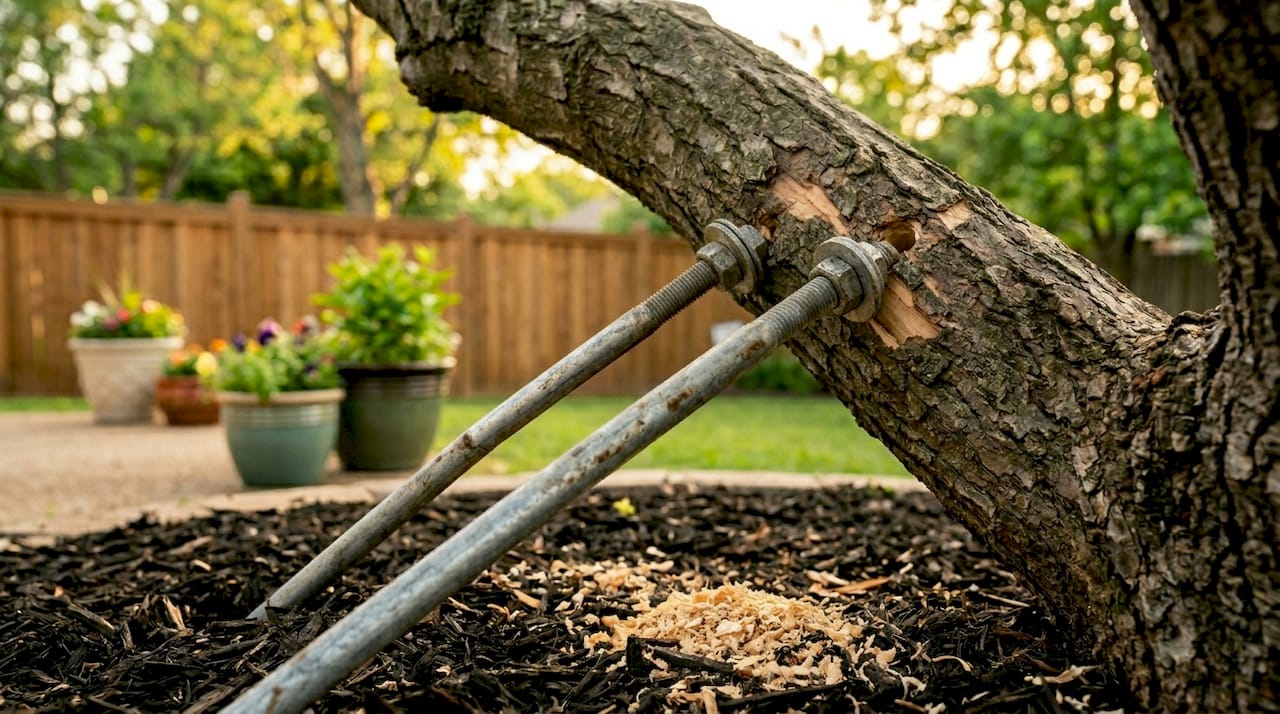
This is where the explanation of tree bracing systems gets more serious. Bracing is not a DIY project. Installation must follow ANSI A300 Part 3 standards, which specify hardware types, placement requirements, load ratings, and documentation protocols. Deviating from these standards doesn’t just reduce effectiveness. It can actively make the situation worse.
The most dangerous mistake is incorrect rod placement. When a rod is placed in the wrong location or at the wrong angle, it can redirect failure forces rather than absorb them. A stem that would have fractured cleanly at the split might instead lever against the rod and tear a much larger section of the trunk. That’s a worse outcome than no bracing at all.
Other common mistakes include:
- Undersized hardware. Using rods that are too small for the stem diameter or the expected load creates false security without meaningful strength.
- Failure to document. Without documentation of rod placement, future arborists inspecting the tree can’t assess whether the installation is still appropriate or whether the tree has grown around it in a way that changes the load path.
- Skipping follow-up inspections. Bracing installed without a maintenance plan is half a job. The tree changes. The hardware doesn’t.
- Bracing a tree that should be removed. Sometimes the structural defect is too severe, the tree’s health too poor, or the risk too high for bracing to be a reasonable option. An honest arborist will tell you this upfront.
ISA-certified arborists bring the combination of tree biology knowledge, structural assessment skills, and hardware installation experience needed to do this correctly. Certification matters here specifically because bracing is as much an engineering problem as it is a tree care practice.
Pro Tip: Always ask your arborist for a written report after bracing installation. It should include rod diameter, placement location, hardware specifications, and a recommended inspection schedule. That document is worth keeping.
Maintenance and lifespan of bracing systems
One of the most overlooked aspects of tree bracing is aftercare. Property owners often think installation is the endpoint. It’s actually the beginning of a long-term management relationship with that tree.
Steel brace rods typically remain structurally useful for many years, but hardware has a limited lifespan and the tree around it keeps changing. What to watch for:
- Corrosion or rust on exposed hardware ends, which can weaken the rod over time in humid climates like Central Florida
- Bark occlusion where the tree’s wood tissue grows over the washers or bolt heads, sometimes creating pressure points or hiding signs of movement
- New cracks or separation in the braced union, which may indicate the existing hardware is no longer adequate
- Changes in tree lean or canopy weight that alter the load the brace rod is managing
Annual inspections by a qualified arborist are the standard recommendation for any tree with structural support hardware. High-risk properties should treat inspections as a non-negotiable part of their tree care calendar, not something to get to eventually.
When hardware reaches the end of its useful life, it either needs to be replaced or the situation reassessed entirely. In some cases, a tree that was safely braceable ten years ago has grown in a way that makes removal the smarter choice now. Regular inspection gives you that information before a storm makes the decision for you.
Comparing bracing with other tree support methods
Understanding what tree bracing is becomes clearer when you put it alongside the other tools arborists use. Each method solves a different problem, and knowing the difference helps you have a more productive conversation with your arborist.
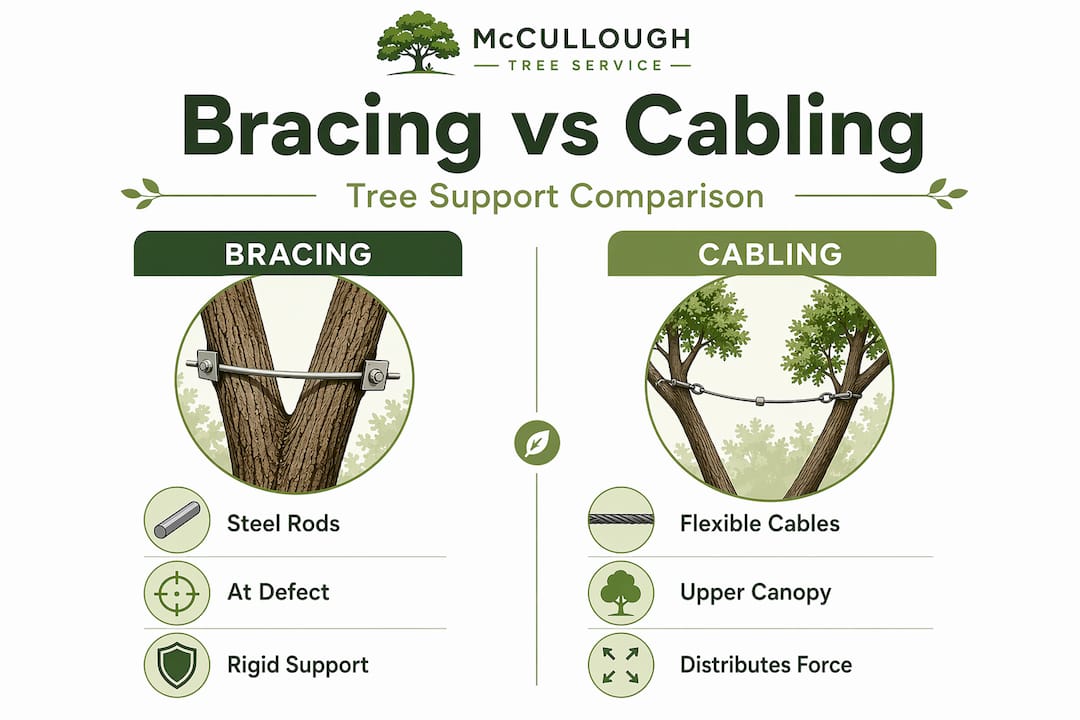
| Support method | Application | Flexibility | Best for |
|---|---|---|---|
| Bracing | At the defect, inside the wood | Rigid | Split crotches, weak unions, partial stem fractures |
| Cabling | Upper canopy, between limbs | Flexible (dynamic or static) | Heavy lateral limbs, codominant stems at height |
| Staking | Young trees, post-planting | Temporary, removable | Newly planted trees needing wind stabilization |
| Pruning | Crown reduction or weight removal | Permanent removal | Overextended limbs, reducing sail effect in wind |
Cabling and bracing are frequently used together on the same tree. A tree with a split crotch near the base might get a brace rod through the union and a cable higher up to reduce the lateral load pulling those stems apart. That combination addresses the defect structurally while reducing the forces acting on it from above.
Professional tree trimming is often the first intervention before bracing, because reducing crown weight and removing dead or overextended limbs lowers the load that any structural support system has to manage. In many cases, smart pruning alone can reduce risk enough that bracing isn’t needed at all.
My take on what most homeowners get wrong about bracing
I’ve seen the same scenario play out more times than I’d like to count. A homeowner hires someone to install a brace rod through a split crotch, feels good about it, and then doesn’t think about that tree again for five years. By the time someone takes another look, the hardware is corroded, the tree has grown around the washers unevenly, and the split has continued to widen despite the rod. The bracing bought time, but no one used that time.
What I’ve learned is that bracing is genuinely valuable, but only when it’s treated as part of an ongoing conversation about that tree’s future, not a one-time fix. The most important thing isn’t even the hardware. It’s the documentation and the follow-up. A well-installed brace rod without a maintenance plan will eventually be a liability.
I also think homeowners underestimate how much the design of the installation matters. The angle of the rod, the diameter, the placement relative to the split geometry: these are not arbitrary choices. A certified arborist with structural assessment experience approaches this as a load-path engineering problem, not just a drilling job. The difference in outcomes is significant.
My honest advice: if you have a tree with a visible structural defect, get a certified arborist assessment before you commit to bracing or write it off. You may find that pruning alone solves the problem. You may find that removal is the right call. Or you may find that a well-designed bracing system gives that tree another decade of safe life. But you won’t know until someone qualified looks at it honestly.
— Mcculloughtreeservice
Protect your trees with McCullough Tree Service
If reading this has made you think about a tree on your property with a split, a heavy codominant stem, or storm damage you’ve been hoping will sort itself out, that’s your signal to get a professional opinion.
Mccullough Tree Service provides certified arborist assessments, bracing and cabling installation, and full structural tree evaluations for residential and commercial properties throughout Orlando and Central Florida. Their certified arborists follow ANSI A300 standards on every installation and provide written documentation so your bracing system is never a mystery. Whether you need bracing, tree trimming, or a full risk assessment, McCullough Tree Service brings the expertise to make the right call. Contact them for an estimate and find out exactly where your trees stand.
FAQ
What is bracing in tree care, exactly?
Bracing in tree care is the installation of rigid steel rods through structurally weak sections of a tree, such as split crotches or weak unions, to hold those sections together and reduce the risk of failure. It is not a cure but a structural support measure that extends safe tree life when properly installed and maintained.
How is bracing different from cabling?
Bracing uses rigid hardware installed directly at the defect, while cabling uses flexible cables in the upper canopy to limit limb movement and redistribute stress. Many trees benefit from both systems working together.
How long does tree bracing last?
A properly installed bracing system can extend the safe life of a tree for 10 to 20 years, but hardware requires periodic inspection and potential replacement. Annual arborist check-ups are the standard recommendation.
Can I install tree bracing myself?
No. Bracing requires drilling into live wood, selecting hardware based on load calculations, and following ANSI A300 Part 3 standards. Incorrect installation can redirect stress forces and create a greater hazard than no bracing at all. Always hire a qualified ISA-certified arborist for this work.
Does a braced tree still need trimming?
Yes. Structural pruning and bracing work best together. Reducing crown weight through professional trimming lowers the load on bracing hardware and improves the overall safety profile of the tree.
Recommended
- Tree care terminology guide for Central Florida homeowners
- Tree Care 101: Trimming vs. Pruning Guide
- Why regular tree maintenance matters for property owners
- Tree Health Assessment Guide for Central Florida Owners