By: Shelby McCullough| Published: August 1, 2026
Emergency storm response is the immediate, professional intervention that protects lives, stabilizes hazardous trees, and clears debris after a storm damages your property. For Central Florida property owners and managers, understanding this process is the difference between a controlled recovery and a preventable tragedy.
The three core goals are straightforward:
- Protect life by neutralizing active threats to people and structures
- Stabilize hazards by securing leaning trees, hanging limbs, and compromised root systems
- Clear debris to restore safe access for residents, crews, and emergency vehicles
The International Society of Arboriculture (ISA) and University of Florida IFAS extension both emphasize that triage and professional assessment come before any cleanup work. Mcculloughtreeservice applies exactly this framework on every emergency call in Central Florida.
Pro Tip: Not every storm-damaged tree needs removal. IFAS guidance cautions against rushing removals — many trees can be restored with proper assessment and time. A certified arborist’s evaluation is the first step, not the chainsaw.
Table of Contents
- What are the signs you need emergency storm response right now?
- What do emergency storm crews actually do when they arrive?
- How long does emergency storm response take, and what drives the cost?
- How does emergency storm response support your insurance claim?
- How do you choose a qualified emergency storm response provider?
- What can you do before storm season to reduce emergency needs?
- How Mcculloughtreeservice handles emergency storm response in Central Florida
- Key Takeaways
- A Central Florida perspective on storm response
- Ready to protect your property? Contact Mcculloughtreeservice
- Useful sources for further reading
What are the signs you need emergency storm response right now?
Some situations cannot wait. Call a licensed arborist immediately if you see any of these:
- A tree or large limb leaning toward a structure, vehicle, or occupied space
- Any tree or branch in contact with or near a power line
- Hanging “widow-maker” limbs suspended in the canopy above walkways or driveways
- A fully uprooted tree blocking access routes or resting against a building
- Active cracking or splitting sounds from a damaged trunk
What you should NOT do while waiting for crews:
- Never attempt DIY cutting near power lines. Only qualified line-clearance arborists may work within that zone.
- Never stand under hanging limbs to assess them from below.
- Never use a personal ladder or rope on a tensioned branch. Stored energy in bent limbs can release violently.
Call your utility company first if any line is involved. Then call a licensed, insured arborist. For power-line contact, do not wait for the arborist to arrive before contacting the utility.
Pro Tip: A professional storm damage assessment is the priority, not immediate cutting. Crews triage risk on arrival and address life-safety threats before debris clearing — that sequencing is intentional and keeps everyone safer.
What do emergency storm crews actually do when they arrive?
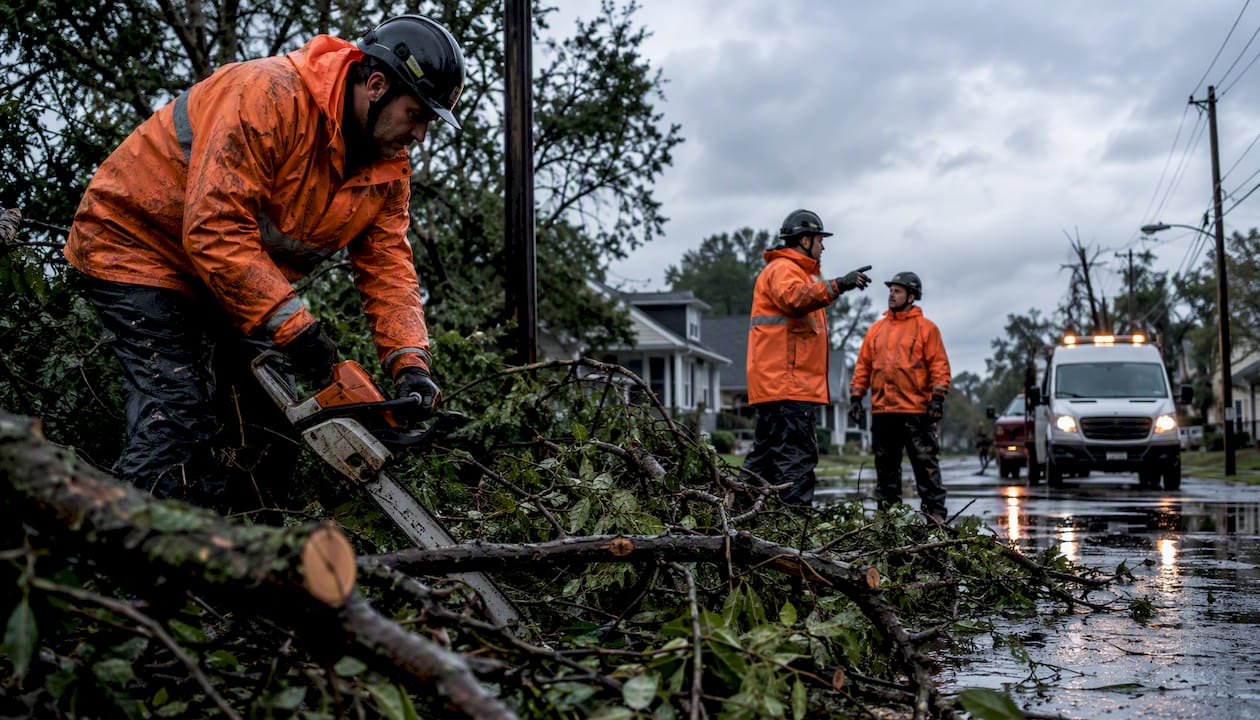
Crews don’t start cutting the moment they step out of the truck. The first ten minutes are assessment.
- On-site triage — The lead arborist walks the property and assigns risk ratings using a structured matrix: likelihood of failure, likelihood of hitting a target, and consequence of impact. Trees rated high on all three get immediate attention.
- Escape route planning — Before any cut, crews identify and communicate pre-planned escape routes. Storm-damaged limbs hold stored energy that releases unpredictably; this step is non-negotiable.
- Stabilization — Bracing, rigging, and controlled lowering of high-tension limbs come before full removal. A leaning tree resting against a roof gets rigged before it gets cut.
- Removal sequence — Unsafe limbs come down first, then controlled felling or sectional dismantling of compromised trees. Equipment typically includes aerial lift trucks, rigging systems, chippers, and cranes for larger jobs.
- Tarping and temporary protection — If a tree has breached a roof, crews coordinate tarping to prevent water intrusion before the full removal is complete.
- Debris hauling — Chippers and loaders handle the volume. Final site cleanup follows once all hazards are resolved.
Crews communicate triage priorities to property managers throughout the job. If debris isn’t cleared immediately, it’s because a higher-priority hazard is being addressed first. Watch a real removal in action to see how the sequence plays out.
How long does emergency storm response take, and what drives the cost?
Timeline depends almost entirely on severity. Small jobs like single limbs on fences or driveways often get same-day response and can be resolved in a few hours. Medium jobs involving trees leaning on structures or moderate debris typically receive same-day triage and stabilization, with removal and hauling completed within a few days. Large jobs with multiple trees down, roof contact, or requiring cranes take longer, with full resolution over several days.
The primary cost drivers are:
- Severity and volume of damage across the property
- Access constraints — tight lots, fenced yards, or blocked driveways require more rigging and time
- Equipment — crane and aerial lift mobilization adds significant cost versus ground-level work
- Hazardous conditions — power-line proximity, tensioned limbs, and saturated soils all increase crew risk and time
- Surge demand — after a named storm, every crew in the region is booked. Pricing reflects that reality.
Preventive maintenance consistently costs less than emergency response during storm season. Scheduling structural pruning before hurricane season reduces both the likelihood of failure and the surge-pricing exposure that follows a major storm event.
How does emergency storm response support your insurance claim?
The documentation your storm-response crew provides can be the difference between a smooth claim and a months-long dispute. Experienced firms know what adjusters need and build that into their standard workflow.
What to expect from a qualified provider:
- Before/after photos taken at each stage of the job, not just at completion
- Itemized invoices that separate emergency stabilization costs from debris hauling and cleanup
- Certificates of insurance and scope-of-work descriptions that match adjuster expectations
- Written estimates provided before work begins, updated if scope changes
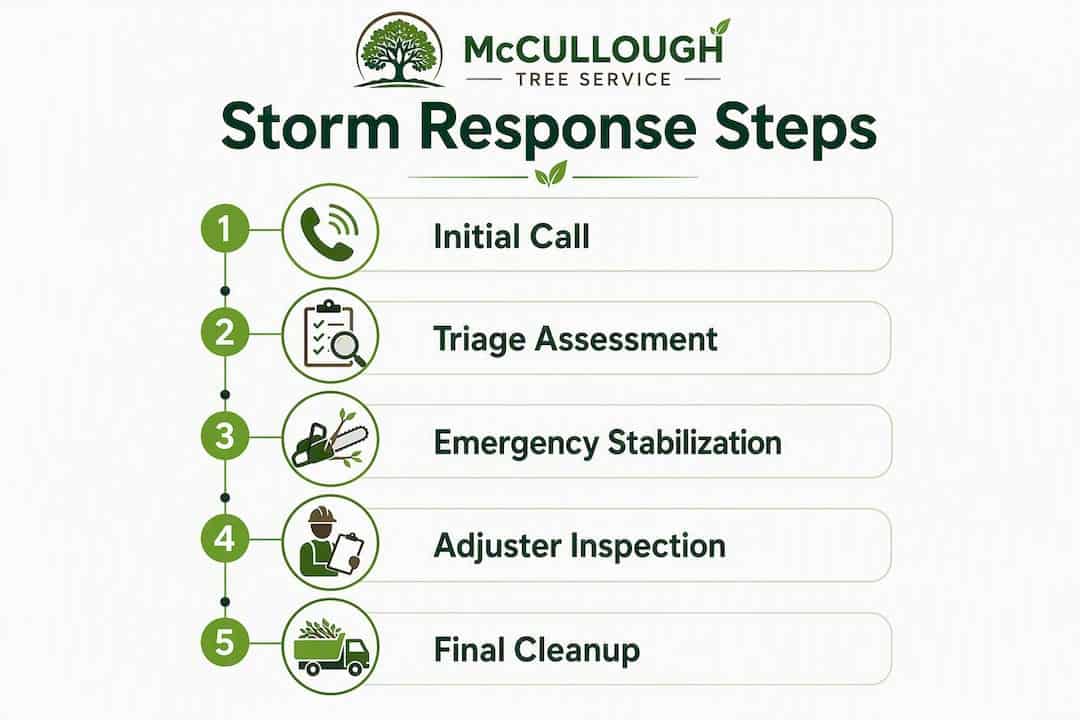
The claims workflow typically runs: initial estimate → emergency stabilization (same day) → adjuster inspection → final invoice submission → reimbursement. A documentation package that’s organized from the start shortens every step. Commercial property managers especially benefit from firms that have handled managed-repair programs before — they know the paperwork, and it shows.
How do you choose a qualified emergency storm response provider?
The wrong crew can make a bad situation worse. Here’s what to verify before anyone touches your trees:
- ISA-certified arborists on staff (ask for the certification number)
- Active city or county license for tree work in your municipality
- Proof of general liability insurance and workers’ compensation coverage
- Documented 24/7 emergency availability, not just a voicemail
Questions to ask on the first call: What’s your estimated response time? Who specifically will be on the crew? What equipment are you bringing? Can you provide a written estimate before starting? What does your documentation package include?
Red flags: demand for full cash payment up front, vague answers about insurance, refusal to provide references or before/after photos, and high-pressure upsells for work beyond the immediate hazard.
Pro Tip: For commercial properties, ask specifically whether the firm has experience with insurance-managed repairs. Selecting a provider with that background means faster adjuster approvals and fewer documentation gaps.
What can you do before storm season to reduce emergency needs?
The best emergency response is the one you never need. A pre-season checklist for Central Florida property managers:
- Schedule a certified arborist risk assessment by May, before the June 1 hurricane season start
- Remove deadwood and structurally compromised limbs through structural pruning
- Clear access routes so equipment can reach every tree on the property
- Consider a pre-season service agreement to lock in response priority and avoid surge pricing
Pro Tip: In Central Florida, watch live oaks for codominant stems and overextended lateral limbs — these are the most common failure points in high-wind events. Palms shed fronds naturally but can destabilize in saturated soils after prolonged rain. Root destabilization is often invisible until a tree goes down.
How Mcculloughtreeservice handles emergency storm response in Central Florida
Mcculloughtreeservice provides 24/7 emergency response across Central Florida, with ISA-certified arborists leading every job. The service list covers the full response sequence: hazardous tree assessment, stabilization and rigging, emergency removal, tarping and roof-protection coordination, debris hauling, and a complete insurance documentation package.
Every job includes before/after photos, itemized invoices, and certificates of insurance structured for adjuster review. Licensed and insured crews arrive with the equipment the job actually requires, from chippers and aerial lifts to cranes for complex removals.
What to have ready when you call: your property address, a description of the hazard (leaning tree, limb on roof, power-line contact), any photos you can safely take from a distance, access notes, and your insurance carrier information. That information speeds dispatch and gets the right equipment to your property faster.
Key Takeaways
Emergency storm response is a structured, safety-first process: call a certified arborist for any active life-safety threat, get a professional assessment before any DIY work, and document everything for your insurance claim.
| Point | Details |
|---|---|
| Call pros for life-safety threats | Leaning trees, power-line contact, and widow-makers require a licensed arborist, not DIY tools. |
| Assessment before cutting | Crews triage risk first; not every damaged tree needs removal, and rushing causes injuries. |
| Documentation drives claims | Before/after photos and itemized invoices are what adjusters need to approve reimbursements. |
| Pre-season pruning pays off | Structural pruning before June 1 reduces both failure risk and surge-pricing exposure after a storm. |
| Mcculloughtreeservice | Provides 24/7 ISA-certified emergency response across Central Florida with full insurance documentation. |
A Central Florida perspective on storm response
Central Florida’s storm season runs longer and hits harder than most property managers from other regions expect. Afternoon thunderstorms in July can drop a live oak limb with no warning. A named storm tracking inland from the Gulf can saturate soils for days before the wind even arrives, destabilizing root systems that looked perfectly healthy the week before.
What changes the outcome isn’t the storm itself. It’s whether the trees on your property were assessed and maintained before the season started, and whether you called a certified crew within hours of the damage rather than waiting to see if things “settle.” The species here, the sandy soils, the combination of wet and dry cycles — these are local variables that a crew from out of state simply won’t account for the way a team that works Central Florida year-round will.
Documented, safety-first work is the only kind worth paying for. Everything else is a liability.
Ready to protect your property? Contact Mcculloughtreeservice
When a storm hits and you need help now, Mcculloughtreeservice is available 24/7 across Central Florida.
Before you call, have ready: your property address, a description of the hazard, any photos you can safely take from a distance, access notes for the property, and your insurance carrier information. That preparation cuts intake time and gets the right crew and equipment dispatched faster.
Mccullough Tree Service handles the full response sequence, from hazardous tree removal and stabilization to debris hauling and the insurance documentation package your adjuster will need. For properties that want to get ahead of the next storm, pre-season trimming services are available now.
Call or contact Mcculloughtreeservice online to schedule an assessment or request emergency dispatch.
Useful sources for further reading
- Assessing Hurricane-Damaged Trees (IFAS FR172) — University of Florida IFAS guidance on triage, assessment criteria, and restoration vs. removal decisions
- Cleaning Up After a Hurricane: Get the Right Tree Care Professional (IFAS FR171) — Safety protocols and professional hiring guidance for post-storm cleanup
- Restoring Trees After a Hurricane (IFAS EP300) — Step-by-step restoration process for storm-damaged trees in Florida
- Cleaning Up After a Hurricane — Gardening Solutions (UF/IFAS) — Practical safety and hiring guidance for homeowners
- How to assess storm-damaged trees in Central Florida — Mcculloughtreeservice’s local checklist for property owners and managers
Recommended
- How to Plan Emergency Storm Response in Central Florida
- Emergency Tree Service Steps for Storm Recovery
- Quick and Effective Storm Cleanup Strategies
- Responsibilities in Storm Cleanup: Essential Guide