By: Shelby McCullough| Published: July 30, 2026
Formative pruning is the selective removal of stems and branches from young trees and shrubs to develop a safe, stable framework before problems become expensive to fix. Done correctly during the first four to five years of a tree’s life, it produces a single dominant leader, well-spaced scaffold branches, and a structure that resists failure for decades. The International Society of Arboriculture (ISA) frames this work as the primary objective whenever pruning young or medium-aged trees. Mcculloughtreeservice’s certified arborists apply the same standard on every young-tree job in Central Florida.
Here is what formative pruning actually delivers in practice:
- A single dominant central leader that anchors the tree’s long-term structure
- Scaffold branches spaced vertically and radially so no two compete for the same space
- Removal of codominant stems before they develop included bark and become a splitting hazard
- Small pruning wounds that close quickly, minimizing decay risk
- Lower future maintenance costs because large corrective cuts are avoided entirely
Table of Contents
- Why formative pruning matters more than most homeowners realize
- When should you start formative pruning?
- How to perform formative pruning: a step-by-step approach
- Tools and safety for formative pruning
- Common mistakes that undo formative pruning
- When should you hire a certified arborist?
- What the research says about formative pruning costs and outcomes
- Key Takeaways
- Why early pruning decisions shape a tree’s entire future
- Mcculloughtreeservice offers certified formative pruning in Central Florida
- Useful sources and further reading
Why formative pruning matters more than most homeowners realize
The goal is not just a prettier tree. Formative pruning is a structural safety decision made early, when the cost is low and the tree can still be guided.
The primary objectives are:
- Establish a central leader (or the appropriate multi-stem form for the species) to give the tree a stable vertical axis
- Correct codominant stems before they develop the included bark that makes them prone to catastrophic splitting
- Control scaffold branch diameter relative to the trunk, keeping the aspect ratio low enough that branches stay attached under load
- Distribute scaffold branches evenly around the trunk and vertically along the stem so no single side carries disproportionate weight
Each of these goals has a direct safety consequence. Codominant stems with included bark are among the most common precursors to structural failure in mature trees. Catching them at year two, when the stem is pencil-thick, takes a single snip. Catching them at year twenty requires a major cut, a large wound, and a significant bill.
The cost difference is stark. Research on street trees found formative pruning averaged a low cost per tree compared to a significantly higher cost for structural pruning of mature trees. That reflects a large cost gap for deferring the work. Urban forestry reviews consistently show that neglecting formative maintenance raises future pruning costs significantly and inflates risk-management budgets.
Statistic: Formative pruning of recently planted street trees averaged a low cost per tree, while structural pruning of the same trees at maturity averaged a substantially higher cost, a difference that compounds across an entire property or street planting.
Pro Tip: Treat formative pruning as a capital investment in your tree, not a maintenance expense. The money spent in years one through five typically prevents several times that amount in corrective work later, and it keeps the tree safer throughout its life.
For homeowners, the benefits land in three places: safety (no splitting codominant stems over the driveway), lower ongoing maintenance (fewer large cuts, less debris, smaller arborist bills), and better appearance from the start.
When should you start formative pruning?
The short answer: at planting, or as close to it as possible, and then again every two to four years through year five.
The RHS recommends beginning formative work from about year one and continuing through roughly year four or five to complete the training process. For deciduous shrubs, formative pruning often begins at planting to balance the plant and remove crossing stems. Trees up to about 6 meters tall are generally manageable from the ground with hand tools, which keeps the work accessible and low-risk for a skilled DIYer.
Year-by-year timeline
| Year | Primary action | Notes |
|---|---|---|
| — | Remove damaged, crossing, or rubbing stems; identify the leader | Light work only; do not stress a newly planted tree |
| Year 1 | Confirm leader; remove any competing codominant stems while they are small | Small cuts heal fast; this is the highest-leverage moment |
| Year 2–3 | Select and space scaffold branches; subordinate vigorous laterals | Remove branches that compete with the leader or crowd others |
| Year 4 | Refine scaffold spacing; remove any remaining codominant stems | Tree structure should be largely set by now |
| Year 5+ | Transition to regular maintenance pruning | Formative work is complete; monitor for new defects |
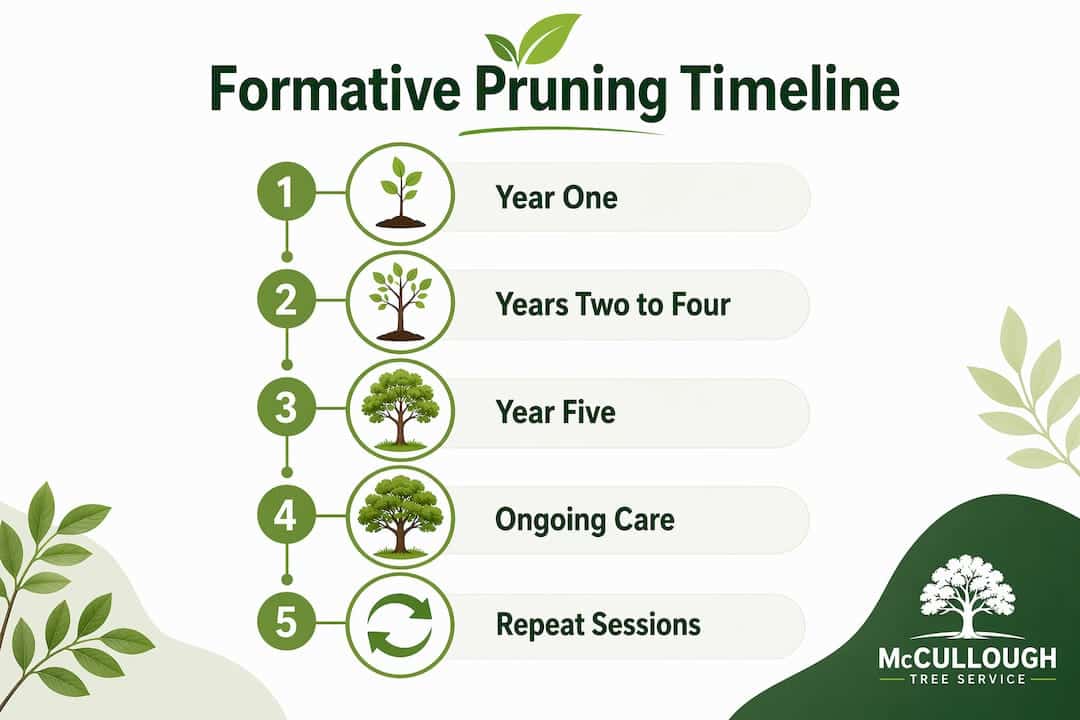
A single session is rarely enough. Repeat, light interventions every 2–4 years during the first five years stabilize form far better than one aggressive early cut.
Seasonal timing
For deciduous trees, late winter dormancy is the preferred window. The tree is leafless, so the structure is fully visible, wounds close quickly as growth resumes in spring, and disease pressure is lower. For evergreens, early in the growing season works better, just as new growth begins. Avoid heavy pruning in late summer or fall for most species, since new growth stimulated by pruning may not harden before cold weather arrives.
Species habit matters too. Some trees naturally produce multiple leaders (certain ornamental cherries, multi-stem serviceberries) and should not be forced into a single-leader form. Misidentifying a species’ natural growth pattern and over-pruning to correct it can cause long-term structural and health problems.
Pro Tip: Before you prune, identify the species and look up its natural form. A tree that wants to grow with multiple stems will fight you every year if you keep removing them. Work with the species, not against it.
How to perform formative pruning: a step-by-step approach
Formative pruning is a series of deliberate decisions, not a general tidy-up. Each cut should have a specific reason.
Step 1: Identify the central leader
Look for the single most vertical, most vigorous stem. That is your leader. Everything else is subordinate to it. If two stems are competing at roughly equal height and diameter, that is a codominant situation and one must go.
Step 2: Remove competing codominant stems
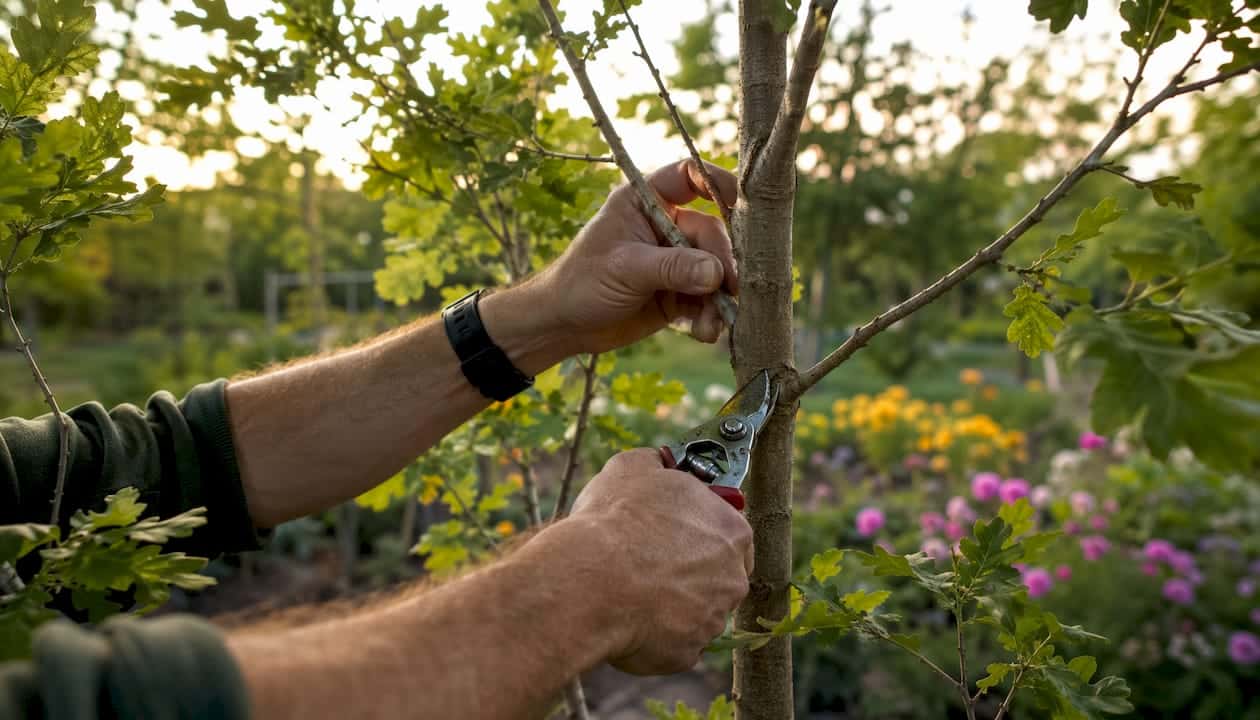
Cut the weaker or less well-positioned of the two competing stems back to its point of origin at the branch collar. Never leave a stub. The branch collar is the slightly swollen ring of tissue where the branch meets the trunk; cutting just outside it preserves the tree’s natural wound-closure response. Early removal of small stems creates small wounds that close quickly, minimizing long-term decay compared to large branch removals on mature trees.
Step 3: Select and space scaffold branches
Scaffold branches are the permanent lateral limbs that form the tree’s crown. Choose branches that:
- Are spaced at least 6–18 inches apart vertically along the trunk (species-dependent)
- Radiate in different directions around the trunk rather than clustering on one side
- Have a wide branch attachment angle (U-shaped crotch, not V-shaped)
- Are noticeably smaller in diameter than the trunk at their attachment point
Remove branches that fail these criteria while they are still small.
Step 4: Subordinate vigorous laterals
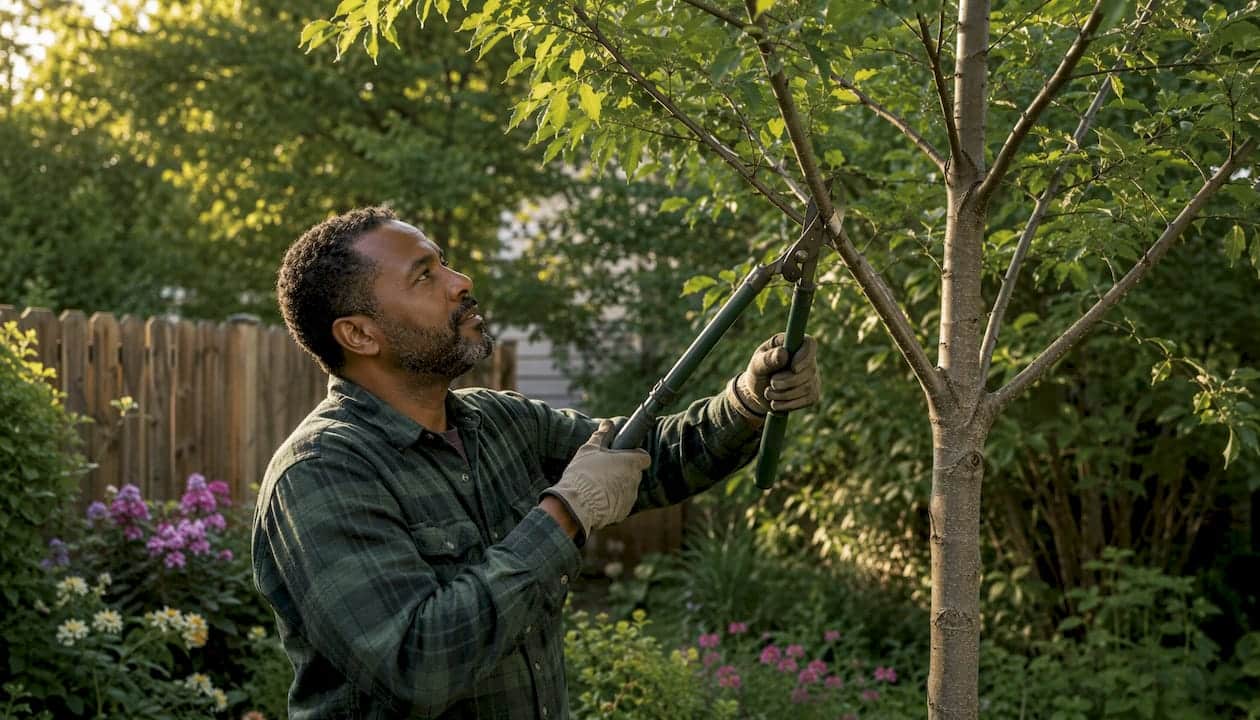
Subordination means reducing the length of secondary branches so they stay smaller than the leader. You are not removing them entirely; you are slowing their growth relative to the central stem. A thinning cut (removing a branch back to a lateral or the trunk) is preferable to a heading cut (cutting a branch mid-stem), because heading cuts stimulate dense regrowth and can create multiple competing shoots.
Step 5: Limit crown reduction and avoid topping
Never remove more than about 25% of the live crown in a single session. Removing too much at once stresses the tree and triggers excessive regrowth that undoes the structural work. Topping, cutting the central leader or major branches to stubs, is one of the most damaging things you can do to a young tree. It destroys the structure you are trying to build, creates large wounds that decay readily, and produces weakly attached water sprouts that become the next generation of structural problems.
Pro Tip: One formative pruning session is almost never enough. Plan for at least three visits over the first five years. The second and third visits are where you refine what the first visit started, and they are usually faster and cheaper than the first.
For shrubs, the same principles apply at a smaller scale. Formative pruning for shrubs is often done immediately after planting to direct early shape and can usually be performed from the ground with hand pruners.
Tools and safety for formative pruning
The right tool for formative pruning is almost always the smallest one that can make a clean cut. Forcing a large saw through a pencil-thick stem damages surrounding tissue and signals that the cut was made too late.
Tool checklist
- Hand pruners (bypass secateurs): For stems up to about ¾ inch in diameter. Bypass blades make cleaner cuts than anvil types and cause less crushing damage.
- Bypass loppers: For stems ¾ inch to about 1.5 inches. Extend your reach and add leverage without a saw.
- Pruning saw: For anything larger than loppers can handle cleanly. A folding pruning saw is sufficient for most formative work on young trees.
- Pole pruner: For branches up to about 10–12 feet high without a ladder. Useful for early scaffold work on faster-growing species.
PPE and safety
- Safety glasses or goggles (falling debris is the most common minor injury)
- Cut-resistant gloves
- Closed-toe shoes or boots
- Long sleeves to protect against scratches and sap
- Hard hat when working under or near any overhead branches
Ladder safety deserves its own note. Most formative pruning on trees under 6 meters should be reachable from the ground or with a step ladder on level ground. Never lean a ladder against a branch you are about to cut. If the work requires climbing or positioning a ladder on uneven ground near the tree, that is a job for a professional.
Pro Tip: Sterilize your pruning tools between trees, especially if disease is present in your area. A quick wipe with 70% isopropyl alcohol between cuts is sufficient for most situations and takes about 10 seconds.
Safety warning: Any branch larger than about 2 inches in diameter on a tree taller than 10 feet should be assessed by a certified arborist before you attempt removal. The combination of height, leverage, and unpredictable fall direction makes these cuts genuinely dangerous for untrained DIYers.
Common mistakes that undo formative pruning
Most formative pruning errors fall into one of five categories, and all of them are easier to prevent than to fix.
- Topping the tree. Cutting the central leader to a stub destroys the tree’s architecture and triggers a flush of weakly attached water sprouts. Those sprouts become the next round of structural problems.
- Removing too much live crown at once. More than 25% in a single session stresses the tree severely, reduces photosynthetic capacity, and often triggers excessive compensatory growth.
- Leaving stubs. A stub cut outside the branch collar prevents proper wound closure, invites decay, and can kill the surrounding bark. Always cut to the collar.
- Retaining or creating V-crotches. Branches with narrow, V-shaped attachments are far more likely to split under load than wide, U-shaped ones. Remove narrow-angle branches early, while they are small.
- Waiting too long. The most common mistake of all. A codominant stem that could have been removed with a hand pruner at year two requires a saw and a significant wound at year ten, and may be structurally dangerous by year twenty.
Red flags that mean you need a professional:
- Any codominant stem with visible included bark (a ridge of compressed bark between the two stems)
- Cracks or splits at branch attachments
- Branches growing toward utility lines or over structures
- A tree that has already been topped and is producing dense water sprout regrowth
- Any formative work above comfortable ladder height
When should you hire a certified arborist?
Some formative pruning is genuinely DIY-friendly. A young ornamental tree in an open yard, under 6 feet tall, with one obvious codominant stem to remove, is a reasonable homeowner project. But several situations call for a professional.
Clear triggers for hiring a pro
- The tree is taller than you can safely reach from the ground or a stable step ladder
- You can see included bark between two competing stems
- The tree is near a structure, vehicle, or utility line
- The species has complex branching habits you are not familiar with
- The tree has already developed multiple structural defects that require prioritization
- You want a written assessment and multi-year management plan
What to ask before hiring
- Are you a certified arborist through the ISA?
- Do you carry liability insurance and workers’ compensation?
- Can you provide references for formative pruning work specifically?
- Will you provide a written scope of work and recommended revisit schedule?
- Do you follow ANSI A300 pruning standards?
What to expect from a professional visit
A qualified arborist will inspect the tree’s structure, identify defects in priority order, make targeted cuts with documented reasoning, and recommend a follow-up schedule. Formative pruning is not a one-visit service. Expect a plan that covers multiple short visits over three to five years, with each visit building on the last.
Mcculloughtreeservice’s certified arborists provide exactly this kind of structured, multi-visit formative pruning program for residential and commercial properties across Central Florida. The certified arborist services include an initial structural assessment, a written recommended timeline, and follow-up visits calibrated to each tree’s species and growth rate.
What the research says about formative pruning costs and outcomes
The economic case for formative pruning is well-documented in arboricultural literature, and the numbers are consistent across studies.
Key findings
| Study / Source | Core finding |
|---|---|
| Ryder & Moore (Journal of Arboriculture) | Codominant stems and included bark were the most common structural defects in young nursery stock; most correctable with small early cuts |
| Street tree cost study (Arboriculture & Urban Forestry) | Formative pruning averaged AUD $2.79/tree vs. AUD $44.59 for structural pruning at 20 years |
| Urban forestry cost review (Arboriculture & Urban Forestry) | Deferring formative maintenance raises future pruning costs significantly and inflates risk budgets |
| Gilman / ISA structural pruning guidance | Structural pruning should be the primary objective when pruning young and medium-aged trees |
The pattern across all of these sources is the same: early, small interventions produce outsized long-term savings. The Ryder/Moore research found that the defects most likely to cause catastrophic failure in mature trees, codominant stems and included bark, are also the most common defects in young nursery stock. They are present from the start, and they are correctable with a single small cut if caught early.
The ISA’s Gilman guidance frames structural pruning not as optional maintenance but as the primary professional objective for any young tree. That framing matters because it shifts the question from “should I prune this tree?” to “when and how do I start?”
- Urban forestry reviews confirm that deferred formative maintenance consistently raises future costs
- Early formative work reduces both the frequency and the scale of future corrective pruning
- Trees with sound early structure require less intervention throughout their mature life
- The per-tree cost of formative work is low enough that it is economically justified even for municipal street tree programs at scale
Key Takeaways
Formative pruning is the single highest-leverage investment you can make in a young tree: small cuts in years one through five prevent large, expensive, and sometimes dangerous problems at maturity.
| Point | Details |
|---|---|
| Start at planting | Begin formative work at year one and revisit every 2–4 years through year five. |
| Remove codominant stems early | A codominant stem corrected at year two takes one cut; the same defect at year twenty requires a major wound and carries lasting decay risk. |
| Keep cuts small | Cuts on stems under 1–2 inches in diameter close quickly; large-diameter removals create wounds that take years to seal. |
| Never remove more than 25% at once | Exceeding this threshold stresses the tree and triggers the compensatory regrowth that undoes structural work. |
| Mcculloughtreeservice | Provides certified arborist-led formative pruning programs across Central Florida, including initial assessment, written timeline, and multi-year follow-up visits. |
Why early pruning decisions shape a tree’s entire future
Most people think about tree care reactively. A branch fails, a tree leans, a storm reveals a crack that was always there. Formative pruning is the opposite of that mindset, and that is what makes it genuinely undervalued.
The conventional wisdom treats pruning as cosmetic, something you do when a tree looks messy or a branch gets in the way. But the arboricultural research tells a different story. The defects that cause mature trees to fail, the codominant stems, the included bark, the poorly attached scaffold branches, are almost always present in the nursery stock before the tree is even planted. They do not develop because of neglect. They are there from day one, and they either get corrected early or they get worse.
What experienced arborists understand, and what most homeowners do not, is that a tree’s structure at year five largely determines its maintenance burden for the next fifty years. A tree with a sound early framework needs fewer large cuts, generates less debris, poses less risk to property, and costs less to maintain over its entire life. A tree that was never formatively pruned often becomes the expensive problem in the backyard, the one that needs a crane and a significant bill to address safely.
The other thing worth saying plainly: formative pruning requires species knowledge. The same cut that improves a young live oak can damage a crape myrtle. Working with a certified arborist for the first few visits, even if you plan to handle later maintenance yourself, gives you a species-specific roadmap that generic guides cannot provide. That investment in knowledge pays off every time you pick up the pruners.
Mcculloughtreeservice offers certified formative pruning in Central Florida
If you have young trees on your property and are not sure whether they have been formatively pruned, the most useful thing you can do right now is schedule a structural assessment.
Mccullough Tree Service’s certified arborists serve residential, commercial, and municipal clients across Orlando and Central Florida. A first visit includes a full structural inspection of your young trees, identification of any codominant stems or defects, a recommended pruning timeline, and a written estimate. The work follows ISA standards and ANSI A300 pruning guidelines, so you know exactly what is being done and why.
Formative pruning is most effective as a multi-year program, not a single appointment. Mcculloughtreeservice structures these engagements as professional tree trimming programs with scheduled follow-up visits, so your trees get the consistent attention that produces lasting results. If you are also working with a landscape designer on a new planting, coordinating arborist and design-build landscaping work from the start gives your trees the best possible foundation.
Contact Mcculloughtreeservice to request a consultation and get a written formative pruning plan for your property.
Useful sources and further reading
The sources below are the primary references behind this article. Each covers a distinct aspect of formative pruning practice and research.
- Gilman / ISA Structural Pruning Guide — The foundational ISA technical paper on structural pruning as the primary objective for young trees. Start here for the professional framework.
- Ryder & Moore, Journal of Arboriculture — Documents the prevalence of codominant stems and included bark in young nursery stock and the economic case for early correction.
- Arboriculture & Urban Forestry: Street Tree Cost Study — Quantifies the cost difference between formative pruning at planting and structural pruning at 20 years. The most-cited economic evidence in this field.
- Urban Forest Maintenance Cost Review — Broader review of how deferred maintenance raises long-term costs across urban tree populations.
- SGA Formative Pruning Guide — Practical how-to guidance covering technique, timing, and the subordination approach. Accessible for homeowners.
- RHS: Trees: Formative Pruning — Concise practical guidance on timing (year one through four to five) and seasonal considerations.
- Woodland Heritage: Formative Pruning — Covers shrub-specific formative pruning and early-planting timing guidance.
Recommended
- Pruning Trees: Essential Tips and Benefits
- The Importance of Tree Pruning
- What Is Structural Pruning and Why Your Trees Need It