By: Shelby McCullough| Published: December 29, 2025
When we perform a tree risk assessment, we aren’t just looking at dead branches or brown leaves. We are looking closely at the tree’s architecture—the structural integrity that keeps it standing during a storm.
One of the most critical defects we look for is something called included bark.
You might not notice it at a glance, but to a certified arborist, included bark is a red flag. It is a sign of a weak union that could lead to a tree splitting apart, potentially damaging your home or property.
How to Identify Included Bark
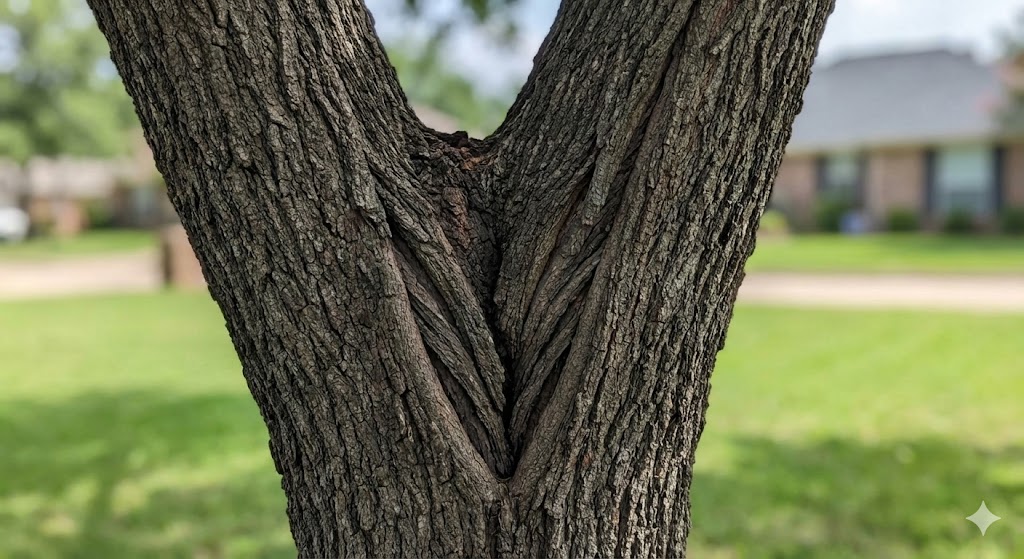
If you look at the “crotch” or union of a tree—where the trunk splits into two or more main stems—you expect to see a smooth transition.
Included bark happens when the bark is “bunched up” or rolled inward at that union. Instead of a strong, U-shaped connection, you see a sharp V-shape with a visible crease running down the middle.
Basically, this means that the bark from the two separate stems is rolling in and pressing against each other.
Why Is This Dangerous?
Trees rely on solid wood-to-wood connections for strength. When you have included bark, that connection is compromised.
Instead of the stems being fused together by strong wood, they are separated by layers of bark. As the tree grows and the stems get thicker, they push harder against each other. This creates tension at the union, acting almost like a wedge being driven down the center of the trunk.
Eventually, this pressure can cause the tree to fail, splitting right down the middle during high winds or simply under its own weight.
Can It Be Fixed?
If these trees had been trimmed properly at a very young age, we could have prevented this structure and encouraged a stronger union. But for mature trees, we have to look at mitigation.
If you have a tree with included bark, removal isn’t always the only option. Depending on the severity, we can use several techniques to reduce the risk:
- Supplemental Cabling: We can install high-strength cables in the upper canopy to limit how much the stems can move apart during a storm.
- Bracing (Through-Bolting): We can insert a large metal rod (through-bolt) directly through the union to mechanically hold the two stems together.
- End Weight Reduction: By pruning the heavy lateral limbs, we bring the tree’s center of gravity closer to the middle, reducing the leverage and strain on that weak union.
Don’t Guess—Get an Assessment
If you see a deep crease or bunched-up bark on your trees, don’t ignore it. It is difficult for a homeowner to determine if the tree is stable or if it is a ticking time bomb.
Give McCullough Tree Service a call. We can inspect the union and let you know if the tree can be saved with cabling and bracing or if it poses too high of a risk.
Call us today at 407-734-5854 to schedule your evaluation.