By: | Published: May 22, 2026
TL;DR:
- Structural pruning is a science-based approach that early intervention shapes a tree’s architecture for stability and safety. It involves removing defects like codominant stems and included bark during dormancy, ideally within the first five years, to prevent costly failures later. Regular light pruning every two to three years enhances long-term health, safety, and property value while reducing storm damage risks.
Most homeowners think pruning means cutting back overgrown branches to keep things looking tidy. That assumption costs trees their structural integrity and costs property owners thousands of dollars down the road. What is structural pruning, really? It is a deliberate, science-based approach to shaping a tree’s architecture from its earliest years so it grows strong, stable, and safe. Unlike cosmetic trimming, structural pruning targets the skeleton of the tree, correcting defects before they become hazards. This article covers what structural pruning is, when and how to do it, and why the importance of structural pruning goes far beyond appearances.
Table of Contents
- Key takeaways
- What structural pruning actually is
- When and how to do structural pruning
- Benefits of structural pruning for homeowners
- Common structural defects and how pruning addresses them
- DIY vs. professional structural pruning
- My take on why structural pruning gets ignored
- Let Mcculloughtreeservice protect your trees from the ground up
- FAQ
Key takeaways
| Point | Details |
|---|---|
| Start early for best results | Structural pruning is most effective within a tree’s first five years of growth. |
| Dormant season is the right time | Prune between December and early February for better wound closure and clearer branch visibility. |
| Consistent light pruning wins | Pruning every two to three years is far less stressful on trees than one heavy session. |
| Defects compound over time | Problems like codominant stems and included bark worsen with age and become costly to fix. |
| Professionals make a real difference | Certified arborists spot hidden structural problems and apply cuts that protect long-term health. |
What structural pruning actually is
Structural pruning is the practice of removing or reducing specific branches to establish a strong, stable tree architecture during the early stages of a tree’s development. It is not about making a tree look manicured. It is about training the tree to grow in a way that minimizes future failure.
The primary goals center on four things:
- Establishing a single dominant central leader. A tree with one clear main stem distributes weight and resists wind far better than a tree with two or three competing tops.
- Developing well-spaced scaffold branches. These are the main lateral branches that form the tree’s framework. Proper spacing prevents crowding, rubbing, and uneven weight distribution.
- Preventing included bark and weak unions. When two stems grow at tight, equal angles, bark gets trapped between them rather than forming a strong wood bond. This is one of the leading causes of branch failure.
- Correcting structural defects early. The role of structural pruning is fundamentally preventive, not reactive.
Where structural pruning differs from corrective pruning is in timing and intent. Corrective pruning fixes problems in mature trees that already have defects. Structural pruning prevents those defects from forming in the first place. Think of it like orthodontic work on children versus reconstructive jaw surgery on adults. The earlier you act, the simpler and safer the intervention.
When and how to do structural pruning
Timing and technique are everything. Get them wrong, and even well-intentioned cuts can damage a tree rather than help it.
The right time to prune
Pruning during the dormant season, typically December through early February, gives trees the best chance to recover. During dormancy, the tree’s metabolism slows, which means wounds close more efficiently. You also get a clear view of the branching structure without foliage in the way, making it far easier to spot competing leaders and crossing branches. This is not a minor detail. Pruning during active growth puts more stress on the tree and opens wounds during periods when insects and pathogens are most active.
Structural pruning started early, ideally within the first five years of a tree’s life, sets the foundation for decades of healthy growth. Waiting until a tree matures means dealing with larger, more complex problems.
Steps for structural pruning
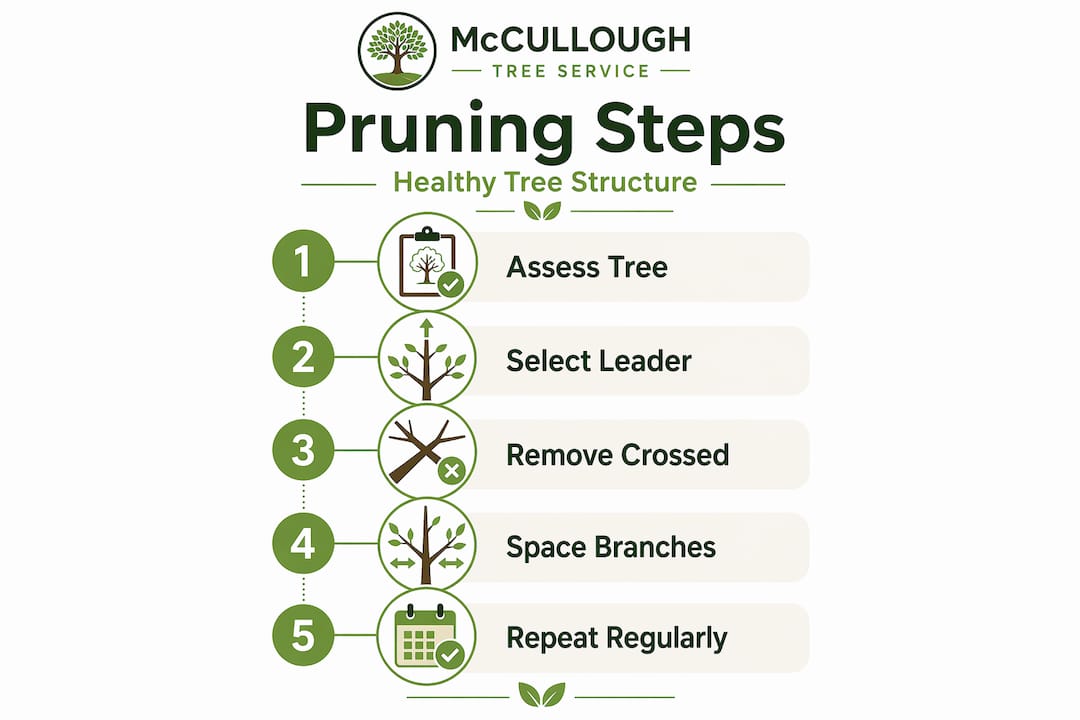
Follow these steps for structural pruning to get the best outcome:
- Assess the tree’s current structure. Walk around the tree and identify the central leader, main scaffold branches, and any obvious defects like competing stems or crossing branches.
- Identify the primary cut targets. Look for branches that are more than one-third the diameter of the trunk, codominant stems, and any branches growing back toward the center of the canopy.
- Start with the worst defects. Remove the weaker of any two competing leaders first. Do not try to fix everything in one session.
- Make proper cuts outside the branch collar. The branch collar is the slightly swollen area at the base of a branch where it meets the trunk. Flush cuts that remove the branch collar severely compromise the tree’s ability to seal the wound and invite decay.
- Apply the one-third diameter rule. Lateral branches should not exceed one-third the diameter of the trunk they attach to. Branches approaching or exceeding half the trunk diameter pose a serious failure risk.
- Avoid removing more than 25% of the canopy in any single session. Removing too much foliage at once stresses the tree significantly.
Pro Tip: Mark your calendar. Light pruning every two to three years is far more effective for long-term structural development than occasional heavy pruning events. Consistency is the point.
Benefits of structural pruning for homeowners
The practical benefits of structural pruning go well beyond tree health. For homeowners and property managers, the payoff is safety, savings, and property value.
Here is what consistent structural tree care delivers over time:
- Reduced storm damage risk. Codominant stems and overloaded branches are the first things that fail in a hurricane or high wind event. Structural pruning eliminates those weak points before the storm season arrives. This matters especially in Central Florida where storm exposure is a real annual concern.
- Lower long-term costs. Proactive pruning avoids expensive emergency removals, cabling systems, and corrective pruning on mature trees. A couple hundred dollars invested early can prevent a multi-thousand-dollar removal later.
- Better weight distribution. A properly trained canopy distributes weight evenly across the structure. That means the trunk and root system are not being overloaded on one side, which reduces the risk of uprooting during soil saturation.
- Improved aesthetics and property value. A structurally sound tree with a well-formed canopy simply looks better. It adds curb appeal without the stressed, overgrown look that comes from neglect followed by reactive cutting.
- Prevention of compounding defects. Included bark and codominant stems do not stay the same. They get worse every year as both stems grow larger and the trapped bark puts more pressure on the union.
“An ounce of prevention is worth a pound of cure” applies perfectly to trees. A young tree with one structural pruning session per growing cycle can be guided into a strong, beautiful specimen. That same tree, left unchecked for ten years, may require aggressive corrective work or full removal."
Common structural defects and how pruning addresses them
Knowing what to look for is half the battle. These are the most common problems that structural pruning techniques target.
| Defect | What it looks like | How pruning helps |
|---|---|---|
| Codominant stems | Two stems of equal size growing from the same point | Remove the weaker stem early to establish one dominant leader |
| Included bark | Bark trapped between two tight-angled stems | Address before the union grows and bark acts as a wedge |
| Crossing branches | Branches growing into or rubbing each other | Remove one to prevent wounding and decay entry points |
| Oversize laterals | Side branches exceeding one-third trunk diameter | Reduce or remove to maintain safe branch proportions |
| Interior crowding | Dense growth blocking light and airflow | Thin selectively to improve light penetration and wind resistance |
Codominant stems with included bark are probably the most dangerous defect because they look healthy until they suddenly split. The included bark acts like a wedge, and as both stems grow, the union weakens rather than strengthens. Removing the weaker competing leader while the tree is young is a simple cut. Dealing with a split in a mature 40-foot tree is a completely different situation.
Pro Tip: If you can see a “V” shaped crotch between two stems rather than a “U” shape, that is a warning sign. The narrow angle almost always means included bark is present underneath.
Opening up the interior of the canopy is another goal of structural pruning methods. Dense interiors trap wind rather than letting it pass through, which increases the physical load on the tree during storms. They also reduce light penetration, which weakens interior branches over time.
DIY vs. professional structural pruning
Some structural pruning tasks on young, small trees are within reach for a knowledgeable homeowner. Most are not.
Here is an honest breakdown of what to consider:
- Small trees under ten feet with visible competing leaders can often be addressed with proper hand pruners or a pruning saw, provided you understand where to cut and why.
- Improper cuts cause more harm than no cuts at all. A flush cut or a stub left behind creates a decay pathway that can hollow out a section of trunk over years. Learning proper pruning cut technique before picking up a saw matters.
- Certified arborists bring diagnostic value. They are not just there to make cuts. They assess the whole tree, identify defects you may not recognize, and create a multi-year pruning plan tailored to that specific tree’s species and growth pattern.
- Safety is a real factor. Working at height with power tools on branches under tension is genuinely dangerous. The importance of structural pruning done safely cannot be overstated when ladder work is involved.
- Professional pruning is an investment with a clear return. The cost of having a certified arborist handle structural pruning on your young trees is a fraction of what emergency tree removal or storm damage repair costs.
For trees already showing significant defects like large codominant stems or oversize laterals, professional assessment is not optional. It is the responsible move.
My take on why structural pruning gets ignored
I have watched homeowners spend significant money on mature trees that never needed to be in that situation. In my experience, the single biggest factor is delay. People assume their young trees are fine, that they will “sort themselves out,” and that pruning is something you do when a tree looks bad. By the time the tree looks bad, the problem is already expensive.
What I find genuinely frustrating is the confusion between trimming and pruning. Many people get an annual trim that keeps the edges neat and walk away feeling their tree care is handled. It is not. Trimming and structural pruning are not the same thing. One maintains appearances. The other builds the tree’s actual framework.
The homeowners who benefit most from structural tree care are the ones who start thinking about it early and stay consistent. Two to three light sessions during a young tree’s first decade can mean the difference between a landmark tree that adds value to a property for 50 years and a liability that needs removal after the first major storm. That is not an exaggeration. That is what the data from arboriculture professionals shows, and it is what I have seen play out on real properties time and again.
If you take one thing from this article, let it be this: structural pruning is not maintenance. It is an investment in the long-term architecture of your tree, and it pays back many times over.
— Mcculloughtreeservice
Let Mcculloughtreeservice protect your trees from the ground up

Structural pruning done right requires trained eyes and precise cuts. At Mcculloughtreeservice, our ISA-certified arborists work with homeowners and property managers across Orlando and Central Florida to build strong, storm-resistant trees from the ground up. Whether your trees are newly planted and need a development plan, or you have mature trees showing early signs of structural problems, we bring the expertise to address both. Our professional tree trimming services are built around your trees’ long-term health, not just how they look today. For trees that have already reached a point where removal is the safer path, our tree removal team handles that safely too. Contact us to schedule an assessment and let a certified arborist evaluate your trees before the next storm season arrives.
FAQ
What is structural pruning in simple terms?
Structural pruning is the practice of removing or reducing specific branches on young trees to establish a strong, stable architecture with a single dominant leader and well-spaced scaffold branches. Its goal is to prevent structural defects that lead to storm damage and costly removal later.
When is the best time to do structural pruning?
The best time for structural pruning is during the dormant season, typically December through early February. Pruning during dormancy reduces stress on the tree, allows wounds to close more efficiently, and gives you a clearer view of the tree’s structure without leaves in the way.
How is structural pruning different from regular trimming?
Regular trimming focuses on maintaining shape and removing dead or overgrown growth for aesthetic reasons. Structural pruning targets the internal architecture of the tree, correcting or preventing defects like codominant stems, included bark, and poorly positioned scaffold branches to build long-term stability.
Can you do structural pruning yourself?
Small trees under ten feet with minor competing leaders can sometimes be addressed by a homeowner with proper knowledge and tools. For larger trees, trees with significant defects, or any pruning that requires ladder work, hiring a certified arborist is strongly recommended to avoid making cuts that cause more harm than good.
How often should structural pruning be done?
Consistent light pruning every two to three years during a tree’s development is significantly more effective and less stressful than infrequent heavy pruning. Starting within the first five years and maintaining a regular schedule gives the tree the best chance of developing strong, lasting structure.
Recommended
- Pruning Trees: Essential Tips and Benefits
- Tree Pruning Importance: Key Benefits Explained
- The Importance of Tree Pruning
- Check Out Our Videos – McCullough Tree Service