By: Shelby McCullough| Published: June 20, 2026
TL;DR:
- Tree health management involves year-round monitoring, soil care, pest control, and pruning to extend tree lifespans. It treats trees as part of a larger system, addressing underground and environmental factors proactively. Proper care reduces costs and risks compared to reactive, crisis-driven approaches.
Tree health management is defined as a year-round, structured program of monitoring, preventive care, and targeted treatments designed to maintain and extend the life of trees on your property. Known formally as Plant Health Care (PHC), this approach treats trees as living systems rather than static landscape features. It covers everything from soil aeration and root zone nutrition to pest control and structural pruning. Done right, proactive tree care costs far less than emergency removal and protects both your property value and the broader ecosystem around your home.
What is tree health management and why does it matter?
Tree health management is a year-round preventive program that integrates monitoring, soil nutrition, pest and disease control, and pruning into one coordinated care system. The industry term for this approach is Plant Health Care, or PHC. PHC treats the tree as part of a larger system that includes soil chemistry, site history, local climate, moisture levels, and nearby construction activity.
The importance of tree health extends well beyond aesthetics. Urban forests improve air quality, reduce heat, and cut storm runoff. Louisville’s planting of 9,000 trees was linked to measurable reductions in heart disease and stroke incidences in surrounding neighborhoods. That connection between tree canopy and human health makes tree management a public benefit, not just a private one.
Reactive care, meaning calling an arborist only when a tree looks sick or falls, is the most expensive way to manage trees. Scheduled maintenance vastly reduces premature tree loss and extends the lifespan of mature specimens that would otherwise cost thousands to remove.
What are the key components of tree health management?
Effective tree care practices rest on five core pillars: monitoring, soil management, pest and disease control, pruning, and professional inspection.
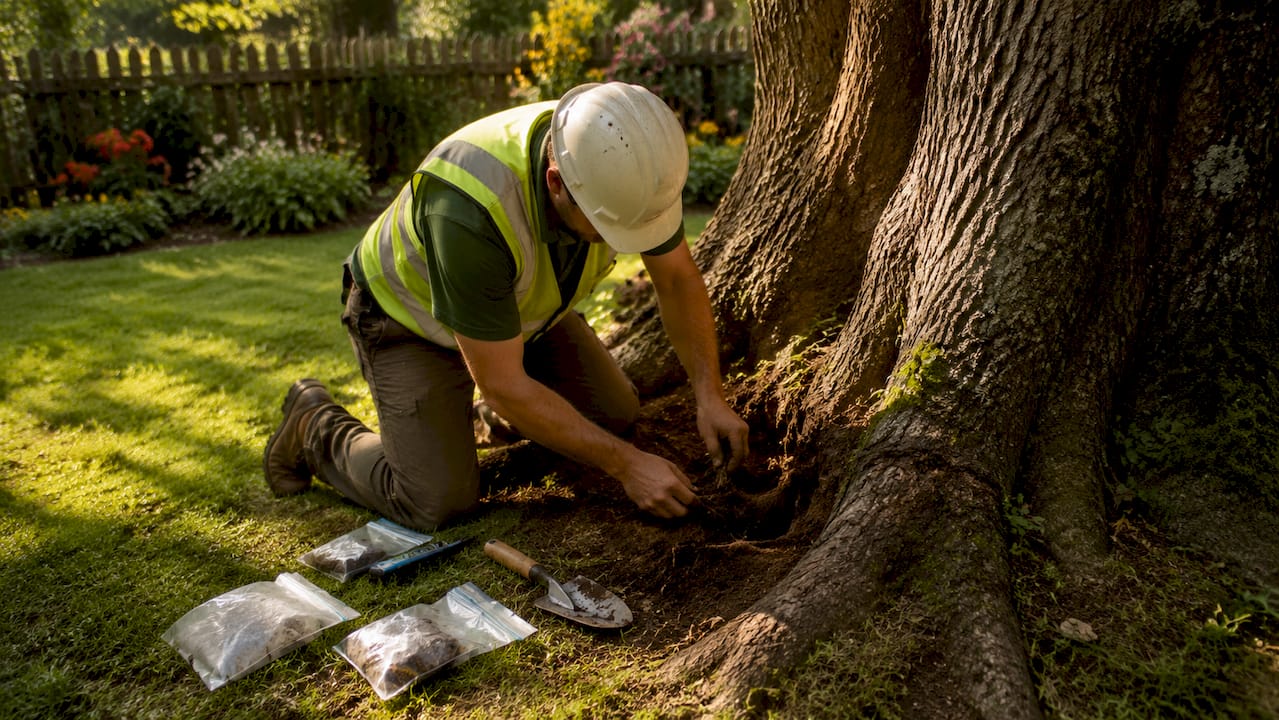
Monitoring means regularly examining leaves, branches, the trunk, and the root zone for early warning signs. Yellowing leaves, sparse canopy growth, or soft spots in the bark all signal stress before it becomes a crisis. Monitoring also includes tracking environmental conditions like soil moisture and drainage patterns.
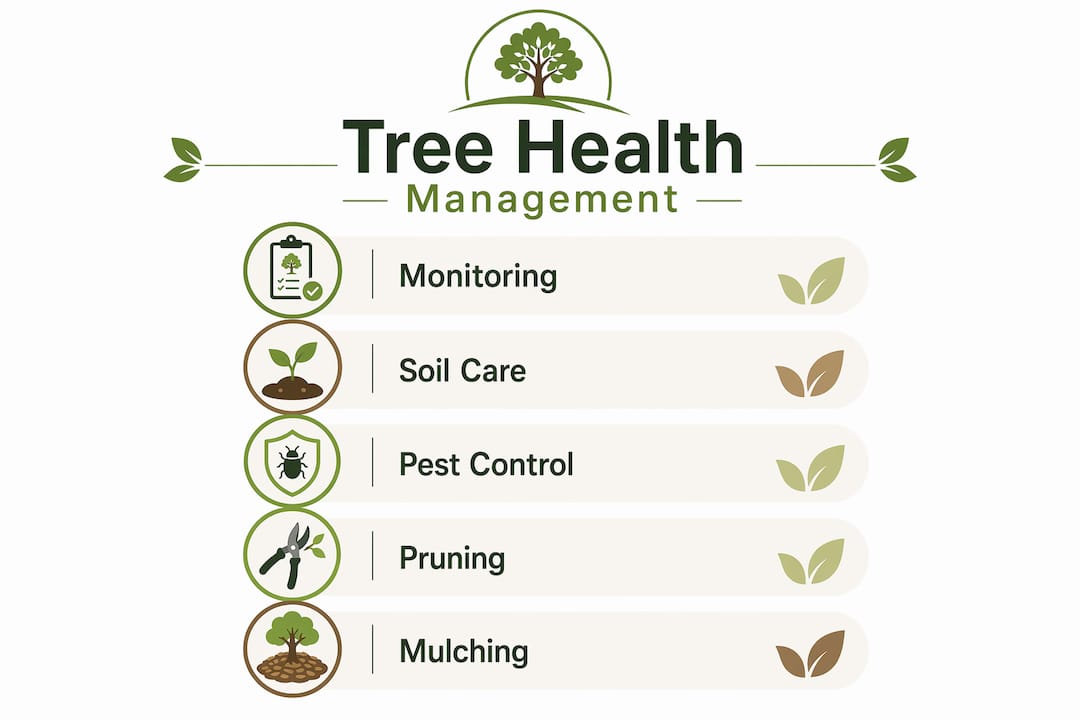
Soil management is the most underrated component. Most tree health problems begin underground due to soil compaction, poor drainage, or nutrient deficiency, often long before any symptoms appear in the canopy. Techniques like soil aeration, organic mulching, and targeted fertilization directly improve root performance and pest resistance. Removing competing vegetation from around the trunk base and applying a 2–4 inch layer of organic mulch supports soil texture and nutrient availability.
Pest and disease control in PHC relies on early detection and targeted treatments rather than blanket chemical applications. Trunk injections deliver treatments directly into the vascular system of the tree, which is more effective and less disruptive than spraying.
Pruning follows specific techniques to protect structural integrity. The 1-2-3 pruning rule sequences cuts to prevent bark tearing and internal decay. Regular pruning improves canopy airflow, reduces stress, and supports recovery from storm damage or disease.
- Annual professional inspections are the baseline standard
- Immediate follow-up inspections are warranted when distress signs appear
- Soil testing before fertilizing prevents over-application and root burn
- Mulching should never touch the trunk directly, as contact causes rot
Pro Tip: Apply mulch in a ring starting 6 inches from the trunk base and extending outward to the drip line. This protects roots without creating moisture traps against the bark.
How to assess tree health at home and when to call an arborist
A basic tree health assessment takes about 20 minutes and requires only a notebook, a camera, and a rubber mallet. Homeowners should assess leaves, branches, the trunk, and visible roots annually and after major storms.
- Examine the leaves. Look for discoloration, spots, premature drop, or unusual curling. Yellowing between leaf veins often signals nutrient deficiency. Brown leaf edges typically point to drought stress or salt damage.
- Check the branches. Scratch a small patch of bark on a small branch. Green tissue underneath means the branch is alive. Brown or dry tissue means dieback has started.
- Inspect the trunk. Look for cracks, cavities, fungal growth like mushrooms or conks, and areas where bark is peeling or missing. Tap the trunk with a rubber mallet. A hollow sound indicates internal decay.
- Look at the root zone. Heaving soil, exposed roots, or soft ground near the base can indicate root rot or structural failure risk. Check for signs of unhealthy tree indicators like girdling roots wrapping around the base.
- Document everything. Photograph each area and note the date. Comparing photos year over year reveals slow decline that is easy to miss in a single visit.
Call a certified arborist when you find hollow sections, significant fungal growth, major cracks in the trunk, or any sign that the tree may be leaning more than it used to. Advanced diagnostics like sonic tomography can detect internal decay invisible to visual inspection. This technology is critical for high-value trees where the cost of removal would be significant.
Pro Tip: Schedule your annual tree inspection in late winter or early spring before leaf-out. Bare branches make structural defects far easier to spot.
What are the most common factors affecting tree health?
Tree decline rarely has a single cause. Mature tree decline results from cumulative environmental stressors, not a single disease or pest event. Understanding those stressors is the first step toward preventing them.
Environmental stressors include soil compaction from foot traffic or vehicle parking, drought, flooding, and poor planting site selection. Soil compaction reduces oxygen in the root zone and blocks water infiltration. Mechanical relief techniques like air-spade excavation break up compacted soil without cutting roots.
Pests and diseases cause serious damage when trees are already stressed. The Emerald Ash Borer, for example, kills ash trees that are weakened by drought or compaction far faster than it attacks healthy specimens. Fungal infections like root rot and canker diseases spread rapidly in poorly drained soils.
Human activity causes more tree damage than most property owners realize. Construction within the root zone, improper pruning cuts, and lawn mower strikes to the trunk base all create entry points for decay and disease.
| Factor | Reactive approach | Proactive approach |
|---|---|---|
| Soil compaction | Emergency aeration after decline shows | Annual aeration and mulching program |
| Pest infestation | Chemical treatment after damage | Monitoring and biological controls |
| Storm damage | Emergency removal | Structural pruning before storm season |
| Disease | Fungicide after spread | Species selection and site preparation |
Proactive management through species selection, proper planting depth, and active management practices including thinning and minimal stem damage builds long-term resilience. Reactive management consistently costs more and produces worse outcomes.
How does professional tree health management differ from ordinary tree care?
Ordinary tree care means trimming branches when they get too long or removing a tree after it dies. Professional tree health management, grounded in PHC principles, is a different discipline entirely.
A certified arborist builds a care plan specific to each tree’s species, age, site conditions, and history. PHC views the tree as a system that includes soil, climate, moisture, and surrounding structures. That system-level view leads to treatments that address root causes rather than surface symptoms.
- Soil testing and remediation to correct pH and nutrient imbalances
- Targeted pest control using trunk injections instead of broadcast spraying
- Structural pruning timed to the tree’s growth cycle, not the homeowner’s schedule
- Sonic tomography to map internal decay before it becomes a safety hazard
- Species-specific fertilization programs based on seasonal nutrient demand
“Tree care is stewardship. Trees are dynamic, long-term assets that require ongoing attention, not just a trim when they look overgrown.” — Plant Health Care principles
Customized care plans that account for species, site history, and local climate are the standard in professional PHC. One-size-fits-all treatments are ineffective and often accelerate decline in trees that need a different approach. The difference between a tree that lives another 50 years and one that needs removal in a decade often comes down to whether it received professional care or just occasional trimming.
Key Takeaways
Effective tree health management requires a proactive, system-level approach that addresses soil, structure, pests, and monitoring together rather than treating each problem in isolation.
| Point | Details |
|---|---|
| PHC is the standard | Plant Health Care treats trees as systems, not trimming targets, for long-term resilience. |
| Soil health drives canopy health | Most decline starts underground. Aeration, mulching, and soil testing prevent visible symptoms. |
| Annual inspections are the baseline | Inspect leaves, branches, trunk, and roots every year and after every major storm. |
| Proactive care costs less | Scheduled maintenance is far cheaper than emergency removal of a declining mature tree. |
| Certified arborists deliver better outcomes | Species-specific, site-informed care plans outperform generic treatments every time. |
What I’ve learned from watching homeowners skip the root zone
Most property owners focus on what they can see. They notice a dead branch or a leaning trunk and call for a trim. What they miss is the 18 inches of soil beneath the root zone where the real story is unfolding.
I’ve seen beautiful, mature oaks in Central Florida decline over three to four years because of compacted soil from a driveway expansion. The canopy looked fine for the first two seasons. By the time the yellowing started, the root system was already severely compromised. A soil aeration program started in year one would have cost a fraction of what the eventual removal did.
The other misconception I run into constantly is that pruning equals care. Pruning is one tool in a much larger kit. A tree that gets trimmed every year but never receives a soil assessment, a pest inspection, or a structural evaluation is not being managed. It is being maintained at best, and neglected at worst.
The property owners who get the best results treat their trees the way they treat their homes. They schedule annual checkups, address small problems before they grow, and work with professionals who know the difference between a cosmetic issue and a structural one. That mindset shift, from trimming to stewardship, is what separates trees that thrive for generations from trees that get removed at the worst possible time.
— Mcculloughtreeservice
How Mcculloughtreeservice can help you manage tree health
Property owners in Orlando and Central Florida have a reliable partner in Mcculloughtreeservice for professional tree health management.
Mcculloughtreeservice’s certified arborists in Orlando build customized care plans based on each tree’s species, site conditions, and history. Their team handles everything from soil assessments and pest control to structural pruning and storm preparation. For trees that need regular maintenance, their professional tree trimming services keep canopies healthy and structurally sound year-round. Schedule a consultation to get a personalized assessment and stop paying for reactive fixes when proactive care is available.
FAQ
What is the difference between tree trimming and tree health management?
Tree trimming removes specific branches for aesthetics or clearance. Tree health management, or Plant Health Care, is a full program covering soil care, pest control, structural pruning, and monitoring to maintain long-term tree vitality.
How often should I have my trees professionally inspected?
Annual inspections are the standard recommendation. You should also schedule an inspection immediately after a major storm or whenever you notice yellowing leaves, fungal growth, or unusual leaning.
What are the signs of a healthy tree?
Signs of healthy trees include firm, evenly colored bark, full and evenly distributed leaf canopy, no fungal growth at the base, and stable root flare at ground level with no heaving soil.
Can I assess my tree’s health myself?
Yes, a basic assessment using a notebook, camera, and rubber mallet covers leaves, branches, trunk, and roots. However, internal decay and root zone problems require a certified arborist assessment and diagnostic tools like sonic tomography.
Why do mature trees decline even without obvious disease?
Mature tree decline is typically caused by cumulative environmental stressors like soil compaction, drought, and poor drainage rather than a single disease. These stressors weaken the tree over years before visible symptoms appear.
Recommended
- Tree Health Assessment Guide for Central Florida Owners
- Tree Hazard Evaluation Explained: A Guide for FL Owners
- Tree health tips for Central Florida properties in 2026
- Commercial Tree Removal Guide for Safe Property Management