By: Shelby McCullough| Published: June 15, 2026
TL;DR:
- Tree pollarding is a cyclical pruning method that consistently cuts trees back to fixed points, encouraging dense regrowth and extending lifespan. It differs from topping and other forms of pruning because it involves planned, recurring cuts that maintain tree structure and health when performed correctly on suitable species. Proper timing, professional consultation, and ongoing maintenance are essential for safe, long-term results.
Tree pollarding is a cyclical pruning system where the upper branches of a tree are cut back to the same points repeatedly, controlling size and stimulating dense regrowth. Unlike a one-time trim, pollarding commits a tree to a managed structure for its entire life. Homeowners and property managers use it to keep large trees contained near power lines, buildings, and tight urban lots. Species like London Plane, Willow, and Elm respond best. When done correctly, pollarding extends a tree’s lifespan and creates a distinctive, controlled silhouette that standard pruning cannot achieve.
What is tree pollarding vs. other pruning methods?
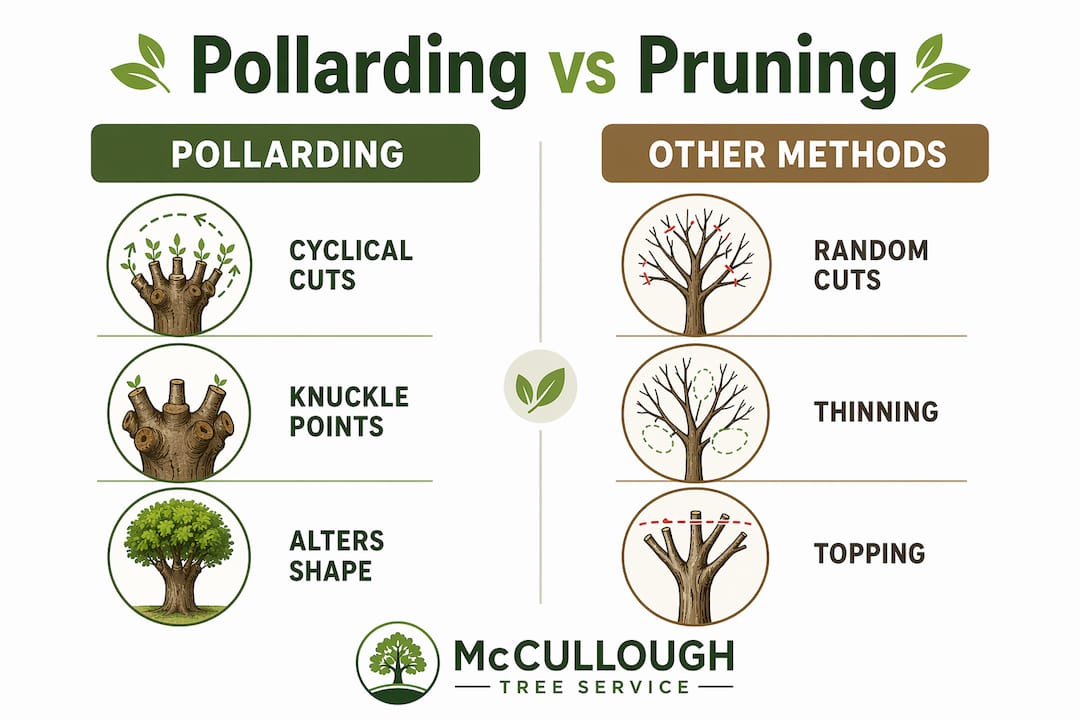
Pollarding is not the same as trimming, thinning, or topping, and confusing them leads to real damage. The table below shows the core differences.
| Method | Cut Type | Effect on Tree | Maintenance Cycle |
|---|---|---|---|
| Pollarding | Heading cuts to fixed points | Dense regrowth, controlled size | Every 1–5 years |
| Selective pruning | Thinning cuts | Natural form preserved | As needed |
| Topping | Random heading cuts | Weak, unstable regrowth | Ongoing damage |
| Crown reduction | Reduction cuts | Smaller canopy, natural shape | Every 3–7 years |
Heading cuts invigorate growth and alter the tree’s typical shape, which is exactly what pollarding intends. Thinning cuts, used in selective pruning, do the opposite by opening the canopy while preserving the tree’s natural branching pattern.
Topping is the method most often confused with pollarding, and the distinction matters. Pollarding differs from topping because it is a planned, cyclical technique that preserves tree structure and promotes dense, healthy growth. Topping makes random cuts that leave large wounds, trigger weak water sprouts, and destabilize the tree over time. A pollarded tree grows back to predictable knuckle points every cycle. A topped tree grows back unpredictably and becomes a safety hazard.
Pro Tip: If someone quotes you a job that involves cutting branches back to random points with no plan for follow-up maintenance, that is topping, not pollarding. Walk away.
Pollarding also differs from crown reduction, which reduces the overall canopy size while keeping the tree’s natural shape. Crown reduction is a one-time or occasional correction. Pollarding is a lifelong commitment that permanently changes the tree’s structure.
Which trees are best suited for pollarding?
Species selection is the single most important factor in whether pollarding succeeds or fails. Willows, Elms, and London Plane tolerate pollarding because they produce vigorous regrowth from cut points and form strong callus tissue over wounds. Trees that lack this ability simply decline after repeated heavy cuts.
The best candidates for pollarding share three traits: they are broadleaf deciduous species, they produce vigorous new shoots from old wood, and they tolerate wound exposure without significant disease risk. Strong performers include:
- London Plane (Platanus x acerifolia): the most common urban pollard worldwide
- Willow (Salix spp.): fast regrowth, ideal for waterside landscapes
- Elm (Ulmus spp.): tolerates repeated cutting and recovers well
- Mulberry (Morus spp.): traditional pollard species with edible fruit production
- Linden/Basswood (Tilia spp.): popular in European formal gardens
Trees that do not respond well to pollarding include most conifers, oaks, and ornamental flowering trees like dogwood or cherry. These species either fail to produce new growth from old wood or are highly susceptible to decay after large wounds. Applying pollarding to the wrong species causes slow decline, disease entry, and eventual structural failure.
ANSI A300 pruning standards state that pruning must serve a defined health, safety, or structural purpose and must only be applied to species that tolerate the technique. This standard exists because well-meaning homeowners sometimes apply pollarding to unsuitable trees with damaging results.
Pro Tip: Before committing any tree to a pollarding program, consult a certified arborist who can confirm species suitability and assess the tree’s current health.
When should you pollard a tree?
Timing determines whether pollarding strengthens or stresses a tree. Late winter to very early spring is the correct window for deciduous species. Cutting at the end of dormancy preserves the tree’s energy reserves and allows wounds to close quickly as new growth begins. Cutting in summer or fall forces the tree to heal wounds while also managing heat or preparing for winter, which compounds stress.
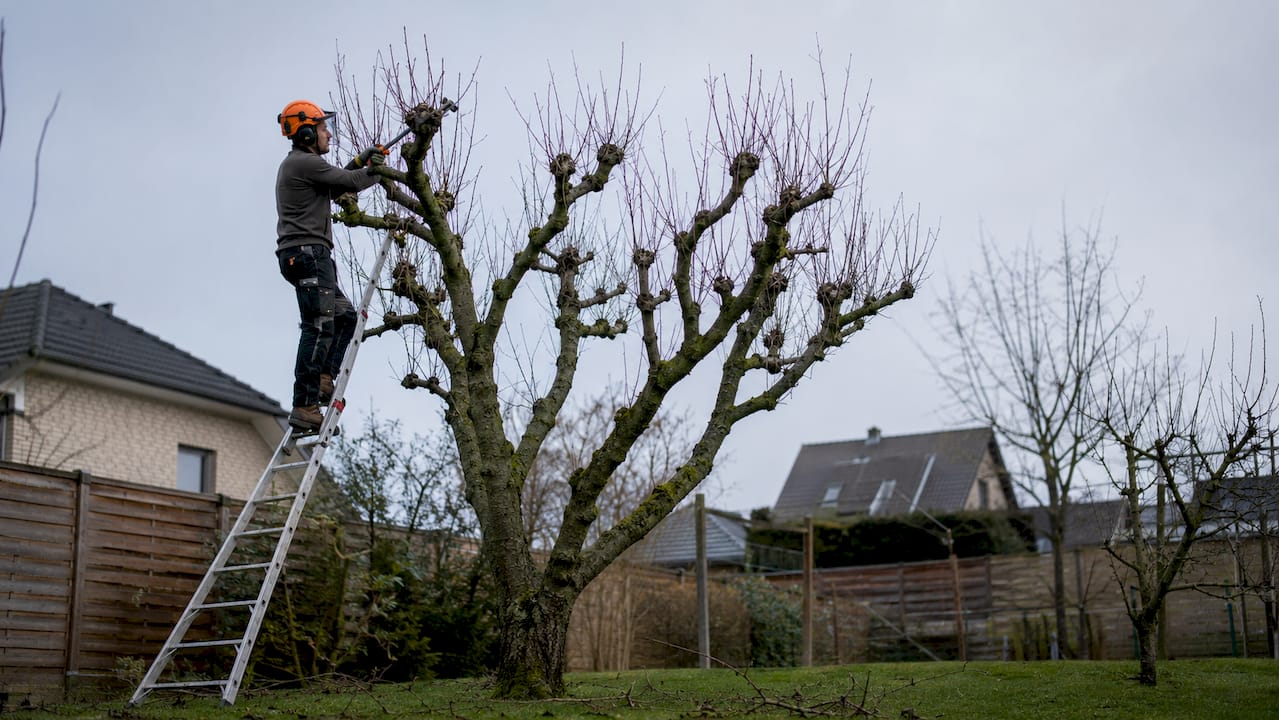
The frequency of cuts depends on species and goals. Pollarding is a lifelong cyclical system requiring maintenance every 1–5 years. Fast-growing species like Willow may need annual cuts to prevent shoots from becoming too heavy. Slower-growing species like Linden can go three to five years between cycles.
Here is the basic sequence for maintaining an established pollard:
- Identify the knuckles. These are the swollen cut points from previous cycles where new shoots originate.
- Remove all new shoots back to the knuckle. Cut flush without leaving stubs, and avoid cutting into the knuckle itself.
- Check for decay or disease. Inspect each knuckle for soft wood, discoloration, or fungal growth before cutting.
- Clear debris. Remove all cut material from the area to reduce disease pressure.
- Monitor through the growing season. Watch for unusual shoot dieback or signs of stress after cutting.
Once knuckles are established, annual maintenance cuts require less specialized skill than the initial framework cuts. The first pollarding cuts, which establish the knuckle structure, require an experienced arborist. Subsequent maintenance is more straightforward but must remain consistent.
Pro Tip: Align your pollarding schedule with your local climate. In Central Florida, late January through early March works well before the spring growth flush begins.
What are the benefits and drawbacks of pollarding?
Pollarding delivers specific advantages that no other tree pruning method replicates, but it also carries real costs and risks that homeowners need to understand before starting.
Benefits worth knowing
Pollarding allows trees to live longer by controlling size, reducing limb failure risk, and preventing overcrowding stress. A large tree that would otherwise outgrow a residential lot can remain healthy and contained for decades under a pollarding program. That is a significant advantage for property managers who want mature trees without the liability of oversized canopies.
Pollarded trees create specialized habitats as they age. The knuckles hollow out over time, providing nesting sites for birds, bats, and cavity-dependent insects. This ecological benefit is rarely found on unmanaged trees of the same age. For homeowners interested in supporting local wildlife, a well-managed pollard is a genuine contribution to the yard’s biodiversity.
Additional benefits include:
- Size control in tight spaces near buildings, fences, and utility lines
- Reduced storm risk by removing heavy upper branches before hurricane season
- Dense, lush foliage each growing season as the tree pushes vigorous new shoots
- Predictable maintenance costs because the work follows a defined cycle
Drawbacks to consider
Pollarding is not a low-maintenance option. Stopping pollarding mid-cycle causes structural weakness because new shoots grow heavy and attach poorly to the knuckles. A neglected pollard becomes more dangerous than an unpollarded tree. You must commit to the full program or not start it at all.
The winter appearance of a pollarded tree is stark. Bare knuckles and no canopy look severe to neighbors unfamiliar with the practice. Some homeowners find the look unattractive during the dormant season, which is worth considering for front-yard trees in visible locations.
How can homeowners manage pollarding effectively?
Managing a pollarding program well comes down to three things: choosing the right professional for the initial cuts, committing to the maintenance cycle, and monitoring tree health between sessions. The tree trimming services that handle pollarding correctly are those staffed by certified arborists who understand species-specific responses and follow ANSI A300 standards.
When selecting a professional for pollarding work, look for these qualifications:
- ISA Certified Arborist credential: the International Society of Arboriculture certification is the industry standard
- Proof of insurance: both liability and workers’ compensation coverage
- Written scope of work: a clear description of which cuts will be made and why
- Maintenance plan: a follow-up schedule, not just a one-time quote
- References from similar work: ask specifically about pollarding projects, not just general trimming
Selecting the right tree trimming service matters more for pollarding than for most other tree work because the first cuts establish the permanent structure. A poorly placed initial cut creates a knuckle in the wrong location, and that mistake repeats every cycle for the life of the tree.
For property managers overseeing multiple trees, regular maintenance cycles are most cost-effective when scheduled in advance and bundled with other seasonal tree care. Reactive tree care always costs more than planned programs.
Pollarding in residential landscapes: what i’ve observed
Most homeowners I talk to have one of two reactions when they first see a pollarded tree in winter. They either think something went wrong, or they assume the tree is dead. Neither is true. The bare knuckles and absence of canopy are exactly what a healthy pollard looks like in dormancy. The confusion is understandable, but it points to a bigger issue: most residential tree care decisions get made without enough context.
The homeowners who get the most value from pollarding are the ones who commit to it as a long-term program, not a one-time fix. I have seen properties where a single London Plane was pollarded correctly for twenty years and became the defining feature of the yard. I have also seen trees that were pollarded once and then abandoned, which created heavy, weakly attached shoots that became a liability in the first major storm.
The misconception I push back on most often is that pollarding is just aggressive trimming. It is not. It is a structural commitment. Once you start, the tree depends on you to continue. That is not a reason to avoid it. It is a reason to go in informed, with a qualified arborist and a written maintenance plan. The ecological and aesthetic value of a well-managed pollard is genuinely hard to replicate with any other technique.
If you manage a property in Central Florida and you are looking at a tree that is outgrowing its space, pollarding is worth a serious conversation with a certified arborist before you default to removal.
— Mcculloughtreeservice
Expert pollarding and tree trimming in central florida
Pollarding is one of the most technical tree care services a property owner can request, and the quality of the initial cuts determines the tree’s structure for decades.

Mcculloughtreeservice provides professional tree trimming and pollarding services across Orlando and Central Florida, performed by ISA Certified Arborists who follow ANSI A300 pruning standards. Whether you are establishing a new pollard program or maintaining an existing one, the team at Mcculloughtreeservice builds a written maintenance plan tailored to your species, property layout, and goals. Contact Mcculloughtreeservice today for a consultation and get a clear picture of what your trees need before the next growing season begins.
Key takeaways
Tree pollarding is a lifelong structural commitment that controls size, extends tree lifespan, and creates wildlife habitat when applied to the right species on a consistent maintenance cycle.
| Point | Details |
|---|---|
| Pollarding is cyclical | Trees require cuts every 1–5 years; skipping cycles creates dangerous, weakly attached shoots. |
| Species selection is critical | Willows, London Plane, and Elms tolerate pollarding; conifers and most ornamentals do not. |
| Timing matters | Cut deciduous trees in late winter to early spring during dormancy to minimize stress. |
| Pollarding differs from topping | Pollarding follows a planned cycle to fixed knuckle points; topping causes random wounds and instability. |
| Professional setup is required | Initial framework cuts must be made by a certified arborist to establish correct knuckle placement. |
FAQ
What is tree pollarding in simple terms?
Tree pollarding is a pruning method where the upper branches of a tree are cut back to the same fixed points every one to five years, controlling size and encouraging dense new growth. It is a lifelong management system, not a one-time trim.
How does pollarding differ from topping?
Pollarding is a planned, cyclical technique that cuts to defined knuckle points and promotes healthy regrowth. Topping makes random cuts that leave large wounds, trigger weak unstable shoots, and damage the tree’s long-term structure.
When is the best time to pollard a tree?
Late winter to very early spring is the correct window, just before dormancy ends. Cutting at this time preserves the tree’s energy reserves and allows wounds to close quickly as new growth begins.
Can any tree be pollarded?
No. Broadleaf deciduous species like Willow, Elm, London Plane, and Mulberry tolerate pollarding well. Conifers, oaks, and most flowering ornamentals do not respond well and may decline after repeated heavy cuts.
What happens if you stop pollarding a tree?
Stopping mid-cycle allows new shoots to grow heavy with weak attachment to the knuckles, creating a significant structural hazard. Once a tree is committed to a pollarding program, consistent maintenance is required for its safety and health.
Recommended
- Tree Care 101: Trimming vs. Pruning Guide
- The Importance of Tree Pruning
- What Is Bracing in Tree Care? A Property Owner’s Guide