By: Shelby McCullough| Published: July 23, 2026
What is tree risk assessment and why does it matter?
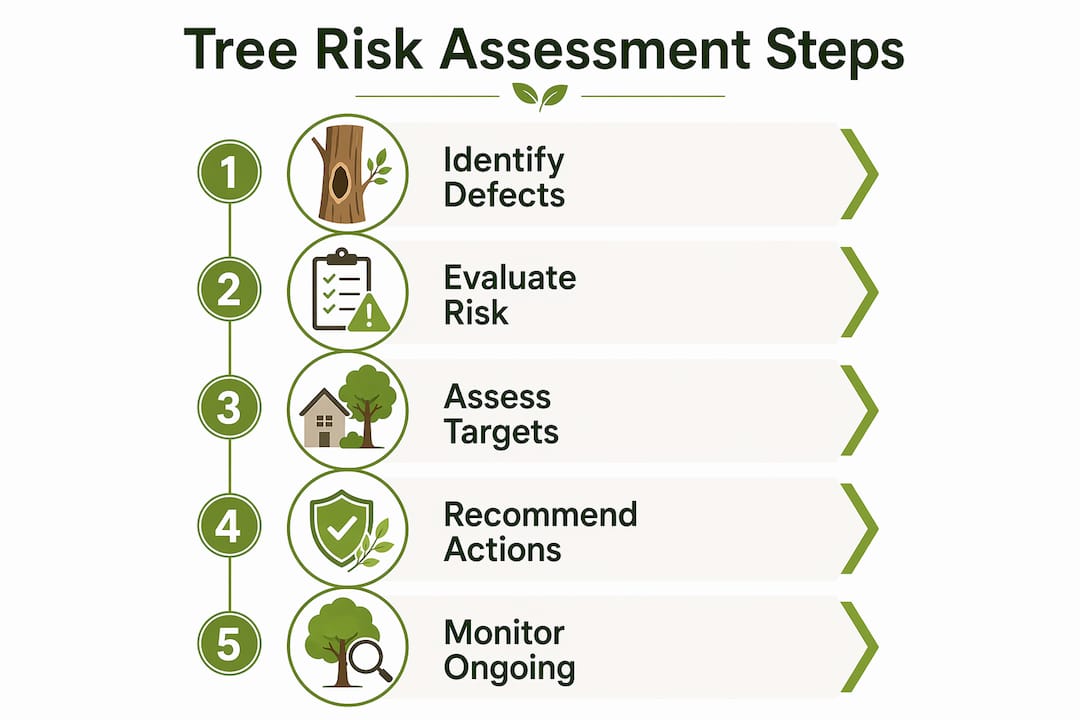
A tree risk assessment is a systematic, scientific process conducted by trained arborists to identify, analyze, and evaluate the potential hazards trees pose to people, property, and activities nearby. The International Society of Arboriculture defines it as a structured, standardized approach carried out by professionals using industry-accepted methodologies. Put simply, it answers one question: could this tree hurt someone or damage something, and if so, what do we do about it?
Every tree risk assessment revolves around three core elements:
- The tree or tree part at risk of failure, such as a branch, stem, or root system
- The target, meaning the people, property, vehicles, or activities that could be affected if that part fails
- The likelihood of failure and whether that failure would actually reach and harm the target
The goal is not to declare every imperfect tree a danger. It is to promote safety while preserving the real benefits trees provide, from shade and air quality to property value and storm buffering. Industry standards like ANSI A300 define the scope and methods arborists follow, and the ISA Tree Risk Assessment Qualification (ISA TRAQ) certifies the professionals who conduct them. A property owner who understands these basics is already better positioned to make informed decisions about the trees on their land.
Table of Contents
- Core principles behind a tree failure risk assessment
- How arborists assess tree risk: methods and levels explained
- How target evaluation shapes the urgency of any assessment
- Environmental and weather conditions that raise tree risk
- Managing assessed tree risk: from evaluation to mitigation
- What certified arborists bring to a professional tree evaluation
- Mcculloughtreeservice brings certified expertise to your property
- Key Takeaways
Core principles behind a tree failure risk assessment
The foundation of any credible tree risk assessment is a systematic approach: identify potential defects, analyze the likelihood that those defects lead to failure, and evaluate the consequences if failure occurs. Arborists do not simply look at a tree and guess. They work through a structured process that weighs multiple variables at once.
Tree biology and mechanics play a central role. A crack in a branch is not just a visual flaw; it reflects how the wood is loaded under wind stress, how decay has progressed, and whether the tree’s natural compartmentalization has contained the damage or lost the battle. Understanding how trees grow, respond to injury, and distribute structural loads is what separates a professional evaluation from a homeowner’s best guess.
Two concepts that often get confused are defect detection and risk evaluation. Detecting a defect, such as a hollow trunk or a co-dominant stem, tells you a hazard exists. Calculating risk requires adding the likelihood that the defect causes failure and the consequence of that failure reaching a target. A massive hollow oak over an empty field carries far less risk than a smaller cracked branch directly above a playground. The distinction between hazard and risk is what drives every mitigation decision.
Pro Tip: When talking to a contractor or neighbor about a tree, use “hazard” to describe a physical defect you can see, and “risk” to describe the probability and consequence of that defect causing harm. Mixing the two leads to either unnecessary removals or ignored dangers.
How arborists assess tree risk: methods and levels explained
ANSI A300 standards organize tree risk assessments into three levels of increasing detail and complexity. The level chosen depends on the tree’s location, the nature of the concern, and what decisions the assessment needs to support.
| Assessment Level | Method | Tools Used | Typical Use Case |
|---|---|---|---|
| Level 1: Limited visual | Walk-by survey from a distance | Unaided eye, binoculars | Routine inventory of large tree populations |
| Level 2: Basic | Detailed ground-level inspection | Visual exam, basic tools, probes | Single-tree evaluation for homeowners or managers |
| Level 3: Advanced | Diagnostic testing | Sonic tomography, resistance drilling, pull testing, aerial inspection | High-value trees, legal cases, complex defects |
Level 1 is a broad pass. An arborist walks a site and flags trees that need closer attention. It is efficient for parks, campuses, or large residential properties with many trees, but it does not produce a detailed risk rating for any individual tree.
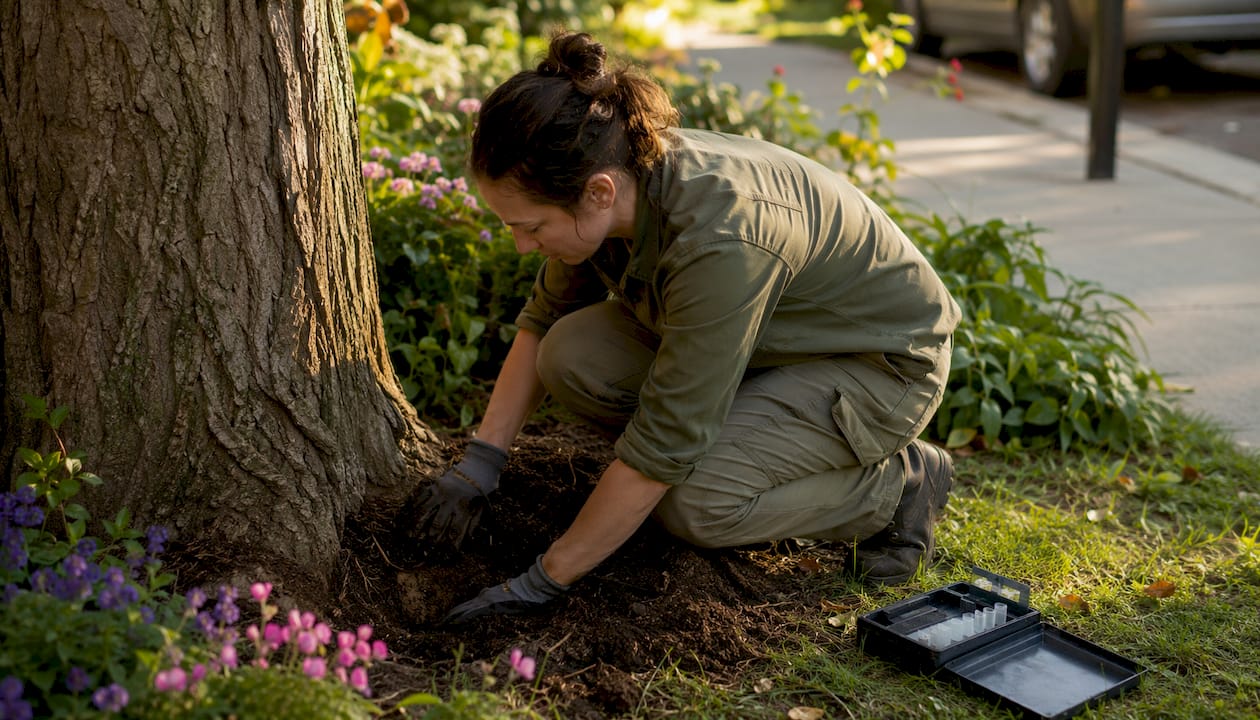
Level 2 is what most homeowners encounter. The arborist circles the tree, examines the root flare, trunk, scaffold branches, and crown, and documents defects, targets, and risk ratings. This level covers the vast majority of residential and commercial assessments.
Level 3 brings in specialized equipment when a Level 2 inspection raises questions that visual examination cannot answer. Sonic tomography maps internal decay without drilling. Resistance drilling measures wood density along a path through the trunk. Pull testing applies measured loads to evaluate root anchorage. Aerial inspection, conducted from a lift or by a climber, gets eyes on defects in the upper crown that are invisible from the ground.
A separate methodology worth knowing is Quantified Tree Risk Assessment (QTRA), which assigns numeric probability values to failure likelihood and target occupancy to produce a calculated risk figure. QTRA is used more commonly in the United Kingdom and in formal risk management contexts, but the underlying logic, multiplying probability of failure by consequence, mirrors the qualitative ratings used in standard ISA-based assessments.
Advantages and limitations by level:
- Level 1: Fast and cost-effective for large populations; misses defects not visible from a distance
- Level 2: Practical and thorough for most situations; limited by what is visible from the ground
- Level 3: Highest accuracy for complex cases; requires specialized equipment and adds cost
How target evaluation shapes the urgency of any assessment
Risk is calculated by combining the likelihood of tree failure with the consequence of that failure reaching a target. The target is not an afterthought; it is half the equation.
| Target Type | Examples | Impact Potential |
|---|---|---|
| People | Pedestrians, residents, children playing | High: injury or fatality possible |
| Structures | Homes, garages, fences, utility lines | High: costly damage, potential injury |
| Vehicles | Parked cars, driveways | Moderate to high: property damage, possible injury |
| Open areas | Lawns, fields with no regular occupancy | Low: failure may cause no harm |
Proximity matters enormously. A tree whose canopy extends directly over a bedroom roof presents a different risk profile than one at the far edge of a property, even if both trees have identical defects. Occupancy frequency also factors in. A picnic table used every weekend under a large oak raises the risk rating compared to the same table used twice a year.
Consequence severity is assessed alongside likelihood. An arborist evaluating a tree over a high-traffic sidewalk will weight the target consequence as severe, which can push the overall risk rating to “high” even when the probability of failure is moderate. That combination is what drives mitigation urgency, not the defect alone. Property owners who understand this logic can have much more productive conversations with their arborist about which trees genuinely need immediate action and which can be monitored.
Environmental and weather conditions that raise tree risk
Storms, drought, and soil conditions significantly influence tree stability and risk levels. Trees do not fail in a vacuum; external stressors weaken structural integrity over time and can turn a manageable defect into an emergency.
Weather conditions and biological factors that increase risk include:
- High winds and storms: The most common trigger for acute failure, especially in trees with crown imbalance, decay, or root damage
- Heavy rain and soil saturation: Waterlogged soil loses its ability to anchor roots, making even structurally sound trees vulnerable to windthrow
- Drought stress: Prolonged dry periods weaken wood fiber and make trees more susceptible to pest infestation and disease
- Freeze/thaw cycles: Repeated freezing and thawing opens cracks in wood and bark, accelerating decay entry points
- Pest infestations and disease: Bark beetles, wood-boring insects, and fungal pathogens compromise structural wood, often invisibly until failure is imminent
- Soil erosion: Erosion around the root zone reduces anchorage and exposes roots to mechanical damage and desiccation
- Construction disturbance: Trenching, compaction, and grade changes near trees sever or suffocate roots, with effects that may not appear for two to five years
Seasonal timing shapes when assessments are most valuable. In Central Florida, the period leading into hurricane season, roughly May through June, is the most critical window for scheduling a professional evaluation. Trees stressed by the previous dry season carry elevated failure risk when the first major storms arrive. Scheduling an assessment before that window, rather than after a storm has already done the damage, is the practical move for any property owner with mature trees near structures.
Pro Tip: After any significant storm, even one that caused no visible damage, walk your property and look for newly leaning trees, exposed root plates, or fresh cracks in major limbs. These are early indicators that warrant a professional follow-up before the next weather event.
Managing assessed tree risk: from evaluation to mitigation
A tree risk assessment is only useful if it leads to action. The goal is balance: reducing risk to an acceptable level while preserving as much of the tree’s value as possible. Removal is rarely the first or only answer.
Common mitigation options include:
- Pruning: Removing dead, weak, or structurally compromised branches reduces the load on defective unions and lowers the sail area that catches wind
- Cabling and bracing: Installing flexible steel cables or rigid rods between co-dominant stems or weak branch attachments provides supplemental support without removing the tree
- Crown reduction: Reducing the overall size of the crown decreases wind resistance and redistributes weight away from a compromised root system
- Hazardous limb removal: Targeting specific high-risk branches over occupied areas while retaining the rest of the tree
- Tree removal: Reserved for cases where risk cannot be reduced to an acceptable level through other means, or where the tree is already dead or dying
Before any mitigation work, property owners benefit from taking a few practical steps. Document the tree’s condition with photos. Note any changes since the last inspection, new lean, bark damage, mushrooms at the base, or wilting foliage. Check whether the tree is covered under a homeowner’s insurance policy and whether local ordinances require permits for removal. Understanding why regular tree maintenance matters before a problem develops is far less expensive than emergency response after a failure.
After the assessment and any immediate mitigation, ongoing monitoring is part of the plan. Most arborists recommend re-evaluation every one to three years for trees rated as moderate risk, and annually for those in high-risk categories. A tree’s condition changes with time, weather, and biology, so a single assessment is a snapshot, not a permanent verdict.
Pro Tip: Ask your arborist to provide a written report with a risk rating and specific recommendations. A formal document protects you legally, supports insurance claims, and gives you a clear benchmark for the next inspection.
What certified arborists bring to a professional tree evaluation
The ISA TRAQ credential is the benchmark qualification for professionals conducting tree risk assessments in the United States. Earning it requires completing a two-day educational course and passing both a written and a performance-based field assessment. Maintaining it requires retraining and retesting every seven years. That cycle keeps credentialed arborists current with evolving science and standards.
A common misconception among property owners is that any tree service company can perform a legitimate risk assessment. The reality is that a credible assessment requires someone trained in tree biology, structural mechanics, defect identification, and risk communication. ISA TRAQ certified arborists use standardized tools like the ISA Basic Tree Risk Assessment Form to document findings consistently, which matters when reports are used for insurance claims, legal disputes, or municipal compliance.
Qualified arborists conducting assessments with accepted scientific methods give property owners both peace of mind and legal protection. A documented, professionally conducted evaluation demonstrates due diligence, which can be decisive in liability cases involving tree failure.
The ISA TRAQ program updates effective November 2025 include expanded exam content, revised performance assessments, and alignment with international standards. These changes reflect a job task analysis ensuring that credentialed professionals stay current with best practices. For property owners, this means that an arborist who recently recertified is working from the most current body of knowledge available.
One area where professional expertise consistently prevents costly mistakes is the risk-versus-hazard distinction discussed earlier. Homeowners who see a hollow trunk often assume the tree must come down immediately. A trained arborist evaluates whether the remaining wood shell is structurally adequate, whether the target exposure justifies removal, and whether cabling or monitoring is a viable alternative. That nuanced judgment, grounded in tree biology and structural analysis, is what certified arborist services deliver that a general contractor cannot.
Assessment reports vary considerably in scope. A brief field note may suffice for a routine residential check. A formal multi-page document with photographs, risk ratings, and mitigation recommendations is appropriate for legal cases, insurance purposes, or high-value trees. Clarifying the expected report format with your arborist before the visit prevents mismatched expectations and ensures you get documentation that actually serves your needs.
For homeowners in Central Florida, the combination of hurricane-force winds, sandy soils with shallow root zones, and year-round pest pressure makes professional tree evaluation especially relevant. Scheduling a tree risk assessment checklist review before storm season is a practical step that takes a fraction of the time and cost of post-storm emergency response.
Pro Tip: When hiring an arborist for a risk assessment, ask specifically whether they hold the ISA TRAQ credential, not just a general ISA Certified Arborist credential. The TRAQ qualification is the specialized training for risk assessment work.
Mcculloughtreeservice brings certified expertise to your property
When a tree on your property raises questions, you need someone who can give you a straight answer backed by real credentials, not a sales pitch for removal. Mcculloughtreeservice serves homeowners and property managers across Orlando and Central Florida with certified arborist evaluations grounded in ISA standards and ANSI A300 methodology.
The team at Mccullough Tree Service handles the full range of outcomes an assessment might recommend: from targeted tree trimming and crown reduction to tree removal when a tree genuinely cannot be saved. For property owners heading into hurricane season, the storm preparation services address the exact risk factors, crown imbalance, weak attachments, root zone stress, that make Central Florida trees vulnerable. If you want to understand your property’s tree risk before the next storm season, contact Mcculloughtreeservice for a professional evaluation and get a clear, documented picture of what your trees actually need.
Key Takeaways
A tree risk assessment is a structured, scientific process that evaluates three core elements: the tree’s condition, the targets nearby, and the likelihood of failure reaching those targets.
| Point | Details |
|---|---|
| Three core elements | Every assessment evaluates the tree or part at risk, the target that could be harmed, and the likelihood of failure reaching that target. |
| Three assessment levels | Level 1 is a walk-by survey, Level 2 is a detailed ground inspection, and Level 3 uses advanced tools like sonic tomography and resistance drilling. |
| Target proximity drives urgency | Trees directly over occupied structures or high-traffic areas carry higher risk ratings even when defects are moderate. |
| Mitigation before removal | Pruning, cabling, and crown reduction often reduce risk to acceptable levels without removing the tree entirely. |
| Mcculloughtreeservice | Certified arborists at Mcculloughtreeservice conduct ISA-standard evaluations and handle all recommended mitigation work across Central Florida. |
Recommended
- Tree risk assessment checklist: protect your property
- Why Tree Risk Assessment Matters for Your Property
- Tree Hazard Evaluation Explained: A Guide for FL Owners
- Tree Risk Assessment Guide for Central Florida (2026)