By: | Published: July 22, 2026
Why you should assess storm damage to your trees
Skipping a post-storm tree inspection is one of the most expensive mistakes a homeowner can make. A tree that looks fine from the street can have a cracked trunk, severed roots, or a hanging limb that’s one gust away from landing on your roof. Assessing storm damage to trees protects people, property, and the long-term value of your landscape.
The case for a prompt inspection comes down to three things:
- Safety first. Damaged trees pose hazards to people and property when broken limbs, unstable trunks, or uprooted root systems go undetected. A tree becomes an unacceptable risk the moment any part of it could strike a structure, vehicle, or person.
- Insurance and liability. Homeowners insurance typically covers tree removal only when a tree falls on a covered structure. Removal costs range $85–300, and coverage caps for debris removal often sit around $500 per tree. Documenting damage immediately after a storm strengthens any claim you file.
- Smarter decisions. A thorough inspection tells you whether a tree needs pruning, monitoring, or removal. Rushing to cut down a tree that could have recovered wastes a valuable landscape asset. Waiting too long on a genuinely hazardous one risks far worse.
- Cost savings. Targeted pruning of damaged limbs costs a fraction of full removal. Catching problems early, before decay spreads or pests colonize a wound, keeps repair costs manageable.
- ISA standards. The International Society of Arboriculture (ISA) sets the professional benchmark for tree risk assessment. An ISA Certified Arborist follows a systematic inspection protocol covering roots, trunk, limbs, and crown, giving you a credible, defensible evaluation rather than a guess.
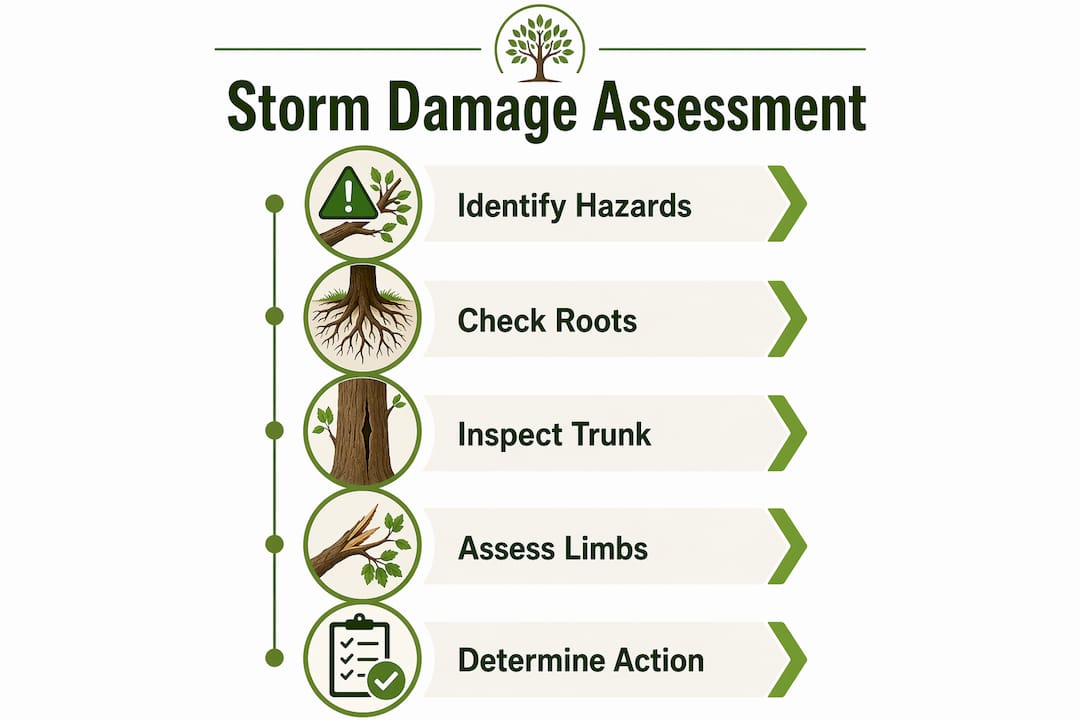
The goal of any storm damage assessment is triage: identify immediate hazards, separate salvageable trees from those that must come down, and build a recovery plan that protects both people and the trees worth saving.
How to check your tree’s roots for storm damage
Roots are the foundation of every tree. When they fail, the whole tree can fail, often without much warning. That’s why root inspection is the starting point of any storm damage tree inspection.
Signs of root damage to look for:
- Soil heaving or mounding around the base of the trunk
- Exposed roots that were previously underground
- A visible gap or crack in the soil on the side opposite a lean
- The root plate lifting out of the ground on one side
- A tree that has shifted from its normal vertical position since the storm
Root damage cuts two ways. Structurally, roots anchor the tree against wind and gravity. Functionally, they pull water and nutrients from the soil. Sever or decay enough of them and the tree loses both its grip and its food supply.
Confined root spaces make things worse. Trees growing in compacted soil, shallow hardpan, or small urban planting areas can’t develop the deep, wide root systems that resist wind throw. A storm that a forest tree shrugs off can topple an urban tree whose roots never had room to spread.
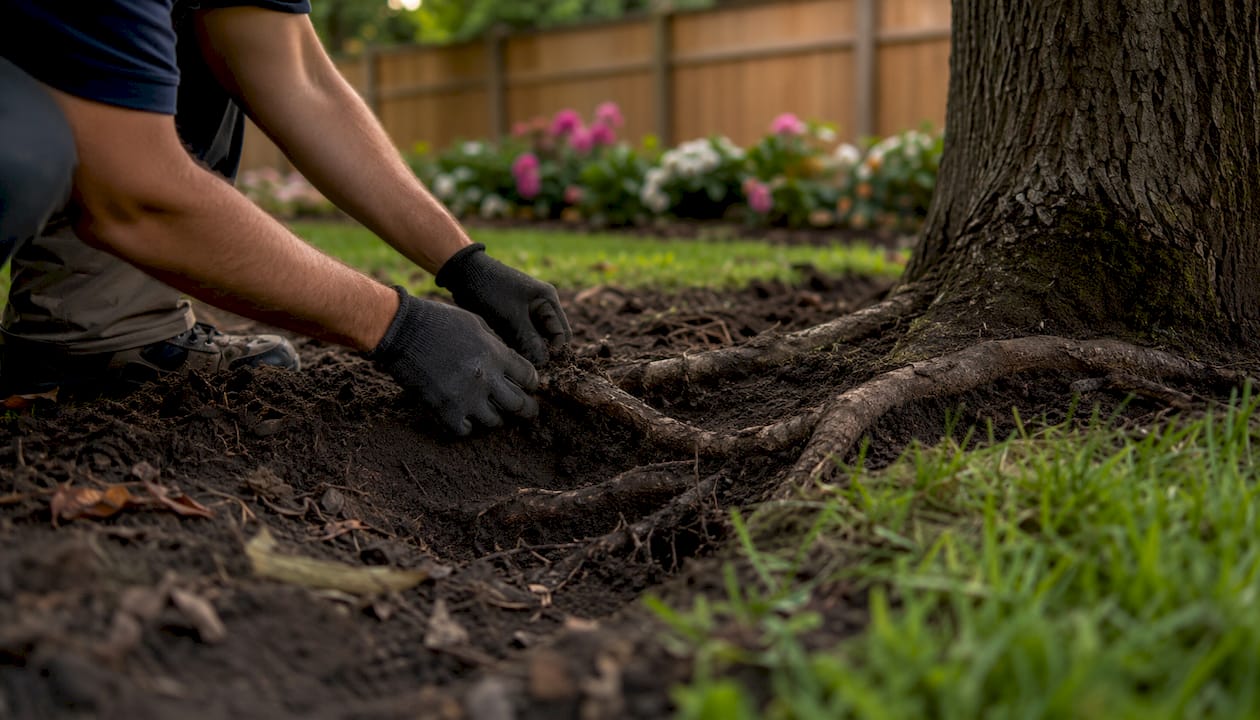
One critical detail: severed large-diameter roots do not regenerate new roots as effectively as small-diameter roots. A fallen or leaning mature tree with major root breakage is unlikely to re-anchor itself, regardless of how healthy the canopy looks.
| Root Damage Sign | Risk Level | Recommended Action |
|---|---|---|
| Soil heaving around base | High | Professional evaluation immediately |
| Exposed surface roots, no lean | Moderate | Monitor; arborist assessment within days |
| Girdling roots with trunk cracks | High | Removal likely required |
| Shallow root plate lifting | Critical | Do not approach; call arborist |
| Minor root exposure, tree upright | Low–Moderate | Document and monitor |
Pro Tip: Walk a full circle around the base of any large tree after a storm. Soil mounding on the side opposite a lean is one of the clearest signs the root plate is failing. Don’t evaluate from one angle only.
What trunk damage tells you about a tree’s future
The trunk is the structural spine of the tree. It transfers wind forces from the canopy down into the root system, and any defect along that path raises the risk of catastrophic failure.
Trunk damage types to identify:
- Deep cracks or splits running vertically along the bark
- Bark torn away in large sections, exposing the cambium
- Cavities or hollows, especially near the base or a major branch junction
- Abnormal swelling, cankers, or seams that suggest internal decay
- Co-dominant stems with included bark forming a tight V-shape union
- A lean that appeared or worsened after the storm
Cracks deserve particular attention. When a crack runs all the way through the trunk, or when cracks appear on two perpendicular sides, the tree is actively in the process of failing. Decay next to a crack compounds the danger significantly. Decay is caused by fungi that weaken wood as they grow, and it’s often present without obvious external signs. Cracks, seams, dead branch stubs, and older wounds all suggest internal decay even when the surface looks intact.
The main leader, the central upward-growing stem, matters too. Losing it doesn’t automatically kill a tree, but it changes the tree’s structure permanently. Without a leader, lateral branches compete to fill the gap, often producing co-dominant stems that are weaker than a single dominant trunk.
Bark loss is more serious than it looks. The cambium layer just beneath the bark carries water and nutrients between roots and leaves. Large sections of stripped bark interrupt that flow. The larger the wound relative to the trunk’s diameter, the lower the odds of full recovery.
When trunk damage is severe, the removal-versus-restoration decision usually tips toward removal. A split trunk, extensive decay at the base, or cracks that won’t close are not conditions a tree can prune its way out of.
Inspecting limbs and branches for damage
Broken and hanging branches are the most immediate hazard after a storm, and they’re also the most visible. That visibility can be deceptive, though. A branch that looks stable may be held in place by tension in surrounding wood or caught in adjacent branches, ready to drop the moment conditions change.
Common limb damage to identify:
- Completely snapped branches hanging in the canopy (“widow makers”)
- Partially split limbs still attached but cracked at the base
- Branches bent under tension that may spring back when cut
- Bark stripped from limbs where they attach to the trunk
- Dead branches that the storm revealed by stripping surrounding foliage
- Broken stubs left where branches tore away
The size of the wound relative to the limb matters enormously. A 2–3 inch wound on a 12-inch diameter limb will seal over with new bark within a couple of years. A wound that covers most of the limb’s cross-section may never close, leaving a permanent entry point for fungi and wood-boring insects.
Safe inspection means keeping your distance from anything overhead. Branches under tension can release energy unpredictably when cut or disturbed, and the force can be enough to cause serious injury. Walk the perimeter of the tree and look up from multiple angles before stepping underneath.
When pruning is appropriate, the three-cut method protects the branch collar and prevents bark from tearing down the trunk. Cut limbs back to a lateral branch that is roughly half the diameter of the removed limb. Never leave stubs. And never remove more than one-third of a tree’s branching system at one time. If more than a third of the branches are damaged, the math often points toward removal rather than salvage.
Pro Tip: Avoid topping at all costs. Cutting main branches back to stubs produces weakly attached sprouts that are more likely to break in the next storm than the original branches were. A topped tree that has already sustained major storm damage is far more likely to die than recover.
How crown damage affects a tree’s ability to survive
The crown is where a tree makes its food. Leaves capture sunlight and convert it to the energy the tree needs to grow, seal wounds, and fight off pathogens. Lose too much of the crown and the tree simply can’t sustain itself.
What to evaluate in the canopy:
- What percentage of the original leaf area remains
- Whether the remaining branches are distributed evenly or heavily weighted to one side
- Signs of leaf scorch, wilting, or premature drop that suggest stress beyond mechanical damage
- Whether the central leader is intact and dominant
- The presence of hanging or broken branches still lodged in the upper canopy
The 50% threshold is a practical rule of thumb: a tree that has lost more than half of its crown may not be able to produce enough foliage to nourish itself through the next growing season. For gymnosperms like pines, the threshold is even lower. Research from the University of Florida suggests pines with 30–50% canopy damage may already be beyond recovery, while angiosperms like live oak can sometimes survive up to 70% canopy loss depending on overall health and structure.
Canopy symmetry matters for more than aesthetics. A heavily one-sided crown shifts the tree’s center of gravity, increasing the mechanical load on the root system and trunk on the heavier side. That imbalance becomes a problem in the next wind event.
Species differences are real. Slower-growing trees with dense wood, like live oak, tend to recover better from crown damage than fast-growing, brittle-wooded species. Knowing your tree’s species helps set realistic expectations for recovery. A certified arborist can factor species traits into the assessment and give you a more accurate prognosis than a general rule of thumb ever could.
Safety steps you should take immediately after a storm
Before you assess anything, stop and look up. The most dangerous moment after a storm is the one where a homeowner walks under a tree without checking what’s overhead.
Immediate safety priorities:
- Scan the entire canopy for hanging limbs before walking under any tree
- Check for downed or sagging power lines near or touching trees
- Look for trees leaning against structures, fences, or other trees
- Identify any limbs bent under tension that could spring back when disturbed
- Keep children and pets away from the area until the inspection is complete
- Call your utility company immediately if a tree is in contact with power lines
Never attempt to remove a tree or limb that is touching, near, or tangled with electrical wires. Contact with a live wire can cause electrocution, and the risk extends to the ground around the tree. Call your utility company or a qualified professional. This is not a DIY situation under any circumstances.
Documenting damage is the next step once the immediate area is confirmed safe. Photograph every damaged tree from multiple angles, including close-ups of cracks, broken limbs, and root disturbance. Note the date and time. This documentation supports insurance claims and gives any arborist you bring in a baseline to work from.
DIY tree work after a storm carries risks that most homeowners underestimate. More than 50 fatalities per year occur nationwide among professionals removing or pruning trees. The accident rate for untrained individuals is considerably higher. Chainsaws, heights, tensioned limbs, and unstable trees are a combination that demands professional training and equipment. For anything beyond removing small broken branches at ground level, the right call is to hire a qualified professional and let them handle it safely.
A tree risk assessment checklist can help you organize what you’ve observed before a professional arrives, but it’s not a substitute for the professional visit itself.
When to call an ISA Certified Arborist
Some tree damage is obvious enough that any homeowner can spot it. The harder question is knowing when what you’re seeing requires a professional to interpret. The answer, in most cases, is sooner than you think.
Situations that require a certified arborist:
- Any tree with cracks in the main trunk or major limbs
- Trees that have shifted, leaned, or show soil heaving at the base
- Trees within striking distance of your home, a power line, a vehicle, or a sidewalk
- Any tree where more than 50% of the canopy is lost
- Trees with visible decay, cavities, or fungal growth at the base
- Large hanging limbs that require a chainsaw or ladder to remove
- Any situation where you’re unsure whether to remove or keep a tree
An ISA Certified Arborist has passed a comprehensive exam covering tree biology, diagnosis, pruning, and risk assessment, and is required to maintain continuing education to keep that credential current. That training translates directly into the ability to distinguish a tree that looks bad but is structurally sound from one that looks fine but is quietly failing from the inside.
The ISA’s risk assessment framework prioritizes trees based on two factors: the likelihood of failure and the consequences if failure occurs. A large tree with moderate damage directly over a frequently used driveway gets different treatment than a small tree with similar damage in an unused corner of the yard. That kind of triage is what separates a professional evaluation from a homeowner’s best guess.
Hiring a certified arborist also protects you financially. Unnecessary removal of a healthy tree wastes money and eliminates a landscape asset that took decades to grow. Keeping a genuinely hazardous tree to save on removal costs exposes you to liability if it falls. Professional assessments follow systematic inspection patterns covering crown, trunk, and roots, and they produce a documented recommendation you can act on with confidence.
For emergency storm response in Orlando and Central Florida, Mcculloughtreeservice deploys ISA Certified Arborists who can evaluate your trees, prioritize hazards, and execute safe removal or restoration pruning on the same visit.
Best practices for post-storm tree care and long-term recovery
Getting through the immediate aftermath of a storm is one thing. Giving your trees the best chance of full recovery over the following months is another, and it requires a different kind of attention.
Post-storm care priorities:
- Remove all broken or damaged limbs using proper three-cut pruning technique
- Avoid heavy fertilization immediately after a storm; let the tree stabilize first
- Water deeply and consistently during dry periods to support root recovery
- Mulch around the base (keeping mulch away from the trunk) to retain soil moisture
- Schedule a follow-up inspection 60–90 days after the storm to check for delayed effects
- Watch for signs of pest infestation, particularly wood-boring insects attracted to stressed trees
- Monitor for fungal growth, cankers, or new cracks that weren’t visible immediately after the storm
Timing matters. Many trees recover from minor damage with time if they aren’t pruned too aggressively too soon. The temptation to clean everything up at once can lead to over-pruning that removes foliage the tree desperately needs for recovery. Remove what’s broken and hazardous, then wait and watch before making further cuts.
Pest pressure is a real concern in the weeks after a storm. Wood-boring insects detect chemicals released by stressed trees and can colonize wounds quickly. Proper pruning and nutrient management reduce the window of vulnerability by helping the tree compartmentalize wounds faster. Compartmentalization is the tree’s own defense mechanism: it forms chemical and physical barriers around wounds to limit the spread of pathogens and insects into healthy tissue.
Preventative care before the next storm is the other half of the equation. Storm preparation pruning removes dead wood, corrects co-dominant stems, and improves canopy structure so trees are better positioned to handle wind loads. Trees that receive regular structural pruning from early in their lives develop stronger branch attachments and more balanced crowns. That investment pays off every time severe weather rolls through.
Pro Tip: Never top a recovering tree. The weakly attached sprouts that grow from topped stubs are more susceptible to breakage in future storms than the original branches were, and the practice permanently compromises the tree’s structural integrity.
Key Takeaways
Assessing storm damage to trees immediately after severe weather is the single most effective step homeowners can take to protect people, property, and the long-term health of their landscape.
| Point | Details |
|---|---|
| Assess roots first | Soil heaving, exposed roots, or a shifted lean signal potential whole-tree failure requiring immediate professional evaluation. |
| Crown loss threshold | Trees that have lost over 50% of their crown often cannot produce enough foliage to recover, making survival unlikely. |
| Limb wound size matters | A 2–3 inch wound on a 12-inch diameter limb can seal within a couple of years; larger wounds elevate decay and pest risk significantly. |
| Never remove more than one-third | Pruning more than one-third of a tree’s branches at once impairs recovery; damage beyond that threshold often warrants removal instead. |
| Call an ISA Certified Arborist | When damage is near structures, involves trunk cracks, or exceeds 50% canopy loss, a certified arborist provides the only reliable assessment. |
Recommended
- How to Assess Storm-Damaged Trees in Central Florida
- Emergency Tree Service Steps for Storm Recovery
- Tree risk assessment checklist: protect your property
- Storm Cleanup Guide 2025: Central Florida Homeowners