By: Shelby McCullough| Published: July 29, 2026
Dormant pruning is used to reduce disease and pest risk, correct structural problems, and lower the stress on trees so wounds heal faster and growth rebounds stronger in spring. The Arbor Day Foundation puts it plainly: structural defects like included bark and weak branch attachments are easiest to see and correct when a tree has no foliage. University of Illinois Extension adds that late-winter pruning leaves fresh wounds exposed for only a short time before new growth kicks off the sealing process.
The three practical benefits that drive the practice:
- Reduced pest and disease transfer — insects and fungal spores are largely inactive in winter, so fresh cuts face far less infection risk
- Cleaner structural cuts — no leaves means full visibility of branch architecture, so corrective work is more precise
- Faster wound sealing — pruning just before spring growth means callus tissue forms almost immediately
Timing callout: For most of the U.S., late January through early March is the sweet spot. In Central Florida, where true dormancy is rare, mid-January to mid-February is the closest practical equivalent. Mcculloughtreeservice works within that window to protect Orlando-area trees before the rainy season raises fungal pressure.
Table of Contents
- What dormant pruning actually means
- Key benefits of dormant pruning for your trees
- When to prune trees: timing and regional caveats
- How dormant pruning helps trees physiologically
- How to prune safely and the mistakes that cause lasting harm
- When you should hire a certified arborist
- Dormancy as biology, not a calendar date
- Key Takeaways
- Why dormant pruning results speak for themselves in Central Florida
- Dormant pruning services from Mcculloughtreeservice
- Useful sources for further reading
What dormant pruning actually means
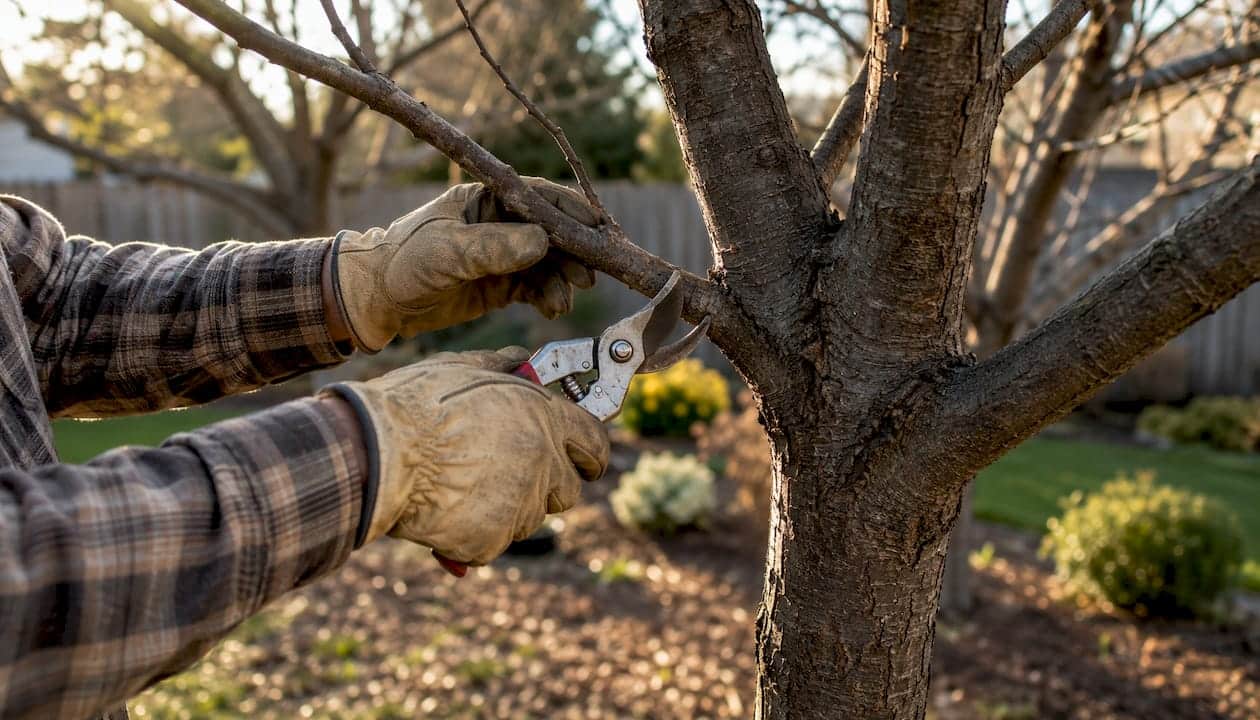
Dormant pruning means cutting branches while a tree’s metabolic activity is at its lowest point — after the growing season ends and before new buds break in spring. It is not the same as routine trimming for aesthetics, and it is definitely not topping.
Common dormant pruning cuts include:
- Removing dead, diseased, or storm-damaged wood
- Correcting structural problems: crossing branches, included bark, co-dominant stems
- Thinning the crown to reduce wind resistance
- Crown cleaning to remove water sprouts and suckers
The difference between dormant pruning and trimming vs. pruning is worth understanding. Trimming is largely cosmetic. Dormant pruning is surgical — it targets specific branches to improve long-term structure and health.
Why topping is not dormant pruning: Topping removes large portions of the crown indiscriminately, destroys tree architecture, and creates large wounds that rarely seal properly. According to University of Illinois Extension guidance, topping triggers weak, fast-growing regrowth that is structurally inferior to the original branches. A certified arborist considers topping one of the most harmful practices in tree care, full stop.
Key benefits of dormant pruning for your trees
Disease and pest risk drops significantly
Pruning during dormancy reduces the risk that insect vectors and fungal spores transmit serious pathogens through fresh cuts. Diseases like Dutch elm disease and oak wilt spread primarily through bark beetles that are active in warmer months. A cut made in January simply does not attract the same insect traffic as one made in June.
In Florida specifically, the rainy season that runs roughly June through September creates ideal conditions for fungal growth. Late-winter pruning helps trees heal before that wet season raises pathogen pressure, giving wounds weeks to begin closing before humidity spikes.
Structural training builds storm resistance
Corrective cuts made early in a tree’s life prevent the kind of weak crotches and co-dominant stems that snap during hurricanes and ice storms. The Missouri Extension notes that trees breaking up in wind and ice storms are often those that were never pruned to develop good structure. Dormant pruning is the best time for this work because the branch architecture is fully visible and the tree is not spending energy on active growth.
Wounds seal faster heading into spring
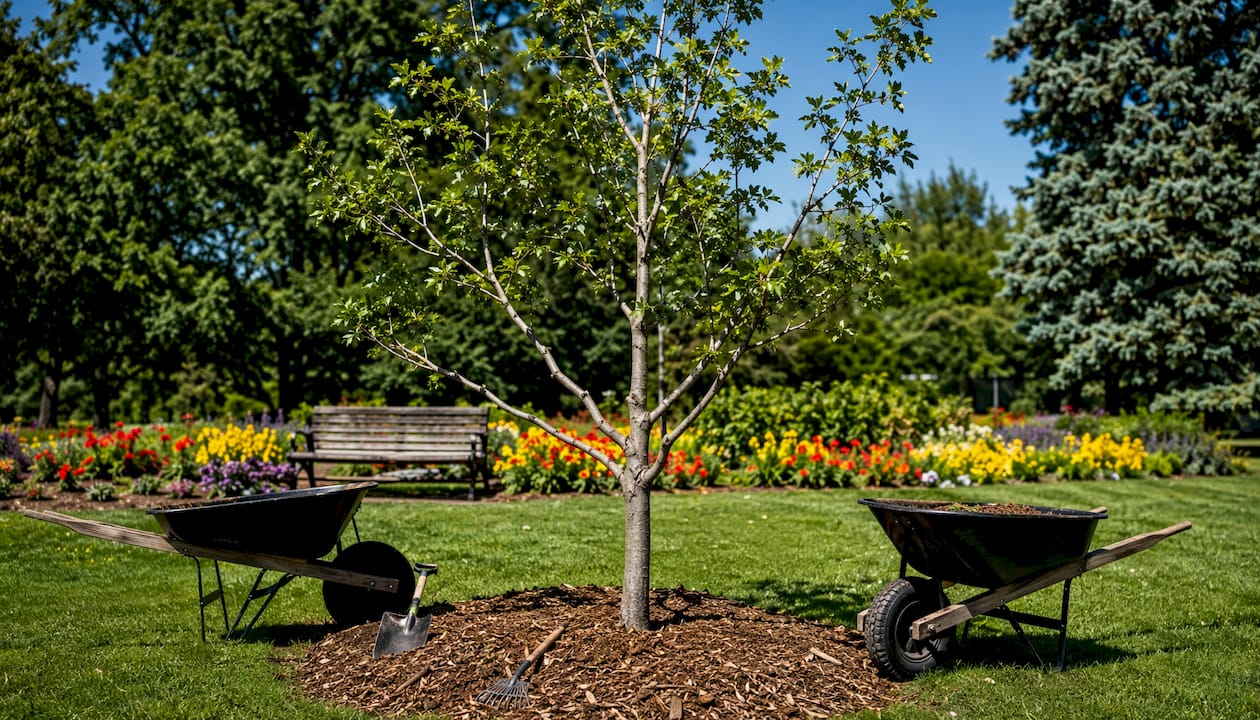
Energy reserves sit in the roots and trunk during winter. Removing a branch then does not deplete those reserves. Purdue Extension notes that dormant pruning tends to be invigorating — because stored energy is intact, the tree can produce vigorous new shoots in spring and prioritize healing simultaneously. That combination is hard to replicate with summer cuts.
Safety and hazard detection improve
Without foliage blocking the view, dead limbs, cracks, and decay at branch unions become obvious. UF/IFAS Extension notes that winter visibility lets arborists make more precise, surgical corrections that are genuinely harder to execute during the growing season. For property managers responsible for multiple trees, a dormant-season walkthrough often reveals hazards that went unnoticed all summer.
Less mess, better access
No leaves means no leaf cleanup after cuts. Garden beds and lawn areas are less disturbed. For commercial properties where appearance matters daily, that practical advantage is real.
When to prune trees: timing and regional caveats
The right pruning window depends on your climate and the specific tree, not just the calendar.
| Region | Typical Dormant Window | Key Cue to Watch |
|---|---|---|
| Northern U.S. (cold climates) | December through February | After hard freeze, before bud swell |
| Mid-Atlantic / Midwest | Late January through March | Bud swell just starting |
| Southeast / Gulf Coast | January through mid-February | Lowest metabolic activity period |
| Central Florida | Mid-January to mid-February | Reduced growth flush, cooler nights |
For most deciduous trees across the U.S., the best pruning window falls between late fall after leaf drop and very early spring just as new growth begins. That window maximizes callus formation because the tree transitions directly from dormancy into active healing.
Central Florida is a different situation. Many broadleaf trees here never fully go dormant. The practical goal, as UF/IFAS guidance makes clear, is to schedule structural pruning during the period of lowest metabolic activity — not to wait for a dormancy that may never fully arrive. Mid-January to mid-February fits that description for most Central Florida species.
Pro Tip: Watch bud swell, not the date. Once you see buds beginning to open, the optimal window is closing. In Florida, also watch for new leaf flush on live oaks and laurel oaks — pruning during an active growth flush stresses the tree and wastes the energy it just invested in new leaves.
When to avoid pruning entirely:
- During active insect transmission windows (spring and early summer for oak wilt regions)
- During heavy sap flow (maples, birches in late winter)
- During severe drought or heat stress
- Late summer, which encourages tender new growth that cannot harden before cooler weather
How dormant pruning helps trees physiologically
The biology behind dormant pruning is straightforward once you understand where a tree stores its energy.
- Energy storage: Through fall, trees move carbohydrates from leaves into the trunk and root system. By mid-winter, those reserves are fully banked. Removing a branch at that point does not touch those reserves — the tree still has everything it needs to push new growth in spring.
- Wound response timing: Callus tissue — the tree’s wound-sealing mechanism — forms most aggressively at the start of the growing season. Pruning just before that window means the tree begins sealing almost immediately after the cut, rather than leaving a wound exposed for months.
- Reduced fungal and insect activity: Fungal spores and bark beetles that carry pathogens are largely inactive in winter. Dormant cuts face a fraction of the infection risk compared to cuts made in summer.
- Controlled growth response: Because energy is stored rather than actively circulating, the tree’s response to pruning is measured. In contrast, pruning during a spring growth flush removes carbohydrates the tree just mobilized from its roots, leaving it with less fuel to recover.
One caveat worth knowing: Purdue Extension flags that heavy dormant pruning on fruit trees can trigger an overly vigorous shoot response that reduces fruit production. Moderation and clear objectives matter. The goal is targeted structural work, not wholesale canopy removal.
How to prune safely and the mistakes that cause lasting harm
What to remove and what to leave
Remove:
- Dead, diseased, or broken branches (these can come out any time of year)
- Crossing branches that rub and create wounds
- Branches with included bark or narrow V-crotch attachments
- Water sprouts and root suckers
- Branches growing back toward the center of the crown
Leave:
- Healthy scaffold branches that form the tree’s main structure
- Any branch you are unsure about — when in doubt, wait or consult an arborist
Safe-cut technique basics
Make cuts just outside the branch collar, the slightly swollen area where the branch meets the trunk or parent limb. Cutting into the collar removes the tissue the tree needs to seal the wound. Leaving a stub does the same damage in reverse — the tree cannot seal over a protruding stub, and decay sets in.
For branches larger than a couple of inches in diameter, use the three-cut method: an undercut first to prevent bark tearing, a relief cut to remove the weight, then a final clean cut at the collar.
Common mistakes that cause lasting damage
- Topping — removes large portions of the crown, creates massive wounds, and produces structurally weak regrowth
- Over-pruning — removing more than a quarter of the live canopy in one season stresses the tree severely
- Flush cuts — cutting flush with the trunk removes the branch collar and destroys the tree’s natural wound response
- Stub cuts — leaving a protruding stub invites decay and pests
- Wrong timing — pruning oaks in spring in oak wilt regions, or pruning spring-flowering shrubs in late winter before they bloom
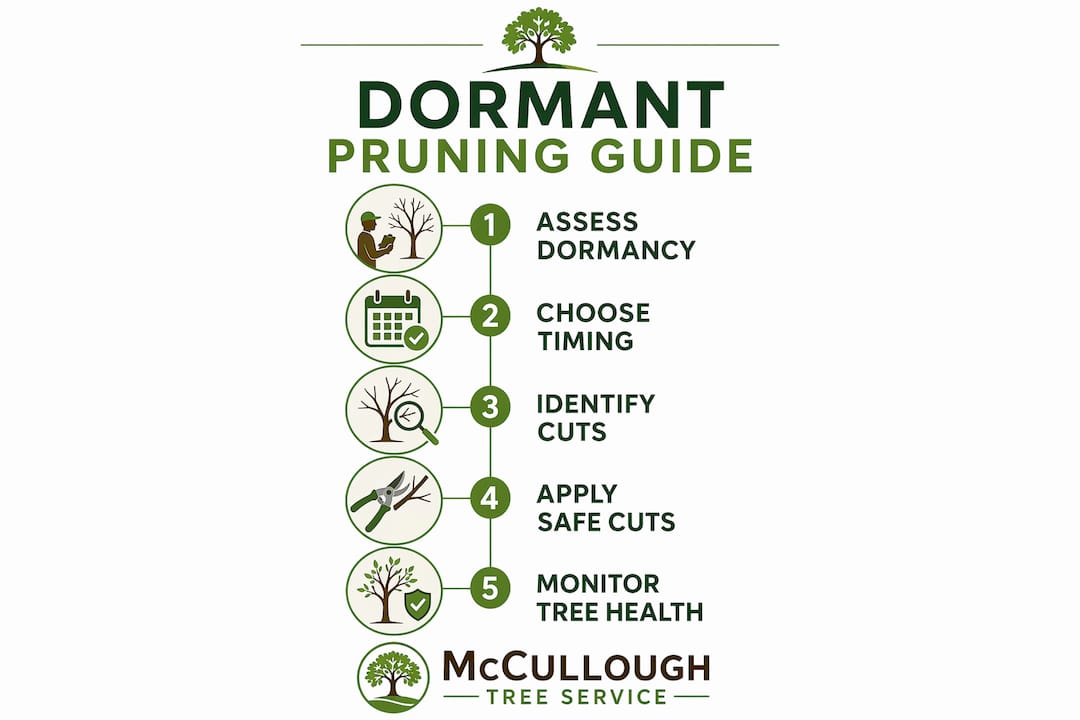
A basic dormant pruning checklist
- Inspect the tree from all sides before making any cuts
- Remove dead, diseased, and broken wood first
- Identify and remove crossing or rubbing branches
- Address any included bark or weak attachments
- Step back and assess the crown balance before any additional cuts
- Sanitize tools between trees with a 10% bleach solution or undiluted 70% isopropyl alcohol
For more on safe technique, pruning trees essentials covers the step-by-step approach in detail.
When you should hire a certified arborist
Some pruning jobs belong to professionals. Knowing the line protects both you and your trees.
Call a certified arborist when:
- Any branch is larger than 4 inches in diameter
- The tree shows fungal growth, conks, or significant decay at the base or major limbs
- Branches are within 10 feet of power lines
- The tree leans toward a structure or shows signs of root failure
- You need structural corrections on a mature tree
- Storm damage has left hanging or partially attached limbs
Why ISA certification matters: An arborist certified by the International Society of Arboriculture (ISA) has passed a standardized exam covering tree biology, pruning standards, and safety. Always ask for proof of certification, liability insurance, and worker’s compensation coverage before any work begins. For hazardous tree removal, those credentials are non-optional.
| Job Type | DIY Suitable | Borderline | Pro Only |
|---|---|---|---|
| Removing dead twigs and small branches | ✓ | ||
| Pruning shrubs under 6 feet | ✓ | ||
| Removing branches up to 2″ diameter | ✓ | ||
| Branches 2–4″ diameter, reachable | ✓ | ||
| Crown thinning on mature trees | ✓ | ||
| Any work near power lines | ✓ | ||
| Large structural cuts (4″+ diameter) | ✓ | ||
| Hazard trees with decay or lean | ✓ | ||
| Storm-damaged hanging limbs | ✓ |
Dormancy as biology, not a calendar date
The most useful shift in thinking about dormant pruning is treating dormancy as a biological state rather than a fixed date range.
- UF/IFAS Extension is explicit: large structural pruning is safest in winter dormancy for most species, but the timing depends on the species and its actual growth cycle, not a universal date.
- In Florida, many broadleaf trees never fully go dormant. The practical target is the period of lowest metabolic activity, commonly mid-January to mid-February for Central Florida.
- The Arbor Day Foundation reinforces that dormant pruning is the best time for structural training because correcting problems before leaf-out prevents a chaotic growth response that makes structural issues worse.
- Watch the plant, not the weather app. Leaf drop, reduced growth flush, and cooler overnight temperatures are more reliable cues than any fixed date.
Local extension offices — UF/IFAS in Florida, University of Illinois Extension in the Midwest, and similar state programs — publish species-specific timing guides that are worth consulting before major work.
Key Takeaways
Dormant pruning works because it combines low pest activity, full structural visibility, and intact energy reserves into a single window that maximizes healing and minimizes stress.
| Point | Details |
|---|---|
| Primary purpose | Reduces disease/pest risk, corrects structure, and lowers pruning stress so trees heal faster in spring. |
| Best timing | Late winter to early spring for most of the U.S.; mid-January to mid-February in Central Florida. |
| Biological reason | Energy reserves stay in roots and trunk during dormancy, so wound sealing begins immediately when spring growth starts. |
| Avoid these mistakes | Never top trees, remove more than 25–30% of live canopy, or make flush cuts — all cause lasting structural harm. |
| Mcculloughtreeservice | Provides certified arborist-led dormant pruning and hazard assessment for residential and commercial properties in Central Florida. |
Why dormant pruning results speak for themselves in Central Florida
The conventional advice on dormant pruning was written for climates with hard winters and clear leaf-drop signals. Central Florida does not work that way, and applying northern timing rules here can mean pruning during an active growth flush or right before a cold snap that damages fresh cuts.
What actually matters in this region is reading the tree. Live oaks, crape myrtles, and laurel oaks each have their own rhythm, and a certified arborist who works these species year-round recognizes those cues in a way a calendar cannot replicate. Mcculloughtreeservice’s approach centers on structure-focused, selective pruning — removing what genuinely needs to go, preserving the scaffold, and timing the work to the plant’s biology rather than to a fixed month. That philosophy is the opposite of cosmetic shearing or the destructive topping that still shows up on too many Central Florida properties.
The sustainable approach also means not over-pruning. Removing more than necessary in a single season stresses the tree, depletes reserves, and often triggers the weak, dense regrowth that creates more problems the following year. Less, done precisely, consistently outperforms more, done carelessly.
Dormant pruning services from Mcculloughtreeservice
Healthy trees do not happen by accident in Central Florida’s climate. Mccullough Tree Service gives homeowners and property managers a clear path from inspection to completed work, with certified arborists who understand the regional timing nuances covered in this article.

Dormant-season services include:
- Structural pruning and corrective crown work
- Dead, diseased, and hazard branch removal
- Storm-prep trimming before hurricane season
- Full site inspection and written scope of work
- Proof of insurance and ISA-certified arborist credentials on every job
Every estimate starts with a site walkthrough, a recommended scope, and a safety plan — no guesswork about what needs to come down or why. For professional tree trimming in Orlando and Central Florida, request a free estimate and get a clear picture of what your trees actually need this season.
Useful sources for further reading
These U.S.-based extension services and industry organizations publish the most reliable guidance on dormant pruning and tree care:
- Arbor Day Foundation — Arborist-written guidance on dormant pruning timing, structural work, and why the practice matters
- UF/IFAS Extension — Florida-specific pruning timing, species guidance, and winter maintenance recommendations
- Morton Arboretum — Research-backed how-to on pruning timing, technique, and disease risk reduction
- Purdue Extension — Detailed guidance on training and pruning, including fruit tree dormant pruning effects
- University of Illinois Extension — Practical dormant-season pruning guidance for deciduous trees and shrubs
- International Society of Arboriculture (ISA) — Certification standards, arborist lookup tool, and pruning best-practice resources
For species-specific timing, contact your local cooperative extension office — they publish regional guides that account for local climate, pest pressure, and common tree species.
Recommended
- Pruning Trees: Essential Tips and Benefits
- Tree Care 101: Trimming vs. Pruning Guide
- Why Seasonal Pruning Matters for Tree Health
- What Is Structural Pruning and Why Your Trees Need It