By: Shelby McCullough| Published: June 21, 2026
TL;DR:
- Tree risk assessment is a structured evaluation that measures a tree’s failure likelihood and potential impact. Certified arborists using the ISA’s TRAQ framework conduct assessments to identify risks and recommend appropriate actions. Regular evaluations help property owners manage hazards proactively, reduce liability, and preserve valuable trees.
Tree risk assessment is a systematic, professional evaluation that measures a tree’s likelihood of failure, the probability of impact on people or property, and the severity of potential consequences. The formal industry term is “tree risk assessment,” standardized by the International Society of Arboriculture through its TRAQ (Tree Risk Assessment Qualification) certification program. Approximately 70% of tree-related injuries are linked to improper tree care. That figure alone explains why tree risk assessment is one of the most critical responsibilities a property owner or manager can take seriously.
Why tree risk assessment is the foundation of property safety
A tree risk assessment is not a casual visual check. It is a documented, methodical process that produces a probabilistic rating, not a simple “safe” or “dangerous” verdict. Living trees cannot be declared absolutely safe; the goal is to manage risk to an acceptable level, not eliminate it entirely. That distinction matters because it shifts the conversation from “is this tree okay?” to “what is the acceptable level of risk for this location?”
The ISA’s TRAQ framework chains three probabilities together: the likelihood of structural failure, the probability that failure strikes a person or structure, and the severity of the resulting consequences. A massive oak over an empty field carries far less risk than a moderately stressed tree overhanging a school playground. Same tree condition, completely different risk rating. Understanding that relationship is the core of property tree risk assessment practice.
What happens during a tree risk assessment?
Professional tree risk assessments follow three levels, each increasing in depth and diagnostic detail.
- Level 1 (Limited visual assessment): A broad survey of multiple trees, typically from a distance. Used for large properties, parks, or post-storm triage to flag trees needing closer attention.
- Level 2 (Standard detailed assessment): A thorough, ground-level inspection of individual trees. The arborist examines the trunk, root collar, canopy structure, branch attachments, and surrounding soil. This is the most common assessment type for residential and commercial properties.
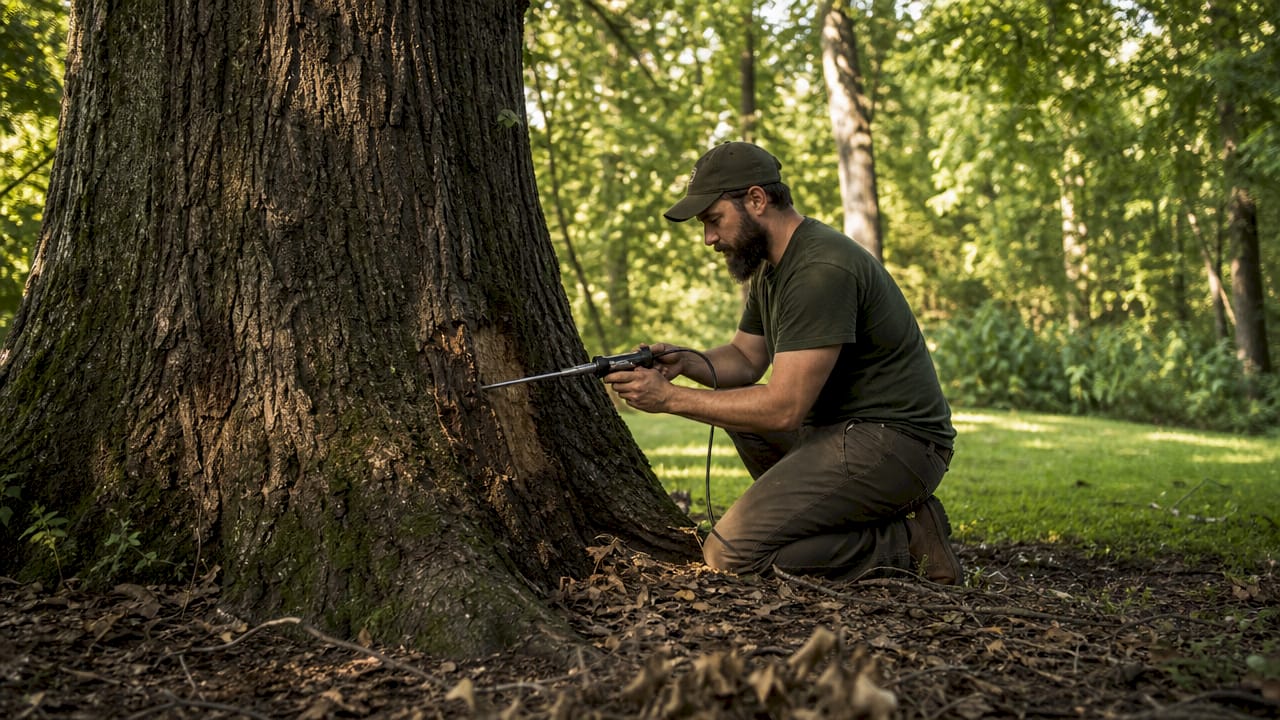
- Level 3 (Advanced diagnostic assessment): Reserved for high-value or high-risk trees where internal conditions are uncertain. Arborists deploy specialized tools at this level.
During a Level 2 or Level 3 assessment, the arborist inspects specific defect indicators: cracks in the trunk, co-dominant stems with included bark, visible decay, root damage from construction, soil compaction, and canopy dieback. Root and canopy issues are the main causes of tree failure, and external symptoms often appear late. That lag time is exactly why waiting for obvious warning signs is a losing strategy.
At Level 3, tools like resistographs and sonic tomography allow arborists to detect internal decay that is completely invisible from the outside. Advanced assessment tools prevent overlooked hazards that a visual inspection would miss entirely. The arborist then applies a risk rating matrix, combining failure likelihood, impact probability, and consequence severity to assign a final risk category.
Pro Tip: Never rely on a free or visual-only inspection as your official risk assessment. TRAQ-qualified arborists produce the only results that carry legal and professional weight.
How are risk levels classified and what should you do?
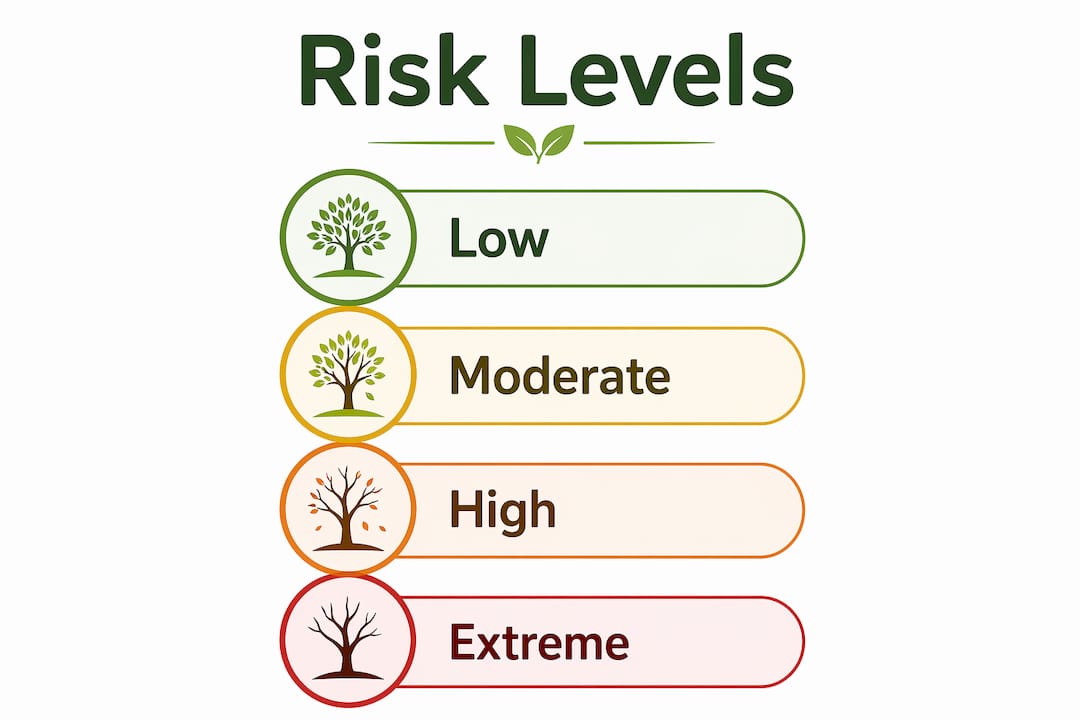
Risk is classified into four standard categories, each with a corresponding response expectation.
| Risk category | Description | Recommended action | Timeframe |
|---|---|---|---|
| Low | Failure unlikely; minimal targets present | Routine monitoring | Annual review |
| Moderate | Some defects present; targets occasionally exposed | Scheduled maintenance | Within 1 year |
| High | Significant defects; frequent target exposure | Prompt mitigation or removal | Within weeks |
| Extreme | Imminent failure likely; high-consequence targets | Immediate action required | Same day or next day |
Risk categories range from Low to Extreme, and each dictates a specific response urgency. A dead branch hanging over an empty storage lot may rate Low. That same branch directly above a playground entrance rates Extreme. The physical condition of the tree is only one variable. Target exposure and consequence severity drive the final rating just as much.
Property owners sometimes assume a “Low” rating means no action is needed. That is not accurate. Low risk still requires annual monitoring because conditions change. A tree rated Low after a dry summer may shift to Moderate after a hurricane season strips root anchorage or introduces new decay pathways. Regular reassessment is the only way to track those changes before they become emergencies.
Why recurring assessments protect you legally and financially
Regular risk assessments should occur annually or after major weather events to catch structural issues before failure. In Central Florida, that means scheduling assessments before and after hurricane season at minimum. Trees that survive a major storm often sustain root damage or internal cracking that does not show up visibly for months.
Documented assessments create a legal defense by demonstrating that a property owner exercised reasonable care to identify and manage known hazards. Courts and insurance companies look for evidence of proactive management. A written risk assessment report is that evidence. Without it, a property owner facing a negligence claim has no documentation to show they acted responsibly.
“A written risk assessment is a vital legal and management document, often critical during insurance claims or litigation involving tree-related damages.” — Tree Risk Assessment Legal Importance
The financial case is equally strong. The benefits of regular, documented assessments for property owners and managers include:
- Reduced liability exposure when a tree failure occurs and litigation follows
- Lower insurance premiums with some carriers who recognize documented tree management programs
- Avoided emergency costs from reactive removal after a failure, which typically costs far more than planned mitigation
- Preserved property value by keeping mature trees healthy rather than removing them unnecessarily
- Stronger negotiating position during property sales or lease renewals where tree condition is a disclosed factor
Documented risk assessments shift property management from reactive to proactive, demonstrating responsible stewardship. That shift is not just philosophical. It has direct, measurable financial consequences for your property.
What mitigation options does an assessment identify?
The goal of a tree risk assessment is often preservation, not removal. Assessments frequently identify mitigation techniques like cabling or pruning that reduce risk without requiring the tree to come down. That matters because mature trees add significant appraised value to residential and commercial properties.
Common mitigation strategies identified through professional assessments include:
- Structural pruning: Removes dead, crossing, or overextended branches to restore weight distribution and reduce wind resistance
- Cabling and bracing: Installs flexible steel cables or rigid rods to support weak branch unions or co-dominant stems
- Soil health improvements: Addresses compaction, drainage issues, or nutrient deficiencies that weaken root systems
- Crown reduction: Reduces the overall canopy size to lower the mechanical load on a compromised trunk or root system
- Monitoring programs: Schedules follow-up inspections at defined intervals for trees with manageable but active defects
Typical mitigation efforts include pruning, cabling, and soil health improvements to strengthen root systems and structural integrity. Removal becomes the recommendation only when defects are so severe that no intervention can reduce risk to an acceptable level, or when the cost of mitigation exceeds the tree’s value.
Consider a practical example: a 60-year-old live oak on a commercial property in Orlando shows a co-dominant stem with included bark at 15 feet. A Level 2 assessment rates it High risk. Rather than removing a tree that adds shade, curb appeal, and ecological value, the arborist installs a cabling system and schedules a follow-up assessment in six months. The risk drops to Moderate. The tree stays. The property owner avoids a removal cost and retains an asset.
Pro Tip: Working with a certified arborist produces a tailored intervention plan that weighs the tree’s structural condition, location, and long-term health together, not just the most visible defect.
Key Takeaways
Tree risk assessment is the most defensible action a property owner can take to protect people, property, and legal standing from tree-related hazards.
| Point | Details |
|---|---|
| Assessment is probabilistic | Risk is rated by combining failure likelihood, impact probability, and consequence severity, not a simple safe or unsafe label. |
| Three assessment levels exist | Level 1 surveys broadly, Level 2 inspects individual trees in detail, and Level 3 uses diagnostic tools for internal decay. |
| Four risk categories guide response | Low through Extreme ratings each carry specific recommended actions and timeframes for property owners. |
| Documentation protects legally | A written assessment report is a critical legal document during insurance claims or negligence litigation. |
| Mitigation often beats removal | Pruning, cabling, and soil work frequently reduce risk to acceptable levels while preserving valuable mature trees. |
The case for getting ahead of tree risk on your property
Most property owners I talk to assume that if a tree looks healthy, it is healthy. That assumption is the most expensive mistake in tree management. Root and canopy issues are the leading causes of tree failure, and they develop internally for years before any visible symptom appears. By the time you see a crack or a lean, the structural compromise is often already severe.
The other misconception I see constantly is that tree risk assessment is something you do once after a storm. Conditions change. A tree that rated Moderate in march can rate High by october after a dry summer stresses the root system. Annual assessments are not a luxury for large commercial properties. They are the minimum standard for any property with mature trees near structures, walkways, or people.
Selecting the right professional matters more than most owners realize. TRAQ certification from the ISA is the specific credential that qualifies an arborist to produce a legally valid risk assessment. A general tree service quote is not a risk assessment. Asking for TRAQ credentials before scheduling any assessment is the single most important step you can take to get a report that actually holds up.
The importance of tree risk assessment comes down to one principle: proactive management is always cheaper, safer, and legally stronger than reactive management. A $400 assessment that identifies a cabling solution beats a $15,000 emergency removal and a liability claim by a wide margin. Prioritize the assessment. The rest follows from there.
— Mcculloughtreeservice
Mcculloughtreeservice: professional tree risk assessment in Central Florida
Mcculloughtreeservice serves residential and commercial property owners across Orlando and Central Florida with certified arborists and TRAQ-qualified professionals on staff.
Whether your assessment identifies a need for professional tree trimming to reduce structural load or a hazardous tree removal for a high-risk specimen, Mcculloughtreeservice delivers documented, defensible results. The team builds customized care plans based on your property’s specific risk profile, not a one-size-fits-all approach. Contact Mcculloughtreeservice to schedule a comprehensive assessment and get a clear picture of where your trees stand.
FAQ
What is a tree risk assessment?
A tree risk assessment is a structured, professional evaluation that rates a tree’s likelihood of failure, the probability of impact on people or property, and the severity of potential consequences. The ISA’s TRAQ framework is the recognized standard for producing valid, documented results.
How often should a property tree risk assessment be done?
Assessments should occur annually or after any major weather event such as a hurricane, ice storm, or severe wind event. Trees in high-traffic areas or near structures warrant more frequent monitoring.
Can a tree risk assessment prevent removal?
Yes. Assessments often identify mitigation options like pruning, cabling, or soil improvements that reduce risk to an acceptable level without removing the tree. Removal is recommended only when defects cannot be managed through intervention.
Does a tree risk assessment protect me legally?
A documented assessment demonstrates that you exercised reasonable care to identify and manage known hazards. Written reports serve as legal defense during insurance claims or negligence litigation involving tree-related property damage or injury.
Who is qualified to perform a tree risk assessment?
Only arborists holding the ISA’s TRAQ certification are qualified to produce a valid, documented tree risk assessment. Visual-only inspections by non-certified individuals do not meet the standard required for legal or insurance purposes.
Recommended
- Tree Risk Assessment Guide for Central Florida (2026)
- Why regular tree maintenance matters for property owners
- Tree risk assessment checklist: protect your property
- Why tree health assessments protect your property