By: Shelby McCullough| Published: May 22, 2026
TL;DR:
- Trees in Central Florida often show subtle signs of decline before visible damage occurs, such as leaf yellowing, bark issues, or root exposure. Early detection through regular inspections by certified arborists can prevent costly emergencies and ensure safety during storm season. Addressing problems promptly helps protect property value and avoids unnecessary tree removal by accurately assessing structural risks.
Trees in Central Florida face stressors most homeowners underestimate. Between hurricane-force winds, prolonged drought, intense heat, and flooding that can follow the same storm, the signs of unhealthy trees here rarely fit a simple checklist. A tree that looked fine in March may be quietly declining by July, with the real trouble hidden in the roots or buried under intact bark. This guide breaks down exactly what to look for, section by section, so you can catch problems early and make smart decisions about the trees on your property.
Table of Contents
- Key takeaways
- 1. Signs of unhealthy trees in the foliage
- 2. Bark and trunk warning signs
- 3. Branch and limb problems to watch for
- 4. Root zone red flags
- 5. Fungal growth, pests, and biological indicators
- 6. What to look for in sick trees: putting it all together
- My take: don’t wait for the obvious
- Get a professional assessment before the next storm season
- FAQ
Key takeaways
| Point | Details |
|---|---|
| Leaf changes signal early stress | Yellowing, thinning, or uneven canopy growth often appears before more obvious decline sets in. |
| Bark and trunk problems are serious | Cavities, deep cracks, and weeping wounds point to internal decay that threatens structural safety. |
| Root zone issues are easy to miss | Exposed roots, suckers, and leaning are signs of instability that require professional evaluation. |
| Pests follow stressed trees | Insects like bark beetles and carpenter ants accelerate decline rather than cause it from scratch. |
| Early calls to a certified arborist save money | Catching problems at the first symptoms almost always costs less than emergency removal later. |
1. Signs of unhealthy trees in the foliage
Leaves are a tree’s most visible communication system. When something is wrong underground or inside the trunk, the canopy usually shows it first. Subtle canopy changes like thinning and uneven density are early warning signs that appear well before advanced decline becomes obvious.
Here are the foliage changes most worth watching for:
- Yellowing outside of fall. Chlorosis, or yellowing leaves during the active growing season, signals nutrient deficiencies, root damage, or waterlogged soil. In Central Florida, compacted or poorly draining soil is a common trigger.
- Brown, scorched leaf edges. These often indicate drought stress, salt damage near coastal areas, or a fungal disease moving through the vascular system.
- Premature leaf drop. Leaves falling in summer or early fall before a cold snap points to a stressed or sick tree. This is one of the clearer unhealthy tree characteristics to recognize.
- Leaf spots and unusual coatings. Dark spots, powdery residue, or fuzzy growth on leaf surfaces are tree disease symptoms tied to fungal or bacterial infections common in Florida’s humid climate.
- Sparse or lopsided canopy. When one side of a tree looks full and the other looks bare, the tree is likely compensating for root damage or internal disease on the weak side.
Pro Tip: Don’t assess a single leaf. Walk around the whole tree and look at the canopy from multiple angles. A thinning section on the north side is easy to miss from the driveway.
2. Bark and trunk warning signs
The bark is the tree’s outer armor. When it starts failing, what you are looking at is a window into potential structural collapse. Trunk hazard indicators including cavities, deep cracks, texture changes, and weeping wounds are all red flags that require professional inspection.
Key bark and trunk signs to check for:
- Loose or peeling bark. Some shedding is natural in species like sycamores and crape myrtles. But on most common Florida trees, large sections of loose or missing bark expose the sapwood beneath and create entry points for pathogens.
- Deep vertical cracks. These can develop after severe temperature swings or physical trauma. Frost cracks and sunscald cause bark splits that pathogens exploit, and even in Central Florida, winter cold events are more frequent than many people expect.
- Weeping wounds or seeping sap. Sap oozing from a spot on the trunk, particularly with discoloration or foul smell, often signals bacterial infection or borer damage underneath.
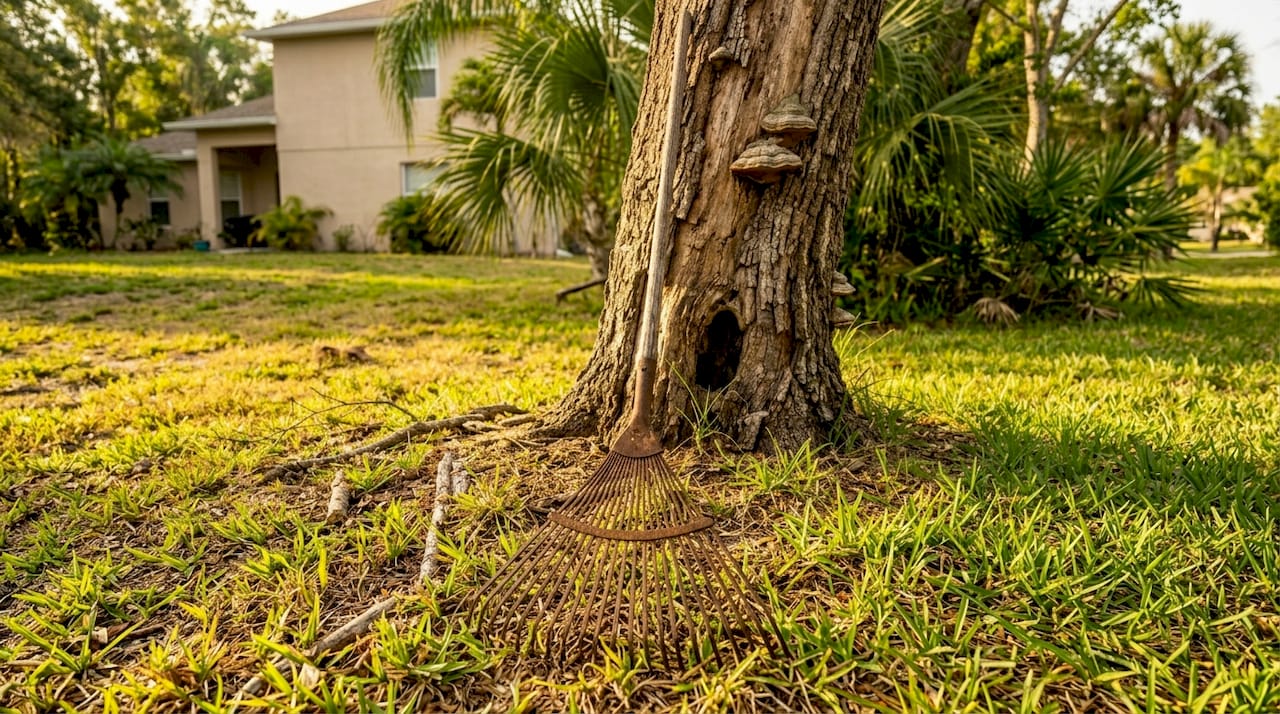
- Trunk cavities and hollows. A cavity does not automatically mean removal, but it does mean a certified arborist needs to assess how much structural wood remains. Hollow trees can stand for years, or fail in the next storm.
- Unusual swelling or bulging. Swollen areas on the trunk, sometimes called burls, can be harmless. But swelling near the base combined with other symptoms is worth a closer look.
Professionals prioritize trunk and root integrity over leaf symptoms when assessing early decline because the trunk tells a more complete story about structural risk.
3. Branch and limb problems to watch for
Branches are where risk becomes most immediate. A failing limb over a roof, driveway, or play area is a liability that can cause serious injury or damage in minutes during a Florida thunderstorm.
Watch for these branch and limb issues:
- Dead branches throughout the canopy. One or two dead branches can be normal. Frequent deadwood scattered throughout the canopy, especially in the lower and mid-sections, suggests systemic decline rather than isolated damage.
- Branches that snap easily. Brittle, dry wood that breaks without much force is a strong indicator of disease or drought stress inside the branch.
- Large open wounds or stubs. Old cuts from improper pruning leave exposed wood that decays inward. Over time, these become highways for fungal rot into the main trunk.
- Unusual leaning branches. Branches that have started growing at odd angles or that appear to be pulling away from the main structure may have weak attachment points called included bark, which split under load.
- Epicormic shoots. Those clusters of small, fast-growing sprouts you see erupting from the trunk or major limbs are not a sign of health. They are a stress response, the tree’s version of throwing everything it has at survival. This is a recognized tree stress indicator worth taking seriously.
Pro Tip: Check branches for the “scratch test.” Scratch a small section of bark on a thin twig with your fingernail. Green underneath means living tissue. Brown or dry means that branch is dead. Do this on multiple branches to gauge the pattern.
4. Root zone red flags
Root problems are the trickiest signs to spot because most of the damage happens underground. By the time roots are visibly compromised, the canopy has usually been suffering for months or even years.
Here is what to look for at and around the base of the tree:
- Exposed surface roots. Roots rising above the soil line can indicate soil erosion, soil compaction, or a response to poor drainage. They are also vulnerable to lawn equipment damage.
- Circling or girdling roots. A root that grows around the base of the trunk instead of outward eventually strangles the tree. This is common in trees that spent too long in nursery containers before planting.
- Root damage from construction. Construction damage and soil compaction are leading causes of tree decline in residential neighborhoods. Cutting roots for a driveway or adding fill soil over the root zone can show up as canopy dieback two to three years later.
- Suckers and basal sprouts. Multiple shoots emerging from the base of the trunk signal that the tree is stressed and trying to generate new growth from the most vigorous part of its system.
- Visible leaning or soil heaving. A tree that has recently begun to lean, especially after a storm, or that shows raised or cracked soil on one side, may have already lost significant root anchoring. This is a safety emergency, not a wait-and-see situation.
5. Fungal growth, pests, and biological indicators
Fungi and insects are rarely the original cause of tree decline, but they are reliable indicators that a tree is already weakened. Fungi and insects exploit stressed trees, accelerating their decline and increasing the hazard level quickly.
| Warning Sign | What It Indicates | Urgency Level |
|---|---|---|
| Mushrooms at base or on roots | Advanced internal root rot | High |
| Conks or shelf fungi on trunk | Serious internal wood decay | High |
| Sawdust-like frass at base | Active borer or carpenter ant activity | High |
| Small round exit holes in bark | Bark beetle emergence | Medium-High |
| Mud tubes on trunk or roots | Termite presence | High |
| White powder on bark or leaves | Fungal infection or scale insects | Medium |
Bark beetles are particularly destructive in Florida because they target trees already weakened by drought, flooding, or storm stress. Once beetles breach the bark, they disrupt the tree’s vascular system and the damage becomes irreversible quickly. If you spot frass, exit holes, or shelf fungi, do not wait to call a certified arborist or pest specialist.
When evaluating signs, keep in mind that monitoring trends over time across canopy density and new growth is more reliable than reacting to any single symptom in isolation.
6. What to look for in sick trees: putting it all together
Knowing how to identify unhealthy trees means learning to read a combination of signals at once rather than treating each symptom as a standalone event. A tree with yellowing leaves and a mushroom at its base is in a very different situation than one with yellowing leaves and otherwise normal structure. Context matters.
Walk your property at least twice a year: once in spring before the storm season begins, and once after hurricane season ends in November. Look at the tree from a distance first to get a sense of overall canopy shape and density. Then move in close to check the bark, trunk base, and root zone. Finish with the branches, working from large limbs down to smaller twigs.
Any combination of signs from multiple categories listed above should prompt a call to a certified arborist for an evaluation. Arborists now use non-invasive tools like resistance drills and acoustic tomography to detect internal decay that is completely invisible from the outside. Those tools exist precisely because what you see on the surface rarely tells the full story.
My take: don’t wait for the obvious
I’ve looked at a lot of trees over the years, and the ones that end up being the most expensive problems are almost never a surprise to the property owner once they hear the diagnosis. They noticed something was off. They just assumed it would work itself out.
The uncomfortable truth about how to identify unhealthy trees is that most of the signs worth caring about are subtle. A slightly thin canopy. A few weeping spots on the trunk. Some sprouts at the base. These are the things people dismiss until a Category 1 storm drops half the tree on their car.
Central Florida’s climate is genuinely hard on trees. Environmental stressors including drought, flooding, and heat create delayed symptoms, meaning a tree can look passable in the spring and drop a major limb by August. That lag time gives you a window to act. Use it.
I’ve also seen homeowners make the opposite mistake: panicking over cosmetic issues and removing healthy trees that just needed a trim. Hazard indicators like cavities and weeping wounds require certified arborist evaluation, not just a visual judgment call. There is a real difference between a tree that needs care and one that needs to come down, and that distinction has significant consequences for your budget, your property value, and your safety.
Get an arborist out annually if you have mature trees. It costs far less than emergency work after the fact.
— Mcculloughtreeservice
Get a professional assessment before the next storm season
If any of the signs above sound familiar, now is the right time to act. Central Florida’s storm season does not forgive neglected trees.
Mccullough Tree Service provides certified arborist evaluations, expert tree trimming services, and full tree removal for trees that have declined beyond recovery. A licensed arborist can assess structural risk using professional-grade methods that go far beyond what any homeowner can see from the ground. Whether you are managing a residential yard or a commercial property with dozens of mature trees, getting eyes on potential problems before a storm is the single most cost-effective thing you can do.
Schedule an evaluation with Mcculloughtreeservice’s certified arborists in Orlando and get a clear answer about which trees need attention, which are fine, and which pose a real risk to your property.
FAQ
What are the most common signs of unhealthy trees?
The most common signs include yellowing or dropping leaves outside of fall, peeling bark, trunk cavities, dead branches throughout the canopy, and fungal growth at the base. Seeing multiple signs together is a strong indicator the tree needs professional evaluation.
Can a tree look healthy and still be dying?
Yes. Internal decay from root damage or fungal rot can progress for years before visible symptoms appear. Subtle canopy thinning is often one of the first external clues, but the real damage may already be severe by the time it shows.
How often should I have my trees inspected in Central Florida?
At minimum, once a year. Many arborists recommend twice: once in spring before hurricane season and once in late fall after it ends. Trees in Central Florida face ongoing stress from heat, storms, and flooding that makes routine monitoring especially worthwhile.
Are mushrooms at the base of a tree always a problem?
Not always, but they usually are. Mushrooms or shelf fungi on or near the trunk indicate wood decay, which can compromise structural integrity. The larger and more established the fungal growth, the more serious the concern. A certified arborist can determine how much decay is present.
When is it time to remove a tree instead of treating it?
Removal becomes necessary when structural integrity is compromised beyond recovery, including severe trunk cavities, significant root loss, or extensive internal decay. Trees that lean suddenly after a storm or show multiple high-severity indicators across trunk, roots, and canopy are often safer to remove than to preserve.
Recommended
- Identify unsafe trees: Essential signs for Central Florida homes
- Unhealthy Tree Indicators: Expert Tips for Diagnosis
- Identify a Dangerous Tree: Signs & Solutions