By: Shelby McCullough| Published: June 7, 2026
TL;DR:
- Thorough planning, including site assessment, boundary confirmation, utility marking, and permit application, is crucial for smooth land clearing. Different methods like forestry mulching, mechanical grubbing, and bulldozing suit specific project needs and soil conditions, with proper access routes vital for equipment operation. Recognizing common planning mistakes, such as neglecting utility location or underestimating costs, can prevent costly delays and foundation issues later.
Land clearing is the deliberate process of removing trees, brush, stumps, and debris from a property to prepare it for construction, agriculture, or landscaping. Knowing how to plan land clearing before any equipment arrives is what separates a smooth project from a costly, legally complicated mess. The planning phase covers site assessment, permit acquisition, method selection, and equipment logistics. Get these steps right, and everything that follows moves faster and cheaper. Skip them, and you will spend weeks undoing problems that a few hours of preparation would have prevented.
How to plan land clearing: the critical preliminary steps
The most expensive mistakes in any land clearing project happen before the first tree falls. Thorough site preparation is the foundation of the entire land clearing process, and it starts with a physical walk of the property.
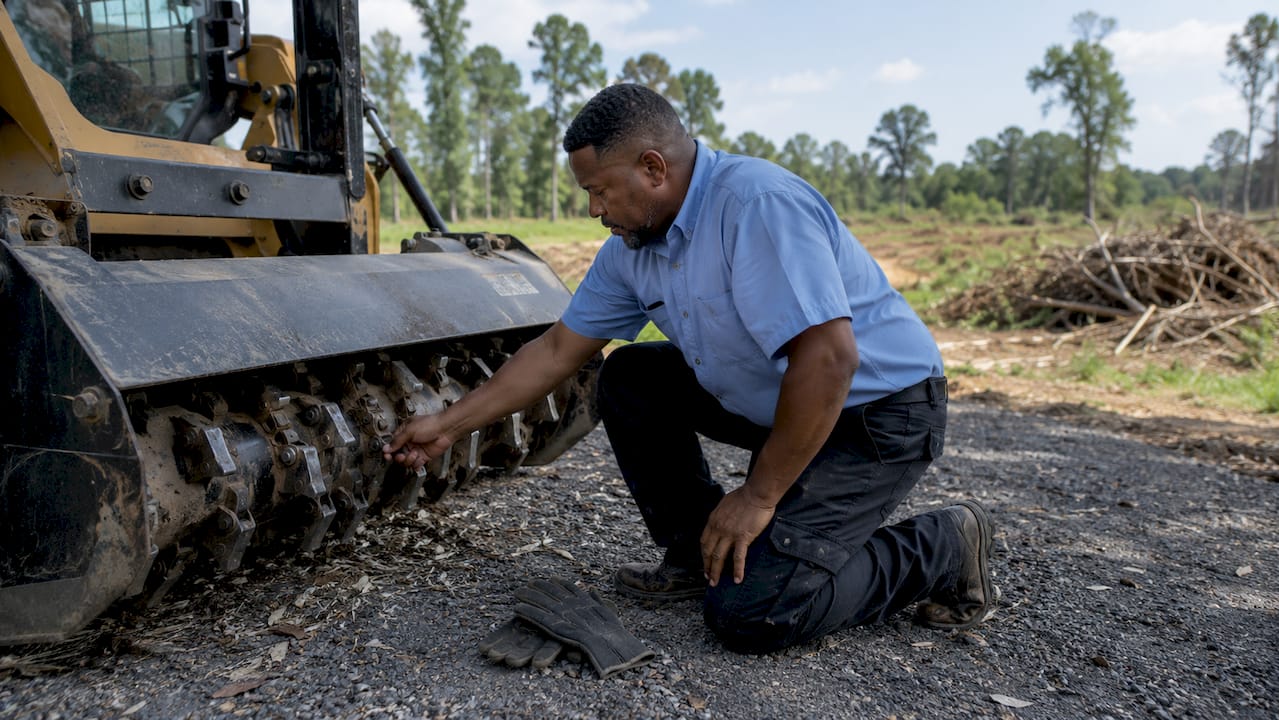
Document everything you see. Photograph existing structures, mature trees worth preserving, drainage channels, and any obvious slope changes. Use colored flags or spray paint to mark trees and vegetation you want to keep. This sounds simple, but crews working quickly with heavy machinery need clear, unmistakable visual cues. A flag on a tree costs nothing. Removing a tree you wanted to keep costs hundreds of dollars and years of regrowth.
Confirm your property boundaries before clearing begins. Disputes over boundary lines are common once vegetation is removed and the land looks different. Hiring a licensed surveyor in Florida costs between $300 and $700 for a standard residential lot, and it eliminates any ambiguity. The Orange County Property Appraiser’s office can provide parcel maps as a starting reference, but a surveyor’s stakes are what hold up legally.
Before any ground disturbance, call 811 to have underground utilities located and marked. Striking a buried gas line or electrical conduit does not just delay your project. It creates liability and genuine physical danger. This call is free, required by law in most states, and takes minutes to schedule.
Permits are the other piece most landowners underestimate. Permit processing takes 2 to 8 weeks and typically costs between $100 and $500 depending on project size and municipality. That timeline means you need to apply before you think you need to, not after. In Central Florida, local municipalities and the St. Johns River Water Management District may both have jurisdiction depending on your site’s proximity to wetlands or protected areas.
Pro Tip: Request a pre-application meeting with your local permitting office. Many counties offer this at no charge, and a 30-minute conversation can clarify exactly which permits apply to your site and save weeks of back-and-forth.
- Walk the site and photograph all features before planning begins
- Mark preservation zones with colored flags or paint
- Hire a surveyor to confirm property boundaries
- Call 811 to locate buried utilities before any ground disturbance
- Apply for permits early, accounting for 2 to 8 weeks of processing time
- Check with your water management district for environmental clearances
How to choose the right land clearing methods and equipment
Not every piece of land clears the same way, and choosing methods based solely on upfront cost risks long-term soil damage that undermines your entire project. Match your technique to your end use, not your initial budget.
The three most common land clearing techniques are forestry mulching, mechanical grubbing, and bulldozing. Each serves a different purpose and leaves the site in a different condition.
| Method | Best use case | Soil impact | Equipment needed |
|---|---|---|---|
| Forestry mulching | Agricultural, recreational, landscaping | Low. Preserves topsoil and controls erosion | Forestry mulcher attachment |
| Mechanical grubbing | Mixed vegetation removal, root extraction | Moderate. Disturbs topsoil but removes roots | Excavator with grubbing attachment |
| Bulldozing | Large-scale site clearing for construction | High. Strips topsoil and compacts subsoil | Bulldozer, skid steer |
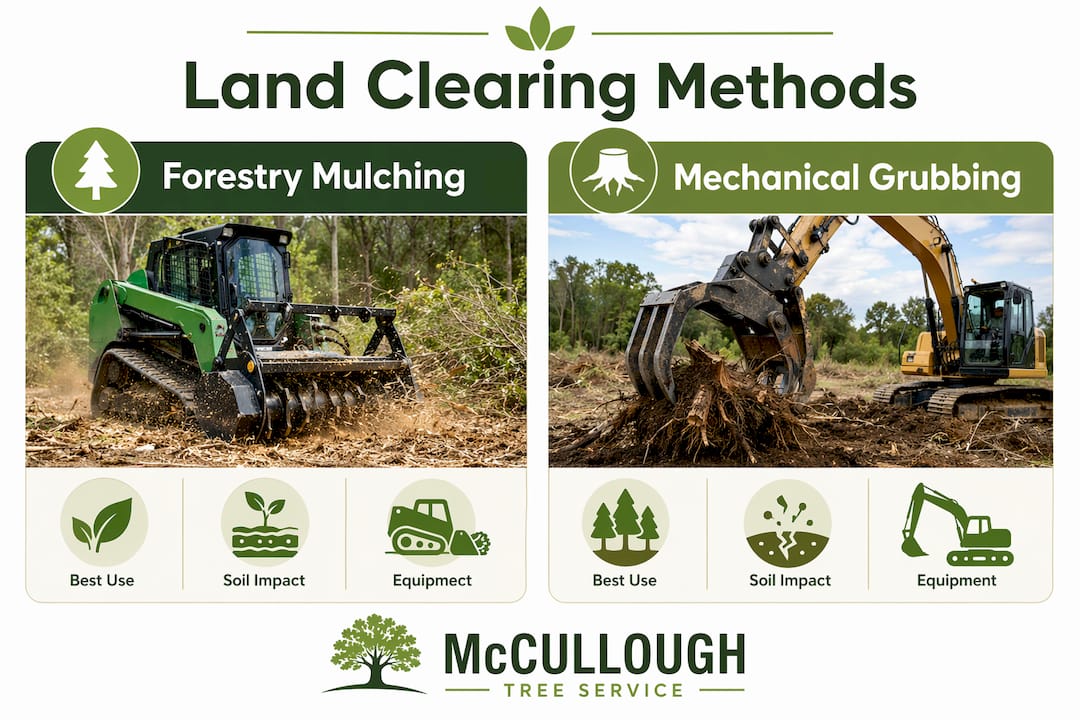
Forestry mulching maintains soil health and controls erosion better than traditional grubbing, making it the preferred method for agricultural plots and recreational land. The mulched material stays on site as ground cover, which reduces erosion and adds organic matter back to the soil. For a construction site where you plan to pour a foundation, bulldozing is faster and more thorough, but you will need to address soil compaction and erosion control afterward.
Equipment access is a logistical factor that surprises many first-time landowners. Access routes require a minimum width of 12 to 14 feet for standard heavy machinery to operate safely. If your property has a narrow entrance or a tight driveway, plan that access route before the crew arrives. Clearing a path for equipment is part of the job, but it needs to be factored into your timeline and cost estimate.
For most residential and light commercial projects, combining methods produces the best results. Use forestry mulching on the perimeter and lighter vegetation, then bring in an excavator to handle stumps and root balls in the core clearing zone.
Pro Tip: If your end goal is a lawn or garden, ask your clearing contractor about leaving the mulched material in place. It breaks down over 12 to 18 months and improves soil structure without any additional amendment cost.
You can find detailed clearing method comparisons that break down cost and technique by project type, which helps when getting contractor bids.
What does the land clearing step-by-step process look like?
Successful land clearing is sequential: assessment, clearing, debris management, and grading each build on the last. Skipping or compressing any phase creates problems in the next one.
- Establish equipment staging areas. Designate flat, accessible zones for machinery parking, fuel storage, and debris stockpiling before work begins. Properly placed staging areas prevent site congestion and keep grading work from being blocked later.
- Clear vegetation systematically. Working progressively from one end of the property to the other improves efficiency and makes progress easy to track. Random clearing creates islands of debris that slow equipment movement.
- Fell trees with proper technique. Larger trees require notch cuts and directional felling to control where they fall. All personnel must stay outside the fall zone, which extends at least twice the height of the tree being cut.
- Remove stumps and root systems. Stumps left in place create long-term problems. Decomposing wood causes ground settlement, and root systems can interfere with foundations and drainage lines. Use a stump grinder for surface removal or an excavator to pull the entire root ball.
- Manage debris deliberately. Organic debris and stumps should be stockpiled separately from mineral fill. Mixing them and using the combined material as backfill causes foundation settling as the organic matter decomposes. Debris options include on-site mulching, hauling to a green waste facility, or repurposing as firewood. Review a residential debris removal workflow if you are managing disposal yourself.
- Install erosion controls. Silt fences, straw wattles, and temporary seeding protect exposed soil from rain events during and after clearing. Central Florida’s afternoon thunderstorms can strip topsoil from a freshly cleared site within a single storm.
- Grade the site. Proper grading controls drainage and protects structures from water intrusion. The standard practice is to slope the site away from any planned building footprint at a minimum of 6 inches over 10 feet.
Pro Tip: Take photos at each phase completion. These document your progress for permit inspections and serve as evidence if a neighbor or municipality questions the scope of your work.
Common mistakes that derail land clearing projects
Most land clearing problems trace back to the planning phase, not the execution phase. Recognizing these mistakes before you make them is the most cost-effective thing you can do.
- Skipping utility location. Hitting a buried line stops your project immediately and can result in fines, repair costs, and injury. Call 811 before any ground is broken, without exception.
- Ignoring preservation zones. Clearing crews work fast. Without clearly marked boundaries, valuable trees, drainage features, and property markers disappear. Mark everything you want to keep before equipment arrives.
- Underestimating DIY costs. DIY land clearing costs often multiply 3 to 5 times above initial estimates once you account for equipment rental, fuel, disposal fees, and time. This is the single most common financial shock for first-time landowners.
- Choosing methods for the wrong reasons. Bulldozing is cheaper per acre than forestry mulching upfront, but if your site needs good topsoil for landscaping or farming, you will spend that savings and more on soil amendment.
- Skipping or compressing clearing phases. Incomplete clearing and grading cause foundation and drainage issues that are expensive to correct after construction begins. Sequence matters.
The most overlooked step in land clearing planning is the post-clearing inspection. Before grading begins, walk the cleared site and verify that all stumps, large root balls, and debris piles are removed and properly separated. What looks clean from a distance often has buried organic material that will cause problems under a foundation or paved surface.
A detailed land clearing process guide for property owners covers these pitfalls in more depth, particularly for residential sites in Florida where wetland buffers and tree ordinances add regulatory complexity.
Key takeaways
Effective land clearing planning requires sequential execution: site assessment, permitting, method selection, and grading each depend on the step before them.
| Point | Details |
|---|---|
| Permits take time | Apply 2 to 8 weeks before your planned start date to avoid project delays. |
| Match method to end use | Forestry mulching preserves topsoil for agriculture; bulldozing suits construction pads but requires erosion remediation. |
| Call 811 before clearing | Utility locating is free, legally required, and prevents costly damage and liability. |
| Separate organic debris | Never mix stumps or wood debris with mineral fill, as decomposition causes foundation settling. |
| DIY costs multiply fast | Budget 3 to 5 times your initial estimate for equipment rental, disposal, and labor time. |
What I’ve learned from watching land clearing projects go sideways
The projects that go wrong almost always share one trait: the landowner treated planning as a formality rather than the actual work. They spent weeks researching equipment and methods, then spent 20 minutes on permits and boundaries. That ratio is backwards.
In my experience working with property owners across Central Florida, the sites that clear cleanly and stay on budget are the ones where the owner walked the property with a contractor before a single machine was scheduled. That conversation surfaces problems that no amount of online research reveals: a seasonal drainage swale that only shows up after rain, a neighbor’s fence that sits six inches inside the property line, a cluster of laurel oaks that a local ordinance protects.
The other thing I have seen consistently underestimated is erosion. Florida’s sandy soils move fast when exposed. A site that looks stable on a dry Tuesday can lose several inches of topsoil by Thursday afternoon after a summer storm. Silt fences and temporary seeding are not optional extras. They are part of the clearing budget from day one.
My honest advice: if your site is more than half an acre, involves any trees over 12 inches in diameter, or sits near a drainage feature, hire a professional for at least the assessment and planning phase. The expert tips on the land clearing process that certified arborists bring to a site walk are worth far more than their hourly rate. You are not paying for labor at that stage. You are paying to avoid a $15,000 mistake.
— Mcculloughtreeservice
Ready to clear your land the right way?
McCullough Tree Service handles land clearing projects across Orlando and Central Florida with certified arborists, professional-grade equipment, and a planning process that covers every step from site assessment to final grading.

Whether you are preparing a residential lot for new construction, clearing acreage for agricultural use, or reclaiming overgrown commercial property, the McCullough team builds a clearing plan specific to your site conditions and end goals. Their tree removal services include full stump grinding, debris management, and coordination with local permitting offices. Contact McCullough Tree Service for a site consultation and get a clear plan before any equipment rolls.
FAQ
What permits do I need before clearing land in Florida?
Most Florida municipalities require a land clearing permit, and sites near wetlands may also need approval from the St. Johns River Water Management District or the Army Corps of Engineers. Permit costs typically range from $100 to $500, with processing times of 2 to 8 weeks.
How do I know which land clearing method is right for my project?
Match the method to your end use. Forestry mulching is best for agricultural and landscaping projects because it preserves topsoil and controls erosion. Bulldozing is faster for construction sites but strips topsoil and requires erosion remediation afterward.
Do I need to call 811 before clearing my own land?
Yes. Calling 811 before any ground disturbance is legally required in most states and takes only a few minutes to schedule. Utility companies will mark buried lines at no cost, preventing damage, fines, and safety hazards.
How wide do access routes need to be for clearing equipment?
Standard heavy land clearing machinery requires a minimum access route width of 12 to 14 feet. Plan and clear this path before the crew arrives to avoid delays on the first day of work.
Is DIY land clearing worth it for large properties?
DIY land clearing costs frequently reach 3 to 5 times the initial estimate once equipment rental, fuel, disposal fees, and labor time are factored in. For properties over half an acre or sites with large trees, professional services typically deliver better cost predictability and faster completion.
Recommended
- Expert Tips on the Land Clearing Process
- Land Clearing Process Guide for Property Owners
- How to Clear Land: Step-by-Step Guide for Central Florida