By: | Published: June 12, 2026
TL;DR:
- Aerial tree inspections leverage drones with multispectral, LiDAR, and sonic sensors to detect hidden health issues and structural hazards. These assessments far surpass ground checks by providing comprehensive, early detection data that support proactive management and reduce emergency costs. Combining aerial data with arborist expertise creates precise maintenance plans that enhance safety, save money, and extend tree longevity.
Aerial tree inspection is defined as the use of unmanned aerial vehicles (UAVs), drones, and airborne sensors to assess tree health, structural integrity, and maintenance needs from above the canopy. The role of aerial tree inspections goes far beyond what any ground-level visual check can deliver. Where a traditional walkthrough misses decay inside a trunk or disease spreading through the upper crown, a drone equipped with 4K cameras and multispectral sensors catches it early. For property owners and managers in Central Florida, where mature oaks and palms grow close to homes and power lines, that difference can mean avoiding a five-figure emergency removal or a liability claim.
How do aerial tree inspections work?
Aerial tree assessment methods combine several technologies to build a complete picture of a tree’s condition. The most common tool is a UAV fitted with a high-resolution RGB camera, which captures detailed visual footage of the crown, bark, and branch structure. That footage alone reveals broken limbs, crown dieback, and pest damage that a person standing on the ground simply cannot see through a dense canopy.
The real diagnostic power comes from layering additional sensors on top of that visual data:
- Multispectral and thermal imaging measure chlorophyll levels and moisture stress. High-resolution multispectral scans during the growing season detect early disease signs before any leaf discoloration appears, giving you a treatment window that ground inspection cannot provide.
- Airborne laser scanning (ALS) and LiDAR generate precise 3D point clouds of the entire tree structure. ALS at 2 pulses per square meter correctly identifies retention trees in 74% of cases and reliably predicts canopy density and volume. That level of accuracy supports structural risk decisions, not just visual impressions.
- Sonic tomography sends sound waves through the trunk to map internal wood density. Sonic tomography combined with drone imagery creates detailed 3D health profiles that reveal decay or hollow sections before they show any external symptoms, and it does so without drilling or cutting the bark.
When an arborist integrates all three data streams, the result is a health profile that covers the tree from root collar to the highest branch tip.
Pro Tip: Ask your inspection provider which sensor types are included in the quote. A drone with only an RGB camera gives you visual data. A drone with multispectral sensors gives you a health diagnosis.

What are the benefits of aerial vs. ground-level tree inspections?
The clearest advantage is detection range. Ground-level visual inspections are limited to what a trained eye can see from below, which means the upper 30 to 50 feet of a mature tree is largely a blind spot. UAVs with 4K cameras and multispectral sensors detect diseases, pests, and structural issues that are invisible from ground level. That is not a marginal improvement. It is a fundamentally different category of information.
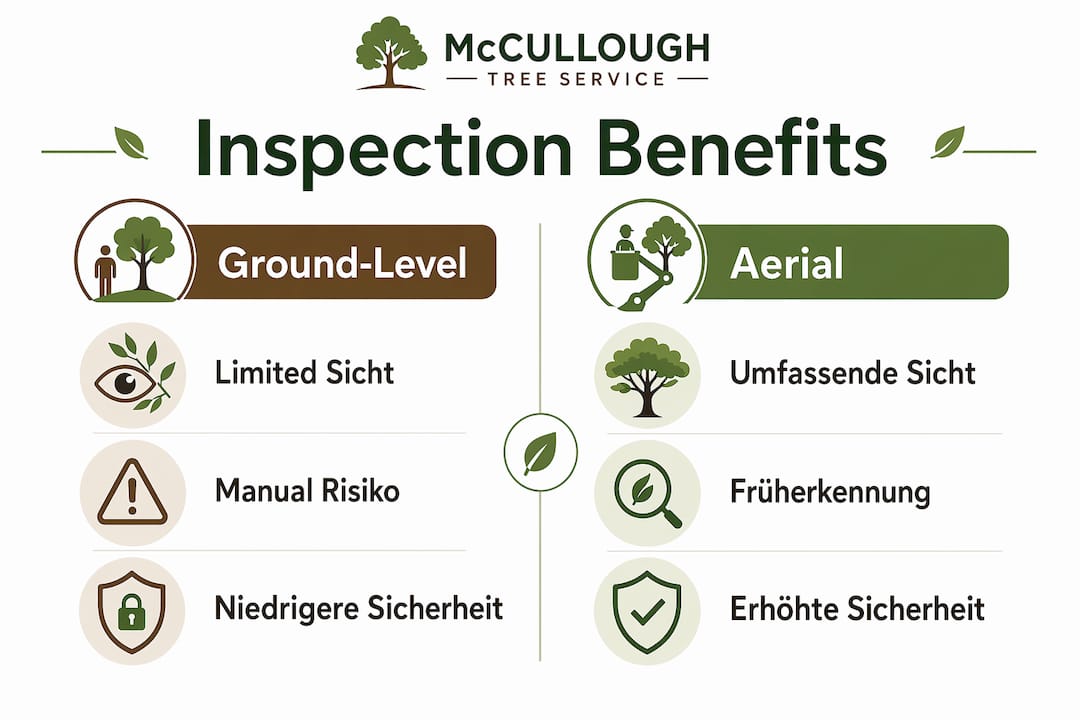
| Factor | Ground-level inspection | Aerial inspection |
|---|---|---|
| Upper canopy visibility | Limited to naked eye from below | Full 360-degree drone coverage |
| Disease detection | Visible symptoms only | Chlorophyll and thermal data before symptoms appear |
| Structural risk data | Subjective visual estimate | 3D point cloud with measurable geometry |
| Arborist safety | Requires climbing to assess upper hazards | Pre-climb hazard check from the ground |
| Documentation | Written notes and photos | Georeferenced imagery and data reports |
| Emergency response | Requires site access and climbing | Rapid aerial assessment after storms, same-day in some cases |
Safety is a benefit that property owners often overlook. Drones used as a pre-climb inspection significantly reduce arborist risk by identifying upper canopy hazards before anyone ascends. A dead limb or a cracked scaffold branch that would be invisible from the ground becomes a known hazard that the crew can plan around. That protects your arborist and reduces your liability exposure.
Early detection of tree hazards extends tree life and reduces the cost of emergency removal. A diseased tree caught at the treatment stage costs a fraction of what an emergency removal costs after a failure. The math strongly favors proactive aerial assessment.
Pro Tip: Request georeferenced imagery in your inspection report. That data lets you compare the same tree across multiple inspection years and track whether a problem is progressing or stabilizing.
When should property owners schedule aerial tree inspections?
Timing matters as much as technology. Certain conditions make aerial inspection not just useful but necessary. Common triggers include unexplained leaf discoloration, dead or broken upper branches, recent severe weather, and proximity to power lines or structures. If any of those conditions apply to a tree on your property, schedule an inspection before the next storm season.
Beyond reactive triggers, the following scenarios call for a scheduled aerial survey:
- Before purchasing or selling a property. Mature trees add significant value, but undisclosed hazard trees create liability. An aerial inspection gives buyers and sellers objective documentation.
- After a named storm or hurricane. Emergency aerial inspections after storms enable rapid assessment and produce actionable reports to guide cleanup and hazard reduction. In Central Florida, where tropical weather is annual, this is a standard step in storm recovery. You can read more about the process in this guide on assessing storm-damaged trees.
- During new construction near existing trees. Root zone compaction and soil disturbance from construction stress trees in ways that take one to three years to appear visually. Aerial monitoring during and after construction catches that stress early.
- On a regular annual or biennial schedule for mature trees. Trees over 20 inches in diameter carry more structural mass and more risk. Annual benchmarking with aerial data lets you track decay progression rather than discovering it after a failure.
- When a tree overhangs a structure, driveway, or utility line. Proximity to high-consequence targets raises the risk profile of any tree. Aerial data gives you the documentation to justify maintenance decisions to your insurer or municipality.
Proactive scheduling beats reactive response every time. A tree that gets annual aerial monitoring is a tree whose problems get caught at the treatment stage, not the emergency stage.
How do aerial inspections inform maintenance and risk management?
The data from an aerial survey does not sit in a report. It drives specific decisions. 3D point cloud analytics combined with ISA TRAQ protocols provide transparent, auditable tree risk assessments that support pruning, support installation, exclusion zones, and monitoring plans. For property managers overseeing multiple trees or a large commercial site, that documentation is the difference between a defensible maintenance record and a liability gap.
Here is how aerial data translates into on-the-ground action:
- Targeted pruning. Instead of pruning by schedule or appearance, arborists use aerial data to identify specific weak attachment points, crossing branches, or crown imbalances. That precision reduces unnecessary cuts and focuses work where it matters.
- Decay monitoring. Sonic tomography maps internal density at a specific point in time. Repeat scans in subsequent years show whether decay is advancing, stable, or responding to treatment. That progression data is something no visual inspection can provide.
- Hazard documentation. Integrating 3D data with ISA TRAQ risk protocols creates audit-ready maintenance documentation. If a tree fails and causes damage, that documentation demonstrates that you acted on known information with professional guidance.
- Arborist pre-climb safety. Before any climber ascends, aerial footage of the upper canopy identifies dead wood, weak crotches, and pest damage. That pre-climb check is now considered best practice in professional arboriculture.
- Removal justification. When a tree must come down, aerial data provides the objective evidence to support that decision. Neighbors, municipalities, and insurers respond differently to a georeferenced 3D risk assessment than to a verbal recommendation.
A tree risk assessment checklist built from aerial data gives property owners a repeatable framework for managing their entire tree inventory, not just the trees that look obviously problematic.
Key takeaways
Aerial tree inspections are the most effective method for detecting hidden health and structural problems before they become emergencies, and property owners who schedule them proactively spend less on tree care over time.
| Point | Details |
|---|---|
| Detection beyond ground level | Multispectral and LiDAR sensors reveal disease and decay invisible to the naked eye. |
| Arborist safety improvement | Pre-climb drone surveys identify upper canopy hazards before anyone ascends. |
| Audit-ready documentation | ISA TRAQ protocols applied to 3D data create defensible maintenance records for liability protection. |
| Proactive scheduling pays off | Annual aerial benchmarking catches decay at the treatment stage, not the emergency stage. |
| Technology integration matters | RGB cameras alone are insufficient; multispectral and sonic tomography data complete the health profile. |
Why aerial inspections have changed how I think about tree care
The shift aerial data creates is not just technical. It changes the entire posture of tree management from reactive to proactive. Before drone-based assessment became accessible, property owners made decisions based on what they could see from the sidewalk or what an arborist observed from a ladder. That meant most serious problems were discovered after they had already progressed to a point where options were limited and costs were high.
What I find most significant is that aerial inspections do not replace ground assessments but complement them for a full tree health profile. The best outcomes come from combining aerial data with a certified arborist’s hands-on evaluation. The drone tells you where to look. The arborist tells you what it means and what to do about it. Property owners who treat aerial inspection as a standalone service miss half the value.
The cost savings argument is straightforward once you run the numbers. Emergency tree removal in Central Florida regularly costs two to four times more than planned removal, and that figure does not include property damage or liability exposure. A single aerial inspection that catches a structural problem early can pay for several years of monitoring. The technology is no longer exotic or expensive enough to justify skipping it.
Looking ahead, AI-assisted analysis of aerial imagery is already being piloted by arboricultural researchers. That will make pattern recognition across large tree inventories faster and more consistent. Property managers overseeing commercial sites with dozens or hundreds of trees will benefit most from that development. For now, the combination of LiDAR, multispectral imaging, and sonic tomography is already more than sufficient to transform how you manage the trees on your property.
— Mcculloughtreeservice
How Mcculloughtreeservice puts aerial data to work for you
Mcculloughtreeservice brings certified arborist expertise and aerial inspection technology together for residential and commercial property owners across Orlando and Central Florida. When aerial data identifies a structural weakness, overgrown canopy, or storm-damaged limb, the team translates that finding into a precise maintenance plan rather than a generic recommendation.
Whether the aerial assessment calls for targeted crown reduction, hazard limb removal, or a full professional tree trimming program, Mcculloughtreeservice’s licensed arborists handle every step with the documentation and safety standards your property deserves. Contact Mcculloughtreeservice today to schedule an aerial tree assessment and get a free estimate on any recommended tree care work.
FAQ
What is the role of aerial tree inspections?
Aerial tree inspections use drones and airborne sensors to assess tree health, structural integrity, and maintenance needs from above the canopy. Their primary role is detecting disease, decay, and hazards that are invisible from ground level, enabling proactive property management.
How do drones detect tree disease before symptoms appear?
Multispectral drone sensors measure chlorophyll levels and moisture stress in the canopy. This data reveals early disease indicators before any visible leaf discoloration develops, giving property owners a treatment window that ground inspection cannot provide.
Are aerial tree inspections safe for the trees?
Aerial inspections are entirely non-invasive. Sonic tomography uses sound waves rather than drilling, and drone surveys require no contact with the tree at all, preserving bark and root zones throughout the assessment.
When should I schedule an aerial tree inspection?
Schedule an inspection after any severe storm, when you notice unexplained leaf discoloration or dead upper branches, before buying or selling a property, or on an annual basis for mature trees near structures. You can also review tree hazard signs to identify when immediate assessment is warranted.
Do aerial inspections replace a certified arborist’s evaluation?
No. Aerial data complements ground-level assessment by a certified arborist rather than replacing it. The most accurate tree health profile combines drone imagery and sensor data with a hands-on evaluation from a licensed professional.
Recommended
- Tree inspections: protect your property and stay compliant
- Defining Arborist Reports: What Property Owners Need to Know
- Why tree health assessments protect your property