By: Shelby McCullough| Published: August 8, 2026
Ganoderma palm disease, caused by Ganoderma zonatum, is a lethal butt rot with no cure. Once a palm is infected, removal is the only responsible path. There is no systemic fungicide that stops or reverses the internal decay, and waiting only increases the structural failure risk to anyone nearby.
If you are reading this because you spotted a shelf-like fungus growing from the base of a palm, here is what to do right now:
- Stay clear of the area under the palm, especially during high winds or storms. Internal decay can be extensive even when the trunk looks solid from outside.
- Do not attempt to knock off or remove the conk yourself without sealing it in a heavy plastic bag first. Conks release millions of spores that spread the disease.
- Contact a certified arborist for a risk assessment before the next storm season. If the conk is present, plan removal, not treatment.
- Do not chip or mulch the lower trunk. That material carries the fungus and can spread it across your property.
Pro Tip: If a conk has appeared, treat the tree as a structural hazard immediately. According to UF/IFAS Extension guidance (PP100), visible conks signal extensive internal decay that cannot be reversed — the tree is already compromised.
Key Takeaways
Ganoderma palm disease is a lethal, incurable butt rot caused by Ganoderma zonatum; removal, stump grinding, and proper disposal are the only effective management steps once infection is confirmed.
| Point | Details |
|---|---|
| No cure exists | There is no systemic fungicide for Ganoderma; removal is the only management option once a conk appears. |
| Conk confirms infection | A shelf-like basidiocarp on the lower trunk signals extensive internal decay and immediate structural risk. |
| Stump must be ground or removed | Stumps left in place produce new conks for years; grind below the decay zone and dispose of lower trunk material in a landfill. |
| Replanting risk is real | The fungus persists in soil; planting another palm in the same spot risks infecting the replacement tree. |
| Mcculloughtreeservice | Provides certified arborist assessment, safe removal, stump grinding, and off-site disposal across Central Florida. |
Table of Contents
- How do you identify Ganoderma palm disease?
- What is Ganoderma zonatum and how does it spread?
- What to do when you suspect or confirm Ganoderma on a palm
- How do you prevent Ganoderma and replant safely?
- When should you call an arborist, and what happens next?
- What does recent research say about detecting Ganoderma?
- An arborist’s perspective on what actually matters in the field
- Mcculloughtreeservice handles Ganoderma removal from assessment to cleanup
- Sources
How do you identify Ganoderma palm disease?
The earliest signs are easy to miss. A palm with Ganoderma butt rot often shows general decline first: fronds that wilt and hang without falling, slower-than-normal new growth, and an increasing number of dead lower fronds. The spear leaf (the youngest, central frond) typically stays green longer than the rest of the canopy, which can create a false sense that the tree is recovering.
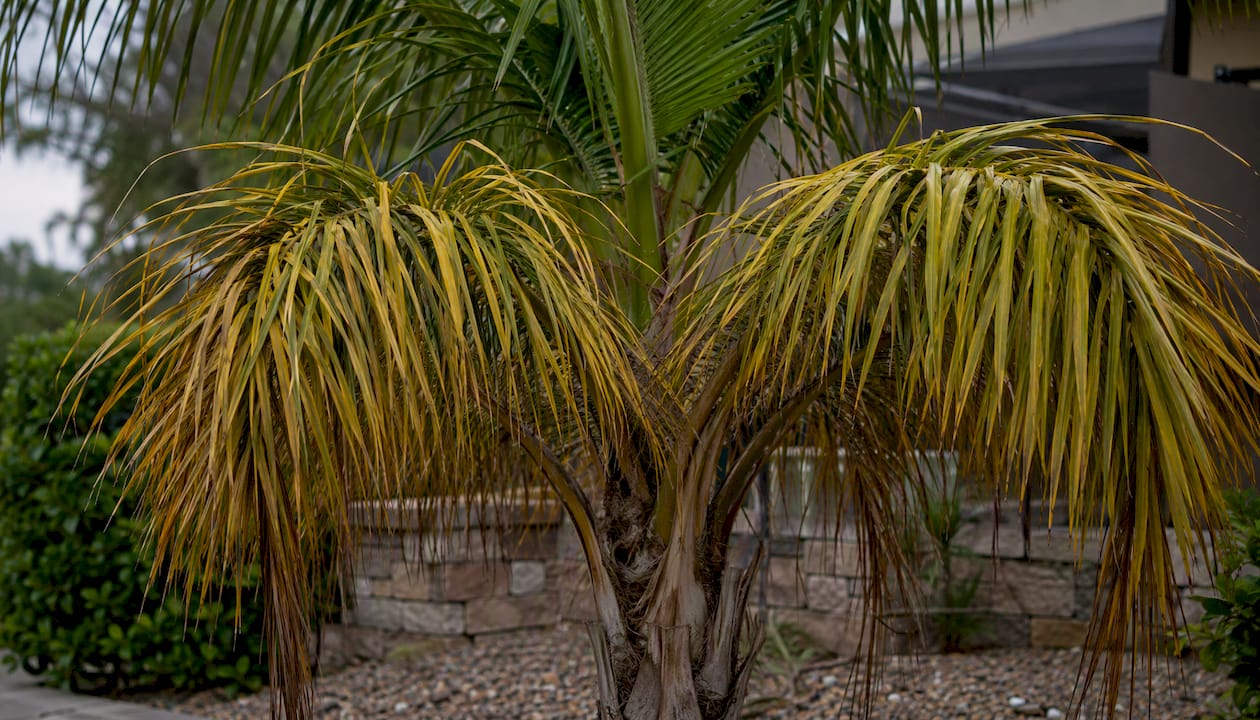
The diagnostic hallmark is the basidiocarp, commonly called a conk. It grows directly from the lower portion of the trunk, usually near the soil line. A fresh conk has a reddish-brown, zoned upper surface and a white, pore-covered underside. Older conks turn darker and harder. Once you see one, the diagnosis is effectively confirmed.
That said, many infected palms never produce a visible conk before they collapse. Definitive confirmation in those cases requires a cross-section of the trunk after felling, which reveals the characteristic internal discoloration and decay. In research settings, lab testing of fruiting bodies or soil samples can also confirm the pathogen, but that is not a standard field tool yet.
Ruling out other problems
A few quick checks help separate Ganoderma from other common palm problems:
- Nutrient deficiency (especially potassium or magnesium) causes yellowing in a specific pattern, usually starting on older fronds, without the structural softness or conk.
- Fusarium wilt (Fusarium oxysporum f. sp. canariensis) causes one-sided frond death and a distinctive brown stripe in the petiole, not a shelf fungus at the base.
- Lethal yellowing progresses rapidly through the entire canopy and affects specific species; it does not produce a conk.
- Physical damage from lawn equipment or root disturbance can mimic early decline but shows no internal decay pattern.
If you can safely approach the base of the palm, look for any discoloration or cracking at the trunk base and the presence of any shelf-like growth. Those three together are a strong field indicator.
What is Ganoderma zonatum and how does it spread?
Ganoderma zonatum is a white-rot basidiomycete, meaning it breaks down both lignin and cellulose in wood. It concentrates its decay in the lower trunk, typically the proximal section, creating a cone-shaped zone of internal rot. The outside of the trunk can feel and look completely normal while the interior is severely compromised. That gap between external appearance and internal reality is exactly what makes this disease so dangerous near structures, walkways, and occupied spaces.
At least 65 palm species are susceptible to G. zonatum, and it does not meaningfully infect non-palm plants. That host specificity matters for replanting decisions, which are covered later.
How the fungus moves
Spread happens through three main routes. First, conks release enormous numbers of airborne basidiospores that travel by wind and water. Second, infected palms and infested soil moved during landscaping or transplanting carry the fungus to new sites. Third, stumps left in place after removal continue producing conks for years, acting as a persistent spore source on the property.
The disease has been documented across Florida and in Georgia and South Carolina, and recent reports show it appearing in additional U.S. regions. For Central Florida property owners, the risk is not theoretical. Monitoring should be a routine part of any palm maintenance schedule, particularly if a neighbor’s palm has been removed for disease or if a conk has appeared anywhere on the block.
What to do when you suspect or confirm Ganoderma on a palm
This is the operational sequence that property owners and landscapers should follow from first suspicion through post-removal cleanup.
- Assess the immediate safety risk. Check for visible lean, canopy thinning, soft wood at the trunk base, and any conk. If the palm is within striking distance of a structure, vehicle, or pedestrian area, treat it as a hazard until assessed by a professional.
- Restrict access. Rope off the area under the canopy. This is especially urgent before storms or high-wind events, when structurally compromised palms are most likely to fail.
- Hire a certified arborist. Request a formal tree risk assessment using ISA (International Society of Arboriculture) methodology. The arborist will document the risk level and provide written guidance on removal timing.
- Schedule removal promptly. There is no effective systemic fungicide for Ganoderma butt rot. Removal is the management step, not a last resort.
- Handle the stump correctly. Grind the stump to below the high-risk zone or remove it entirely. Stumps left in place readily produce new conks, extending the spore-release period on your property.
- Dispose of infected material properly. Wrap conks and lower trunk sections in heavy plastic and send them to a landfill or incineration. Never place this material in green-waste bins or use it as mulch.
- Monitor the site. Inspect the removal area and any remaining palms every six months as a baseline. If a nearby palm or stump has recently produced conks, increase that to monthly checks.
Pro Tip: Never chip the lower 4–5 feet of an infected trunk for mulch. That section carries the highest fungal load and can spread the pathogen across your yard or a client’s property.
Monitoring reference
| Situation | Recommended inspection frequency |
|---|---|
| No known infection on property | Every 6 months |
| Nearby palm removed for Ganoderma | Every 3 months |
| Active conk on property or adjacent lot | Monthly |
| Post-removal site (stump ground) | Every 3 months for first year |
How do you prevent Ganoderma and replant safely?
Prevention is mostly about sanitation and not moving the problem around.
Do: Remove conks immediately in sealed plastic bags. Inspect palms at the base during every routine maintenance visit. Keep records of any palm removals in the neighborhood. Follow a Central Florida tree maintenance schedule that includes base inspections.
Don’t: Move lower trunk sections from a removal site to another location. Chip the proximal 4–5 feet of an infected trunk for mulch. Plant another palm in the exact spot where an infected palm stood without serious site preparation.
Replanting after a loss
The fungus survives in soil and can infect replacement palms planted in the same location. The safest choice after losing a palm to Ganoderma is to plant something other than a palm in that spot. Non-palm alternatives that serve similar landscape functions include:
| Landscape function | Palm alternative |
|---|---|
| Vertical accent | Southern magnolia, crape myrtle |
| Windbreak or privacy screen | Clusia hedge, podocarpus |
| Tropical aesthetic | Heliconia, bird-of-paradise |
| Shade canopy | Live oak, bald cypress |
If a palm is the only acceptable replacement for the site, full soil replacement or an extended fallow period reduces but does not eliminate the risk. Chemical fumigants exist but are rarely practical or cost-effective for residential sites, and their effectiveness against G. zonatum in field conditions is not well established. Any replanting decision should be made in consultation with a certified arborist who knows the site history.
For broader tree disease prevention guidance specific to Central Florida, the local extension resources and professional arborists are the most reliable starting point.
When should you call an arborist, and what happens next?
Call a certified arborist immediately if you see any of the following: a visible conk on the lower trunk, a palm that is leaning when it was previously upright, significant canopy thinning concentrated in the lower fronds, or any palm within falling distance of a structure, road, or occupied space.
Questions to ask before hiring
- Is the arborist ISA-certified? Ask for their credential number.
- Does the company carry liability insurance and workers’ compensation?
- Will they provide a written risk assessment or arborist report?
- What is the stump grinding depth, and will they remove the lower trunk material from the site?
- How will infected material be disposed of? Landfill or incineration only.
- Can they provide references for similar Ganoderma removal projects?
What the service process looks like
A professional Ganoderma removal project typically follows this sequence: on-site risk assessment and documentation, permit guidance if required by the municipality, safe felling with a defined drop zone, stump grinding to below the decay zone, removal and proper disposal of infected material, and a post-removal monitoring recommendation in writing.
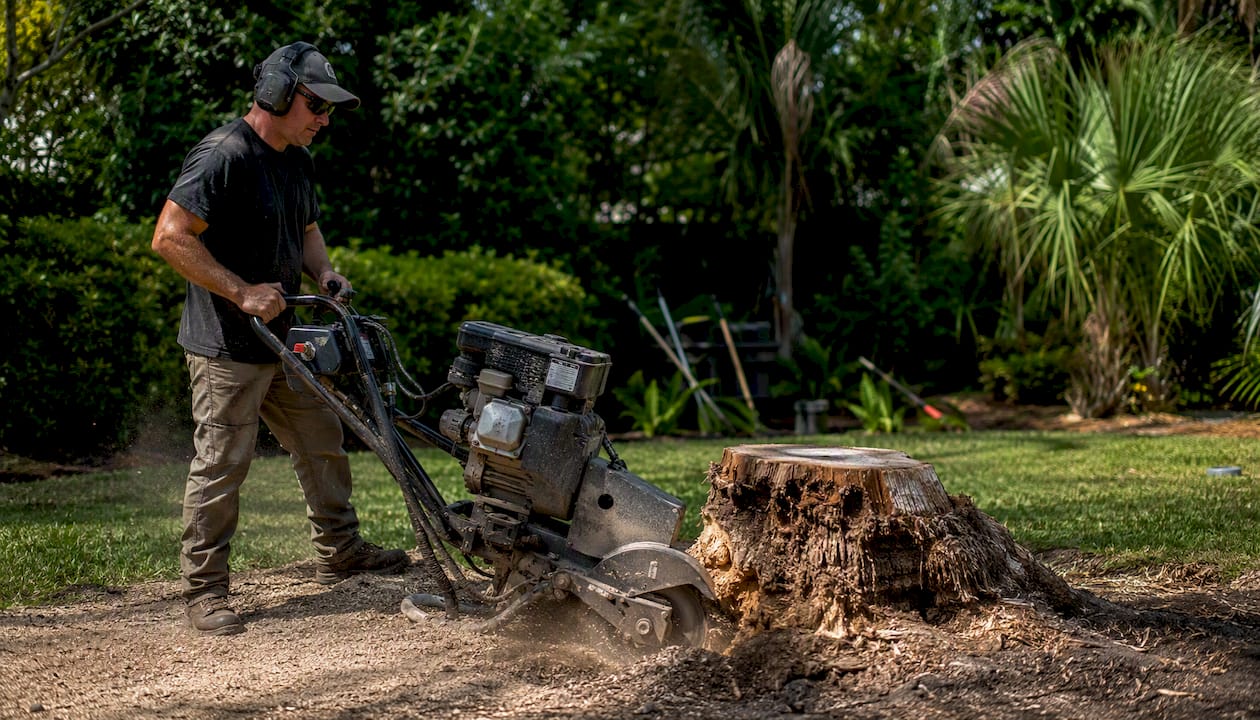
Cost varies considerably based on palm height, trunk diameter, site access, and whether crane use is required. A straightforward removal with stump grinding on an accessible residential lot runs less than a complex removal near a structure or over a pool, which may require rigging and specialized equipment. Get at least two written quotes and confirm that disposal of infected material is included, not billed separately.
One practical note: hazardous tree removal near structures carries liability implications for the property owner if the work is delayed after a documented risk assessment recommends removal. Confirm your contractor’s insurance covers the full scope of the job before work begins.
What does recent research say about detecting Ganoderma?
The most practically significant development in Ganoderma research over the past few years is molecular detection. Studies have shown that G. zonatum DNA can be identified from soil and sawdust samples before a conk appears, which could theoretically allow pre-symptomatic screening of planting sites or recently removed stumps.
Research published in the UC ANR Palm Arbor review (Santos & Hodel, 2025) confirms that early molecular detection of Ganoderma zonatum from soil and sawdust is achievable in research settings, but these methods are not yet standard diagnostic tools available to landscape managers. The practical takeaway: do not wait for a lab test before acting on visible symptoms.
The community dimension of this research matters as much as the detection angle. Because conks release spores by wind, a single infected palm or stump can seed neighboring properties. Extension authorities recommend coordinating inspections and conk removal across a neighborhood, not just managing individual trees in isolation. If you manage multiple properties or a homeowners association, a shared monitoring calendar is worth the effort.
Pro Tip: Ask your arborist whether any palms removed from nearby properties in the past two to three years showed signs of Ganoderma. That history changes how aggressively you should monitor your own trees.
An arborist’s perspective on what actually matters in the field
The cases that concern me most are not the ones where a homeowner calls immediately after spotting a conk. Those are straightforward. The difficult situations are the palms that fail without warning, where the internal decay was advanced but no conk had formed yet, and the tree was near a pool deck, a fence line, or a parked car.
What I see repeatedly in Central Florida is homeowners who were told by a lawn crew that the palm “looks fine” because the trunk felt hard on the outside. That external hardness is not a reliable indicator. G. zonatum hollows the interior while the outer shell stays intact, sometimes for years. By the time the trunk feels soft or a conk appears, the structural margin is already gone.
The other pattern worth naming: people who remove the infected palm correctly but then plant another queen palm or sabal palm in the same hole six months later. The soil still carries the pathogen. That replacement tree is starting at a disadvantage.
If you have a palm near your home or a high-traffic area and you are not sure of its history, a professional assessment is worth the cost. Mcculloughtreeservice handles risk assessments, removal, and stump grinding for exactly these situations across Central Florida. Reach out for a site evaluation before the next storm season.
Mcculloughtreeservice handles Ganoderma removal from assessment to cleanup
When a palm on your property shows signs of butt rot, the fastest path to safety is a team that handles every step without hand-offs.
Mcculloughtreeservice provides ISA-certified arborist inspections, professional tree removal for infected palms, and stump grinding deep enough to address the high-risk lower trunk zone. Infected material is hauled off-site to landfill, not left in your green-waste bin. The team works across Orlando and Central Florida, with the insurance, equipment, and local experience to handle removals near structures, pools, and tight residential lots.
To get an accurate quote, have ready: photos of the palm base and any visible conk, the approximate species and height, and the proximity to structures or utilities. Call or contact Mcculloughtreeservice online to schedule a site assessment before the next storm window opens.
Sources
The guidance in this article draws on the following authoritative sources. Each one is worth bookmarking if you manage palms professionally or want to go deeper on any specific aspect.
- PP54/PP100: Ganoderma Butt Rot of Palms – Ask IFAS
- Ganoderma butt rot of palms (Santos & Hodel) – UC ANR
- Ganoderma Butt Rot of Palms (Elliott & Broschat) – Collier County IFAS
- Protect your palm trees from fatal diseases – Florida Today
Pro Tip: The UF/IFAS and Collier County IFAS documents are free PDFs. Download them and share with your HOA or property management team so everyone is working from the same guidance when a conk appears in the neighborhood.
Recommended
- Tree root management: protect your property and trees
- Identify a Dangerous Tree: Signs & Solutions
- Commercial Tree Removal Guide for Safe Property Management
- Tree Health Assessment: Protecting Orlando Landscapes