By: | Published: August 23, 2026
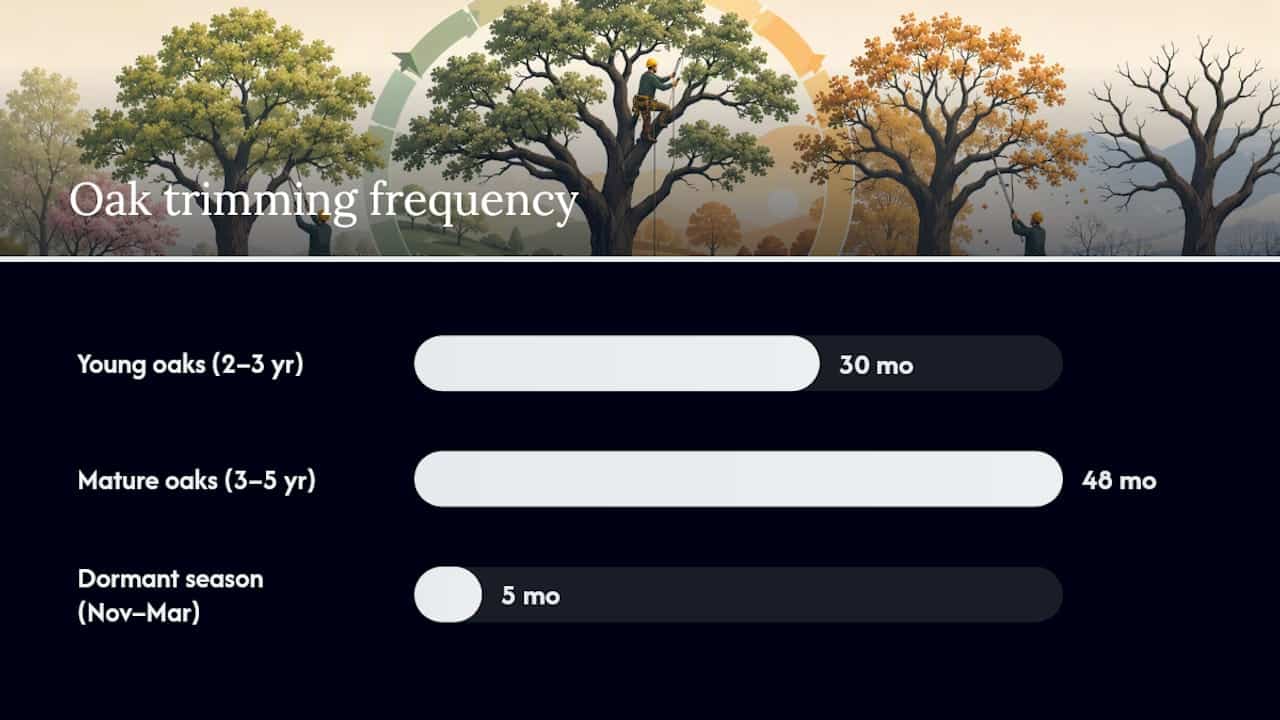
Young oaks need trimming every 2 to 3 years to build strong structure while they’re still establishing their branch pattern. Mature oaks need it less often, usually every 3 to 5 years, mostly to remove deadwood and manage safety risks rather than shape growth. Timing matters more than the calendar reminder on your phone: prune during dormant season whenever you can, and steer clear of the months when sap-feeding beetles are active, since they’re the main way oak wilt spreads from tree to tree.
- Young oaks (under 15 years or still developing a central structure): trim every 2 to 3 years
- Mature oaks (established canopy, slower growth): trim every 3 to 5 years
- Best timing: dormant season, when the tree is not actively growing
- Avoid: pruning during peak beetle-activity months in your region
Key Takeaways
Oak trimming frequency depends on tree age, with young oaks pruned every 2 to 3 years and mature oaks every 3 to 5 years, always during dormant season when possible.
| Point | Details |
|---|---|
| Young oaks need more frequent cuts | Trim every 2 to 3 years to correct weak crotches and establish one dominant leader. |
| Mature oaks need less frequent maintenance | Trim every 3 to 5 years, mainly for deadwood removal and storm-risk reduction. |
| Dormant season is the safe window | Prune November through March when sap-feeding beetles are least active. |
| Sanitize tools between every tree | Use a 10% bleach solution or commercial disinfectant, even on trees that look healthy. |
| Professional help for structural risk | Mcculloughtreeservice provides certified-arborist trimming and emergency response across Central Florida when damage exceeds DIY scope. |
Table of Contents
- Oak Trimming Frequency by Age and Tree Condition
- When Is the Best Time to Trim Oak Trees?
- How to Prune Oaks Safely and Sanitize Your Tools
- When to Call a Professional for Emergency Pruning
- Common Oak Trimming Mistakes to Avoid
- A Certified Arborist’s Take on Trimming Timing
- Let McCullough Tree Service Handle Your Oak’s Timing
- Frequently Asked Questions
- Sources
Oak Trimming Frequency by Age and Tree Condition
A young oak is still figuring out its shape. Branches compete for dominance, weak crotches form where two limbs meet at a narrow angle, and without intervention, that tree can grow into a structural liability by the time it’s 30 feet tall. That’s why arborists trim young trees more often, roughly every 2 to 3 years, to remove competing leaders and encourage one dominant trunk.
Mature oaks operate differently. Once a tree has a settled crown and stable branch architecture, the goal shifts from shaping to maintenance: removing dead or crossing limbs, thinning storm-prone sections, and checking for decay. That’s usually a 3 to 5 year cycle for a healthy specimen. Trees in storm-exposed yards or with a history of storm damage sometimes need attention closer to every 2 years, while a stable, mature oak on a quiet property can often go the full 5 years without issue.
- Small residential lot, single mature oak: inspect annually, trim every 4 to 5 years
- Property with multiple young oaks: trim every 2 to 3 years until structure sets
- Large estate or commercial property with mixed ages: stagger trimming so not all trees are cut the same year
Pro Tip: Removing more than a quarter of live canopy in one session stresses even a healthy oak. If a tree needs heavy correction, spread the work over two visits a few years apart instead of doing it all at once.
When Is the Best Time to Trim Oak Trees?
The dormant season, generally November 1 through March 31, is the safest window for trimming oak trees, because the beetles that transmit oak wilt are least active during cold months. Fresh cuts release sap, and that sap is exactly what draws the beetles carrying the fungal spores responsible for the disease.
The window to avoid is roughly April 1 through July 15, when beetle activity spikes. Some regions extend that caution further: extensions in oak wilt zones commonly recommend skipping pruning from February through June entirely, since local beetle populations and weather don’t always match a generic calendar.
- Safe: November through March in most regions
- High risk: April through mid July (some regions extend this to February through June)
- Wild card: unusually warm winters can shift beetle activity earlier than expected
That last point is worth sitting with. Arboretum experts advise anchoring pruning decisions to local dormancy signs and weather rather than rigid dates, because warming winters and unpredictable springs shift when beetles wake up. A degree-day model can estimate local beetle activity using accumulated heat units for your specific area, giving you a sharper answer than “sometime in winter.” If you’re not sure how your property’s microclimate behaves, a seasonal pruning schedule built around local conditions beats guessing every time.
How to Prune Oaks Safely and Sanitize Your Tools
Good pruning technique matters almost as much as timing. Cut just outside the branch collar, that slightly swollen area where a limb meets the trunk, rather than flush against the bark. A flush cut removes tissue the tree needs to seal the wound properly, and it heals far slower.
- Identify the branch collar before you cut, and leave it intact.
- Remove no more than about a quarter of live canopy in a single visit.
- Wipe blades clean of sap and debris between cuts on the same tree.
- Disinfect tools between different trees using a 10% bleach solution or a commercial disinfectant, letting the solution sit on the blade for a few minutes before rinsing.
- Only apply wound dressing if you were forced to cut during a high-risk month.
That last step trips up a lot of homeowners. Wound paint isn’t standard practice, it’s a stopgap. Latex-based paint, never asphalt-based, is appropriate only on emergency cuts made during beetle season; painting a wound made during dormancy traps moisture and can actually slow healing.
Oak wilt doesn’t just travel by beetle. Root systems of live oaks growing near each other can be connected underground, letting the fungus move tree to tree without a single insect involved. That’s why sanitizing tools between every oak, not just ones that look sick, matters even on properties with no visible disease.
If a job requires climbing higher than a ladder safely allows, or involves limbs near power lines, that’s the point to stop and call in help. Our oak tree trimming guide covers technique in more depth if you want to go further before deciding what’s within your skill level.
When to Call a Professional for Emergency Pruning
Some situations don’t wait for dormant season. Call a certified arborist immediately if you see a cracked limb over 4 inches thick, a split running into the trunk, exposed roots after heavy wind, or leaves wilting and browning from the top down, a classic oak wilt symptom.
- Document the damage with photos and note the date
- Seal any emergency cut made outside dormant season, and mention nearby trees with known infection when you call
- Ask whether the arborist offers diagnostic testing if oak wilt is suspected
- Have your last pruning date ready; it helps a professional judge how much more the tree can tolerate
Certified arborists carry the rigging and safety training that emergency limb removal demands, along with sanitary protocols most homeowners don’t have on hand.
Common Oak Trimming Mistakes to Avoid
Topping, cutting main limbs back to stubs, is one of the most damaging things you can do to an oak. It forces weak, fast-growing shoots that are more likely to break in a storm than the limbs they replaced. Over-thinning has a similar effect: strip too much canopy and you shock the tree into stress responses that invite pests and disease.
- Topping or over-thinning in a single aggressive session
- Pruning during peak beetle months without a good reason
- Skipping tool sanitation between trees, even ones that look healthy
- Using asphalt-based paint or painting wounds made during dormancy
- Removing more than a quarter of live canopy at once
A Certified Arborist’s Take on Trimming Timing
Homeowners often treat pruning as a one-time fix rather than a cycle. Timing and tool sanitation matter as much as the cut itself, and certified-arborist training exists precisely because those details separate a healthy oak from a slow decline.

Let McCullough Tree Service Handle Your Oak’s Timing
Getting oak trimming timing right means tracking dormancy windows, beetle activity, and each tree’s own history, work most property owners don’t have time to monitor year after year. Mcculloughtreeservice is the alternative to guessing at your own schedule: our certified arborists plan trimming around dormant-season windows for your specific Central Florida property, follow sanitation protocols between every tree, and respond fast when a limb splits mid summer and waiting isn’t an option.

Our tree trimming services cover routine maintenance and emergency response alike, with financing available for larger jobs. If a recent storm left a limb hanging or you’re overdue on a maintenance cycle, reach out for an estimate and we’ll assess your oak’s actual condition instead of a generic timetable.
Frequently Asked Questions
How often should I trim a mature oak tree?
Every 3 to 5 years is typical for a healthy, established oak, mainly to clear deadwood and address storm-risk limbs rather than reshape the tree.
What is the best time of year to trim oak trees?
Dormant season, generally November through March, is the safest window because oak-wilt beetles are least active in the cold months.
Can trimming oaks in spring or summer cause oak wilt?
Fresh cuts made during beetle-active months, roughly April through mid July in many areas, release sap that attracts beetles carrying oak wilt fungus, raising infection risk substantially.
Do I need to sanitize pruning tools between oak trees?
Yes. Wiping blades with a 10% bleach solution or commercial disinfectant between trees helps prevent spreading disease, even from trees showing no symptoms.
When should I call a certified arborist instead of trimming myself?
Call immediately for cracked limbs over 4 inches thick, trunk splits, exposed roots, or wilting leaves that suggest oak wilt, and generally whenever the job requires climbing beyond safe ladder height.
Sources
- Oak Wilt – Wisconsin DNR
- Pruning Mature Trees – Texas A&M Forest Service
- Morton Arboretum guidance on pruning timing
- Online tool for determining a guideline timing for pruning oaks – Dane County Extension (UW)
Recommended
- Oak Tree Trimming Guide: Best Practices and Techniques
- Check Out Our Videos – McCullough Tree Service
- How to Trim Commercial Trees for Safety and Curb Appeal
- Tree Trimming Safety Protocols to Remember