By: | Published: September 3, 2026
A crack in a tree trunk usually signals structural weakness, but urgency depends on the crack’s depth, location, and what’s growing around it. A split running through the stem, a cracked branch over 4 inches thick, or multiple cracks paired with visible decay all point to high risk. Keep people, cars, and structures away from the area, then arrange a visual risk assessment before doing anything else.
TL;DR:
- Cracks over 4 inches in diameter or involving the main stem indicate high risk and require immediate restricted access until assessed by an arborist.
- Transverse cracks and cracks paired with decay or a recent lean are more structurally dangerous than frost cracks which often reoccur seasonally.
- Proper documentation of crack size, location, and bark condition is essential for accurate risk evaluation and future comparison.
- Mechanical forces like wind and improper pruning exacerbate cracks, especially at branch unions with trapped bark that lack structural wood.
- Preventive measures include species selection, regular pruning, consistent watering, mulch, and removing trunk wraps annually to reduce crack development.
Table of Contents
- Types of Tree Trunk Cracks and How to Spot Them
- What Causes Cracks in Trees in the First Place
- How to Check a Cracked Tree for Risk: A Homeowner’s Walkthrough
- What to Do Right Now, Before Help Arrives
- Should You Monitor, Prune, Brace, or Remove the Tree?
- Preventing Cracks Before They Start
- Why This Guidance Follows Extension and ISA Standards
- The Real Lesson Homeowners Miss About Cracked Trees
- Get a Professional Read on Your Cracked Tree
- Sources
Types of Tree Trunk Cracks and How to Spot Them
Not every crack behaves the same way, and knowing which type you’re looking at tells you a lot about how worried to be. Trees develop distinct crack patterns depending on what caused the damage, and each one leaves different clues on the bark.
Frost cracks run vertically along the trunk, usually on the south or southwest side where winter sun warms bark during the day and rapid cooling at night causes the wood to contract unevenly. These are longitudinal splits, and they often reopen every winter in the same spot for years. Thin-barked species like maple, cherry, and elm are particularly prone to this, especially when young. Cracks like these frequently follow an old injury line, a flush pruning cut or lawn mower scrape from seasons past that never fully closed.
Transverse (or traverse) cracks run across the grain instead of along it, and they’re a different animal entirely. A crack cutting perpendicular to the trunk’s fibers usually means the wood has already failed under bending stress, often from wind load or a heavy, lopsided canopy. This type deserves more concern than a vertical frost crack because it signals the wood’s structural integrity, not just its bark, has given way.
Shear cracks show up at branch unions, particularly where two stems of similar size grow tightly together with bark trapped between them, a defect arborists call included bark. These unions lack the interlocking wood grain that gives a healthy branch attachment its strength, so they’re prone to splitting apart during wind events or under their own weight.
When you spot a crack, take a few minutes to document it properly:
- Photograph the crack from multiple angles, including one shot that shows scale (a tape measure or a common object works)
- Measure the length of the crack and the widest point it opens
- Note the diameter of the branch or trunk section involved
- Check whether the bark around the edges looks callused (healing) or fresh and raw
- Look for ribbing, discoloration, or fungal growth near the crack
That documentation becomes valuable if you eventually need an arborist risk assessment and want a clear before-and-after record.
What Causes Cracks in Trees in the First Place
Most trunk cracks trace back to one of four culprits: temperature extremes, mechanical force, rapid growth, or old wounds that never healed right.
Frost cracking happens when a sudden temperature swing, common on clear winter nights after a sunny day, causes the outer wood to contract faster than the inner wood. That mismatch splits the trunk. Illinois Extension’s research on frost cracking notes this typically happens along existing wounds rather than on undamaged bark, which is why a tree that cracked once tends to crack again in the same place.
Wind and torsion are the other major driver, especially at branch unions with included bark. A gust that would barely stress a well attached limb can shear apart a union with trapped bark, since there’s no solid wood grain locking the branch to the trunk.
A few other causes worth knowing:
- Lightning strikes cause explosive, often vertical splits with scorched or blackened wood at the entry point
- Rapid growth after heavy rain following drought can stress bark faster than it can expand, leading to splits
- Mechanical wounds from lawn equipment, weed trimmers, or construction machinery create weak points that crack years later
- Improper pruning, especially flush cuts that remove the branch collar, leaves an injury that never seals properly and becomes a future crack site
One statistic worth sitting with: a crack that splits the main stem or involves a branch larger than 4 inches in diameter is classified as high risk under widely used extension risk frameworks. That threshold isn’t arbitrary. It reflects how much load-bearing wood is compromised relative to what’s holding the rest of the tree together.
How to Check a Cracked Tree for Risk: A Homeowner’s Walkthrough
Before you decide whether a crack is a minor cosmetic issue or a reason to call in a professional, walk through this checklist. It borrows directly from the visual assessment methods certified arborists use in the field.
-
Map your targets first. Stand back and look at what’s within falling range of the tree or the cracked limb: your house, a parked car, a play set, a walkway, a neighbor’s fence. If nothing is in range, your urgency drops significantly. If a bedroom window or driveway sits underneath, urgency goes up no matter how small the crack looks.
-
Check the crack against known thresholds. A crack that splits the stem itself, a cracked branch over 4 inches across, or multiple cracks paired with visible decay all meet the high-risk bar used in federal urban forestry guidance on hazardous tree defects.
-
Look for a lean. A tree that has always leaned slightly is usually fine. A tree that started leaning recently, particularly a lean between 15 and 40 degrees, combined with a crack, exposed roots, or heaving soil at the base, needs same-week professional attention.
-
Scan the canopy for dieback. Dead branches, sparse leaf cover on one side, or fungal conks growing on the bark are secondary signs that the tree’s internal health is already compromised, not just its bark.
-
Measure what you can safely reach. Note the crack’s length, how wide it gapes at its widest point, and the diameter of the affected branch or trunk section. Write these numbers down.
-
Decide: monitor, restrict access, or call now. A small, callused crack with no decay and no targets nearby can often just be watched. A crack meeting any high-risk threshold above, especially paired with a target in range, means restrict access immediately and schedule a professional look.
Pro Tip: Take a photo of the crack next to a tape measure every few months. A crack that’s widening or lengthening over a season tells you far more than a single snapshot ever could.
Extension guidance also breaks professional inspections into three levels: a level 1 visual walkaround, a level 2 detailed evaluation that may include probing or sounding the wood, and a level 3 advanced assessment using tools like resistance drilling. Most homeowner situations resolve at level 1 or 2.
What to Do Right Now, Before Help Arrives
If you’ve identified a crack that meets any high-risk threshold, take these steps immediately while you wait for a professional evaluation.
- Rope off or clearly mark the drop zone beneath the affected limb or trunk section
- Move vehicles, grills, patio furniture, and anything else you’d hate to lose out of that zone
- Keep kids and pets away from the area, even if the crack looks stable
- Do not climb the tree or attempt to cut a large cracked limb yourself. A limb under tension can release suddenly and violently
- Small corrective pruning on minor, low branches is fine if you’re comfortable and trained, but leave anything involving a ladder or a chainsaw to a professional
- Photograph the damage now, with a visible date stamp if your camera supports it. These photos matter for insurance claims and give an arborist a timeline
On insurance: coverage for tree damage depends heavily on your policy and the cause. Most homeowners policies pay for damage to your house, garage, or fence if a tree falls due to a covered peril like wind or lightning. Far fewer policies pay to remove a cracked or diseased tree that hasn’t yet caused damage to a structure. Read your policy’s tree removal clause before assuming you’re covered either way.
Should You Monitor, Prune, Brace, or Remove the Tree?
Once you know how serious the crack is, the next question is what to actually do about it. The right answer depends on the crack’s severity, the tree’s overall health, and what’s at stake if it fails.
Monitoring works for small, shallow cracks that show callus tissue forming at the edges, have no visible decay, and sit far from anything worth protecting. Extension research shows most trees with shallow or partially callused cracks recover over time with basic cultural care: consistent watering, a layer of mulch, and correct pruning that keeps the tree vigorous.
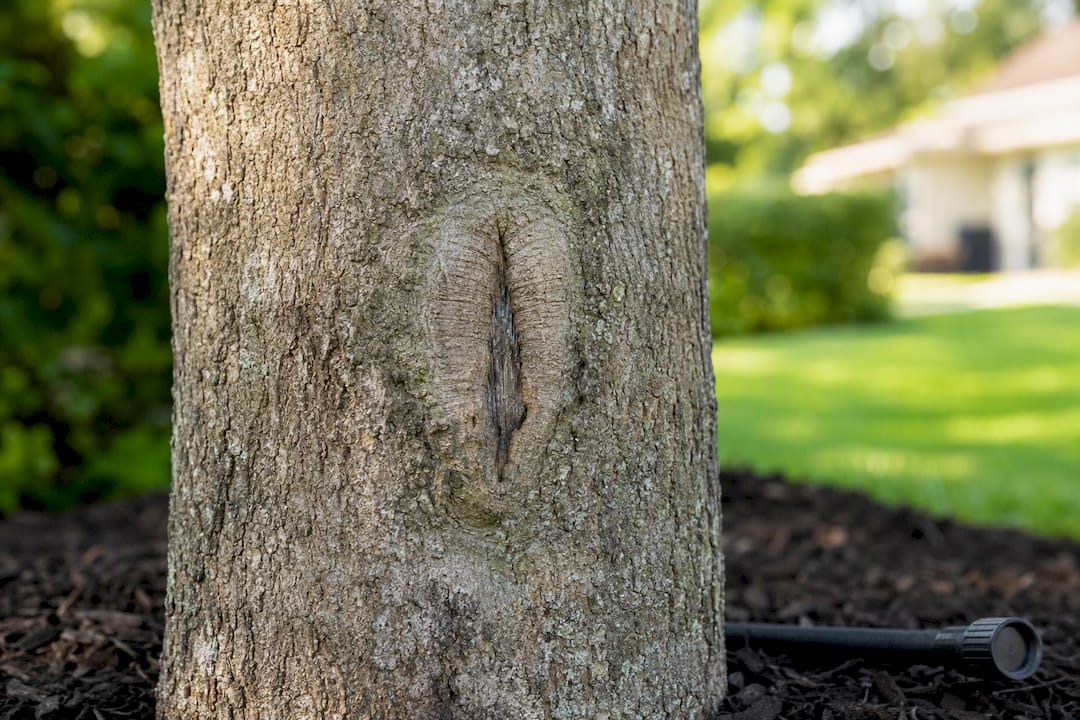
Pruning removes weight or leverage that’s putting stress on a cracked area, but this is a job for a professional once you’re dealing with anything above a small, low branch. A trained arborist knows how to make cuts that encourage healing rather than create new wounds, which matters because flush cuts and improper technique are a leading cause of the cracks you’re trying to prevent in the first place.
Cabling and bracing provide temporary mechanical support, typically installed between major limbs or across a split trunk to redistribute load. This buys time and reduces failure risk, but it’s not a permanent fix. The crack itself doesn’t heal because of a cable; the tree still needs to grow its way toward recovery.
On wound care, skip the tar and wound paint entirely. Kansas State Extension’s research is clear on this: sealants trap moisture and can actually slow healing rather than speed it. Removing loose, decayed wood when an arborist recommends it, and otherwise letting the tree callus over naturally, produces better long-term outcomes.
- Monitor: small, callused, no decay, no targets nearby
- Prune: excess weight or leverage contributing to the crack
- Brace or cable: temporary support for a structurally compromised union
- Remove: stem split through sound wood, severe decay, or a target that can’t be moved
Pro Tip: If an arborist recommends removal, ask for the reasoning in plain terms. A good professional will point to specific defects, not just “it looks bad,” and will explain what happens if you wait.
Removal becomes the answer when the crack runs through sound wood in the main stem, when decay has spread significantly, or when the tree threatens a target you can’t relocate, like your house. Hazardous tree removal involves specialized rigging and, often, a crane, especially when a tree can’t safely fall in the direction it’s leaning.
Preventing Cracks Before They Start
Prevention comes down to reducing stress on the tree year round, not applying a one-time fix.
Pick species suited to your soil and site, and give new trees enough room that roots don’t grow shallow and unstable. Prune on a proper schedule, avoiding flush cuts and steering clear of major pruning right before a late-season growth spurt, since fresh wounds heading into winter are exactly what sets up frost cracking the following year.
Water consistently through the growing season and mulch generously, especially heading into winter when moisture stress compounds temperature stress. If you use trunk wraps on young, thin-barked trees, apply them in autumn and pull them off by spring without exception. Left on too long, wraps trap moisture and create habitat for insects, and can girdle the trunk as it grows.
- Choose species matched to your soil, sun, and space
- Prune on a schedule; avoid flush cuts and late-season heavy pruning
- Water and mulch consistently, especially before winter
- Remove trunk wraps every spring without fail
- Schedule a periodic arborist checkup, even when nothing looks wrong
Why This Guidance Follows Extension and ISA Standards
The thresholds and steps in this guide track directly with university extension publications and the risk-assessment framework the International Society of Arboriculture (ISA) uses to train certified arborists. Those levels, visual, detailed, and advanced, exist so a homeowner and a professional are speaking the same language about risk.
An ISA-certified arborist inspection typically covers a visual walkaround of the crack and surrounding canopy, documented findings with photos, a written safety recommendation, and a cost estimate for whatever action is needed. That’s the point at which Mcculloughtreeservice’s own certified arborists step in for Central Florida property owners who want a professional read on what they’re looking at.
The Real Lesson Homeowners Miss About Cracked Trees
Most advice about tree cracks jumps straight to “call an arborist,” which is safe advice but not particularly useful on its own. The gap in most guidance is triage. A crack by itself is a symptom, not a diagnosis, and the difference between a tree that needs watching and one that needs to come down this week almost always shows up in the details most people skip: decay near the crack edge, a lean that’s new rather than lifelong, a canopy thinning on one side.
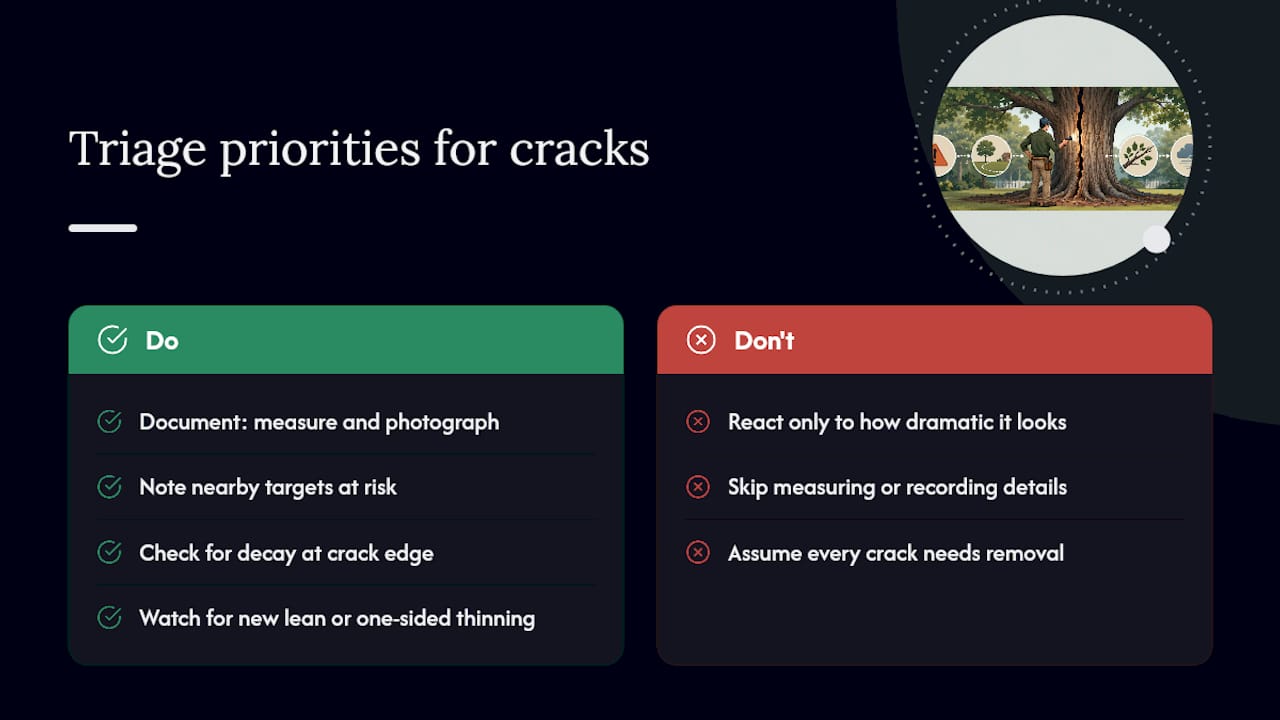
The conventional wisdom oversells symmetry between fear and risk. A dramatic-looking frost crack on a healthy oak is often far less dangerous than a subtle transverse crack tucked behind a branch union, simply because one is cosmetic and the other is structural. Homeowners tend to react to how alarming a crack looks rather than what it actually indicates about load-bearing wood.
If there’s one thing to prioritize, it’s documentation before diagnosis. Measure it, photograph it, note what’s nearby that could get hit. That record turns a guess into a real assessment, whether you end up handling it yourself or handing it to a professional.
— Results
Get a Professional Read on Your Cracked Tree
A crack that meets high-risk criteria isn’t something to gamble on, and it isn’t something most homeowners can accurately judge alone from the ground. Certified arborist inspections can provide property owners with a faster, more reliable path than guessing: a clear, written recommendation based on a professional visual assessment, no ladder climbing or online forum diagnosis required.

A typical visit includes a visual check of the crack and surrounding canopy, photo documentation you can keep for your own records, and a written recommendation with a cost estimate attached. From there, Mcculloughtreeservice handles whatever comes next, whether that’s corrective pruning to relieve stress on a cracked union, cabling for temporary support, or full hazardous tree removal when the wood underneath the crack can’t be trusted anymore.
If you’ve got a cracked trunk or branch on your property and you’re not sure which category it falls into, consider scheduling an assessment with a certified arborist to get a straight answer instead of a guess.
Sources
- Tree health assessment and risk management (P3717) — Mississippi State Extension
- Spotting danger: How to identify and assess hazard trees — ACES
- Exploding trees? A closer look at frost cracking — Illinois Extension (2026)
- Frost cracks on trees — Kansas State Extension
- How to recognize hazardous defects in trees — federal/urban forestry guidance
Recommended
- Identify a Dangerous Tree: Signs & Solutions
- Emergency Tree Service Steps for Storm Recovery
- Why Assess Storm Damage to Trees: A Homeowner’s Guide
- Emergency tree response guide for Central Florida