By: Shelby McCullough| Published: August 26, 2026
If you need shade fast, plant a laurel oak, wild tamarind, red maple, or crape myrtle, all of which push at least 3 feet of new growth a year, the threshold UF/IFAS uses to call a tree “fast-growing.” Slash pine and hybrid poplar can go even quicker under the right conditions.
That speed comes with a catch. The tree that grows fastest is often the one most likely to snap in a July thunderstorm.
- Laurel oak: fast, big, but brittle by middle age
- Wild (false) tamarind: native, salt tolerant, moderate speed
- Red maple cultivars: reliable, fast, good structure
- Crape myrtle: fast for its size, compact, low storm risk
Fast-growing, by the numbers: UF/IFAS defines it as 3+ feet of height growth per year, with usable shade arriving in roughly 5 years.
Pick the wrong species for your lot, though, and you’ll be paying for removal before the tree even earns its keep.
Key Takeaways
The fastest path to real Florida shade is choosing a species that adds at least 3 feet a year, planting it in the right spot for its mature size, and giving it strong first-year care.
| Point | Details |
|---|---|
| Know the threshold | UF/IFAS defines fast-growing as 3+ feet of height gain per year, with shade in about 5 years. |
| Match species to site | Use the “right tree, right place” principle to check mature size, soil, and salt exposure before buying. |
| Avoid weak-wooded invasives | Skip Australian pine and Chinaberry despite their speed; both perform poorly in wind. |
| Start with bigger stock | Larger B&B or container trees establish and shade out faster than small saplings. |
| Call in a professional for risk sites | McCullough Tree Service’s certified arborists handle large-species planting, storm-prone lots, and utility conflicts across Central Florida. |
Table of Contents
- Fast Growing Shade Trees for Florida: Species Profiles by Size
- How to Pick a Fast Grower That Won’t Cost You Later
- Planting and Care That Speeds Up Real Shade
- When to Bring In a Certified Arborist
- Florida’s Rules on Tree Planting and Protected Species
- What Most Advice Gets Wrong About Fast Growth
- Get a Custom Shade Plan From McCullough Tree Service
- Sources
Fast Growing Shade Trees for Florida: Species Profiles by Size
Not every fast grower belongs in every yard. A tree that’s perfect for a five-acre inland property can be the wrong call 30 feet from a coastal seawall. Here’s how the strongest candidates break down by size and site.
Large canopy trees (40+ feet mature height)
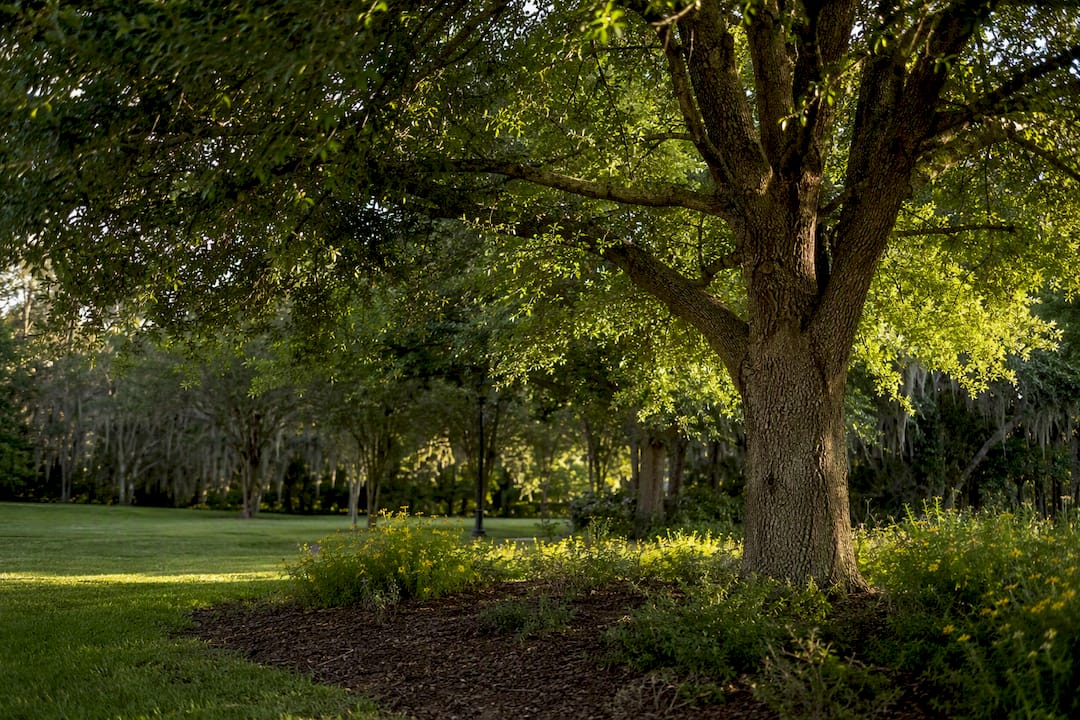
1. Laurel oak (Quercus laurifolia)
Grows 2 to 3 feet a year and reaches 60 to 70 feet at maturity, making it one of the fastest oaks you can plant in Central Florida. It tolerates wet soil and part shade, which makes it popular on new residential lots. The tradeoff: laurel oaks are short-lived for an oak, often declining after 50 to 70 years, and their wood gets weaker with age. Practitioners frequently plant them as nurse trees alongside slower, longer-lived species like live oak, then remove the laurel oak once the live oak canopy establishes. Usable shade: 5 to 7 years.
2. Slash pine (Pinus elliottii)
A Florida native that grows fast and straight, tolerating sandy, well-drained soil across most of the peninsula. It gives filtered shade rather than dense canopy, and it handles wind reasonably well when planted away from crowded root zones. Best for large inland or suburban lots where a softer, dappled shade is fine. Usable shade: 4 to 6 years.
3. Red maple cultivars (Acer rubrum)
One of the best-behaved fast growers for Florida, red maple adds 3 to 5 feet a year, colors up in fall (rare for the state), and holds a stronger branch structure than laurel oak. It prefers moist soil and does best in Central and North Florida rather than the coastal south. Usable shade: 4 to 6 years.
Medium residential trees (25 to 40 feet)
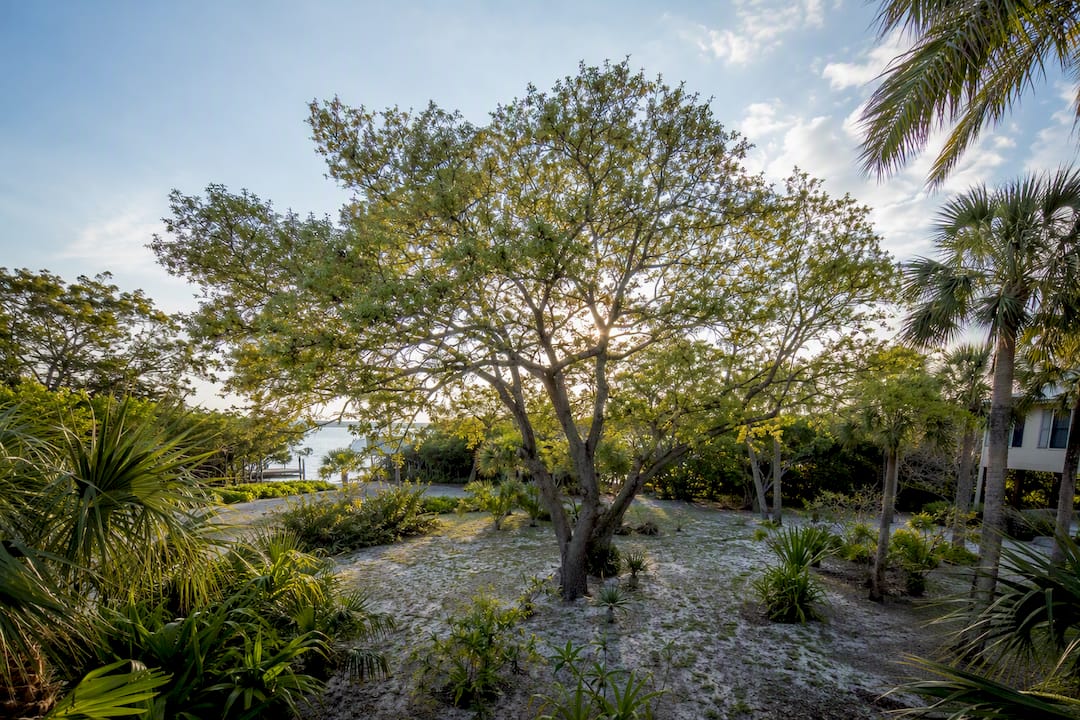
4. Wild tamarind / false tamarind (Lysiloma latisiliquum)
A South Florida native that grows at a moderate-to-fast pace and tops out between 30 and 60 feet. It’s drought tolerant, salt tolerant, and holds up well in coastal and park settings where wind exposure rules out weaker species. This is the pick for a beachside or Intracoastal lot that still wants real canopy.
5. Bahama strongbark (Bourreria succulenta)
Smaller than wild tamarind but tougher against salt spray, making it a smart choice for South Florida yards within reach of ocean air. UF/IFAS Gardening Solutions lists it among the natives that outperform faster non-native species over the long run.
Small and compact options (under 25 feet)
6. Crape myrtle
Fast for its ultimate size, tops out around 20 to 25 feet, and rarely causes storm damage because it’s simply too small and flexible to do much harm. Ideal for patios, driveways, and tight residential lots. Usable shade: 2 to 3 years.
7. Royal poinciana (Delonix regia)
Zone-appropriate only in South Florida (roughly zones 10 to 11), this one grows fast and delivers a wide, umbrella-shaped canopy with a spectacular orange bloom. It has brittle wood, though, so keep it away from structures and parking areas.
Avoid two species that show up constantly in “fast growing” searches for the wrong reasons: Australian pine and Chinaberry. Both grow rapidly, and both are classified as invasive with poor wind performance, meaning they’re more likely to uproot or shatter in a named storm than almost anything on the list above.
How to Pick a Fast Grower That Won’t Cost You Later
Growth rate is only half the equation. The other half is whether the tree still looks good, and stands up, a decade from now.
Start with the UF/IFAS “right tree, right place” principle: measure your actual planting space, look up the tree’s mature spread and root behavior, and keep large-maturing species at least 15 to 20 feet from your house, pool cage, and septic field. Utility lines need even more clearance, both overhead and underground.
If you want speed now but a longer-term canopy tree later, plant a fast nurse tree next to a slower, sturdier species. Once the long-lived tree fills in, the nurse tree comes out. This is exactly how many Central Florida landscapes pair laurel oak with live oak.
Match soil and drainage to species before you match speed. A red maple in dry sandy soil will sulk; a slash pine in a soggy low spot will rot at the roots. If you’re near the coast, salt tolerance moves to the top of the list, ahead of raw growth rate.
Run through this before you buy:
- How much clear space do you actually have to mature size?
- Is this lot coastal, inland, wet, or dry?
- Can this species handle your typical wind exposure?
- What’s the realistic pruning and cleanup schedule for this tree, and what does that cost over time?
- Would a staged nurse tree strategy serve you better than one fast grower alone?
Pro Tip: Walk your yard at different times of day before you plant. A spot that looks like full sun at noon can be deep shade by 4 p.m. once a neighboring roofline or fence line gets factored in, and that changes which species will actually thrive there.
Planting and Care That Speeds Up Real Shade
The single biggest lever for faster shade isn’t the species. It’s the stock size and the first-year care you give it.
- Start bigger. A balled-and-burlapped or larger container tree establishes and shades out faster than a small sapling, even though it costs more upfront.
- Dig wide, not deep. The planting hole should be two to three times the width of the root ball but no deeper, with the root flare sitting slightly above grade.
- Mulch correctly. Lay 2 to 4 inches of mulch in a wide ring, keeping it a few inches clear of the trunk to avoid rot.
- Water deeply, not often. Year one calls for slow, deep watering several times a week, tapering as roots establish, rather than a daily light sprinkle.
- Stake only if needed, and remove stakes within a year once the trunk can stand on its own.
- Prune for structure early, removing competing leaders before they become permanent weak points, and get a soil test before you fertilize.
Done this way, most fast growers deliver usable shade in 1 to 3 years, with a full canopy following in 3 to 7. While you wait, a large potted specimen, a shade sail over a patio, or a fast vine on a pergola covers the gap.
Pro Tip: Position new shade trees on the east and west sides of your house to block the harshest summer sun, and lean on deciduous species to the south so winter sun still reaches your windows.
When to Bring In a Certified Arborist
Some plantings are simple enough to handle yourself. Others aren’t, especially once a tree’s mature size puts your roof, pool cage, or power lines in the blast radius.
McCullough Tree Service works across Central Florida with certified arborists who handle exactly these judgment calls. Bring in a professional when:
- You’re planting a large-maturing species like laurel oak or slash pine near a structure or septic field
- Your site has storm exposure or a documented history of tree failure
- Roots or canopy will conflict with underground utilities or overhead lines
- You’re installing larger B&B stock that needs proper equipment to move and set
For species selection specific to Central Florida yards, McCullough Tree Service’s guide to the best tree species for Orlando properties is a useful next stop.
Florida’s Rules on Tree Planting and Protected Species
Most residential tree planting in Florida doesn’t require a permit, but removal often does, and that distinction trips people up more than you’d expect. Many Florida counties and cities, including several in Central Florida, regulate the removal of trees over a certain trunk diameter on residential and commercial lots, even when the tree was planted by the property owner. Check with your local county or city planning department before removing an established tree, including a fast-growing nurse tree you intend to take out later.
Certain species carry extra protection regardless of local ordinances. Florida law protects specific native trees and habitats, and some municipalities separately protect “grand trees” or heritage trees above a certain age or size, which can restrict trimming and removal even on private property. Mangroves are a special case statewide: trimming or removing mangroves is regulated under Florida’s Mangrove Trimming and Preservation Act, and unauthorized work can carry real penalties.
If your planting plan is near a wetland, conservation easement, or shoreline, check with your county environmental office before you dig. Homeowners associations add another layer, since many HOAs set their own rules on species, placement, and setback distances that go beyond what the county requires. When you’re unsure whether a permit applies, a quick call to your local building or zoning department is faster and cheaper than finding out after the fact.
What Most Advice Gets Wrong About Fast Growth
Most articles on fast-growing shade treat speed as the whole story, ranking species purely by feet-per-year and calling it a day. That’s backwards. The real question is what a tree looks like at year 30, not year 3, and a lot of “fast growing” lists lead readers straight toward laurel oak and Chinaberry without mentioning that one gets structurally weak with age and the other is invasive.
The nurse tree strategy deserves far more attention than it gets in typical homeowner guides. Planting a fast grower alongside a slower, sturdier species and removing the fast one later sounds like extra work, but it’s the only approach that gives you both immediate shade and a landscape that survives hurricane season for decades. Coastal versus inland siting matters just as much as species choice. A wild tamarind on a seawall lot and a red maple on an inland acre are solving two different problems, not competing for the same slot on a list.
If there’s one thing to prioritize first, it’s matching the tree to your actual site conditions before you fall for a growth-rate number on a nursery tag.
— Results
Get a Custom Shade Plan From McCullough Tree Service
There are other ways to get shade fast, a big container tree from a nursery, a DIY sapling from a big box store, or a landscaper who plants whatever’s in stock that week. None of them factor in your specific soil, wind exposure, and setback distances the way a certified arborist does. McCullough Tree Service works across Orlando and Central Florida matching species and stock size to your actual lot, not a generic list, so the tree you plant this year still looks right in year 20 instead of becoming a removal job.
Whether you need help selecting species, proper planting of larger B&B stock, or formative trimming and pruning once your new trees take hold, our certified arborists can walk your property and give you a straight answer. Request a consultation or estimate through McCullough Tree Service and get a shade plan built for your specific lot, not a nursery tag.
Sources
Recommended
- 6 Outstanding Examples of Native Trees for Florida Yards
- 7 Best Tree Species for Orlando Yards: Expert Picks
- Tree Planting Guide Central Florida for Homeowners
- Tree Planting Considerations for Central Florida Homes