By: Shelby McCullough| Published: May 16, 2026
TL;DR:
- Most tree failures result from neglect, disease, or poor pruning rather than natural acts. Preventative care, including risk assessments and proper pruning, effectively protects property and reduces costly failures. In Central Florida’s climate, year-round maintenance and seasonally timed pruning are essential for tree health and safety.
Most tree failures are not random acts of nature. They are the predictable result of years of neglected care, undetected disease, or poor pruning decisions. The role of preventative tree care goes far beyond aesthetics; it is the single most effective way to protect your property, your family, and the trees themselves. In Central Florida, where subtropical heat, seasonal storms, and aggressive pests create year-round pressure on trees, waiting until something goes wrong is the most expensive strategy you can choose.
Table of Contents
- Understanding preventative tree care and risk assessment
- Key practices in preventative pruning for tree health and safety
- Proper mulching techniques to support tree health and prevent diseases
- Distinguishing tree health assessment from risk assessment for smarter care
- Applying preventative tree care in Central Florida: seasonal and local considerations
- Why many property owners overlook risk-focused prevention and how to change that
- Enhance your property’s safety and beauty with expert preventative tree care
- Frequently asked questions
Key Takeaways
| Point | Details |
|---|---|
| Risk-focused care | Prioritizing tree care based on risk assessments effectively reduces hazard potential and liability. |
| Pruning limits | Never remove more than 25% of a tree’s live canopy yearly to preserve health and structure. |
| Proper mulching | Applying mulch correctly prevents root flare rot and promotes healthy tree growth. |
| Local adaptation | Tailoring tree care to Central Florida’s climate and species ensures optimal results. |
| Professional support | Engaging certified arborists enhances safety, tree health, and long-term property value. |
Understanding preventative tree care and risk assessment
Preventative tree care means addressing potential problems before they become failures. Think of it like dental checkups. You go in regularly not because something hurts, but to catch issues while they are still small and manageable. For trees, that means routine inspections, targeted pruning, proper mulching, and formal assessments that evaluate actual risk, not just appearance.
A critical distinction here: not every tree inspection is a risk assessment. A general health check tells you whether a tree looks good and is growing well. An ISA-based risk assessment goes deeper. It evaluates three specific factors: the probability that a tree or branch will fail, the likelihood that a failure will strike a target (a person, structure, vehicle, or utility line), and the consequence if it does.
This matters practically. Two trees can have the same level of decay, but if one hangs over a parking lot and the other stands in an open field, the risk priority is completely different. A tree risk assessment guide helps property owners understand how these factors combine to set priorities.
Common targets evaluated in a formal risk assessment include:
- People and pedestrians in the strike zone
- Residential and commercial structures
- Parked or moving vehicles
- Power lines and utility infrastructure
- Fences, outbuildings, and hardscaping
Pro Tip: Request a written risk assessment report that assigns a risk rating to each tree. This gives you a prioritized action list and protects you legally if a tree later causes damage.
Key practices in preventative pruning for tree health and safety
With risk priorities identified, you can apply targeted pruning practices that both preserve tree health and reduce hazards. Pruning is not just cosmetic trimming. Done correctly, it improves light penetration into the canopy, increases air circulation (which directly reduces fungal disease), and trains trees toward stronger structural form.
The single most common mistake Central Florida property owners make is over-pruning. Removing too much live foliage at once forces a tree to exhaust its energy reserves regenerating canopy, leaving it vulnerable to pests and disease. You should never remove more than 25% of a tree’s live canopy in a single year to avoid permanent damage and stress.
Here are the core pruning best practices to follow:
- Start with dead, diseased, and crossing branches. These are your highest-priority cuts. Dead wood is a disease reservoir and a structural liability.
- Make cuts just outside the branch collar. The branch collar is the slightly swollen area where a branch meets the trunk. Cutting through it damages the tree’s natural wound-sealing response.
- Avoid flush cuts and stubs. A flush cut removes the collar; a stub leaves dead wood that decays inward. Both invite disease.
- Time your pruning before hurricane season. In Central Florida, May is ideal. You remove hazardous structure before storm season without triggering new growth during peak heat stress.
- Clean your tools between trees. This step gets skipped constantly and it spreads fungal and bacterial disease from one tree to the next.
Understanding the importance of tree pruning goes well beyond aesthetics; it is one of the primary tools of tree disease prevention. For a deeper walkthrough of specific techniques, the pruning trees tips and benefits resource covers common species considerations specific to Central Florida.
Pro Tip: Never top a tree (cutting the main trunk or primary branches back to stubs). Topping is the single most destructive pruning practice and dramatically shortens tree lifespan while creating multiple new structural hazards.
Proper mulching techniques to support tree health and prevent diseases
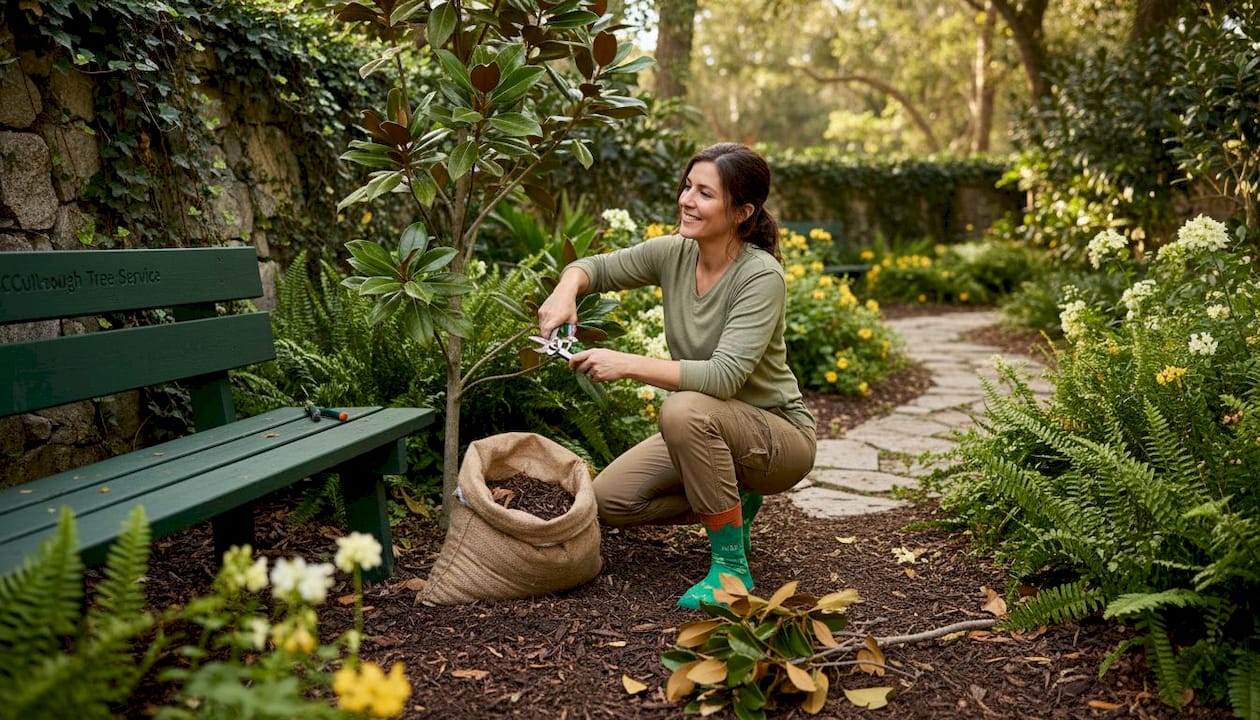
Beyond pruning, how you mulch greatly affects your tree’s root health and disease resistance. Mulch serves several critical functions: it regulates soil temperature, retains moisture during Florida’s dry season, suppresses competing weeds, and gradually improves soil biology as it breaks down.
The problem is that mulching is done badly more often than not. The most damaging error is what arborists call a “mulch volcano,” where mulch is piled directly against the trunk in a mound shape. Correct mulching prevents these volcanoes because they trap moisture against the bark, causing rot and disease at the root flare, which is where the trunk meets the soil. Reviewing mulching best practices from landscape professionals reinforces how consistent this principle is across the industry.
Follow these guidelines for mulching done right:
- Apply a 3 to 4 inch layer of organic mulch such as wood chips, pine bark, or shredded hardwood.
- Pull mulch back 2 to 3 inches from the trunk flare. The flare, the widened base of the trunk, must remain exposed to air.
- Spread mulch in a donut or dish shape, extending out to the drip line (the edge of the canopy) where possible.
- Avoid rubber mulch near trees. Rubber mulch does not decompose and contributes nothing to soil health.
- Refresh mulch annually rather than piling new layers on top of old ones. Compacted, anaerobic mulch can itself become a disease source.
Pro Tip: In Central Florida’s summer rainy season, check your mulch monthly. Heavy rains can pile mulch against trunks over time, and what was a clean donut shape in April can become a volcano by July.
Distinguishing tree health assessment from risk assessment for smarter care
Knowing your tree’s health status is important, but understanding risk assessments helps you prioritize interventions where they matter most. These two types of evaluation serve different purposes, and confusing them leads to misallocated budgets and missed hazards.
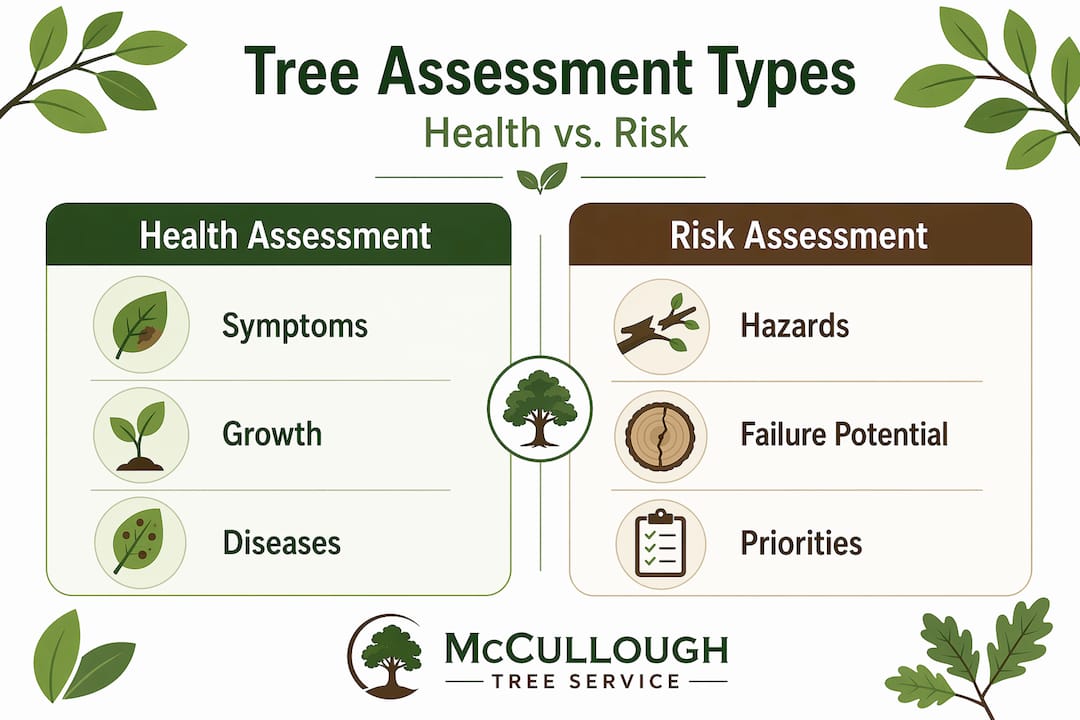
Experts distinguish “tree health assessment” from “tree risk assessment” at a fundamental level: health assessments focus on what is happening inside the tree, while risk assessments focus on what could happen to the people and property around it.
| Feature | Tree health assessment | Tree risk assessment |
|---|---|---|
| Primary focus | Tree vitality and diagnosis | Failure probability and consequence |
| Evaluates | Disease, pests, soil, and nutrients | Structural defects and targets at risk |
| Output | Treatment or care recommendations | Risk rating and prioritized mitigation |
| Urgency driver | Tree decline rate | Proximity to people and structures |
| Who benefits most | Owners focused on tree longevity | Owners focused on liability and safety |
Key takeaways from this comparison:
- A tree can be in poor health but pose low risk if it stands away from targets.
- A structurally compromised tree near a home poses high risk even if it still looks leafy.
- Both assessments are valuable, but risk assessment drives safety decisions.
- Insurance and liability documentation typically require a formal risk assessment, not just a health check.
The tree risk vs health assessment resource outlines exactly what to expect from each type of evaluation and when to request one.
Applying preventative tree care in Central Florida: seasonal and local considerations
With an understanding of assessments and core care practices, adapting your approach to local conditions produces the best results. Central Florida’s subtropical climate creates conditions that simply do not exist in most of the country, and year-round growth and hurricane season demand a care calendar that never really stops.
Here is a practical seasonal action plan:
- January to March: Schedule your ISA-based risk assessment for the year. Trees are easier to evaluate before full spring growth.
- April to May: Complete structural pruning before hurricane season. Focus on removing weak attachments, crossing branches, and dead wood.
- June to September: Monitor for storm damage after each significant weather event. Check tree trimming safety protocols before touching anything storm-damaged.
- October to November: Apply or refresh organic mulch as the rainy season winds down and soil moisture management becomes critical.
- December: Light fertilization for palms and any trees showing nutrient deficiency symptoms.
Central Florida tree care also varies significantly by species:
| Species | Key care consideration | Timing note |
|---|---|---|
| Live oak | Prune for clearance and wind resistance | Spring, before hurricane season |
| Slash pine | Remove low dead branches to reduce fire and disease risk | Late winter |
| Sabal palm | Remove only fully brown fronds; avoid over-pruning green fronds | Year-round as needed |
| Crape myrtle | Never top; thin interior branches only | Late winter before budbreak |
| Laurel oak | Monitor for root rot in poorly drained soil | Year-round inspection |
Fertilization in Central Florida’s sandy soils should target iron and manganese deficiencies, which are common and often misread as disease. Watering schedules must account for the wet season (June through September) and dry season (October through May), with irrigation scaled accordingly.
Why many property owners overlook risk-focused prevention and how to change that
Here is the honest truth after working with Central Florida trees for decades: most property owners do not ignore their trees out of laziness. They ignore risk-focused prevention because nobody has explained what the difference actually costs them.
The conventional approach is to treat every tree issue with equal urgency or, more often, to treat nothing until something breaks. Both extremes waste money. Scope control in preventative tree management means prioritizing mitigation where consequences are highest, which explains why two similar-looking trees might receive completely different treatment recommendations from a certified arborist.
What we have seen repeatedly in Central Florida is this: a property owner spends money treating cosmetic leaf issues on a back-corner tree while ignoring a structurally compromised laurel oak directly over their driveway. The cosmetic tree looks better. The hazard tree eventually drops a limb on a car. Risk-based thinking flips that priority correctly.
DIY care creates its own set of problems. Well-meaning pruning with contaminated tools spreads fungal pathogens between trees. Pruning at the wrong time of year (cutting live oaks in summer, for example) opens fresh wounds during peak disease pressure. The impact of tree care done wrong compounds over time in ways that are not immediately visible.
Documentation also matters far more than most owners realize. When you have a written risk assessment from a certified arborist on file, you have demonstrated due diligence. If a tree later causes damage and you cannot show reasonable preventative care, liability exposure grows considerably. The routine tree care insights on record from professional arborists are worth more than their sticker price.
Shifting to risk-based prevention is not about spending more. It is about spending where it counts.
Enhance your property’s safety and beauty with expert preventative tree care
With practical knowledge in hand, partnering with local experts ensures your preventative tree care is safe, effective, and tailored to your property’s unique needs.
McCullough Tree Service works with residential and commercial property owners across Central Florida to deliver exactly this kind of care. Our ISA-certified arborists provide formal professional tree risk assessment services that give you a clear, prioritized action plan, not just a list of vague recommendations. Whether you need professional tree trimming, storm preparation pruning, or guidance on mulching and fertilization schedules, we bring the expertise to make your trees safer and your property more valuable. New to the topic? Our tree care 101 guide is a straightforward starting point. Contact us today for a free consultation.
Frequently asked questions
What is the role of a formal tree risk assessment in preventative tree care?
A formal ISA-based assessment evaluates failure probability and consequence severity to produce prioritized mitigation actions, helping property owners focus resources on trees that pose real danger rather than just cosmetic concerns.
How much live canopy can safely be removed for preventative pruning?
No more than 25% of a tree’s live canopy should be removed in a single year, as exceeding that threshold causes chronic stress that weakens the tree and shortens its lifespan.
Why is avoiding mulch volcanoes important in tree care?
Excess mulch piled against the trunk traps moisture at the root flare, and correct mulching prevents rot and disease that can kill even mature trees over several seasons of undetected damage.
Can homeowners perform all preventative tree care tasks themselves?
Watering, mulching, and small branch pruning are manageable DIY tasks, but large branch removal and risk assessments require certified professionals who have the training and equipment to work safely and accurately.
How does Central Florida’s climate affect preventative tree care?
Year-round subtropical growth and hurricane season mean trees never truly go dormant, requiring a continuous care calendar with storm preparation pruning each spring to minimize structural failure risk before peak storm months.
Recommended
- Routine tree care: prevent damage and boost value
- Tree health tips for Central Florida properties in 2026
- Tree preservation: boost health & beauty in Florida
- Why regular tree maintenance matters for property owners