By: Shelby McCullough| Published: August 13, 2026
Before the next storm warning hits your phone, you should already have these done: bring loose outdoor items inside, trim dead and overhanging limbs, reinforce your garage door, inspect your roof for loose shingles, seal gaps around windows and doors, anchor sheds and fuel tanks, photograph your valuables, and unplug sensitive electronics. FEMA’s severe-wind guidance frames these as low-cost, high-impact steps that cut both wind and water intrusion risk. NOAA’s National Weather Service adds that taping windows is ineffective and that garage doors are the single most vulnerable opening on most homes. ISA-certified arborists round out the picture: tree failures cause a disproportionate share of property damage, and most of them are preventable with routine care.
Here is the priority checklist at a glance:
- Bring in or anchor patio furniture, grills, trash cans, and play equipment
- Remove or replace loose gravel and small rock landscaping
- Trim dead, diseased, and overhanging limbs; schedule an arborist inspection
- Reinforce or brace the garage door
- Inspect the roof for missing shingles, loose flashing, and exposed deck seams
- Seal gaps around windows, doors, and utility penetrations
- Anchor sheds, propane tanks, and HVAC equipment
- Photograph and video your property and valuables; verify your insurance coverage
- Unplug electronics and use surge protectors
- Know your evacuation route and shelter-in-place plan
Key Takeaways
Securing loose items, reinforcing openings, and scheduling routine arborist care are the three highest-impact storm damage prevention steps property owners can take before storm season begins.
| Point | Details |
|---|---|
| Secure loose items first | Bring in or anchor outdoor furniture, grills, and gravel before any storm watch is issued. |
| Roof and openings are the priority | Inspect shingles and flashing annually; reinforce garage doors and install shutters or impact glazing. |
| Continuous load path matters | Hurricane straps, anchor bolts, and sill connections reduce structural uplift — have a contractor verify them on older homes. |
| Tree care is long-term prevention | Routine ISA-certified arborist pruning and hazard assessments prevent most tree failures before storms arrive. |
| Mcculloughtreeservice | Certified arborist inspections, hazard removal, cabling, and storm cleanup for residential and commercial properties in Central Florida. |
Table of Contents
- 1. Secure outdoor items and reduce windborne debris
- 2. Inspect and reinforce your roof to prevent uplift and water intrusion
- 3. Protect your windows, glass doors, and garage doors
- 4. Anchor structures and understand the continuous load path
- 5. How to get your trees storm-ready with certified-arborist guidance
- 6. Secure utilities, outbuildings, and exterior equipment
- 7. Document your property and review your insurance before the storm
- 8. During and immediately after the storm: safety first
- Why early routine care is the real storm damage prevention strategy
- Mcculloughtreeservice protects your property before and after the storm
- Sources
1. Secure outdoor items and reduce windborne debris
Securing loose items is the fastest, cheapest storm damage prevention step you can take. A 40 mph gust can turn a plastic chair into a projectile that punches through a window. A 70 mph gust can carry a gas grill across a yard and into a neighbor’s wall.
Work through this list before any storm watch is issued:
- Patio furniture: Bring chairs, tables, and cushions inside or into a garage. If that’s not possible, use anchor kits or heavy-duty tie-down straps rated for wind load.
- Grills and smokers: Move them into a garage or shed. A propane tank left outside can become a serious hazard if it’s struck.
- Trash and recycling cans: Store them inside or strap them to a fixed structure.
- Play equipment: Trampolines are notorious for becoming airborne. Disassemble them or stake them with ground anchors before a storm.
- Potted plants: Move them inside. Even a medium-sized pot can shatter glass.
- Loose stones and gravel: Small rock landscaping becomes high-velocity debris in strong winds. Replace it with mulch or compacted dirt, which stays put. This is one of the most overlooked storm readiness checklist items.
Pro Tip: Designate a single staging area (a garage corner or a shed) before storm season starts. Label bins for cushions, small tools, and decorative items so your pre-storm routine takes 20 minutes instead of two hours. Talk to neighbors about shared fences and shared risks — a loose panel on their side can damage your property.
2. Inspect and reinforce your roof to prevent uplift and water intrusion
The roof is where most storm damage starts. Wind gets under a loose shingle, lifts it, and suddenly you have water pouring into the attic. FEMA P-804 documents that sealed roof decks and wind-rated materials materially reduce both structural failures and water intrusion in high-wind events.
Walk your roof or hire a contractor to check these specific items:
- Shingles: Look for missing, curling, or cracked shingles. Re-adhere loose ones with roofing cement before a storm.
- Flashing: Check around chimneys, vents, and skylights. Lifted or cracked flashing is a direct water entry point.
- Starter strips and nail patterns: Starter strips at the eaves and rakes hold the first course of shingles. Inadequate nailing is a common failure point.
- Roof-to-wall connections: Hurricane straps or clips connect the roof structure to the wall framing. If your home was built before modern wind codes, these may be absent or undersized.
- Exposed deck seams: A sealed roof deck (typically achieved with a self-adhering underlayment) prevents water intrusion even when shingles are lost. FEMA and IBHS both point to this as one of the highest-value retrofits for vulnerable homes.
- Gutters and downspouts: Clean them out. Blocked gutters overflow and drive water under fascia boards and into soffits.
Sealed roof deck benefit: FEMA building-science materials note that a properly installed sealed roof deck can prevent significant water intrusion even after shingles are lost in a storm — a critical advantage in hurricane-prone regions.
Budget-conscious owners can start with roofing cement and gutter cleaning. The bigger investment, roof strapping and improved sheathing, requires a licensed contractor but pays off in both insurance premiums and avoided repair costs.
3. Protect your windows, glass doors, and garage doors
Protecting openings is about pressure, not just broken glass. When wind enters through a failed opening, internal pressure spikes and can blow the roof off from the inside. NOAA’s wind-mitigation guidance is direct: taping windows does nothing meaningful. It does not prevent breakage or reduce pressure.
What actually works:
- Impact-resistant glazing: The most permanent solution. Laminated glass holds together on impact and prevents pressure breaches. It’s expensive upfront but requires no action before a storm.
- Storm shutters: Roll-down, accordion, and panel shutters all work. Accordion shutters are the fastest to deploy; panel shutters are the most affordable.
- Plywood panels: A legitimate budget option when cut and pre-drilled in advance. Use at least 5/8-inch plywood and pre-mark each panel for the opening it fits.
- Garage doors: This is the priority opening. A standard garage door is a large, flexible panel that can fail under wind load and trigger catastrophic pressure changes. Reinforcement bracing kits are available for many door models, and some doors can be upgraded to a wind-rated version. Check the door’s rating against your local design wind speed.
- Sliding glass doors: Add a bar or pin lock in addition to any shutter. The locking mechanism alone is not enough.
Pro Tip: Pre-mark every shutter panel and its corresponding window with matching numbers using a paint marker. Store hardware (bolts, wing nuts) in a labeled zip-lock bag taped to the panel. When a storm is 24 hours out, installation becomes a 30-minute job instead of a frantic search.
4. Anchor structures and understand the continuous load path
A continuous load path ties your roof to your walls and your walls to your foundation. When that chain is intact, wind loads transfer through the structure rather than tearing it apart at the weakest link. FEMA’s windstorm resilience fact sheet identifies correct connector fastenings — hurricane straps, anchor bolts, and sill connections — as the key variables in whether a structure survives a major wind event.
Here is what to check and what to ask a contractor about:
- Hurricane straps or clips: Visible in the attic where rafters or trusses meet the top plate. If they’re absent, a licensed contractor can retrofit them.
- Anchor bolts: Connect the sill plate to the foundation. Check in the crawl space or basement for bolts at regular intervals (typically every 6 feet or less under modern codes). Missing or corroded bolts are a red flag.
- Sill plate connections: The sill plate should be pressure-treated and bolted, not just nailed, to the foundation.
- Sheds and outbuildings: Anchor them to concrete piers or use ground anchors rated for your wind zone. An unanchored shed becomes a large projectile.
- Fences: Check post depth and concrete footings. Tall privacy fences act as sails and can pull fence posts out of the ground, damaging adjacent structures.
- Fuel and propane tanks: Above-ground tanks must be strapped or chained to a fixed anchor point. Contact your fuel supplier for guidance on approved tie-down methods.
For older homes, a structural engineer or licensed contractor can assess whether the load path is adequate for your local wind zone. This is not a DIY inspection — the consequences of missing a failed connection are too significant.
5. How to get your trees storm-ready with certified-arborist guidance
Correct tree structure and routine arborist care reduce failure risk far more than emergency removals after a storm warning is issued. The Arbor Day Foundation puts it plainly: storm-proofing trees is a long-term project built on regular inspections and targeted structural pruning, not a one-time fix.
Pruning priorities
- Remove dead and diseased wood first. Dead limbs fall in any wind. They’re the easiest risk to eliminate.
- Address codominant leaders. Two trunks of equal size competing for dominance create a weak V-shaped union that splits under load. On young trees, remove one leader early. On mature trees, this is a job for a certified arborist.
- Reduce weight on long, heavy limbs. Crown reduction cuts shorten the lever arm and reduce the load on the attachment point.
- Use the three-cut method for large limbs. An undercut first, then a relief cut, then the final cut at the branch collar. This prevents bark tearing and protects the tree’s wound response.
Cabling and bracing
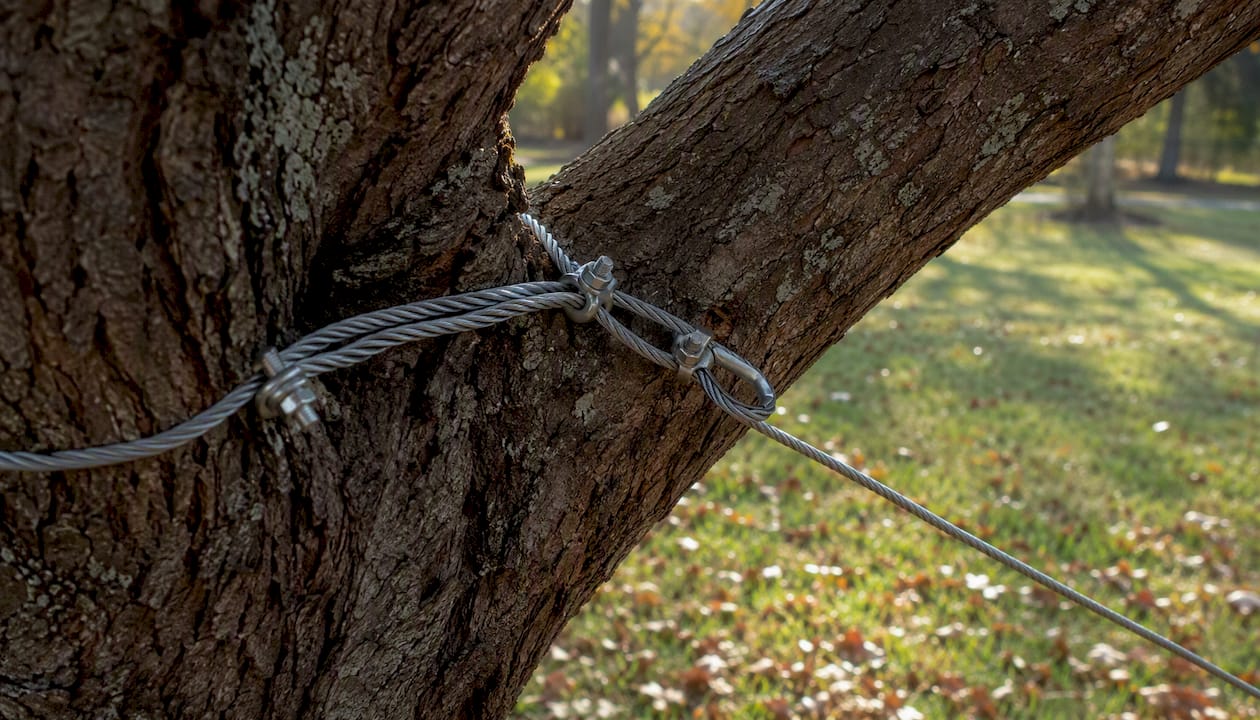
Cable systems can support a weak union, but placement is everything. Reporting in The Saturday Evening Post notes that cables should be set roughly two-thirds to three-quarters of the way from the union to the top of the included limbs. Incorrect placement increases leverage on the weak point rather than reducing it. Installation must follow ANSI A300 standards and should only be done by qualified professionals.
Planting for long-term wind resilience
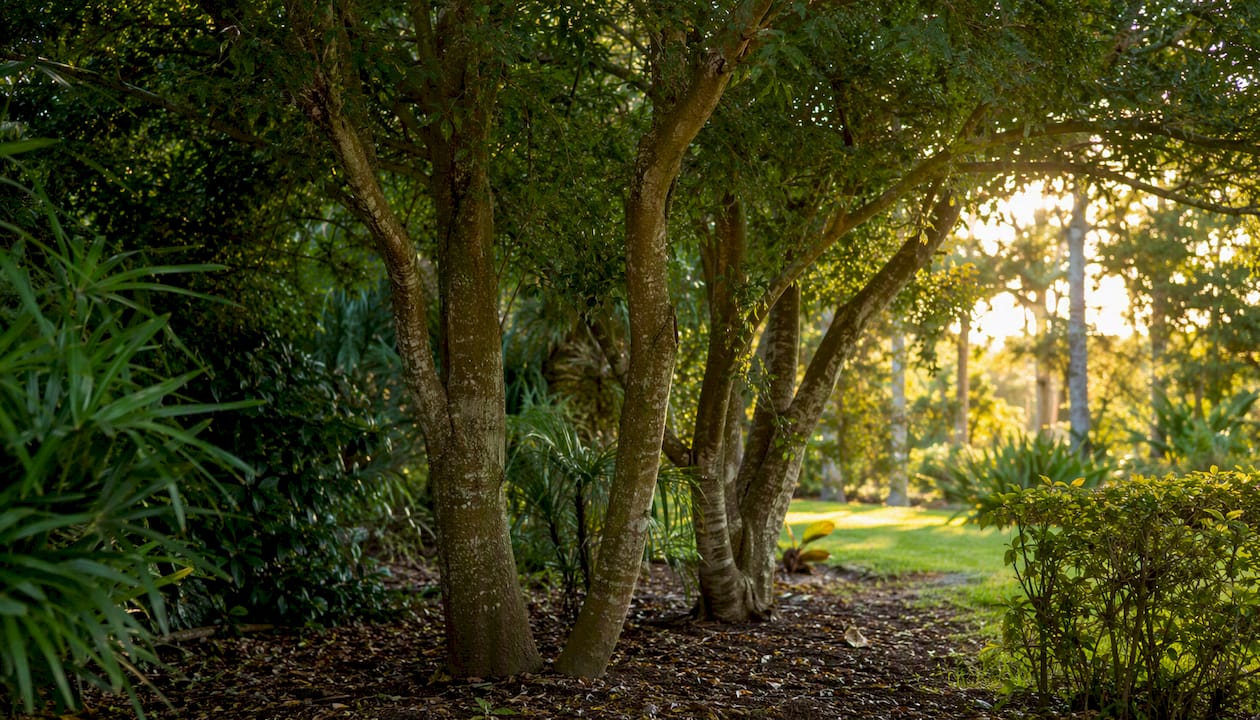
The Virginia Department of Forestry and other state extension programs recommend grouping trees together rather than planting solitary specimens widely spaced across a yard. Groups of trees create mutual wind protection. Species selection matters too: native species adapted to your region’s wind and soil conditions consistently outperform ornamental exotics in storm events.
NC State Extension adds a point most homeowners miss: root stability, not canopy health, is the most common failure mode. Compacted soil, overwatering, and “volcano mulching” (piling mulch against the trunk) create shallow root systems that tip over in wind. Keep mulch 3–4 inches deep and pulled back from the trunk.
Pro Tip: Signs a tree should be removed rather than retained: large dead sections in the crown, significant lean toward a structure, visible root damage or heaving soil at the base, and fungal growth at the trunk base. Document these with photos and share them with your arborist and insurer before storm season. For hurricane season tree preparation, a certified arborist inspection is the single highest-value step you can take.
6. Secure utilities, outbuildings, and exterior equipment
Unsecured secondary structures and exterior equipment are responsible for a surprising share of property damage in storms. They fail first, then damage the main structure or a neighbor’s property.
Work through this checklist:
- Sheds: Anchor to concrete piers with ground anchors or expansion bolts. Check that the roof is fastened to the walls, not just resting on them.
- HVAC equipment: Confirm the condenser unit is bolted to its concrete pad. Straps are available for units in high-wind zones.
- Rooftop equipment: Satellite dishes, solar panel racking, and HVAC curbs all need to be inspected for secure fastening before storm season.
- Mailboxes and light posts: These seem minor but a flying mailbox post causes real damage. Check post depth and concrete footing.
- Fences: Inspect every post for rot and loose concrete. A fence that fails in a storm can take out a window or a parked car.
- Power lines and trees: If you have limbs growing near utility lines, contact your utility company. Do not attempt to trim near live lines yourself. After a storm, treat every downed line as live and stay at least 30 feet away. Call 911 and your utility company immediately.
For regional storm-preparation guidance that covers both structures and landscaping, this storm-preparation resource from a partner landscaper covers community-level coordination steps worth reviewing alongside your local requirements.
7. Document your property and review your insurance before the storm
Documenting possessions and verifying coverage before a storm is one of the most underused home protection methods. A solid record speeds claims, reduces disputes, and can make the difference between a full payout and a partial one.
- Verify your policy: Confirm that wind damage is covered. Flood damage is a separate policy through the National Flood Insurance Program (NFIP) and is not included in standard homeowners insurance. Know your deductibles — wind deductibles in hurricane-prone states are often a percentage of the home’s insured value, not a flat dollar amount.
- Create a home inventory: Walk through every room with your phone camera. Open closets, film serial numbers on appliances and electronics, and narrate what you’re filming. Store the video in cloud storage or email it to yourself so it survives even if your devices don’t.
- Photograph the exterior: Document the current condition of your roof, siding, windows, and outbuildings. Timestamped photos establish pre-storm condition and protect you from disputes about whether damage was pre-existing.
- Store documents off-site: Keep digital copies of your insurance policy, deed, and home inventory in a cloud account or with a trusted contact outside your area.
- Surge protection: Plug computers, televisions, and home-office equipment into UL-listed surge protectors. Unplug them entirely when a storm is imminent — a surge protector does not protect against a direct lightning strike.
- Emergency plan: Identify your safe room (an interior room on the lowest floor, away from windows), know your evacuation route, and have a battery-powered or hand-crank weather radio ready.
8. During and immediately after the storm: safety first
Safety comes before property. No repair cost justifies putting yourself near a downed power line or a structurally compromised building.
During the storm:
- Stay in an interior room away from windows and glass doors
- Keep your emergency kit accessible: water, flashlight, first-aid supplies, phone charger, and weather radio
- Do not go outside to check on property while wind is still active
- Monitor NOAA Weather Radio or the National Weather Service app for updates
Immediately after:
- Do not approach downed power lines. Treat every line as live. Call 911 and your utility company.
- Photograph all damage before touching or moving anything. Insurers need documentation of the original damage state.
- Secure what is safe to secure: cover broken windows with plywood, place buckets under active leaks, and tarp exposed roof sections if you can do so safely from the ground.
- Do not enter a building with visible structural damage, a gas smell, or standing water near electrical panels.
- Contact your insurance company as soon as possible to open a claim.
When to call professionals immediately: a tree has fallen on a structure, you smell gas, you see sparking or downed wires, or there is major roof loss. For post-storm tree assessment, a certified arborist can identify which damaged trees are safe to leave and which need emergency removal before the next weather event.
Why early routine care is the real storm damage prevention strategy
Most property owners think about storm preparation in the 48 hours before a named storm. That window is too late for the work that actually matters. The trees that fail in a hurricane were already compromised before the storm arrived. The roof that leaks had loose flashing for two seasons. The garage door that blew in was never rated for the local design wind speed.
Routine, planned arborist care prevents most high-cost failures. Training a young tree away from a codominant structure costs a fraction of what emergency removal costs after it splits onto a roof. Scheduled pruning every two to three years keeps canopy weight manageable and removes dead wood before it becomes a projectile. A hazard assessment by a certified arborist catches root problems, included bark, and decay that no homeowner can see from the ground.
The same logic applies to the building envelope. A $200 gutter cleaning and shingle inspection every fall is a different financial category than a $15,000 roof replacement after water intrusion goes undetected for a year. Routine tree care and routine building maintenance are not separate budgets — they’re the same investment in avoiding a much larger bill.
One practical rule: if the work requires a ladder, a chainsaw, or proximity to a power line, call a professional. The liability and injury risk of DIY tree work near structures is not worth the savings.
Mcculloughtreeservice protects your property before and after the storm
Mccullough Tree Service’s certified arborists in Orlando and Central Florida do the work that actually lowers your storm risk: hazard tree assessments, structural pruning, cabling and bracing installation, and emergency storm cleanup when the unexpected happens. Unlike a general landscaper, Mcculloughtreeservice brings ISA-certified expertise to every inspection, which means the arborist can identify root instability, weak unions, and decay that a visual check from the ground misses entirely.
For property managers handling multiple sites, Mcculloughtreeservice offers seasonal maintenance plans that keep your tree canopy in shape year-round, not just in the week before a storm watch. Insured crews, local weather experience, and established safety protocols mean the work gets done correctly and without adding liability to your plate.
Schedule a certified arborist inspection before storm season, or request hazardous tree removal for any tree that’s already showing warning signs. Contact Mcculloughtreeservice at Mcculloughtreeservice to book an assessment or get a quote.
Sources
- Protect Your Property from Severe Winds | FEMA
- How to Ready Your Trees Before Storm Season | Arbor Day Foundation
- Preventing & managing storm damage to trees – Gardening | NC State Extension
Recommended
- Storm Damage Cleanup Tips for Central Florida Property Owners
- Protect Your Home with Hurricane Season Tree Preparation
- Storm Cleanup Guide 2025: Central Florida Homeowners
- Quick and Effective Storm Cleanup Strategies