By: Shelby McCullough| Published: August 8, 2026
Hire a certified commercial tree-care provider on a multi-year maintenance contract that includes annual ISA-informed risk assessments and a written emergency-response agreement. That single decision reduces your liability exposure, stabilizes your tree-care budget, and gets a crew on-site within hours after a storm rather than days. Three immediate benefits follow from it:
- Reduced liability. A documented retain/monitor/remove report from an ISA-Certified Arborist becomes your exhibit A if a tree failure ends up in litigation.
- Predictable budgeting. A master service agreement converts unpredictable emergency call-outs into a known annual line item.
- Faster storm response. Priority-service clients get scheduled before the general queue, which matters when a downed oak is blocking a fire lane at 2 AM.
Two steps to take this week: schedule an on-site assessment with a credentialed provider, and request a certificate of insurance (COI) that names your management company as an additional insured.
Commercial tree care is an asset-management discipline, not a landscaping add-on. A fallen limb on a tenant’s car, a root heaving a sidewalk, or an unpermitted removal can each generate costs that dwarf years of preventive maintenance spending. Commercial tree service carries broader contractual, documentation, and insurance requirements than residential work, and some tasks legally require credentialed arborists. The standards that govern this work include ISA (International Society of Arboriculture) risk-assessment protocols, ANSI Z133 safety requirements for aerial tree work, and OSHA 29 CFR Part 1910.268, which sets the floor for worker safety near utility lines. Mcculloughtreeservice operates as a commercial-capable provider in Orlando and Central Florida, with ISA-certified arborists on staff and the crew scale to handle multi-building portfolios.
Key Takeaways
Effective tree care solutions for property managers come down to one decision: contract a certified commercial provider before a tree fails, not after.
| Point | Details |
|---|---|
| Annual ISA risk assessments | A written retain/monitor/remove report is your primary liability defense and the foundation of any commercial tree program. |
| Multi-year contracts reduce costs | Master service agreements deliver better pricing and guaranteed emergency response compared to reactive call-outs. |
| Verify credentials before signing | Require an ISA Certified Arborist number, current COI naming you as additional insured, and ANSI Z133 compliance in writing. |
| Emergency retainer is non-negotiable | A written SLA for Category 1 hazards (2–4 hour response) must be a contract condition, not a verbal promise. |
| Mcculloughtreeservice serves Central Florida | Certified arborist consulting, commercial pruning, removals, stump grinding, and storm cleanup available for portfolio clients in Orlando and Central Florida. |
Table of Contents
- What tree care solutions do property managers actually need?
- Why you need a certified arborist on every commercial job
- How to walk a property and document what you find
- How to evaluate and select a commercial tree-care provider
- What commercial tree work costs and how to budget for it
- Permits, utility coordination, and protecting your property during work
- How to structure a preventive maintenance plan for your portfolio
- What to expect from emergency tree services after a storm
- A scope-of-work template and what Mcculloughtreeservice delivers commercially
- Final decision guidance and next steps for property managers
- A note from Mcculloughtreeservice on what we see in the field
- Mcculloughtreeservice is ready to assess your commercial portfolio
- Sources
What tree care solutions do property managers actually need?
The services below form the core of any commercial tree program. Budget for all of them; the question is frequency and trigger, not whether.
- Risk assessment and tree inventory. The foundation. Every mature tree gets tagged, measured (diameter at breast height, or DBH), and rated.
- Pruning and trimming. Routine crown maintenance for clearance, aesthetics, and structural health. See commercial trimming standards for what a proper scope looks like.
- Structural pruning. Corrective work on young or co-dominant trees to reduce future failure risk. Requires an arborist, not a grounds crew.
- Tree removal. Hazard trees, dead trees, and trees in conflict with construction or utilities. Permit triggers vary by municipality.
- Stump grinding. Removes trip hazards and prevents regrowth. Often bundled with removal but priced separately.
- Plant health care (PHC). Soil treatments, fertilization, pest and disease management. Extends the life of specimen trees and reduces replacement costs.
- Emergency storm response. 24/7 dispatch for fallen or hanging limbs, blocked access, and structural failures.
- Land clearing. Large-scale vegetation removal for redevelopment or site prep.
When does each service apply?
| Property situation | Primary service needed |
|---|---|
| Parking lot shade trees with low canopy | Crown lift pruning, clearance for trucks |
| Courtyard specimen trees near HVAC or signage | Structural pruning + PHC assessment |
| Street trees in utility easements | Utility coordination before any trimming |
| Post-storm debris on occupied site | Emergency response + debris staging |
| Vacant lot before redevelopment | Land clearing + stump grinding |
| Mature oaks showing crown dieback | ISA risk assessment + PHC prescription |
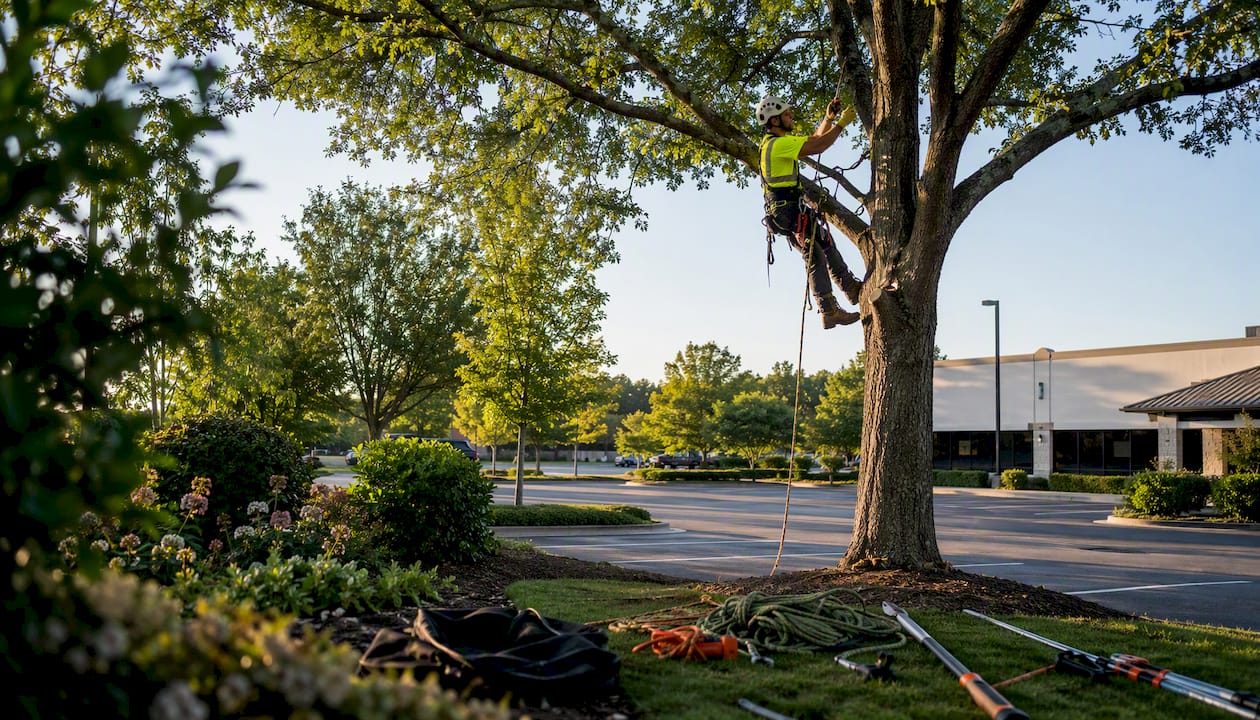
Service-level expectations matter on occupied sites. Require vendors to offer night or weekend scheduling for work near tenant parking or building entries. Cleanup standards should be written into the contract: no debris left overnight, all wood chips removed unless you specify otherwise, and a post-work walkthrough with your facilities contact before the crew leaves.
Why you need a certified arborist on every commercial job
Not all tree work is the same, and misclassifying scope is one of the most common and costly mistakes property managers make. Routine cleanup, leaf blowing, and mulching can be handled by grounds crews. Structural pruning of trees with a DBH over 6 inches, hazard assessments, disease diagnosis, and root-zone treatments must be performed by credentialed arborists. Assigning that work to untrained staff violates OSHA 29 CFR Part 1910.268 and ANSI Z133 and increases your legal exposure directly.
An ISA-Certified Arborist’s core responsibilities on a commercial site include:
- Conducting formal risk assessments using ISA’s Tree Risk Assessment Qualification (TRAQ) framework
- Diagnosing disease, pest pressure, and structural defects
- Writing plant health care prescriptions and treatment plans
- Producing written reports that document findings, ratings, and recommended actions
- Reviewing and signing off on removal permits where local ordinances require an arborist’s report
Credentials to request in every proposal
- ISA Certified Arborist number (verify at treesaregood.org)
- State contractor license for tree work (Florida requires a licensed contractor for commercial jobs)
- Commercial general liability insurance with limits appropriate for your property value (typically $1M per occurrence minimum)
- Workers’ compensation coverage with no exclusions for aerial work
- ANSI A300 and ANSI Z133 compliance stated in writing
ANSI A300 pruning standards and ISA Certified Arborist involvement are the two trust signals that matter most in commercial contracts. A vendor who cannot produce both is not a commercial-grade provider, regardless of price.
How to walk a property and document what you find
A consistent property-walk checklist protects you in two ways: it catches hazards before they become incidents, and it creates the documentation trail your insurer will ask for after one. Use this list yourself during quarterly walkthroughs, or hand it to your arborist as the minimum expected output from a site visit.
Tree identification and measurements:
- Species, common name, and tag number
- DBH (measured at 4.5 ft above grade)
- Estimated height and crown spread
Visible defects to record:
- Cracks, splits, or open wounds in the trunk or major limbs
- Cankers, fungal conks, or signs of decay
- Included bark at branch unions (a V-shaped union with bark trapped inside is a structural failure waiting to happen)
- Lean greater than 15 degrees from vertical, especially with soil mounding at the base
- Root plate lifting or soil cracking near the base
- Crown dieback, dead wood, or asymmetric canopy
Site conflicts:
- Canopy clearance over parking, signage, and lighting fixtures
- Proximity to overhead utility lines
- Root intrusion near sidewalks, curbs, or building foundations
- Soil compaction in root zones (paved or heavily trafficked areas)
Photo guidance: Photograph the trunk base, the crown union of major limbs, the root plate, and any nearby assets the tree could strike if it failed. Capture date, GPS location, and tag number in the file name or metadata.
Priority ranking:
- Immediate: Active hazard to people or property, act within 24–48 hours
- Monitor: Defect present but not yet critical, reassess within 90 days
- Scheduled work: Maintenance need, address in next service cycle
Pro Tip: Ask your arborist to deliver findings in a retain/monitor/remove format for every tree assessed. That three-category system is the standard the insurance industry recognizes, and a written report using it is far more defensible than a verbal summary.
How to evaluate and select a commercial tree-care provider
Comparing bids without a standard framework is how property managers end up with the lowest bidder and the highest post-storm invoice. Build your evaluation around these criteria before you issue an RFP.
Decision checklist:
- Proof of ISA-Certified Arborist on staff (not just “ISA-trained”)
- COI with commercial general liability and workers’ comp, naming your management company as additional insured
- Equipment scale appropriate for your largest trees (aerial lift, crane if needed)
- Documented emergency response capacity and 24/7 contact
- References from at least two commercial property clients of similar size
- Digital reporting: inspection reports, photos, and invoices delivered electronically
Questions to ask on the site visit and in the proposal:
- What is your guaranteed response time for a Category 1 hazard (immediate threat to life or access)?
- Who specifically will be on-site, and what are their credentials?
- Do you handle permit applications, or does that fall to us?
- How do you stage debris on an occupied site to avoid blocking egress?
- What is your subcontracting policy, and will any work be performed by a non-employee crew?
- Can you provide a written scope of work before mobilization, not just a verbal estimate?
Contract clauses to insist on:
- Response-time SLA for hazard categories (e.g., Category 1 within 4 hours)
- COI naming management company as additional insured, renewed annually
- Cleanup standards and post-work inspection protocol
- Permit responsibility assigned to the vendor
- Limitation on subcontracting without written approval
- Warranty on structural pruning and installation work
- Payment milestones tied to completion stages, not calendar dates
Red flags that should end the conversation:
- Verbal-only estimates with no written scope
- Expired or missing COI
- Unusually low bids with no explanation of how scope was reduced
- Reluctance to sign standard commercial contract language
- No ISA credential on staff, only “years of experience”
Multi-year contracts and priority-service agreements consistently deliver better pricing and faster emergency response for commercial portfolios. Ask vendors for their historical response-time data for priority clients before you sign.
What commercial tree work costs and how to budget for it
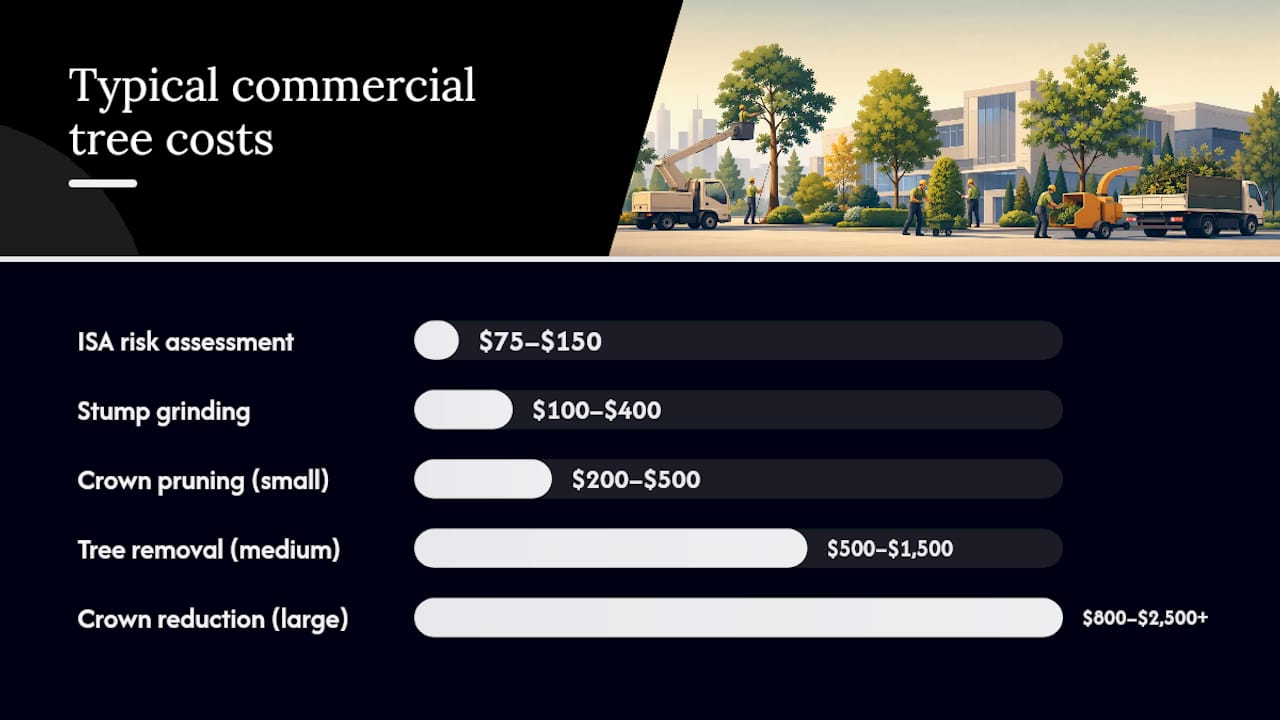
Arborist costs vary widely by service type, tree size, site access, and regional market. The ranges below reflect typical commercial pricing in the Southeast U.S.; Central Florida pricing generally falls within these bands.
| Service | Typical cost range | Key cost drivers |
|---|---|---|
| ISA risk assessment (per tree) | $75–$150 | Number of trees, report complexity |
| Crown pruning, small tree (under 30 ft) | $200–$500 | Access, species, clearance needed |
| Crown reduction, large tree | $800–$2,500+ | Crane need, proximity to structures |
| Single-tree removal, medium (30–50 ft) | $500–$1,500 | Stump included or separate, debris haul |
| Stump grinding (per stump) | $100–$400 | Diameter, root spread, access |
| Emergency call-out (after hours) | $500–$2,000+ | Crew size, equipment, time of night |
| Annual maintenance contract (per acre) | $1,500–$5,000+ | Tree density, service frequency |
Timeline expectations:
| Phase | Typical duration |
|---|---|
| Initial site assessment | 1–3 days after scheduling |
| Permit application (if required) | 2–6 weeks depending on municipality |
| Crew mobilization after permit | 3–10 business days |
| Active work (per site) | 1 day to 2 weeks depending on scope |
| Cleanup and post-work inspection | Same day as work completion |
Choosing the right pricing model:
- Per-tree pricing works well for defined scopes with a known inventory. Good for removal projects and one-time assessments.
- Per-hour pricing suits exploratory or variable-scope work but can escalate without a not-to-exceed cap. Always negotiate a ceiling.
- Master service agreement (MSA) is the right model for portfolios with ongoing needs. Reactive management and using residential crews for commercial work are the two habits that drive costs up fastest. An MSA converts that pattern into a predictable annual expense with priority scheduling built in.
Central Florida’s hurricane season runs June through November, and a single storm can generate more tree work than a full year of scheduled maintenance.*
Permits, utility coordination, and protecting your property during work
Tree work on commercial properties triggers permit requirements more often than most managers expect. Removals of protected species, trees above a certain DBH threshold, or trees in designated heritage or canopy zones typically require a municipal permit and sometimes an arborist’s report before any work begins. Local ordinances can also require mitigation planting or fees when canopy is removed. Your vendor should handle permit applications, but confirm that in writing before mobilization.
Permit checklist:
- Confirm with your municipality whether the target trees fall under a local tree ordinance
- Identify any heritage, champion, or protected-species designations
- Verify whether an arborist report is required to support the permit application
- Confirm mitigation requirements (replacement planting, canopy fees) before budgeting
Utility coordination is non-negotiable. Trees growing into or near overhead utility lines are the utility company’s jurisdiction, not yours. Property managers should not authorize private crews to trim in the wire zone without utility clearance. Contact the utility first, confirm who is responsible for line-clearance work in that easement, and get written confirmation before any crew goes near the wires. Private work in the wire zone without utility approval creates liability that your COI may not cover.
Safety measures to require from every vendor:
- Written ANSI Z133-compliant job hazard analysis before work begins
- Physical barricading of the work zone, including pedestrian and vehicle exclusion
- Traffic control plan for any work near driveways, parking lanes, or public roads
- Full PPE for all crew members (helmet, eye protection, chainsaw chaps, climbing harness)
- Fall protection and aerial-lift safety protocols for elevated work
- Crane spotter assigned whenever a crane is on-site
- Post-work property inspection with your facilities contact before the crew demobilizes
For liability questions involving trees on or near property lines, understanding neighbor tree liability is worth reviewing before any boundary-adjacent work begins.
How to structure a preventive maintenance plan for your portfolio
A preventive program is not a luxury. Scheduled inspections and documented contracts are more cost-effective than emergency removals, and the gap in cost between the two approaches widens every year a property goes without a formal program.
Three-tier program structure:
- Tier 1: Annual risk assessment. Every mature tree assessed, rated, and documented in a retain/monitor/remove report. This is the non-negotiable baseline.
- Tier 2: Pruning cycles by species and asset type. Scheduled trimming based on growth rate, structural needs, and site conflicts. See the frequency table below.
- Tier 3: Emergency retainer. A written priority-response agreement that guarantees crew availability within a defined window after a storm or hazard event.
Recommended service frequencies:
| Tree type / asset | Pruning frequency | Notes |
|---|---|---|
| Parking lot shade trees | Every 2–3 years | Clearance maintenance, deadwood removal |
| Specimen or heritage trees | Every 3–5 years | PHC assessment annually |
| Fast-growing species (e.g., laurel oak) | Every 1–2 years | Higher storm-failure risk |
| Hedges and ornamental shrubs | 2–4 times per year | Aesthetic and clearance maintenance |
| Street trees in utility easements | Per utility schedule | Coordinate with utility company |
KPIs and records to require from your vendor:
- Number of documented inspections per property per year
- Percentage of high-risk trees mitigated within the SLA window
- Cost per acre per year (track this across contract years to measure program efficiency)
- Written work report for every site visit, including before-and-after photos
Seasonal pruning timing affects both tree health and the cost of the work. In Central Florida, late winter and early spring pruning allows wounds to close before the heat of summer, reducing disease entry points.
What to expect from emergency tree services after a storm
Emergency response is where the difference between a commercial-grade vendor and a residential crew becomes obvious. A residential crew may show up eventually. A commercial provider with a priority agreement shows up when you call.
Triage levels for on-call decisions:
- Immediate hazard (Category 1). Tree or limb actively threatening life, blocking emergency vehicle access, or in contact with a structure. Requires response within 2–4 hours. Authorize removal or temporary shoring immediately.
- Access-blocking (Category 2). Debris blocking tenant parking, driveways, or pedestrian paths but no active structural threat. Target response within 24 hours. Prioritize clearing access before full cleanup.
- Non-urgent but pressable (Category 3). Storm damage visible but not blocking access or threatening structures. Schedule within 72 hours to prevent secondary failures.
Emergency plan items to have in place before storm season:
- 24/7 vendor contact number confirmed and tested
- Priority scheduling confirmed in writing in your MSA
- Pre-storm photo documentation of all high-risk trees (use your inspection records)
- Debris staging plan that keeps egress routes clear during cleanup
- Site security protocol for areas with structural damage
For immediate post-storm debris triage, having a storm debris removal plan in place before the season starts saves hours of decision-making when conditions are chaotic.
Insurance coordination checklist:
- Verify your vendor’s COI is current before mobilizing emergency crews
- Document pre-storm and post-storm conditions with timestamped photos
- Preserve all inspection reports, work orders, and vendor invoices as a chain-of-custody record for your insurer
- Request a written incident report from your vendor for any Category 1 event
A scope-of-work template and what Mcculloughtreeservice delivers commercially
A written scope of work is the single document that prevents the most disputes in commercial tree contracts. Use the template sections below as a starting point for your RFP or as an exhibit in your master service agreement.
Scope-of-work template sections:
- Tree inventory and identification: Species, DBH, location tag, and GPS coordinates for every tree in scope
- Risk ratings: ISA-standard rating (low/medium/high/extreme) with supporting observations
- Permitted removals: List of trees requiring municipal permit, with permit responsibility assigned to vendor
- Access and traffic control: Equipment staging plan, barricade locations, and crew ingress/egress routes
- Equipment list: Specific equipment committed to the job (aerial lift model, chipper capacity, crane if applicable)
- Cleanup standards: Debris removal timeline, chip disposal or retention, post-work inspection protocol
- Payment milestones: Tied to completion stages (assessment complete, permits received, work complete, final inspection passed)
- Emergency response SLA: Guaranteed response time by hazard category, with escalation contact
Mcculloughtreeservice has executed this type of scope on commercial properties across Central Florida, covering multi-building assessments, prioritized removals, structural pruning programs, and stump grinding on occupied sites. The typical commercial engagement starts with an on-site ISA-informed assessment, produces a written risk report, and moves into a phased work plan that minimizes tenant disruption. Properties that move from reactive call-outs to a structured program typically see fewer emergency removals within the first two years, as high-risk trees are identified and addressed before they fail.
Pro Tip: Attach the scope-of-work template as Exhibit A to your vendor contract. Any deviation from the exhibit requires a written change order. That one clause eliminates most scope-creep disputes before they start.
Final decision guidance and next steps for property managers
The verdict is straightforward: prioritize a certified commercial tree-care provider on a multi-year program with written inspection records and an emergency retainer. Do not wait for a storm or a slip-and-fall to formalize the relationship.
Immediate administrative checklist:
- Schedule an on-site assessment with an ISA-Certified Arborist within the next 30 days
- Request COI naming your management company as additional insured before any work begins
- Negotiate a response-time SLA for Category 1 hazards as a contract condition, not a verbal promise
- Add a dedicated tree maintenance line item to your annual operating budget
- Confirm permit responsibility is assigned to the vendor in writing
- Set a calendar reminder for annual risk assessment renewal
For Central Florida properties, contact Mcculloughtreeservice to schedule an assessment and discuss a maintenance program suited to your portfolio size.
A note from Mcculloughtreeservice on what we see in the field
One practice we follow on every new commercial account is a pre-season walk with the property manager before we touch a single tree. We bring a tablet, tag every tree we flag, and walk the manager through what we’re seeing in plain language. No jargon, no upselling. The goal is to make sure the manager understands the risk picture before we write the report, so there are no surprises when the retain/monitor/remove list comes back.
The scheduling insight that saves the most disruption: plan structural pruning and removals for Tuesday through Thursday, mid-morning start. Monday crews are often delayed by weekend call-outs, and Friday work gets rushed. Mid-week, mid-morning gives you the best crew focus and the most daylight buffer to finish cleanup before tenants arrive for evening hours. On occupied retail or multi-family sites, that window is the difference between a smooth job and a complaint call.
Mcculloughtreeservice is ready to assess your commercial portfolio
Property managers who have read this far know what a well-run commercial tree program looks like. Mccullough Tree Service delivers exactly that for commercial and multi-family properties across Orlando and Central Florida: certified arborist consulting, commercial trimming and structural pruning, tree removals with full cleanup, stump grinding, and storm cleanup with priority response for contracted clients.
When you call, ask for three specific things: an on-site ISA-informed assessment with a written risk report, a COI naming your management company as additional insured, and a written maintenance cadence with an emergency response SLA. Those three items are the baseline for any credible commercial tree program. Mcculloughtreeservice can deliver all three. Schedule your commercial tree trimming assessment or removal consultation by contacting the team directly at Mcculloughtreeservice.
Sources
The sources below support the standards, cost data, and operational guidance in this article. Each is worth bookmarking for vendor vetting, contract drafting, or board-level reporting.
- Commercial Tree Service Knoxville: Property Manager Guide
- Tree Services for Commercial Properties: Scope and Considerations | National Tree Service Authority
- Commercial Tree Services in Atlanta: Complete Guide for Property Managers & Business Owners | Boutte Tree
- Commercial Tree Services: What Property Managers Need to Know | 757 Tree Solutions
- How Much Does an Arborist Cost? 2025 Data – Angie’s List
Recommended
- Commercial Tree Removal Guide for Safe Property Management
- Landscape Safety Workflow: A Property Manager’s Guide
- Why regular tree maintenance matters for property owners
- Tree root management: protect your property and trees