By: | Published: April 23, 2026
TL;DR:
- A structured tree risk assessment checklist helps identify hidden hazards before storms cause damage.
- Professional evaluation considers tree species, site conditions, and ongoing growth to manage risks effectively.
- DIY checks supplement but cannot replace certified arborist assessments for legal and insurance purposes.
Hidden tree hazards cause millions of dollars in preventable property damage across Florida every year, and the alarming part is that most of the serious warning signs go completely unnoticed until a storm forces the issue. A cracked trunk, a buried root collar, or a leaning canopy can look perfectly normal to an untrained eye. That’s exactly where a field-tested checklist changes the game. This guide breaks down the professional tree risk assessment process into plain, actionable steps, so you can spot problems early, communicate clearly with a certified arborist, and make confident decisions before the next hurricane season rolls in.
Table of Contents
- Why a tree risk assessment checklist matters
- Core items on every tree risk assessment checklist
- How to rate and prioritize tree risks: likelihood, impact, and consequences
- Species survival and storm resilience: learnings from Florida hurricanes
- DIY vs. professional tree risk assessment: when to call an expert
- A professional perspective: why the checklist isn’t everything
- Request a tree risk assessment from Central Florida experts
- frequently asked questions
Key Takeaways
| Point | Details |
|---|---|
| Checklists Prevent Accidents | A structured risk checklist catches both hidden and obvious tree hazards, improving safety for your property. |
| Florida Conditions Require Extras | Storm-prone Florida needs checks for buried roots, trunk mushrooms, and species-specific vulnerabilities. |
| High-Risk Trees Need Experts | Professional assessments are essential for insurance, legal, and severe risk situations—DIY can spot basics but not hidden dangers. |
| Annual Reassessment is Crucial | Trees change over time; high-risk trees should be checked yearly and after major storms for new risks. |
| Not All Risks Mean Removal | Extreme ratings require action but don’t always demand removal—consider ecological value and alternatives. |
Why a tree risk assessment checklist matters
Florida’s storm seasons don’t give you much warning. When a tree fails, it can take out a roof, block an entire driveway, or knock out power lines in seconds. The difference between a costly surprise and a manageable situation often comes down to whether someone took a structured look at that tree beforehand.
Simply glancing up at your trees is not enough. Critical problems, like root decay, included bark (where two branches or stems grow together and trap bark between them, weakening the attachment), and internal cavities, are invisible from the ground without knowing what to look for. A checklist forces you to slow down and examine each key factor, one by one, so nothing gets skipped.
There are also real legal and insurance stakes involved. If a tree on your property falls and injures a neighbor or damages their home, documentation of your risk assessment efforts can significantly affect your liability exposure. Many insurance carriers are now asking property owners for evidence of proactive tree care.
Pro tip: Keep a written or digital log of every tree inspection you conduct, including dates, findings, and any actions taken. This record can be invaluable if a claim or legal dispute arises.
Professional arborists do not rely on gut instinct alone. The ISA’s assessment form covers all major risk factors in a documented format, giving certified professionals a defensible, standardized approach. You can use our hazard evaluation guide to start building that same structured mindset, and our risk assessment tips can help you prepare before bringing in a pro.
“A structured checklist transforms a subjective visual check into a defensible, repeatable process that holds up under professional and legal scrutiny.” The ISA Basic Tree Risk Assessment Form provides exactly this kind of structure for certified professionals.
With the stakes so high, let’s see why simply ‘looking up’ is not enough.
Core items on every tree risk assessment checklist
Now that you know why a checklist mindset matters, let’s break down exactly what to look for. Every credible tree risk assessment starts with three big questions: What could the tree hit if it failed? What conditions is it exposed to? And what visible defects does it have?
Here are the numbered steps professionals follow on every inspection:
- Define the target zone. What structures, people, or utilities are within reach of the tree’s full height? A tree over a parking lot demands more scrutiny than one in an open field.
- Check site and load factors. Is the soil sandy or waterlogged? Are roots compacted by pavement? Is the tree exposed to prevailing winds or sheltered by other trees?
- Look for dead branches. Dead wood is the most immediate falling hazard, especially in Florida where fire ant and beetle activity can accelerate wood decay.
- Check for trunk cracks and canopy lean. A lean greater than 15 degrees, especially toward a structure, is a serious flag.
- Look at the root collar. The root collar is where the trunk meets the soil. A buried root collar, soil heaving, or lifted ground nearby all suggest root system stress.
- Look for mushrooms or fungal growth. These indicate internal decay that is often invisible from the outside.
- Look for lightning scars. Central Florida has the highest lightning strike rate in the United States, and a lightning scar dramatically weakens wood tissue.
Pro tip: Use a rubber mallet to tap the trunk at chest height. A hollow sound suggests internal decay that visual inspection alone would never catch.
UF/IFASsupport recommends prioritizing dead branches, cracks, cavities, buried root flare, lean, and canopy dieback as the core risk indicators for Florida properties.
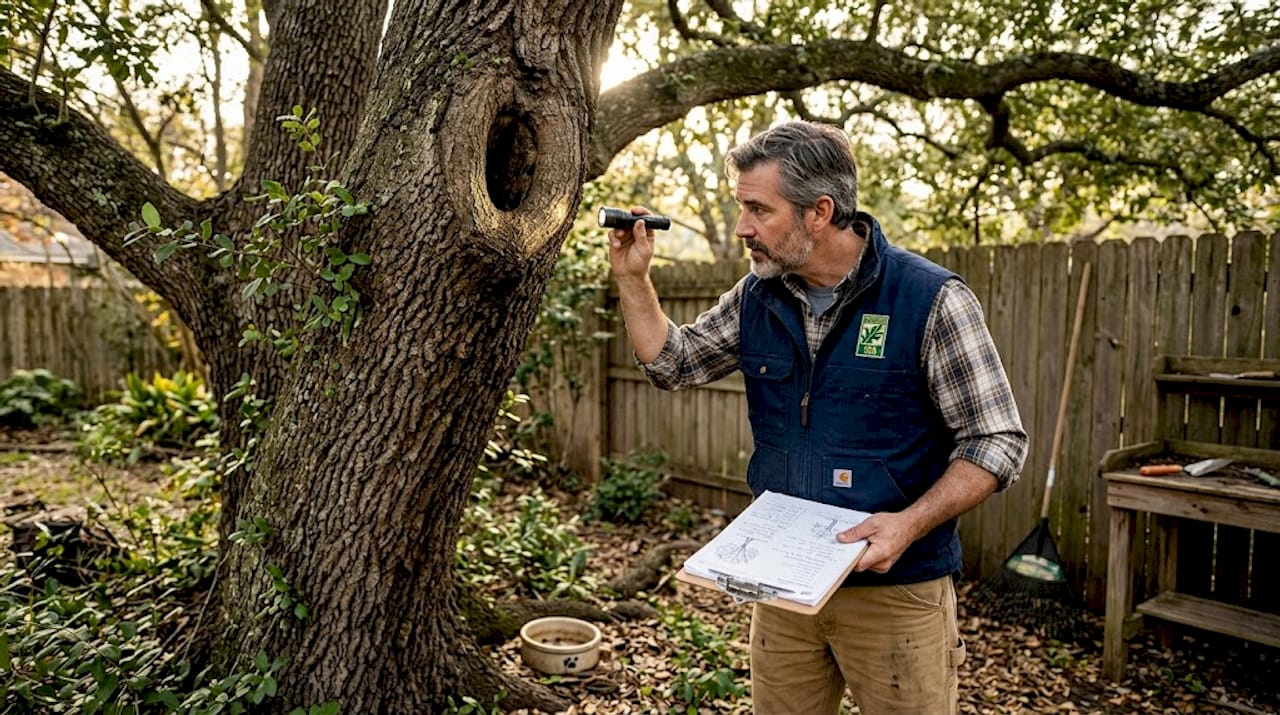
| Risk item | DIY visible? | Professional tool needed? | Florida priority level? |
|---|---|---|---|
| Dead branches | Yes | No | High |
| Root collar burial | Sometimes | Sometimes | High |
| Internal cavities | No | Yes (mallet/sonic) | Very high |
| Lightning scars | Yes | No | Very high |
| mushrooms at base | Yes | No | High |
Browse the full list of unhealthy tree indicators and review our arborist checklist to see how pros structure their evaluations. You can also compare these steps with our tree health assessment workflow.
How to rate and prioritize tree risks: likelihood, impact, and consequences
After you’ve checked for visible issues, the next step is making sense of what you’ve found. Not every defect means equal danger. Rating risk requires weighing three factors: how likely the tree is to fail, what it would hit if it did fail, and how bad the consequences would be.
Step 1: Rate the likelihood of failure. The scale runs from improbable (tree shows minor symptoms and is structurally sound) to imminent (failure could happen at any moment, with or without wind).
Step 2: Rate the likelihood of impact. Very low means the target zone is rarely occupied or out of reach. High means the tree directly overhangs a home, driveway, or play area that people use daily.
Step 3: Rate the consequences. Low consequence means a falling branch may dent a fence. An extreme consequence means structural failure near an occupied building or power lines.
Combining these three factors produces a risk category:
| Risk category | What it means | Required action** |
|---|---|---|
| Low | Minor defects, low-use target zone | Monitor annually |
| Medium | Notable defects, moderate exposure | Schedule arborist visit |
| High | Multiple defects, high-use target zone | Plan treatment or removal |
| extreme | imminent failure, critical target zone | Document response immediately |
One important clarification: an ISA rating of extreme does not automatically mean the tree must come down. Legal, ecological, and site-specific factors all influence the final decision. The rating mandates a documented response, not necessarily removal.
Central Florida properties face a compounding factor: Florida storm data shows that poorly rated trees fail at significantly higher rates during tropical storm conditions. Annual reassessment, especially after every named storm, is essential for any tree rated High or extreme. Learn what dying tree signs look like so you can adjust your risk category between formal evaluations.
Species survival and storm resilience: learnings from Florida hurricanes
Not all trees are created equal. Species and history play a huge role in how your trees will perform when the next major storm hits Central Florida.
Post-hurricane studies from UF/IFASsupport consistently show that live oak, sabal palm, American holly, sweetgum, and southern magnolia survive major storms at far higher rates than other species. Meanwhile, some pine varieties and tulip poplars fail at rates that make them poor choices for high-risk planting zones near structures.
Machine learning research analyzing hurricane tree survival across 281 species found that trees with dense wood, lower overall height, and higher leaf mass tend to outperform their counterparts under hurricane-force conditions, with 91% model accuracy. That said, no algorithm replaces site-specific evaluation. A live oak planted in compacted urban soil next to a foundation is not the same as one growing in open ground with healthy root spread.
High-survival species for Central Florida:
- Live oak (excellent structural strength, deep roots)
- sabal palm (flexible trunk, wind-adaptive)
- American holly (dense wood, compact canopy)
- Southern magnolia (deep anchor roots)
- sweetgum (resilient in well-drained soils)
Species to reconsider near structures:
- slash pine and longleaf pine (brittle branch attachments)
- tulip poplar (top-heavy, prone to uprooting)
- water oak (rapid internal decay in older specimens)
Visit our tree health assessing guide to understand how species selection fits into a broader property risk strategy.
“Even the most storm-resistant species can fail under the right conditions. There is no zero-risk tree, only better-managed ones.”
DIY vs. professional tree risk assessment: when to call an expert
Even the best checklists have their limits. Here is when to trust your findings to a professional.
As a property owner, you can reliably spot these issues on your own:
- Large dead branches that are visibly dry and brittle
- An obvious, sustained lean toward a structure
- major exposed surface roots or soil heaving
- mushrooms or fungal conks growing at or near the trunk base
- visible splits, cracks, or open cavities in the trunk
But some situations require more than careful observation:
- subtle root collar decay that starts below the soil surface
- hidden internal cavities that require sonic or mallet testing
- post-storm structural evaluations where hidden damage is likely
- any situation requiring documentation for insurance or legal purposes
UF/IFASsupport expert guidance is clear: Tree Risk Assessment qualified (TRAQcertified) professionals provide defensible, certified ratings that hold up in insurance disputes and court proceedings. A homeowner’s written notes, however detailed, simply cannot replace that credential when liability is on the table.
Pro tip: Schedule a professional evaluation at least once a year for any tree rated High or extreme, and always after a named tropical storm or hurricane passes through your area. Do not wait for visible failure.
Understanding the certified arborist benefits before you call helps you ask the right questions and get more value from the visit. If you are not sure where to start, our guide to selecting arborist services explains what to look for in a qualified professional.
A professional perspective: why the checklist isn’t everything
A checklist is a starting point, not a finish line. After years of working with Central Florida property owners, the most important lesson we’ve learned is this: the checklist tells you what to look for, but experience tells you what it means on that specific site, on that specific tree, on that specific day.
An extreme risk rating on paper creates urgency, and it should. But we have seen mature live oaks labeled extreme that, with targeted crown reduction and root zone care, remained standing safely for years afterward. We have also seen trees with moderate ratings that failed within weeks of inspection because a hidden root disease was already well advanced.
No checklist updates itself after a storm. Trees grow, site conditions shift, and new hazards emerge every season. The arborist checklist insights from certified professionals reflect this ongoing reality, not a one-time snapshot.
Finally, before removing any mature tree, consider what you lose: shade value, wildlife habitat, property curb appeal, and in many cases, decades of irreplaceable growth. The checklist protects you. Good judgment protects your entire property ecosystem.
Request a tree risk assessment from Central Florida experts
Your checklist findings are a valuable first step. But when results point to High or extreme risk, or when you need documentation for insurance or legal purposes, McCullough Tree Service is ready to help.
Our ISA-certified arborists serve residential and commercial properties across Orlando and Central Florida, providing professional assessments, post-storm inspections, and complete care plans. From a certified arborist consultation to scheduled tree removal service or preventative tree trimming solutions, we cover every stage of tree risk management. Contact us today to schedule your property evaluation and get expert eyes on your trees before the next storm season.
frequently asked questions
What is the minimum checklist every Central Florida tree owner should follow?
Check for dead branches, cracks, cavities, buried root flares, soil heaving, excessive leaning, and canopy dieback. UF/IFASsupport recommends inspecting after every major storm as a minimum standard of care.
How often should high-risk trees be reassessed?
Reassess high-risk trees at least once a year and immediately following any major storm event. Annual reassessment is the recognized standard for trees rated High or extreme.
Is tree removal required if a tree gets an ‘extreme’ risk rating?
No. An extreme rating demands a documented response, but the ISA assessment guidelines confirm that alternatives like pruning, cabling, or increased monitoring are often appropriate before removal is considered.
Which tree species are most storm-resistant in Central Florida?
Live oak, sabal palm, southern magnolia, sweetgum, and American holly show the highest hurricane survival rates in documented post-storm studies across Florida.
Can a DIY checklist replace a professional assessment for insurance purposes?
No. Insurance carriers and courts require certified arborist ratings from a qualified professional. A DIY checklist is for awareness and early detection only, not for legal or insurance documentation.
Recommended
- Tree risk assessment tips for Central Florida owners
- Tree Risk Assessment Guide for Central Florida (2026)
- Tree Hazard Evaluation Explained: A Guide for FL Owners
- Why prioritize tree safety: protect property & prevent risks
- Boost property value and prevent damage with preventative landscaping