By: Shelby McCullough| Published: July 6, 2026
TL;DR:
- Proper wound management in trees involves avoiding wound paint, which traps moisture and hinders natural healing. Using correct pruning techniques, such as collar cuts and three-cut methods for large limbs, promotes faster and healthier healing processes. Assessing storm damage accurately and applying deep, slow irrigation supports recovery, while ongoing preventive care reduces future injury risks.
Tree wound care is the practice of managing tree injuries through proper pruning cuts and supporting the tree’s natural healing process without artificial sealants. The key principle, backed by University of Florida IFAS and USDA Extension research, is that trees do not heal wounds the way humans do. Instead, they isolate damaged tissue through a biological process called CODIT (Compartmentalization of Decay in Trees). This tree wound care guide focuses on scientifically supported methods for Central Florida property owners, covering pruning technique, storm damage response, and long-term prevention.
Why wound paints and sealants harm your trees
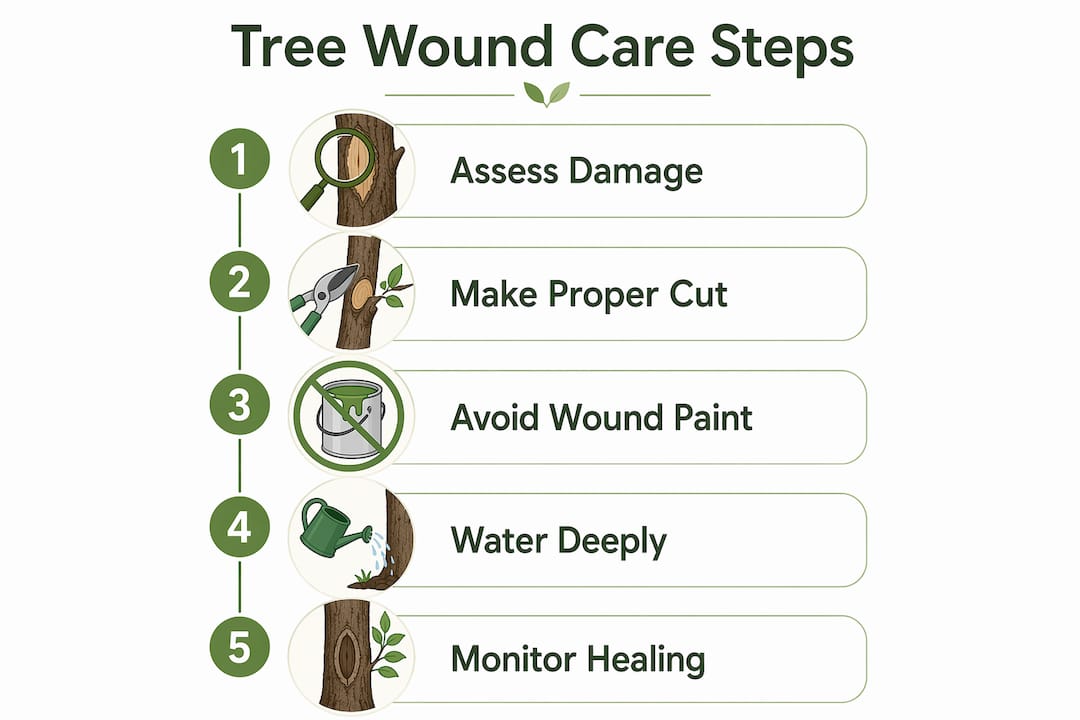
The 2026 scientific consensus is clear: wound paints inhibit healing and should not be used on routine pruning cuts. This is one of the most widespread misconceptions in residential tree care, and it costs homeowners real money in tree loss and disease treatment.
Trees seal wounds biologically through CODIT. The tree grows callus tissue that encircles the wound to isolate damaged tissue from healthy wood. This is isolation, not regeneration. Painting over a wound interrupts that process by trapping moisture against the wood, which accelerates rot and damages the cambium cells responsible for new growth.
University Extension programs across the country advise against routine wound dressings for exactly this reason. The cambium layer sits just beneath the bark. When a paint or sealant blocks oxygen and traps humidity, that layer breaks down. What looks like protection is actually a slow-acting wound.
There is one narrow exception. Fresh oak wounds during active Oak Wilt season may be treated with a non-toxic dressing to prevent beetle transmission of the disease. Outside of that specific scenario, leave the wound exposed.
- Wound paints trap moisture and create rot beneath the surface
- Cambium cell damage from sealants slows or stops callus formation
- Painted wounds often look fine externally while decaying internally
- University Extension programs consistently advise against routine sealant use
Pro Tip: If you feel the urge to “do something” after a pruning cut, water the tree instead. Deep, slow irrigation supports recovery far better than any paint or spray.
How to make proper pruning cuts that promote healing
The single most important factor in tree wound management is where and how you cut. A correct cut preserves the branch collar, the slightly swollen ring of tissue where the branch meets the trunk. That collar contains the cells that form callus tissue and seal the wound. Destroy it, and the tree cannot close the wound efficiently.
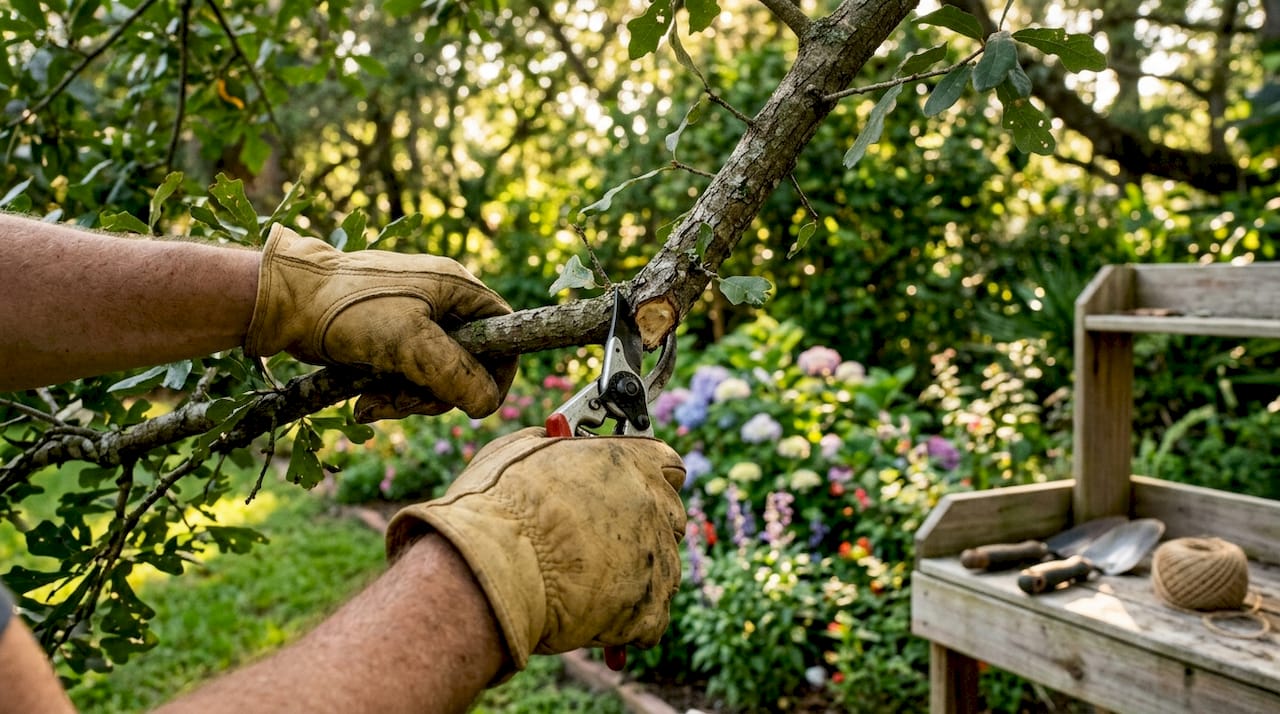
Flush cuts remove this tissue entirely, leaving a flat surface that exposes the trunk to decay. Stub cuts leave too much branch, which dies back and creates an entry point for disease. The correct cut sits just outside the branch collar and the branch bark ridge, the raised line of bark on the upper side of the branch union.
For large limbs, use the three-cut method to prevent bark tearing:
- Make an undercut about 12–18 inches from the trunk, cutting upward about one-third of the way through the branch.
- Make a second cut from the top, about 2 inches farther out from the undercut, until the branch falls cleanly.
- Remove the remaining stub with a final cut just outside the branch collar.
This sequence prevents the weight of a falling branch from stripping bark down the trunk, which creates a much larger and harder-to-close wound. Bark tears are one of the most common causes of serious tree injury during DIY pruning.
Topping trees is the most damaging cut a homeowner can make. It removes large portions of the canopy, creates massive wounds the tree cannot close, and triggers weak, fast-growing sprouts that are structurally inferior. For guidance on the difference between trimming and pruning, the trimming vs. pruning guide from Mcculloughtreeservice explains when each approach applies.
Use sharp, clean tools. Bypass pruners work for branches under 1 inch in diameter. A pruning saw handles branches up to 4 inches. Anything larger requires a chainsaw and, in most cases, a professional.
How do you assess storm-damaged trees in Central Florida?
Central Florida’s hurricane season runs june through november, and storm damage is the most common source of serious tree wounds in the region. Assessing damage correctly determines whether a tree recovers or becomes a hazard.
Trees with more than 50% canopy loss or large trunk cracks often require removal rather than pruning restoration. That threshold matters because a tree with half its canopy gone cannot produce enough energy through photosynthesis to fuel recovery. Trying to save it through aggressive pruning often accelerates decline.
Use these criteria to evaluate a storm-damaged tree:
- Canopy loss under 25%: The tree can likely recover with proper pruning and care.
- Canopy loss between 25% and 50%: Recovery is possible but uncertain. A certified arborist assessment is strongly recommended.
- Canopy loss over 50%: Removal is usually the safer and more cost-effective choice.
- Trunk cracks or split unions: These are structural failures. The tree poses a safety risk and needs professional evaluation immediately.
- Broken branches still hanging in the canopy: Called “widow makers,” these require immediate removal before any other work begins.
After pruning storm damage, support recovery with deep soak irrigation. University of Florida IFAS recommends applying 2 to 3 gallons of water per inch of trunk diameter, wetting the top 12–18 inches of soil. In Central Florida’s sandy soils, water moves through quickly, so slow and deep application matters more than frequency.
| Damage level | Canopy loss | Recommended action |
|---|---|---|
| Minor | Under 25% | Prune broken branches, water deeply |
| Moderate | 25%–50% | Arborist assessment, targeted pruning |
| Severe | Over 50% | Consider removal; consult arborist |
| Structural failure | Trunk cracks or split unions | Immediate professional evaluation |
Mcculloughtreeservice provides storm cleanup services for Central Florida properties, including emergency response after major weather events. Certified arborists have the equipment and training to handle large wounds and hazardous limbs safely, which is beyond what most homeowners can manage without risk.
Preventive tree care that reduces future wound risk
The best tree injury treatment is the one you never need. Structural pruning during a tree’s first 15–20 years prevents weak branch unions and dramatically reduces storm damage risk. Removing competing leaders, crossing branches, and narrow-angle unions while branches are small means smaller wounds and faster closure.
Mulch placement is one of the most underrated tools in tree health restoration. A vegetation-free mulch ring 2–4 inches deep, kept 2–4 inches away from the trunk base, prevents mower and string trimmer contact. Mechanical wounds from lawn equipment are a leading cause of trunk cankers in Florida landscapes. The mulch ring also retains moisture and moderates soil temperature, both of which support root health.
Ongoing maintenance practices that reduce wound risk include:
- Scheduling structural pruning for young trees every 3–5 years
- Keeping mowers and trimmers at least 18 inches from trunk bases
- Removing dead wood annually before hurricane season begins
- Inspecting trees after every significant storm for hanging limbs
- Avoiding soil compaction around root zones from vehicles or heavy foot traffic
Pro Tip: A “messy” appearance after storm damage is normal and beneficial. Resist the urge to over-prune for aesthetics. The tree needs every healthy leaf it has to fuel recovery.
Timing matters in Central Florida’s climate. Pruning during the dry season, roughly november through april, reduces exposure to fungal pathogens that thrive in humid conditions. Avoid heavy pruning during active growth flushes in spring, when trees are directing energy into new growth and wounds close more slowly. For a full breakdown of preventive pruning strategies, Mcculloughtreeservice covers the timing and technique considerations specific to Florida trees.
Proper yard maintenance also plays a role. Avoiding unnecessary soil disturbance near root zones and keeping equipment away from trunk bases are practices that reduce mechanical trunk damage over time.
Key Takeaways
Effective tree wound care relies on proper pruning cuts and the tree’s own CODIT biology, not wound paints or sealants.
| Point | Details |
|---|---|
| Skip wound paints | Sealants trap moisture, damage cambium cells, and slow natural healing. |
| Use collar cuts | Cut just outside the branch collar to preserve the tissue that forms callus. |
| Assess storm damage by canopy loss | Trees with over 50% canopy loss typically need removal, not pruning. |
| Water deeply after damage | Apply 2–3 gallons per inch of trunk diameter to support recovery in sandy Florida soils. |
| Mulch rings prevent mechanical wounds | Keep mulch 2–4 inches from the trunk to protect against mower and trimmer damage. |
What I’ve learned after years of watching homeowners get this wrong
The most common mistake I see is homeowners reaching for a can of wound paint immediately after a pruning cut or storm damage. The instinct makes sense. The wound looks raw, and covering it feels protective. But that instinct works against the tree’s biology every single time.
Trees are not passive. The moment a wound forms, the tree begins building chemical and physical barriers around it. Painting over that process is like putting a bandage over a wound that needs air to close. The tree does the work. Your job is to not interfere with it.
The second mistake is making flush cuts because they “look cleaner.” A flush cut removes the branch collar entirely. That collar is the tree’s repair kit. Without it, the wound stays open, decay moves in, and what started as a small pruning cut becomes a structural problem over years.
Patience is the hardest part of tree wound care best practices. A wound that looks alarming in october may be well on its way to closure by the following spring. The callus tissue rolls in from the edges slowly. That process cannot be rushed, but it can absolutely be stopped by the wrong intervention.
For large wounds, broken leaders, or anything involving a chainsaw above shoulder height, call a certified arborist. The cost of a professional assessment is a fraction of what it costs to remove a tree that declined because of improper wound care.
— Mcculloughtreeservice
Professional tree care from Mcculloughtreeservice
When wounds are large, branches are hanging over structures, or storm damage has left your trees in uncertain condition, professional help is the right call.
Mcculloughtreeservice serves homeowners and property managers across Orlando and Central Florida with certified arborist expertise in tree trimming and pruning, storm damage cleanup, and tree health assessment. The team uses proper collar-cut technique, professional-grade equipment, and current arboricultural standards on every job. Whether you need a post-storm evaluation or seasonal pruning to reduce future wound risk, Mcculloughtreeservice provides the assessment and hands-on work to keep your trees healthy and your property safe. Contact Mcculloughtreeservice for an estimate.
FAQ
Should I use wound paint after pruning a tree?
No. Scientific consensus advises against wound paints for routine pruning cuts because they trap moisture and inhibit the tree’s natural CODIT healing process. Leave the wound exposed.
What is CODIT in tree wound healing?
CODIT stands for Compartmentalization of Decay in Trees. It is the biological process trees use to isolate damaged tissue by growing callus tissue around the wound rather than regenerating injured cells.
How much canopy loss is too much for a storm-damaged tree?
Trees that lose more than 50% of their canopy in a storm often cannot recover through pruning alone and typically require removal. A certified arborist can confirm the threshold for your specific tree.
When is it safe to prune trees in Central Florida?
The dry season from november through april is the best time to prune in Central Florida. Pruning during this period reduces exposure to the fungal pathogens that spread more easily in humid summer conditions.
How far should mulch be kept from a tree trunk?
Keep mulch 2–4 inches away from the trunk base and apply it 2–4 inches deep. Direct contact between mulch and bark traps moisture and promotes trunk cankers and decay.
Recommended
- Tree Planting Guide Central Florida for Homeowners
- Tree Planting Considerations for Central Florida Homes
- Tree Health Assessment Guide for Central Florida Owners
- A homeowner’s guide to planting trees in Central Florida