By: Shelby McCullough| Published: January 23, 2026
An overgrown tree in Central Florida is more than a messy sight; it can put your home, loved ones, and neighborhood at risk when hurricanes and thunderstorms arrive. With our subtropical climate fueling rapid tree growth and regular storms threatening property, ignoring hazardous branches can lead to costly damage or personal injury. Proper pruning reduces risk by stabilizing trees and eliminating weak limbs, so seeking expert help not only boosts curb appeal but also protects what matters most.
Table of Contents
- Tree Trimming For Safety Explained
- Recognizing Dangerous Tree Growth Patterns
- Storm Risks And Property Damage Prevention
- Legal Liabilities And Local Ordinances
- When To Hire A Certified Arborist
Key Takeaways
| Point | Details |
|---|---|
| Tree trimming is crucial for safety | Maintaining trees prevents potential hazards from weak branches, reducing risks during storms. |
| Recognize dangerous growth patterns | Identify structural weaknesses, such as co-dominant stems or narrow crotches, to mitigate failure risks. |
| Professional assessment is vital | Consult a certified arborist for complex issues, particularly for large trees high above ground. |
| Document maintenance practices | Keep records of tree care to demonstrate responsible ownership and address any liability concerns. |
Tree Trimming for Safety Explained
Tree trimming goes far beyond making your yard look neat. In Central Florida, where we deal with high humidity, tropical storms, and year-round growth cycles, proper tree trimming is a direct investment in your property’s safety. An overgrown tree isn’t just an eyesore, it’s a hazard waiting to happen. Branches can fail during thunderstorms, limbs can grow into power lines, and weak structures create dangerous conditions for anyone on your property.
The core purpose of safety-focused tree trimming is to remove hazards before they become problems. This means eliminating dead or dying branches that could snap and fall, cutting limbs that hang over your roof or near your home, and thinning dense canopies that create weak branch angles prone to failure. Critical safety practices emphasize removing these hazardous limbs while maintaining the tree’s structural integrity. When branches cross each other, rub together, or grow at sharp angles, they weaken over time. Central Florida’s humidity accelerates decay in compromised branches, making this a genuine concern for homeowners.
What makes safety trimming different from casual pruning is the focus on structural stability and hazard removal. Proper pruning reduces risk by stabilizing trees and eliminating limbs that pose danger to people, structures, or utilities. This might mean removing a large branch that looks healthy but has poor attachment to the main trunk. It could involve cutting back limbs that extend over your home, driveway, or power lines. In Central Florida, hurricane season makes this particularly critical. A tree that looks fine in July might lose major branches in August if its structure isn’t sound.
The technique matters as much as the assessment. Improper cuts can leave trees vulnerable to disease and insect damage, actually creating more hazards down the line. That’s why professional arborists use specific cutting methods, proper angles, and specialized equipment. They understand how trees heal and which removal techniques promote health rather than harm. For homeowners, this distinction is important. A trimmed tree that’s been cut incorrectly might look better temporarily but could develop problems that make it more dangerous later.
One critical aspect many homeowners overlook is the ongoing nature of safety trimming. Trees don’t stay trimmed once and remain safe forever. Growth continues, new hazards develop, and environmental stress from storms or drought can weaken branches that seemed fine months ago. Central Florida’s weather patterns, including regular thunderstorms and occasional freezes, create variable stress on trees. What was safe in your tree last year might become a problem this year.
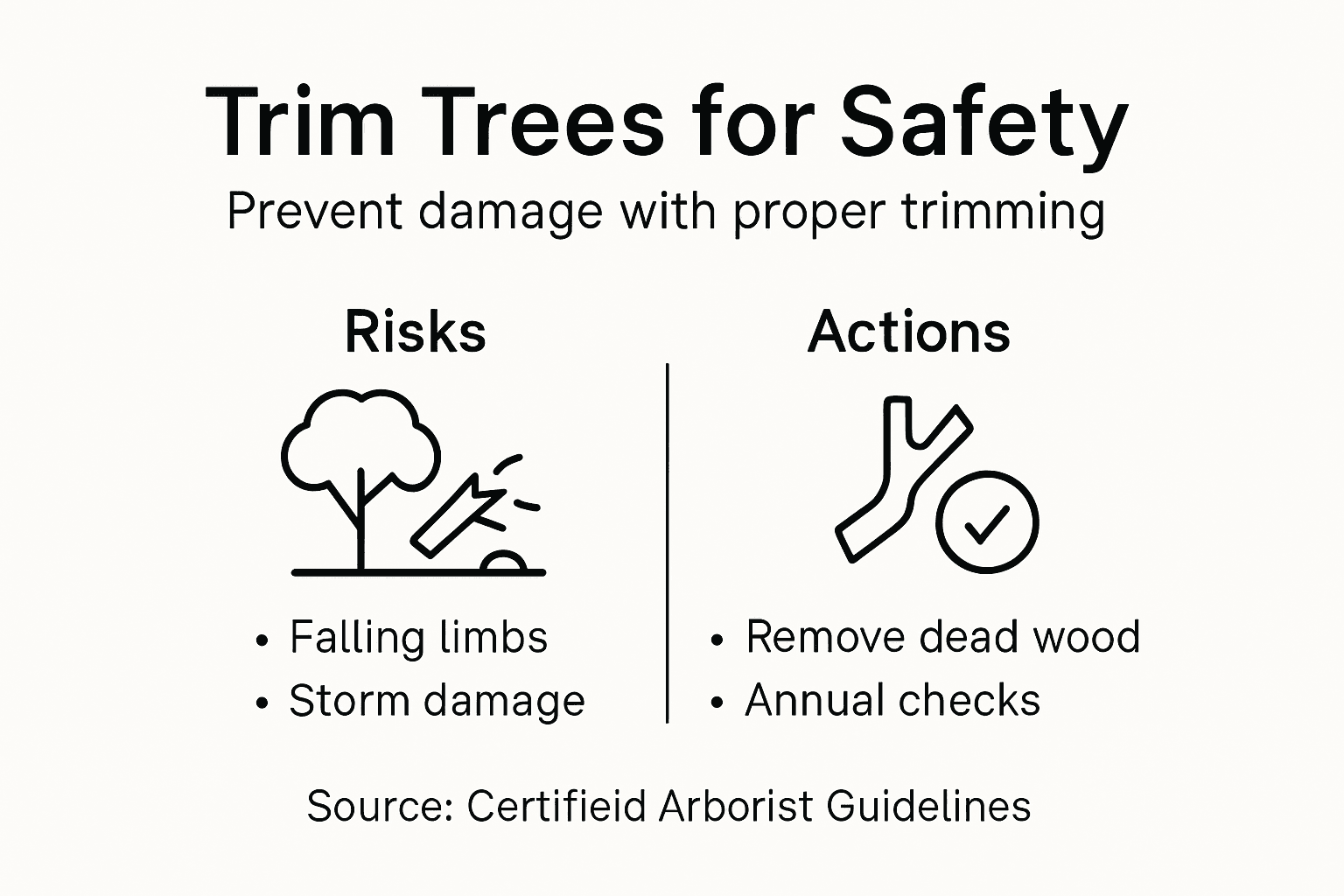
Pro tip: Schedule a professional tree assessment before hurricane season each year. A certified arborist can identify weak branches and structural issues before they become dangerous, giving you time to address hazards before severe weather arrives.
Recognizing Dangerous Tree Growth Patterns
Not all tree problems announce themselves loudly. Some of the most dangerous growth patterns develop quietly over months or years, hidden in plain sight. As a Central Florida homeowner, you live with trees that grow aggressively year-round, which means hazardous patterns can develop faster than you might expect. The key is learning what to look for before a problem becomes a crisis. Certain growth patterns are red flags that signal structural weakness and increased failure risk during storms or even calm weather.
One of the most common dangerous patterns is the co-dominant stem, which occurs when a tree develops two or more main leaders growing upward with equal strength. This creates competing growth instead of a single, stable trunk. When two large stems grow side by side, they eventually develop a narrow crotch between them. That tight angle is a structural weak point. During a storm, wind pressure pushes down on both stems simultaneously, and the narrow crotch fails under stress. Instead of one stem bending and surviving, you get a serious branch failure that can damage your home or injure someone nearby. Poor branch angles and weak attachments are the leading causes of tree failure in residential landscapes.
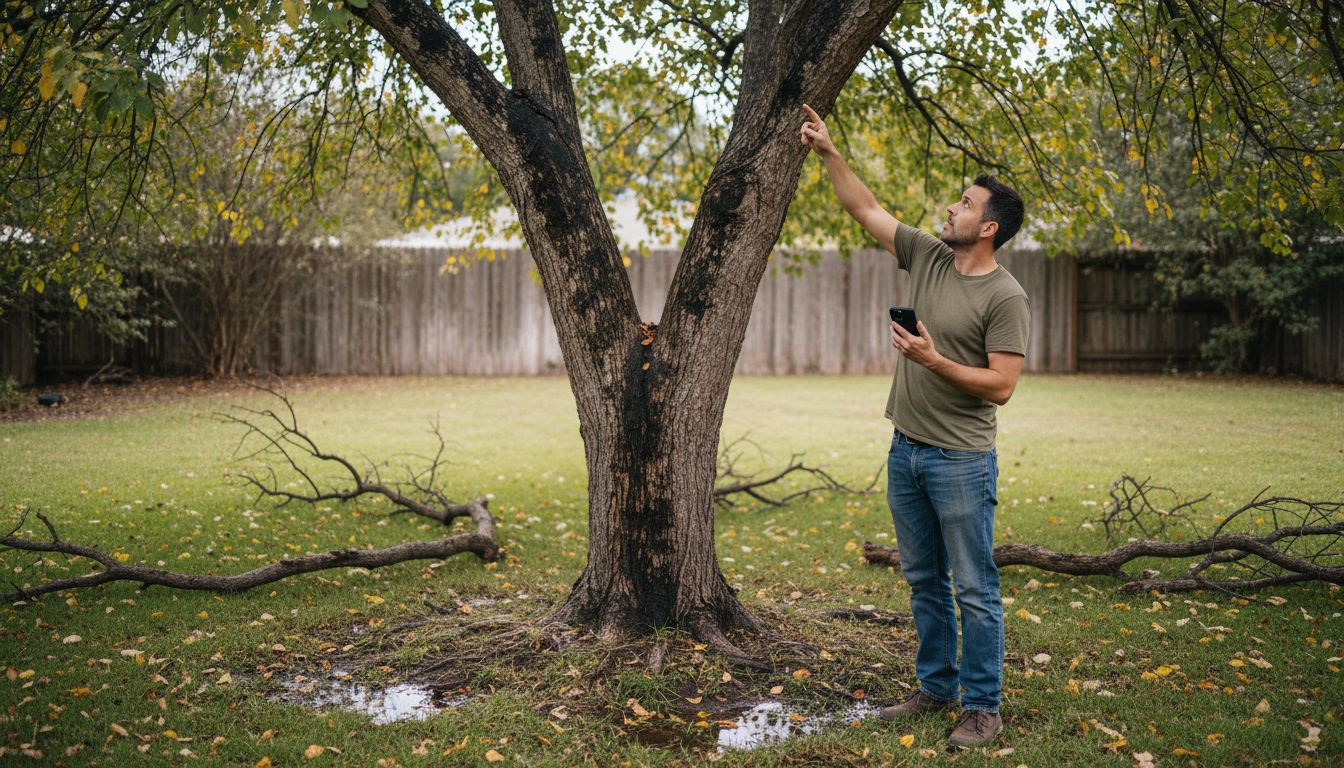
Another critical pattern to watch for is branches with narrow V-shaped crotches. When branches attach to the trunk or main limbs at very tight angles, they lack the strength of branches with wider, U-shaped angles. The wood in narrow crotches cannot distribute stress effectively, making them prone to splitting under load. Central Florida’s humidity also accelerates decay in these tight spaces where moisture gets trapped. You might see bark growing into the crotch itself, which is actually a sign that the attachment is failing internally even if it looks solid from the ground. Branches that cross or rub against each other also create wounds that invite disease and weaken the tree’s structure over time.
Look for vertical cracks or splits in the main trunk or major limbs. These aren’t just cosmetic issues. Cracks indicate internal stress and structural failure in progress. Storm damage, frost cracks from Central Florida’s occasional cold snaps, or simply poor branch attachment can cause these splits. A tree with visible trunk cracks may look intact, but it’s compromised. Similarly, watch for included bark where bark grows into the crotch between branches instead of the branch properly separating from the trunk. This signals that the branch attachment is mechanically weak and failure-prone.
Dead branches hanging in the canopy present an obvious hazard. A dead limb can fall without warning in calm weather, let alone during a storm. But sometimes the danger is subtler. Branches that are structurally defective might look alive but have internal decay or weak wood. You cannot always see this from the ground, which is why professional assessment matters. Also pay attention to branches that are significantly larger than the trunk they’re attached to. A massive limb on a thin trunk creates a mechanical imbalance that makes failure more likely.
Uneven canopy growth is another warning sign. If your tree has heavy branching on one side and sparse growth on the other, it becomes unbalanced. Wind pressure hits the heavy side with more force, and the tree leans. This constant stress makes branches fail more easily over time. Trees that suddenly drop large branches after mild weather, or that have a history of branch failure, are showing you they have structural problems that need attention.
The following table summarizes the most common hazardous tree growth patterns and why they are risky:
| Hazardous Growth Pattern | Key Identification Feature | Why It Increases Failure Risk |
|---|---|---|
| Co-dominant stems | Two main leaders with tight crotch | Weak union prone to splitting during storms |
| Narrow V-shaped branch crotch | Sharp branch angle at attachment | Poor stress distribution, easy splitting |
| Crossing or rubbing branches | Branches touch or abrade each other | Creates wounds, accelerates decay |
| Vertical cracks in trunk | Visible splits or fissures | Signals internal weakness and structural risk |
| Included bark in crotch | Bark growing between branches | Weak mechanical structure, splits easily |
Pro tip: Take photos of your tree’s branch structure every few months and look for new cracks, increased crossing branches, or changes in the canopy shape. Documenting changes helps you and an arborist identify problems early before they become dangerous.
Storm Risks and Property Damage Prevention
Central Florida’s storm season is not a distant threat. It arrives reliably from June through November, and sometimes earlier. What makes our area particularly vulnerable is not just the frequency of storms, but the combination of high winds, heavy rain, and trees that have been growing rapidly in our warm climate. An untrimmed tree is essentially a disaster waiting for weather to trigger it. When a major storm system moves through Central Florida, the trees that fail are rarely healthy, well-maintained specimens. They are almost always the ones that have been neglected, allowed to develop weak structures, and packed with dead or dying wood that cannot withstand wind pressure.
Here’s the reality about storm damage. A single large branch falling from your tree can punch through your roof, crushing the structure underneath and exposing your home to water damage worth tens of thousands of dollars. That same branch could land on a parked car, damage a neighbor’s property, or injure someone. The financial and legal consequences escalate quickly. But the damage doesn’t stop with your property. Falling branches can take down power lines, leaving your entire neighborhood without electricity for days. They can block roads, damage other homes, and create emergency situations that put first responders at risk. What makes this particularly frustrating is that much of this damage is preventable through proper tree maintenance.
Proper tree trimming directly reduces your storm risk by eliminating the branches most likely to fail. When you remove dead wood, you eliminate branches that cannot flex or absorb wind stress. They simply snap. When you remove branches with poor attachment angles, you take out the limbs that fail first under load. Removing weak or hazardous branches through strategic pruning maintains tree structure and reduces the likelihood of property damage during severe weather. The key is that trimming makes trees more resilient, not weaker. A properly trimmed tree can shed wind pressure more effectively because its canopy is more balanced. Heavy, dense foliage creates a sail effect that catches wind like a parachute. A thinned canopy with good structure lets wind pass through instead of pushing on the tree as a single mass.
Consider the specific storm hazards in Central Florida. Our hurricane season brings sustained winds that push on trees for hours. This is different from isolated thunderstorms where winds gust violently for seconds. Sustained wind pressure slowly increases the stress on weak branches until they fail. In a tropical storm, what looked stable at 40 miles per hour starts failing at 60 miles per hour. A branch with a narrow crotch or poor attachment might hold through the initial wind gust but snap when the pressure continues for another 30 minutes. Additionally, heavy rain saturates soil and reduces a tree’s anchoring power. A tree with a weak root system combined with structural defects in the canopy becomes extremely hazardous. The combination of wet soil plus poor branch structure equals failure.
Another critical factor is the tree’s proximity to your home and structures. A large oak that looks fine in calm weather becomes a liability if branches hang over your roof. Storm cleanup companies are not always available immediately after a major event. You could have a damaged roof exposed to rain for days while waiting for repairs. Strategic pruning that improves tree health and removes damaged limbs prevents limb failure that threatens structures. Beyond your own property, trimmed trees also protect your neighbors and community infrastructure. Power lines, utility poles, and street signs all depend on nearby trees being properly maintained.
Timing matters significantly. The best approach is to address tree hazards before storm season begins. Trees that have been trimmed in spring and early summer have months to heal before wind season arrives. You get to choose when work happens, at your own pace. Trees that aren’t trimmed until August or September leave you vulnerable during the peak months. And waiting until after a storm has damaged your tree is far more expensive and risky than preventive work.
Pro tip: Schedule your professional tree trimming by May, well before hurricane season peaks. This timing gives trees months to heal and ensures hazardous branches are removed before major storms arrive in August and September.
Legal Liabilities and Local Ordinances
Many Central Florida homeowners don’t realize they could face serious legal consequences for tree-related damage caused by negligence. The moment a branch from your tree falls and damages your neighbor’s property, or worse, injures someone, you enter liability territory. This is not a small concern. A single lawsuit over tree damage can cost tens of thousands of dollars in legal fees and damages, regardless of whether you win or lose. Local ordinances and state laws create a legal framework that defines what you must do as a property owner, and what happens when you fail to do it.
Florida law holds property owners responsible for maintaining trees on their land in a safe condition. This is called the duty of care. What this means practically is that you cannot simply ignore a tree that is obviously hazardous. If you know or should know that your tree has dangerous branches, structural problems, or dead wood that could fall and injure someone or damage property, you have a legal obligation to address it. The challenge is that “should know” can be interpreted broadly. A reasonable homeowner living in Central Florida should know that trees require maintenance, especially in a climate where growth is aggressive and storm season is a regular threat. If your tree drops a branch and causes damage, and a lawyer can show that the hazard was obvious or could have been discovered with reasonable inspection, your homeowner’s insurance might deny your claim and you could face personal liability.
Many Central Florida municipalities have specific tree ordinances that go beyond basic negligence law. These local rules regulate what you can do with trees on your property and what you must do. For example, some cities require permits before removing or significantly trimming certain tree species. Others have rules about how close trees can grow to utilities or structures. Municipal tree ordinances protect public safety by ensuring that trees are pruned according to established standards and that proper techniques are used to minimize risks. Violating these ordinances can result in fines, forced remediation at your expense, or even legal action by the municipality. The specific rules vary by city, so what’s permitted in Orlando might differ from what’s allowed in Winter Park or Kissimmee.
Power lines create an additional layer of legal complexity. If your tree or a branch from your tree contacts an electric utility line, you could be liable for the cost of repairs, lost service to customers, and sometimes penalties. Utilities take this seriously because tree contact is one of the leading causes of power outages. Tree trimming around electric power lines requires compliance with ANSI A300 standards and OSHA safety guidelines, and only licensed contractors should perform this work. Attempting DIY trimming near power lines puts you at personal risk and creates liability if something goes wrong. Utilities have the right to trim trees near their lines themselves, but they may pursue your insurance for the cost if they determine negligence on your part.
Here is what this means for you as a Central Florida homeowner. First, you need to maintain your trees in a reasonably safe condition. This does not mean they must be perfect, but it does mean addressing obvious hazards like dead branches, poor structure, or branches hanging over occupied areas. Second, before doing any significant tree work, check with your local municipality about permits and regulations. Many cities have arborist or landscape contractor licensing requirements. Third, when you hire someone for tree work, verify they are properly licensed and insured. A licensed contractor with adequate liability insurance protects you because if something goes wrong, their insurance covers it rather than yours. Fourth, never assume DIY tree trimming near power lines or over structures is acceptable. The legal and safety risks are too high.
One often overlooked aspect is documentation. Keep records of tree maintenance you perform or hire done. Take photos of work completed. These records demonstrate that you are being a responsible property owner and address your duty of care. If something goes wrong later, documented maintenance history is far better than no evidence at all. It shows a pattern of reasonable care rather than neglect.
Pro tip: Before hiring any tree service, ask for proof of licensing, liability insurance, and workers’ compensation coverage. Request references from recent jobs in your area and verify they carry adequate coverage limits, typically at least 1 million dollars in liability insurance.
When to Hire a Certified Arborist
Knowing when to call a professional is just as important as knowing your trees need care. Some tree work is straightforward enough for a homeowner to handle. Raking leaves, removing small dead branches within arm’s reach, or clearing minor debris is reasonable DIY work. But many tree situations require expertise, specialized equipment, and training that only a certified arborist possesses. The challenge is recognizing the line between what you can safely handle and what demands professional skill.
Start with tree size and height. If a tree is taller than your roof line and requires climbing or working at significant heights, you need a professional. Climbing a tall tree with a chainsaw is one of the most dangerous activities a person can attempt. A single mistake, a branch that breaks unexpectedly, or loss of balance sends you toward serious injury or death. Certified arborists have years of training, specialized climbing equipment, and safety protocols that allow them to work safely at heights where a homeowner would be at extreme risk. Beyond just height, any tree work near power lines absolutely requires a certified professional. Working near utilities is not just dangerous for you; it puts your neighborhood at risk and creates serious legal liability. Hiring a certified arborist when pruning large or mature trees near power lines brings specialized knowledge and proper equipment to safely handle these hazardous situations.
Structural issues demand professional assessment. If your tree has multiple leaders, significant dead wood, poor branch attachments, or signs of internal decay, a certified arborist can evaluate the problem and determine the right solution. This might be corrective pruning to remove hazards, or it might be that the tree is too far gone and removal is the safest option. A homeowner looking at a problem tree often cannot tell the difference between a structural issue that is fixable and one that requires removal. An arborist’s training includes understanding tree anatomy, recognizing disease and decay patterns, and knowing which interventions will actually improve the tree versus which ones will make it worse. Complex pruning tasks involving climbing or structural modifications require professional expertise to avoid harming the tree or creating new hazards.
Central Florida’s specific conditions also suggest when to call an arborist. Our year-round growing season means trees develop issues faster than in colder climates. Storm damage creates complex scenarios where you need professional assessment to determine what can be salvaged and what must be removed. If your tree shows signs of disease, insect infestation, or unusual decline, have a certified arborist evaluate it. They can identify problems that are not obvious to untrained eyes and recommend treatment before the issue spreads to other trees. Additionally, if you are dealing with protected tree species in your municipality, an arborist understands the regulations and can perform work that complies with local ordinances.
Consider also the scope of the work. Small pruning tasks on young, accessible trees that are clearly dead or damaged are reasonable for a homeowner with basic tools and knowledge. But if the work involves removing large branches, shaping the tree structure, or making decisions about the tree’s future, professional input adds significant value. A certified arborist can distinguish between branches that should be removed and those that should be kept. They understand how pruning cuts affect tree growth, healing, and long-term health. They also have liability insurance that protects you if something goes wrong, which most homeowners lack.
One practical approach is to have a certified arborist assess your trees annually before storm season. This assessment costs far less than repairing storm damage or dealing with an injury. During the assessment, the arborist identifies work you could handle yourself and recommends work that requires professional expertise. This gives you a clear action plan and protects your property investment.
Here is a concise comparison of DIY vs. certified arborist tree care to help homeowners decide on the best approach:
| Tree Care Aspect | DIY Homeowner Work | Certified Arborist Service |
|---|---|---|
| Suitable Task Size | Small branches within reach | Large, high or risky branches |
| Recommended Equipment | Pruners, small saws | Climbing gear, chainsaws, PPE |
| Safety Considerations | Lower risk, limited hazards | Comprehensive safety protocols |
| Legal Protection | Basic homeowner insurance | Professional liability coverage |
| Regulatory Compliance | Usually not applicable | Knowledge of local ordinances |
Signs You Definitely Need Professional Help
- Trees taller than your roof line requiring climbing or chainsaws
- Branches hanging over power lines or near utility infrastructure
- Visible cracks, splits, or cavities in the trunk or major limbs
- Signs of disease, pest infestation, or unusual decline
- Trees that have dropped large branches recently without obvious damage
- Multiple dead limbs throughout the canopy
- Storm damage requiring assessment and decision making about salvage versus removal
- Protected tree species that may have trimming restrictions
Pro tip: Get a certified arborist assessment before attempting any tree work on large or structurally compromised trees. The cost of assessment is negligible compared to the cost of an injury, property damage, or improper pruning that creates bigger problems later.
Protect Your Central Florida Property with Expert Safety Tree Trimming
The risks of hazardous tree growth and storm damage are very real for homeowners in Central Florida. Dead branches, poor branch angles, or co-dominant stems can quickly turn a beautiful tree into a dangerous threat during hurricane season. If you want to reduce the chances of costly property damage, power outages, and legal liabilities you need professional safety-focused tree trimming that understands our unique climate challenges. McCullough Tree Service offers certified arborist expertise to remove hazardous limbs properly, improve tree health, and strengthen structural stability.
Don’t wait until a storm strikes or a branch falls to take action. Schedule a comprehensive tree health assessment or get your trees professionally trimmed by trusted experts who follow all safety standards. Visit McCullough Tree Service to learn more about our certified arborist tree trimming and storm cleanup solutions. Take the first step toward peace of mind knowing your trees are properly maintained for safety and resilience. Contact us now for a free estimate and keep your property safe year-round.
Explore our full range of services including tree removal, emergency storm response, and expert tree health assessments all tailored for Central Florida residents.
Frequently Asked Questions
Why is tree trimming important for safety?
Tree trimming is crucial for safety as it removes dead or dying branches that could fall and cause injury or property damage. Proper trimming enhances tree structural integrity, reducing the risk of branches breaking during storms.
How often should I trim my trees to ensure safety?
It’s recommended to have your trees assessed at least once a year, especially before hurricane season. Trees grow continuously, and regular trimming helps manage hazards and maintain structural stability.
What are some signs that my tree may be a hazard?
Look for signs such as co-dominant stems, narrow branch angles, vertical cracks, dead branches, and uneven canopy growth. These issues signal structural weaknesses that increase failure risks during storms.
Can I trim my trees myself, or should I hire a professional?
While small pruning tasks may be manageable for homeowners, it’s advisable to hire a certified arborist for larger or structurally compromised trees. Professionals have the knowledge and equipment to safely execute complex tree work and mitigate risks.
Recommended
- Role of Tree Trimming in Central Florida Landscapes
- What Is Tree Trimming? Key Facts for Florida Homeowners
- Why Trim Palm Trees: Health, Safety, and Legal Impact
- Tree Trimming in Florida: DIY Tips & Tricks
- Tree Service Orlando FL
- Tree Service Winter Springs FL