By: Shelby McCullough| Published: August 22, 2026
Yes, in most cases. Winter Park requires a permit before you remove or heavily prune a protected tree on residential or commercial property, and skipping that step can trigger fines or forced replanting later. There’s one carve-out: Florida Statute 163.045 lets homeowners remove a genuinely dangerous tree without a city permit, fee, or mitigation requirement, but only when an ISA-certified arborist or licensed Florida landscape architect documents the risk in writing, and Winter Park still wants that report on file.
Your next move depends on your situation:
- Healthy tree, want it gone or heavily trimmed? Register on the city’s Permitting Self-Service Portal and submit a Tree Removal Permit application.
- Tree is hazardous or dying? Get an ISA-certified arborist’s written risk assessment first, before any cutting.
Expect a residential or commercial permit fee as listed on the city’s official fee schedule (https://cityofwinterpark.org/docs/departments/finance/fee-schedule.pdf), plus a field inspection before the city signs off.
Key Takeaways
Winter Park requires a tree permit for most removals and major pruning, and even the state’s dangerous-tree exemption still requires filed arborist documentation.
| Point | Details |
|---|---|
| Permit is the default | Most tree removals and heavy pruning in Winter Park need a permit filed through the city portal. |
| State exemption is narrow | Florida Statute 163.045 only waives fees for documented dangerous trees on residential property. |
| Budget beyond the base fee | Residential permits run $35 and commercial $100, but zone clearance and reinspection fees add up. |
| Replanting has a deadline | Replace with FL #1 grade trees within 30 days to avoid fee-in-lieu billing at $110 per caliper inch. |
| Get help with documentation | McCullough Tree Service prepares ISA-certified permit reports and coordinates removal and replanting in one process. |
Where to Verify Winter Park Tree Permit Rules
Bookmark these official pages and attach the relevant links directly to any arborist letter you submit:
- Tree Removal Permit Application, the Permitting Self-Service Portal entry point.
- Urban Forestry Division, for species guidance and canopy protection resources.
- City fee schedule PDF, for current permit and mitigation fees.
- Florida Statute 163.045, the residential dangerous-tree preemption law.
- Ordinance No. 3320-24, for the latest protected-tree criteria.
Table of Contents
- Winter Park Tree Permit Rules: Who Actually Needs One
- How to Apply for a Winter Park Tree Permit Step by Step
- What a Winter Park Tree Permit Costs
- What Belongs in an ISA Arborist Report for Permit Approval
- Common Permit Mistakes That Cost Property Owners
- Sources
Winter Park Tree Permit Rules: Who Actually Needs One
Winter Park’s tree preservation code protects trees that meet certain size or species criteria, and the city updated those protection standards under Ordinance No. 3320-24, adopted in October 2024. If your tree qualifies as protected, removing it, relocating it, or pruning it beyond routine maintenance puts you squarely in permit territory. This applies whether you’re a homeowner clearing a backyard oak or a commercial property manager clearing a parking lot expansion.
The Florida Statute 163.045 exemption only kicks in for one narrow scenario: a residential property owner with documented proof from a qualified arborist that a specific tree poses an unacceptable risk. It does not cover healthy trees you’d simply prefer gone, and it does not apply to commercial parcels. Here’s the part people miss: even when you’re legally exempt from the permit fee, Winter Park still expects the arborist documentation submitted to the Urban Forestry Division. Skip that filing and you’re exposed to enforcement even if your tree really was hazardous.
Commercial applicants face a different clock. Where a residential permit might clear in days, commercial reviews typically require a longer processing time, partly because larger sites often involve multiple protected trees, zoning overlays, or site-plan coordination.
How to Apply for a Winter Park Tree Permit Step by Step
Getting a Winter Park tree removal permit isn’t complicated, but the sequence matters. Miss a step and you’ll be resubmitting instead of scheduling your removal crew.
- Create an account on the city’s Permitting Self-Service Portal if you don’t already have one. This is the only channel the Urban Forestry Division accepts applications through.
- Start the Tree Removal Permit application and identify the property, the tree species (if known), and the reason for removal or pruning.
- Upload your documentation. This typically means photos of the tree from multiple angles, a basic property sketch showing tree location relative to structures, and, if you’re claiming the dangerous-tree exemption, the ISA-certified arborist’s letter.
- Flag power-line involvement. If the tree sits near primary energized conductors, check the box for it. This routes your application toward zone-clearance requirements before a crew can safely work near the line.
- Pay the applicable fee and keep your receipt as proof of payment attached to the file.
- Wait for the field inspection. City staff visit the site to confirm the tree’s condition, size, and species match what you submitted.
- Track your review status through the portal. Commercial applications generally take about 14 business days; residential permits often move faster.
- Request re-inspection if the city flags an issue, or file an appeal with the Tree Preservation Board if you disagree with a denial.
Pro Tip: Submit your arborist letter and photos in the same upload batch as your initial application, not as a follow-up. Incomplete submissions are the single biggest cause of review delays, and a partial file just sits until someone catches the gap.
What a Winter Park Tree Permit Costs
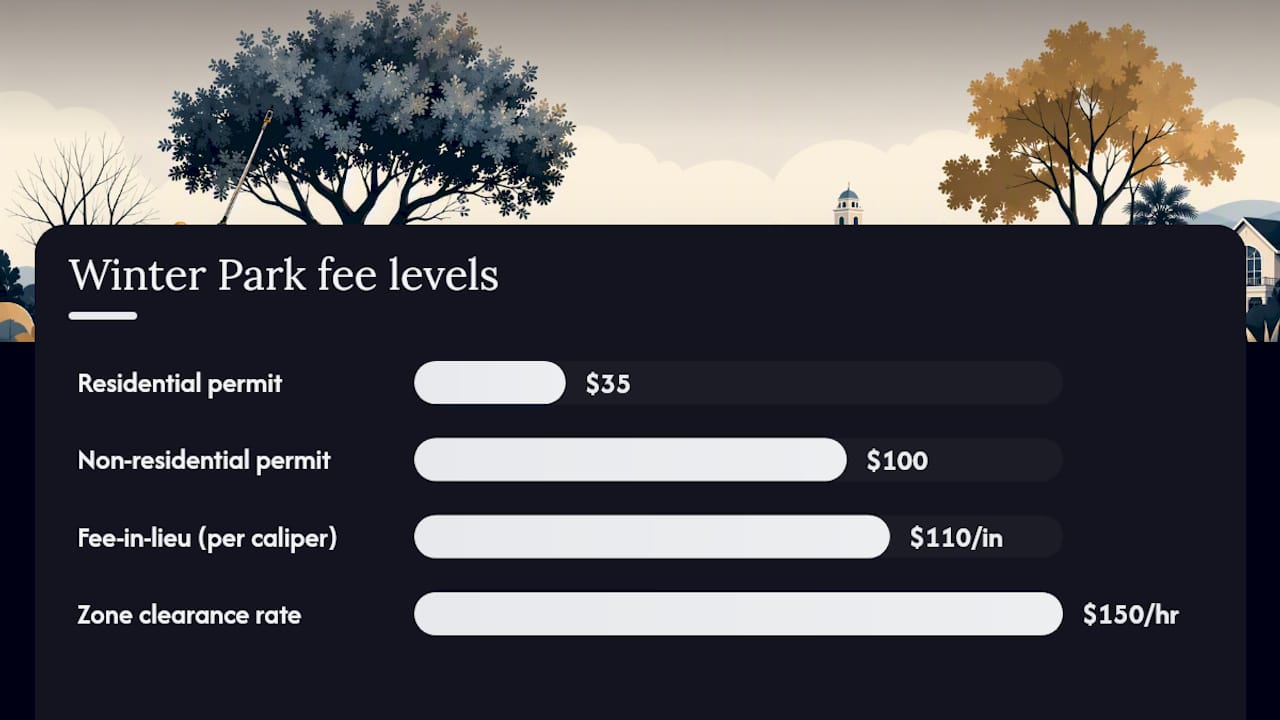
The fees are modest compared to the cost of the tree work itself, but they add up if you’re not planning for mitigation. Here’s what’s actually on the city’s fee schedule:
| Fee Type | Amount |
|---|---|
| Single-family residential permit | $35 |
| Non-residential or multi-family permit | $100 |
| Compensation for protected tree removal (fee-in-lieu) | $110 per caliper inch |
| Zone clearance near power lines (city rate example) | $150 per hour |
That $110-per-caliper-inch figure only applies if you’re not replanting. Winter Park would rather you replace what you remove: put in a Florida #1 grade tree at the required minimum caliper within 30 days, and you avoid or reduce the compensation deposit entirely. Miss that 30-day window and the city bills you for the full caliper-inch total plus an administrative fee.
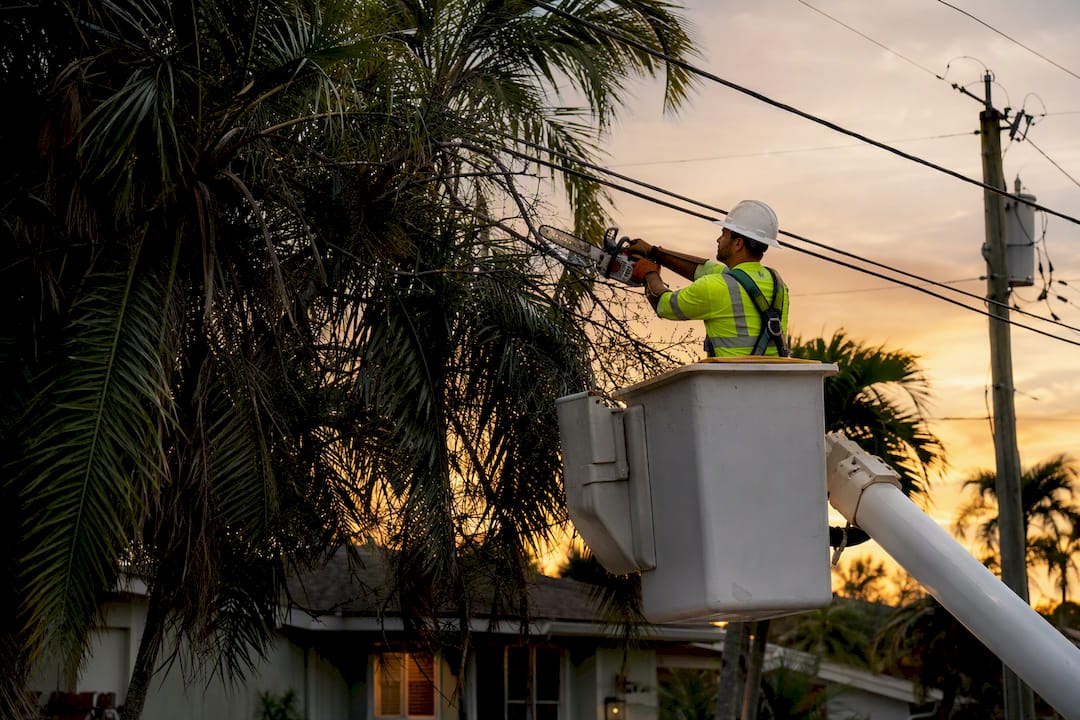
If your removal site sits within 10 feet of a primary energized conductor, you’ll need zone clearance, either performed by the city at roughly $150 per hour or by a qualified line-clearance contractor you hire directly. Reinspection fees apply too, so a tree that fails its first inspection costs you twice.
What Belongs in an ISA Arborist Report for Permit Approval
A vague note that says “this tree looks dangerous” won’t satisfy the Urban Forestry Division and it definitely won’t satisfy the state exemption standard. A permit-ready arborist letter needs specific elements:
- A clear description of the defect (root damage, cavity, lean angle, disease).
- A documented risk rating, not just a subjective impression.
- Dated photographs showing the defect and the tree’s relationship to structures or walkways.
- The exact site location and tree identification.
- A stated conclusion that removal is the only practical way to reduce risk below an acceptable threshold, if you’re invoking the state statute.
- Recommended mitigation or replacement planting, where relevant.
McCullough Tree Service builds every risk assessment around that checklist, then submits it directly in the format the Urban Forestry Division expects. We’ve found that phrasing conclusions to match the statute’s own “unacceptable risk” language, rather than general arborist jargon, cuts down on back-and-forth review cycles significantly.
Pro Tip: Keep a copy of every submitted document and every email exchange with the city. If your permit is questioned months later, that paper trail is your entire defense.
When you’re choosing who writes that report, insist on ISA certification specifically. Not every landscaper or tree cutter carries it, and an uncertified opinion won’t satisfy either the city or the state statute. Our related guide on hazardous tree removal in Orlando walks through how these risk-assessment reports get built.
Common Permit Mistakes That Cost Property Owners
The costliest mistakes with Winter Park’s tree rules aren’t complicated. They’re usually just skipped steps.
- Removing a tree first and asking questions later. Property owners sometimes assume a tree “obviously” qualifies as dangerous under the state exemption and remove it without documentation. Without a filed arborist report, you have no legal protection, and you’re now facing the exact fines the exemption was supposed to help you avoid.
- Forgetting zone-clearance and reinspection costs. A budget built only around the $35 or $100 permit fee gets blindsided by a $150-per-hour utility clearance charge or a second inspection fee after a failed first pass.
- Missing the 30-day replanting window. That deadline is firm. Miss it and the fee-in-lieu billing kicks in retroactively, plus an administrative charge.
File documentation before any cutting begins, confirm your replacement tree meets the FL #1 grade and minimum caliper standard, get written clearance in hand whenever utility lines are anywhere near the work, and hold onto every piece of correspondence with the city. Our guide to tree removal permits across Central Florida covers how these same pitfalls play out in neighboring jurisdictions, if you own property outside Winter Park too.
A Local Arborist’s Note on Permits
Our ISA-certified team has walked hundreds of Winter Park properties, and the pattern is consistent: the permits that sail through are the ones with clean documentation, not the ones with the “worst” tree. We build permit-ready reports as part of every assessment. If you’re unsure whether your tree qualifies for removal or the state exemption, request an on-site estimate before you make a call.
Skip the Guesswork on Your Winter Park Tree Permit
McCullough Tree Service handles the entire permit path in one visit, not three separate contractors. Our ISA-certified arborists assess the tree, write the risk documentation the Urban Forestry Division actually wants, and coordinate the removal or pruning once approval comes through, so you’re not relaying paperwork between a consultant, a permit office, and a crew.
If your tree needs full removal, our tree removal services include permit coordination as part of the job, not an add-on you have to chase separately. Need the stump gone afterward to clear the way for replacement planting? We handle stump grinding too, and we can advise on FL #1 grade replacement species that satisfy the city’s mitigation standards. Property owners dealing with a tree that’s questionable but not obviously hazardous should start with a tree trimming assessment instead of jumping straight to removal. Request a permit-assistance estimate and we’ll tell you plainly whether your situation needs a full application, an arborist letter for the state exemption, or nothing at all.
Sources
- Tree Removal Permit Application – City of Winter Park
- Florida Statute 163.045
- Urban Forestry – City of Winter Park
- Ordinance No. 3320-24 | Code of Ordinances | Winter Park, FL | Municode Library
Recommended
- Tree Permits in Central Florida: What Owners Must Know
- Tree Permits in Central Florida – What Homeowners Need to Know
- Tree Trimming Service in Winter Park, FL | Free Estimate
- Check Out Our Videos – McCullough Tree Service