By: Shelby McCullough| Published: March 23, 2026
Managing trees on your Central Florida property requires understanding potential hazards that threaten safety and property value. Tree risk assessment combines structural evaluation with environmental factors to identify dangerous conditions before failures occur. Professional arborists use systematic criteria to rate risk levels, but property owners benefit from recognizing warning signs and understanding decision frameworks. This guide provides practical assessment tips, explains professional rating systems, and helps you make informed choices about tree management on your premises.
Table of Contents
- Key takeaways
- Understanding key criteria for tree risk assessment
- How professionals rate tree risk: likelihood and consequences
- Impact of Florida’s weather and species on tree failure risk
- Choosing between removal and preservation: expert decision tradeoffs
- Professional tree risk assessment and care services
- Frequently asked questions
Key Takeaways
| Point | Details |
|---|---|
| Defects to watch | Dead or broken branches, decay, cavities, codominant stems, and root issues signal elevated risk and warrant professional review. |
| Risk rating framework | Certified arborists apply standardized likelihood and consequence scales to translate findings into actionable risk levels for decision making. |
| Certified professionals matter | Professional evaluations provide local expertise for hurricane exposed Central Florida landscapes and safer management choices. |
| Removal versus preservation | Decisions should balance safety, ecological health, aesthetics, and property value with guidance from experts. |
| Weather and species influence | Central Florida hurricane exposure and diverse tree species create unique risk profiles that require specialized assessment. |
Understanding key criteria for tree risk assessment
Recognizing structural defects forms the foundation of effective tree risk evaluation. Dead or broken branches pose immediate hazards because they can fall without warning, especially during typical afternoon thunderstorms. These limbs lose structural integrity as wood dries and weakens, creating unpredictable failure points above parking areas, walkways, and buildings.
Decay presents another critical concern that often hides beneath healthy-looking bark. Fungal fruiting bodies growing on trunks or roots signal internal rot that compromises load-bearing capacity. Cavities and hollow sections reduce the wood available to support weight and resist wind forces. You might notice soft spots when probing with a tool, or see sawdust accumulations that indicate active insect damage accelerating decay.
Codeminant stems create structural vulnerabilities where two trunks of similar size compete for dominance. V-shaped unions lack the interlocking wood fibers found in properly formed branch attachments, making them prone to splitting under stress. Storm winds apply tremendous leverage to these weak points, and included bark between stems prevents strong connections from forming. Many unhealthy tree indicators become visible when you examine union angles and bark patterns at major forks.
Root system problems often escape notice until trees lean or fall. Lack of visible root flare where trunk meets ground suggests buried stems or girdling roots that strangle the tree’s vascular system. Soil heaving on one side indicates root plate movement that precedes complete failure. Exposed roots, construction damage, or fungal growth near the base all point to compromised anchoring that reduces stability.
Tree lean exceeding 15 degrees from vertical raises failure risk substantially, particularly when lean developed suddenly rather than gradually. Recent lean accompanied by soil cracks or exposed roots on the opposite side signals active failure in progress. Even long-standing lean becomes hazardous when combined with decay, codominant stems, or root damage that further weakens structural capacity.
Pro Tip: Photograph your trees quarterly from the same angles to track changes in lean, branch condition, and foliage density. Comparing images reveals subtle deterioration that escapes casual observation and helps professionals assess progression rates.
Having identified critical tree defects, we next examine how these factors combine into a professional risk rating system.
How professionals rate tree risk: likelihood and consequences
Certified arborists apply systematic frameworks to translate observations into quantified risk levels. The likelihood of failure ranges across four categories: Improbable means failure is unlikely during normal conditions, Possible indicates defects exist but failure requires unusual stress, Probable suggests failure could occur under typical weather, and Imminent means failure appears certain in the near term regardless of conditions.
Consequence ratings assess potential impact if failure occurs. Negligible consequences involve small branches falling in unoccupied areas with minimal damage potential. Minor consequences might damage property or cause slight injuries requiring first aid. Significant consequences could cause substantial property damage, serious injuries, or disruption of important activities. Catastrophic consequences threaten fatalities, major structural damage, or permanent impairment of critical functions.
Risk rating combines likelihood of failure and impact consequences to yield Low to Extreme ratings. The matrix intersection determines management priorities: Low risk trees require only routine monitoring, Moderate risk suggests scheduling mitigation within normal maintenance cycles, High risk demands prompt action to reduce hazards, and Extreme risk requires immediate intervention to prevent imminent harm.
Professionals document their assessments using standardized forms that support consistent evaluation across different certified arborist practitioners. This framework enables property managers to compare risks objectively and allocate resources effectively. Written reports provide liability protection by demonstrating due diligence in identifying and addressing known hazards.
| Likelihood | Negligible Impact | Minor Impact | Significant Impact | Catastrophic Impact |
|---|---|---|---|---|
| Improbable | Low | Low | Low | Moderate |
| Possible | Low | Low | Moderate | High |
| Probable | Low | Moderate | High | Extreme |
| Imminent | Moderate | High | Extreme | Extreme |
Risk tolerance varies by property owner and context. Schools and hospitals typically accept only Low risk, while remote natural areas might tolerate Moderate ratings. Commercial properties balance insurance requirements against tree preservation goals. Understanding your risk tolerance helps guide discussions with arborists about appropriate management responses.
Pro Tip: Request written risk assessments that specify likelihood, consequences, and overall rating for each evaluated tree. Documentation supports insurance claims, satisfies regulatory requirements, and provides baseline data for tracking changes over time.
With a clear understanding of risk ratings, let’s review empirical data that highlights how Florida’s weather affects tree failure likelihood.
Impact of Florida’s weather and species on tree failure risk
Central Florida’s hurricane exposure creates unique assessment challenges that require local expertise. 2004-2005 hurricanes produced massive debris; studies improve wind resistance ratings for species. Post-storm research evaluated 281 tree species across Florida and Puerto Rico, documenting failure modes and survival rates under extreme wind conditions. This empirical data now informs risk assessments by identifying which species tolerate high winds versus those prone to uprooting or stem breakage.
Native species generally demonstrate better wind resistance because they evolved under local storm regimes. Live oaks develop strong branch architecture and deep root systems that anchor effectively in sandy soils. Sabal palms flex rather than break, allowing fronds to shed while trunks remain standing. Conversely, some popular landscape trees like laurel oaks show higher failure rates due to weak wood and shallow rooting patterns.
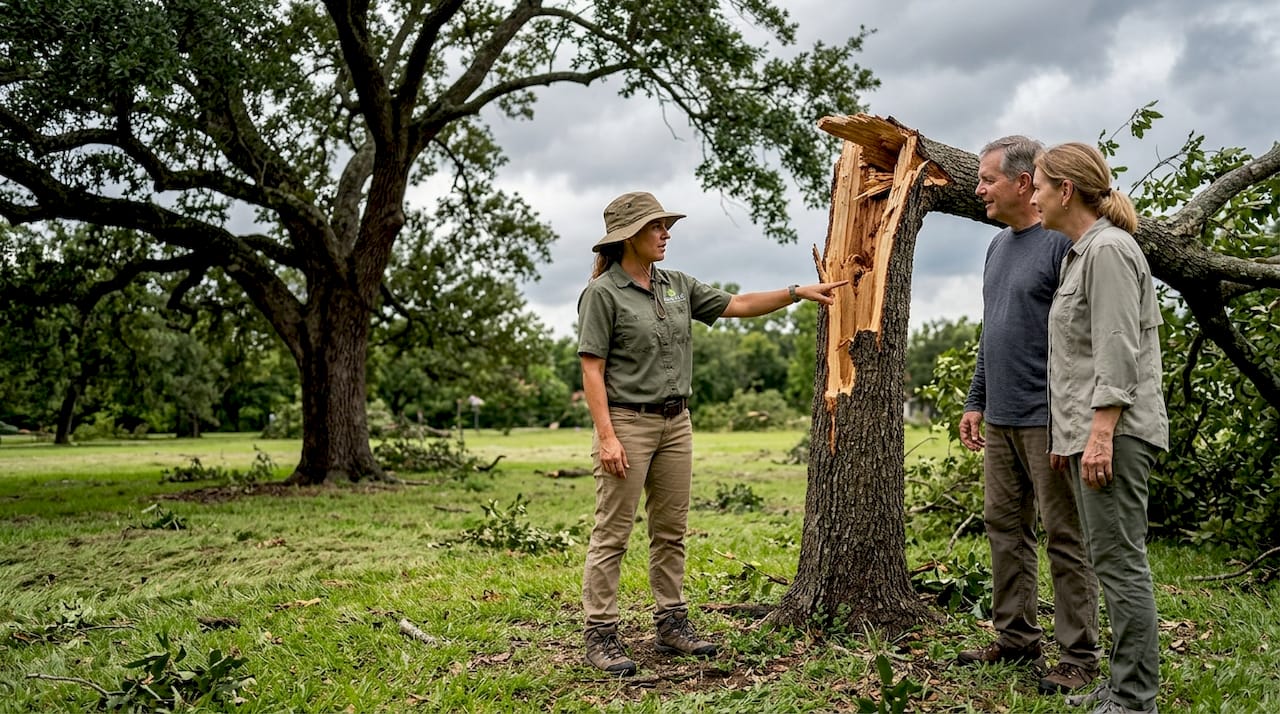
Codeminant stems and internal decay increase risk especially during storms when wind loads multiply normal stress levels. Trees that appear stable in calm conditions reach failure thresholds quickly as gusts apply dynamic forces to crowns. Hidden decay reduces safety factors that normally prevent catastrophic breakage, making professional inspection critical before hurricane season tree preparation begins.
Soil saturation from heavy rainfall compounds wind damage by reducing root anchorage. Wet ground allows root plates to pivot more easily, and waterlogged soil provides less resistance to overturning forces. Trees in low-lying areas or those with restricted root zones face elevated risk during tropical systems that combine high winds with flooding.
Pre-storm preparation significantly mitigates damage risks through strategic pruning and removal. Thinning dense canopies reduces wind resistance while maintaining structural integrity. Removing hazardous trees before storm season eliminates the most dangerous failures. Property owners who invest in proactive management experience substantially less damage than those who defer maintenance until emergencies force reactive responses.
Understanding these dynamics informs your management choices, which we explore when comparing tree risk management options next.
Choosing between removal and preservation: expert decision tradeoffs
Tree removal fully eliminates failure risk but impacts habitat and property aesthetics. Mature trees provide shade that reduces cooling costs, filter air pollution, and support wildlife populations including beneficial insects and birds. Removing large specimens creates visual voids in landscapes and eliminates decades of growth that cannot be quickly replaced. Property values often correlate with mature tree coverage, making removal decisions financially significant beyond immediate safety concerns.
Preservation requires ongoing monitoring and acceptance of some risk that never reaches absolute zero. Regular inspections track condition changes and detect new defects before they progress to dangerous levels. Structural support systems like cabling and bracing can reinforce weak unions or reduce loading on compromised sections. Pruning removes deadwood and reduces crown weight to lower failure probability while maintaining the tree’s presence.
Removal eliminates risk but loses ecological value; professionals differ on risk ratings influenced by client tolerance. Two qualified arborists might assign different ratings to the same tree based on their assessment philosophy and the property owner’s stated priorities. Conservative evaluators recommend removal when any significant defect exists, while others accept higher risk levels when trees provide substantial benefits and targets are limited.
Healthy appearance doesn’t guarantee safety because large diameter is not always safe; healthy looking trees can still fail. Dense foliage can mask internal decay, and vigorous growth sometimes indicates compensatory response to structural damage. Surface observations miss root problems developing underground or decay progressing inside solid-looking trunks. This reality makes professional inspection essential rather than relying on visual assessment alone.
Decision processes often involve emergency removal post-storm or planned trimming during routine maintenance. Storm damage that creates immediate hazards requires rapid response to protect people and property. Scheduled evaluations during calm periods allow time for deliberation, second opinions, and exploring alternatives to removal. Planning ahead provides options that disappear during crisis situations.
Steps to evaluate and choose between management options:
- Schedule assessment with a certified arborist who documents defects, risk rating, and target exposure
- Review written report detailing likelihood and consequences with photographic evidence
- Discuss your risk tolerance and property priorities including ecological and aesthetic values
- Consider alternatives like pruning, cabling, or target modification that might reduce risk acceptably
- Obtain cost estimates for different management approaches including long-term monitoring requirements
- Make informed decision balancing safety, budget, and preservation goals with professional guidance
After reviewing management options, let’s look briefly at how professional services can help implement these decisions effectively.
Professional tree risk assessment and care services
Navigating complex risk decisions becomes manageable with expert support from certified professionals. Arborists certified through the International Society of Arboriculture complete rigorous training in tree biology, hazard identification, and risk assessment methodologies that meet industry standards. Their evaluations provide credible documentation that satisfies insurance requirements and demonstrates responsible property management.
McCullough Tree Service brings certified expertise to Central Florida properties, delivering comprehensive assessments that identify hazards and recommend appropriate responses. Our certified arborist team understands local species characteristics and storm patterns that influence risk profiles throughout Orlando and surrounding areas. Whether you need tree removal to eliminate dangerous specimens or strategic tree trimming to preserve valuable trees safely, we provide solutions tailored to your specific situation and priorities.
Having explored assessment and decision strategies, here are answers to common questions Central Florida property owners have about tree risk.
Frequently asked questions
What are the first signs I should look for in a hazardous tree?
Dead branches, cavities, fungal growth, excessive lean, and damaged roots signal potential structural weakness requiring professional evaluation. These indicators suggest internal problems that compromise the tree’s ability to support its own weight or resist wind forces. Early detection through regular observation allows proactive management before conditions deteriorate to emergency levels. Check unhealthy tree indicators for detailed guidance on recognizing warning signs.
Why should I hire a certified arborist for tree risk assessments?
Certified arborists complete specialized training in hazard identification and assessment methodologies that untrained observers lack. They recognize subtle defects hidden beneath healthy appearances and apply standardized frameworks to quantify risk objectively. Professional reports provide credible documentation essential for liability protection and informed decision-making. Learn more about why hire certified arborists for your property management needs.
How do I decide between removing a risky tree or trying to preserve it?
Your decision depends on the risk rating, tree health, ecological value, property context, and personal risk tolerance. High and Extreme ratings typically warrant removal, while Moderate risks might allow preservation with monitoring and maintenance. Professional advice helps weigh safety priorities against benefits like shade, aesthetics, and wildlife habitat. Resources on how to identify a dangerous tree and hazardous tree removal services support balanced choices.
What should I do with tree damage after a hurricane or severe storm?
Inspect for new lean, broken branches, exposed roots, and soil cracks immediately after storms pass. Contact certified arborists for emergency assessment before attempting cleanup, as damaged trees under tension can release suddenly and cause injuries. Professional evaluation identifies which trees can recover versus those requiring removal. Preparing before storms through proactive storm tree preparation reduces damage severity and simplifies post-event recovery.
Recommended
- Tree Planting Guide Central Florida for Homeowners
- Tree Planting Considerations for Central Florida Homes
- Tree Health Assessment: Protecting Orlando Landscapes
- Why Trim Trees for Safety in Central Florida