By: Shelby McCullough| Published: May 18, 2026
TL;DR:
- Proper planning and site assessment are essential to ensure urban trees survive and provide their ecological benefits effectively.
- Correct planting techniques, including proper root flare exposure, adequate soil volume, and correct mulching, significantly reduce early tree failure.
- Ongoing maintenance such as deep watering, mulch management, formative pruning, and community stewardship are crucial for the long-term success of urban reforestation efforts.
Cities are getting hotter, and the concrete around us isn’t helping. Urban heat islands, poor air quality, and the steady loss of green space are real problems that affect neighborhoods every single day. The good news is that urban tree planting steps, when done correctly, can meaningfully reverse these trends. Trees cool streets, filter pollutants, absorb stormwater, and make communities genuinely better places to live. This guide gives you the exact process, from site selection through long-term care, so your trees survive and thrive in the demanding city environment.
Table of Contents
- Key takeaways
- Urban tree planting steps: planning before you dig
- How to plant trees in cities: the step-by-step process
- Steps for urban tree care after planting
- Common mistakes that kill urban trees
- Benefits of urban tree planting and planning frameworks
- What I’ve learned about urban tree planting success
- Get professional support for your urban trees
- FAQ
Key takeaways
| Point | Details |
|---|---|
| Plan before you plant | Check utilities, soil volume, and mature size before choosing a location or species. |
| Expose the root flare | Burying the root flare is a leading cause of early tree death and must be corrected at planting. |
| Water deeply for 3 years | New trees need 5 to 10 gallons weekly in year one to build a healthy root system. |
| Mulch like a donut, not a volcano | Apply 2 to 3 inches of mulch with a 2-inch gap around the trunk to protect without trapping moisture. |
| Species diversity matters | Plant no more than 10% of one species per neighborhood block to protect against pest outbreaks. |
Urban tree planting steps: planning before you dig
The most expensive mistake in urban tree planting happens before a single shovel breaks ground. Skipping the planning phase is how you end up with a tree that destroys a sidewalk, conflicts with power lines, or dies within two years.
Start with your site. Look at sunlight exposure, overhead clearances, and space for the mature canopy. A tree that tops out at 60 feet has no business living under a utility corridor. Just as critical: always call 811 before digging. This free utility marking service identifies underground gas, water, and electrical lines so you avoid infrastructure damage and keep yourself safe.
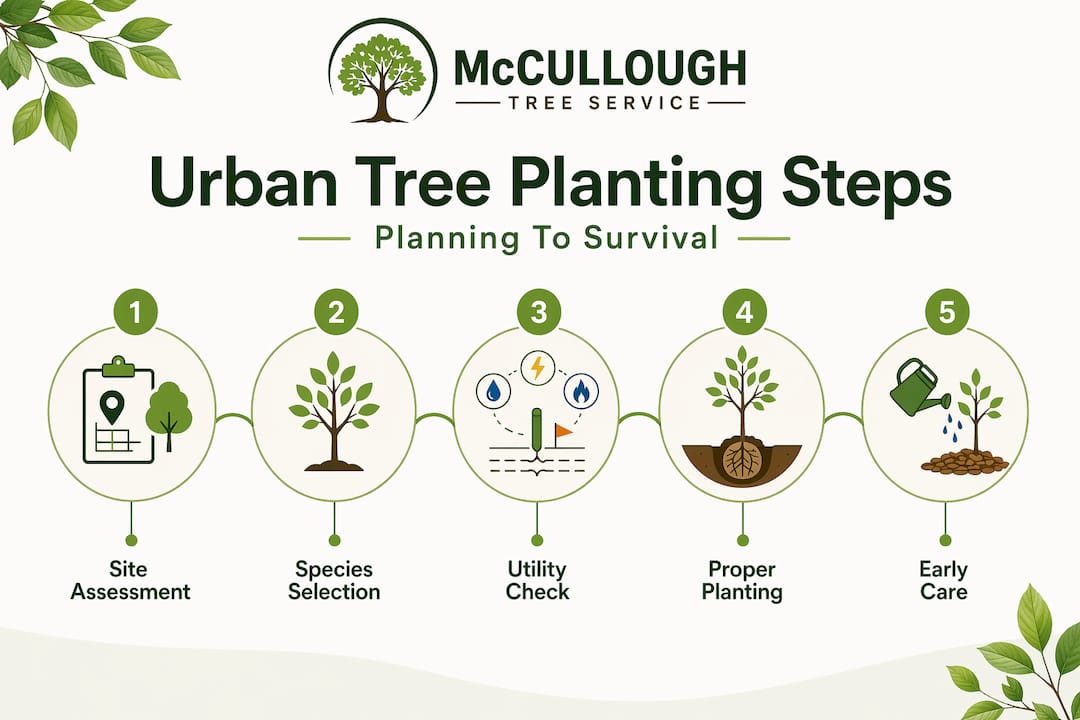
Soil volume is another factor most planners underestimate. Research shows the minimum rootable soil volume for a tree to survive long term in an urban setting is about 12 cubic meters (roughly 425 cubic feet) per tree. In tight urban spaces, this may mean using structural soil cells or shared soil volumes between multiple trees.
Choosing the right species is where the “right tree, right place” principle earns its reputation. Consider the following when evaluating your options:
- Mature size: Height and canopy spread at full growth, not just at the nursery
- Drought and heat tolerance: Especially relevant for Florida and other warm climates
- Salt and compaction tolerance: Urban soils near roads are often salty and heavily compacted
- Root behavior: Non-invasive root systems protect sidewalks and foundations
Timing also affects survival. Fall planting, from September through late October, gives roots time to establish in cooler soil before summer heat returns.
| Factor | What to check | Why it matters |
|---|---|---|
| Overhead clearance | Utility lines, structures | Prevents conflicts at maturity |
| Soil volume | Available rooting space | Supports long-term health |
| Sunlight | Hours of direct sun per day | Determines appropriate species |
| Species diversity | Neighborhood composition | Limits pest vulnerability |
Pro Tip: When planning a community tree planting project, work with your city’s urban forestry department to access approved species lists. These lists are tailored to local soil conditions, climate, and pest pressures, saving you significant guesswork.
Check out Mcculloughtreeservice’s Central Florida planting guide for region-specific species recommendations that apply directly to urban and suburban settings here.
How to plant trees in cities: the step-by-step process
Good preparation means nothing if the physical planting is done wrong. Follow these steps carefully, because most tree failures trace back to errors made on planting day.
- Dig the hole correctly. Make it 2 to 3 times the width of the root ball but only as deep as the root ball itself. A wide, shallow hole is always better than a deep, narrow one. Roots spread laterally and need loosened soil to explore outward.
- Expose the root flare. Before the tree goes in the ground, remove any excess nursery soil piled over the root collar. The root flare must sit at or slightly above the finished soil grade. Burying it even a few inches leads to bark rot, pest infestation, and tree death within 2 to 5 years.
- Cut circling roots. Inspect the root ball for any roots circling around the base. Cut or redirect them now. Left uncorrected, circling roots become girdling roots that strangle the trunk over time.
- Set the tree and backfill with native soil only. Place the tree in the center of the hole and backfill using only the soil you removed. Do not mix in compost, potting mix, or rich organic amendments. Amended backfill creates a bathtub effect where roots stay confined to the enriched pocket instead of growing into surrounding native soil. The result is a shallow, unstable root system.
- Water deeply as you backfill. Water in layers as you add soil to collapse air pockets. Do not stomp or compact the soil, because compaction is already the enemy in urban environments.
- Apply mulch correctly. Spread 2 to 3 inches of wood chip mulch in a donut shape around the tree. Keep a 2-inch gap from the trunk to prevent moisture buildup and rot. This donut shape, not the common volcano pile, is the correct technique.
- Stake only if necessary. Most urban trees do not need staking. If the tree cannot stand on its own due to wind exposure, use flexible ties and remove all stakes within one year. Movement actually builds trunk strength.
Pro Tip: After backfilling, create a small soil berm around the outer edge of the planting hole. It acts as a basin that directs water straight to the root zone instead of running off.
Steps for urban tree care after planting
Planting is the beginning. The next three years determine whether your tree actually makes it.
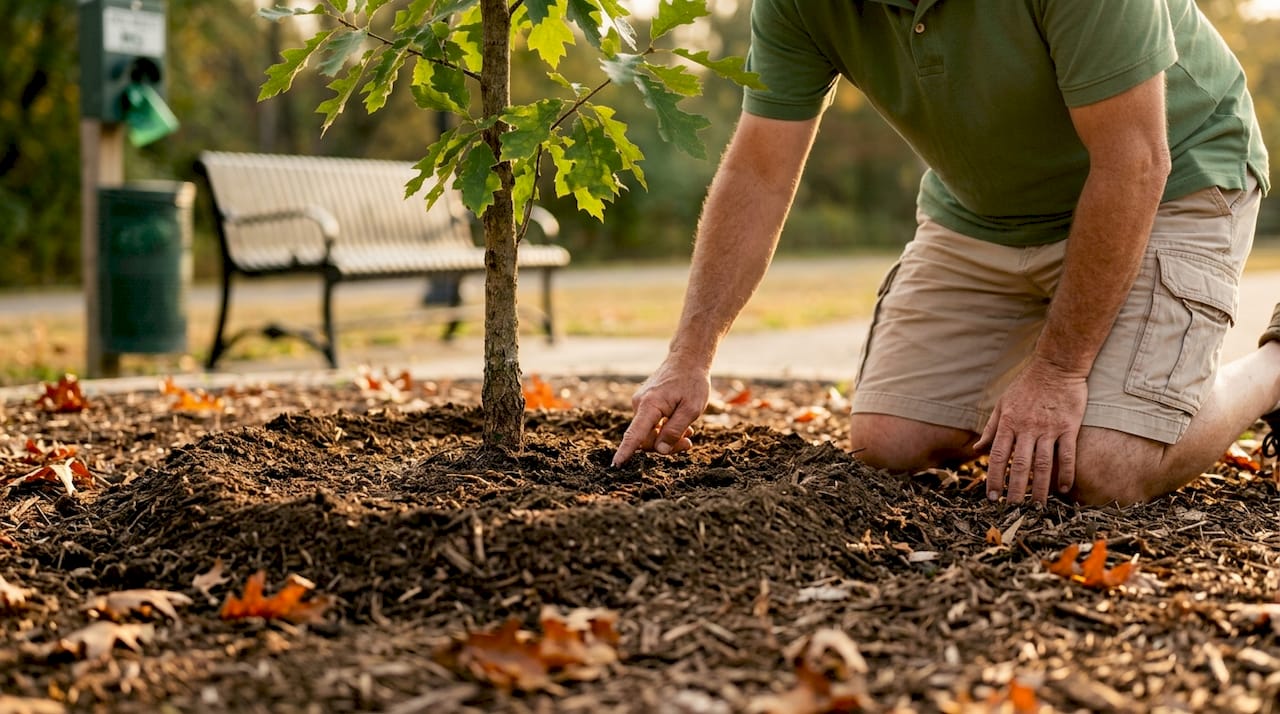
Water is the single biggest factor in new tree survival. Newly planted trees require consistent, deep watering for the first three years of establishment. In year one, that means delivering 5 to 10 gallons per week, applied slowly so the water penetrates rather than runs off. A low and slow drip, whether by hose or drip irrigation, builds deep root development far better than frequent shallow watering. In Central Florida’s heat, this is non-negotiable.
Beyond watering, here are the key care steps to practice consistently:
- Mulch maintenance: Check mulch depth twice a year. Top it up to maintain 2 to 3 inches but never let it contact the trunk. Remove any volcano formations you see on neighboring trees while you are at it.
- Formative pruning: In years 1 through 5, prune to develop a strong structure. Remove crossing branches and competing leaders. Never top a tree. Topping triggers weak, fast-growing sprouts that are more dangerous than the original canopy.
- Annual inspections: Walk your tree once a year and look for signs of pest activity, disease, soil heaving around the base, or exposed roots from mulch washout.
- Fertilization: Hold off on fertilizer at planting. In most cases, healthy native soil provides sufficient nutrients. If the tree shows signs of deficiency after year two, a soil test will tell you what is actually needed rather than guessing.
- Stake removal: If you staked the tree, remove stakes and ties within 12 months without exception.
Pro Tip: Stick your finger 2 to 3 inches into the soil near the root zone. If it feels moist, skip watering for that week. Overwatering kills just as effectively as drought in Florida’s clay-heavy urban soils.
Common mistakes that kill urban trees
Even well-intentioned planters make errors that undermine years of effort. Here are the ones worth knowing before they cost you a tree.
Buried root flare. This is the most common and most fatal mistake in urban tree planting. When the root collar sits below grade, the bark cannot breathe, water pools around the base, and fungal rot sets in. If you inherit a tree with a buried flare, gently remove soil until the flare is visible. It is almost always worth doing.
Planting too close to utilities. Overhead lines and underground infrastructure require clearance buffers. The 811 call system exists precisely for this, and skipping it risks serious consequences including service disruptions and personal liability.
Poor soil volume. Compacted urban soil with insufficient rooting space produces stressed, short-lived trees. Mitigation options include structural soil systems, suspended pavement systems, or coordinating shared soil volumes across adjacent tree pits.
| Mistake | Short-term effect | Long-term consequence |
|---|---|---|
| Buried root flare | Slow growth, yellowing | Tree death within 2 to 5 years |
| Volcano mulching | Moisture retention at trunk | Bark rot, rodent damage |
| Over-staking | Restricted trunk movement | Weak, wind-vulnerable trunk |
| Rich backfill soil | Lush early growth | Shallow roots, drought stress |
“Matching the species to the site is not a preference. It is the single biggest determinant of whether an urban tree survives long enough to deliver any of its promised benefits.” — Urban forestry practitioners consistently echo this in expert recommendations across North American cities.
Benefits of urban tree planting and planning frameworks
The environmental case for urban trees goes well beyond shade. Expanding urban tree canopy measurably reduces heat island effects, lowers surface temperatures, cuts cooling energy costs, and improves public health outcomes in dense neighborhoods.
Community planners now use the 3-30-300 rule as a practical framework for equitable urban greening. The principle is straightforward: every resident should be able to see at least 3 trees from their home, live in an area with at least 30% canopy cover, and access green space within 300 meters. This rule guides where trees are planted, not just how many.
Urban trees also deliver:
- Air quality improvement: Leaves absorb particulates and filter ground-level ozone
- Stormwater absorption: Tree roots and organic soil reduce runoff volume and slow flood peaks
- Biodiversity support: Native tree species provide habitat and food for pollinators and birds
- Mental health benefits: Green space access correlates with lower stress, faster recovery from illness, and stronger community bonds
For community tree planting projects, species diversity is a planning requirement, not a suggestion. Planting no more than 10% of one species or 20% of one genus per neighborhood protects the entire urban forest from a single pest or disease wiping out the canopy at once. Dutch elm disease destroyed the urban tree canopy of dozens of American cities in the 20th century because of single-species monocultures. That lesson still applies.
What I’ve learned about urban tree planting success
I’ve watched a lot of tree planting efforts fall apart, and the pattern is almost always the same. The tree was the wrong size for the space, or it was planted 4 inches too deep, or it got watered twice and then forgotten. None of these failures are complicated to prevent. They just require slowing down and following the steps.
The buried root flare issue genuinely surprises me in how widespread it remains. Even professional installations sometimes deliver trees with excess nursery soil over the collar. You have to check, every single time.
What I’ve come to believe is that community involvement is underrated in urban reforestation methods. A tree planted by volunteers who feel ownership over that block gets watered, checked on, and protected. A tree installed by a municipal crew with no community engagement gets hit by a shopping cart and ignored. The stewardship piece is not soft or secondary. It is core infrastructure for the whole effort.
Climate adaptation is also pressing harder on species selection than it was even five years ago. In Central Florida, that means leaning into native species with deep drought tolerance and storm resilience. The best trees for urban areas in this region are not always the ones developers favor visually.
— Mcculloughtreeservice
Get professional support for your urban trees
When your project involves multiple trees, large specimens, or areas near utilities or structures, professional guidance protects your investment significantly.
Mcculloughtreeservice offers certified arborist consultations for urban and residential tree projects throughout Orlando and Central Florida. Whether you need a site assessment before planting, expert tree trimming services to shape young trees correctly, or professional removal of a failed tree to make way for a better replacement, the team at Mcculloughtreeservice brings licensed expertise to every job. Proper professional care from the start protects the trees, the people around them, and the long-term value of the urban canopy you are working to build.
FAQ
What are the first steps in urban tree planting?
Start by calling 811 to mark underground utilities, assess the site for sunlight and soil volume, and select a species that fits the mature space available. Planning correctly before digging prevents the most common and costly failures.
How much water does a newly planted urban tree need?
New urban trees need 5 to 10 gallons of water per week during the first year, applied slowly to penetrate the root zone. Deep, infrequent watering builds a stronger root system than frequent shallow applications.
What is volcano mulching and why is it harmful?
Volcano mulching piles mulch high against the tree trunk, which traps moisture, promotes bark rot, and attracts rodents. The correct method is a flat 2 to 3 inch donut-shaped layer with a 2-inch gap around the base of the trunk.
How do I choose the best trees for urban areas?
Select species based on mature size, drought and salt tolerance, root behavior, and compatibility with local soil conditions. Native species adapted to your regional climate consistently outperform ornamental choices in urban survival rates.
When should you remove tree stakes?
Remove stakes and ties within 12 months of planting. Leaving stakes in place longer weakens trunk development and reduces the tree’s ability to handle wind load as it matures.
Recommended
- Central Florida tree planting guide: steps for lasting results
- Why proper tree planting matters: health and sustainability
- Urban Tree Care Explained: Health, Safety, and Law
- Tree Planting for Commercial Properties: Boosting Value and Compliance