By: Shelby McCullough| Published: June 10, 2026
TL;DR:
- A structured storm cleanup workflow emphasizes safety, thorough damage documentation, debris triage, moisture control, and contractor coordination to ensure effective recovery. Following each phase carefully prevents claim denials, mold development, and unnecessary costs, while enabling property owners to maintain control over their insurance claims. Discipline in documenting damages, acting quickly on moisture, and coordinating with certified professionals significantly improves restoration outcomes and financial protection.
A storm cleanup workflow is a structured, phase-by-phase process that property owners use to safely restore their properties after severe weather, covering everything from hazard identification to final insurance settlement. The most effective post-storm recovery plan integrates safety protocols, thorough damage documentation, debris triage, moisture management, and contractor coordination into a single repeatable system. Without this structure, property owners in storm-prone regions like Central Florida routinely miss insurance deadlines, overlook hidden moisture damage, and pay far more than necessary for restoration. ISA-Certified arborists, restoration software like Xactimate, and tools such as thermal imaging cameras all play defined roles in a professional-grade workflow. This guide walks you through each phase so you can move from chaos to recovery with confidence.
What does an effective storm cleanup workflow look like?
An effective storm cleanup workflow follows five sequential phases: immediate safety and hazard control, damage documentation, debris removal and triage, moisture management, and insurance and contractor coordination. Skipping or reordering these phases is the single most common reason property owners end up with denied claims or mold problems discovered months after the storm. The phases are not arbitrary. Each one creates the conditions the next phase depends on.
The workflow also separates what you can do yourself from what requires licensed professionals. Tree work involving downed limbs on structures, compromised root systems, or proximity to power lines requires an ISA-Certified arborist, not a chainsaw and good intentions. Knowing where that line sits saves time, money, and physical risk.
What are the critical safety and documentation steps first?
Safety hazards after storms include downed power lines, gas leaks, unstable structures, and contaminated standing water. Authorities recommend staying at least 35 feet from any downed line and avoiding standing water near electrical sources entirely. These are not precautions you weigh against convenience. They are conditions that must be cleared before any cleanup begins.
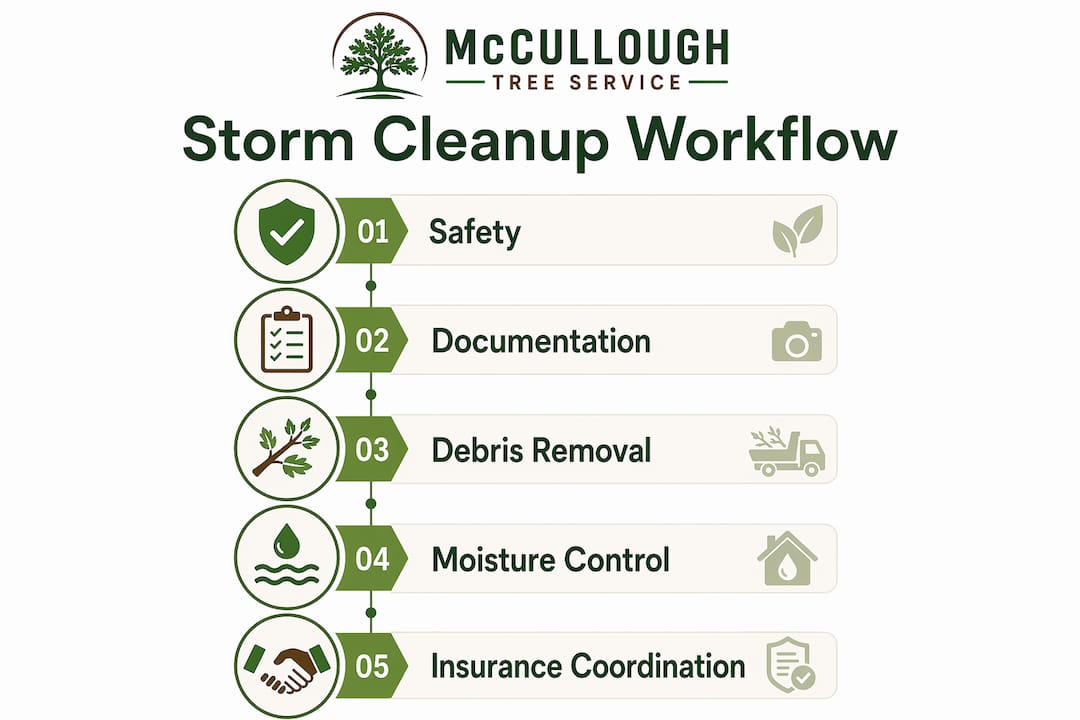
Before entering your property, confirm that local officials have declared the area safe for re-entry. Put on heavy work gloves, steel-toed boots, and eye protection before touching any debris. Once you are cleared to enter, your first task is documentation, not removal.
Photograph and video every area of damage before moving a single branch or piece of debris. Shoot wide-angle shots to establish context, then close-range shots to capture specific damage. Timely claim filing within 72 hours and complete documentation before debris removal are both required to maintain a strong insurance position. Moving debris before your adjuster approves it can weaken or void your claim entirely.
Pro Tip: Use a free app like Google Photos with location tagging enabled so every image is automatically timestamped and geotagged. This creates an audit-ready record your insurer cannot dispute.
Emergency mitigation steps such as tarping damaged roofs and boarding broken windows are legally required by most insurance policies to prevent further damage. Delaying these temporary repairs can reduce your payout or void coverage for secondary damage. Do them the same day you document, not a week later.
How to plan and execute debris removal in the storm cleanup process
Debris removal follows a triage model, not a “clear what’s closest” approach. Emergency dispatch prioritizes trees on homes, road blockages, and live power lines within the first 24 to 48 hours. Non-hazardous yard debris and general cleanup typically gets scheduled between days 3 and 10. Following this sequence keeps emergency vehicles accessible and prevents crews from wasting time on low-risk material while high-risk hazards remain.
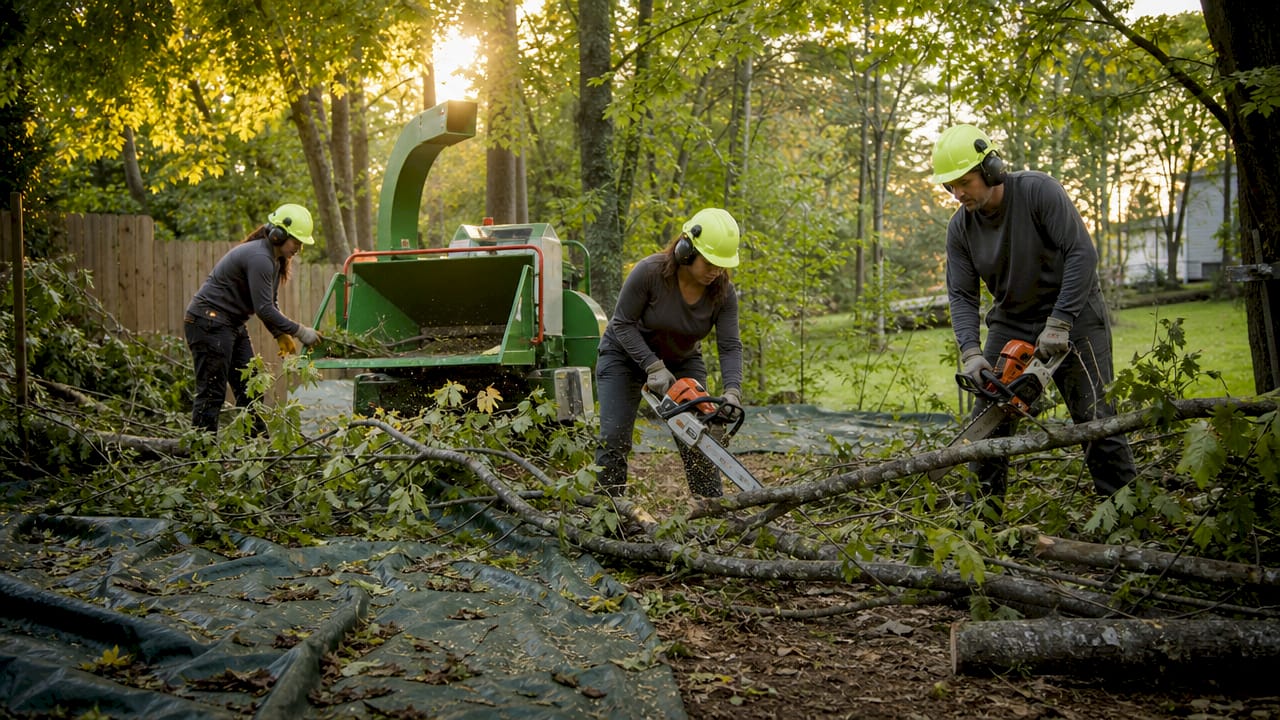
Clear your access routes first. A blocked driveway or pathway delays every subsequent step, from contractor arrival to debris hauling. Once routes are open, sort debris into two categories before any hauling begins.
| Debris type | Removal method | Disposal guideline |
|---|---|---|
| Trees on structures | ISA-Certified arborist with rigging equipment | Coordinate with insurer before removal; document first |
| Large fallen limbs | Professional chainsaw crew or arborist | Cut to municipal length specs; stack separately |
| Branches under 4 inches | Homeowner or crew with loppers and hand saws | Cut into 4-foot lengths for curbside pickup |
| Structural debris (lumber, roofing) | Licensed contractor | Separate from organic debris; check local ordinances |
| Waterlogged organic material | Professional crew with loader equipment | Note: waterlogged debris weighs significantly more than dry material |
Municipal guidelines in most Florida counties require organic and structural debris to be sorted into separate piles for collection. Mixing them results in collection refusal, which means the debris sits on your property longer and creates additional hazards.
Pro Tip: Before hiring any tree crew, verify they carry liability insurance and have ISA-Certified arborists on staff. An uncertified crew that drops a limb on your roof creates a new insurance claim, not a solution.
Equipment used in professional debris removal includes commercial wood chippers, chainsaws, stump grinders, and skid-steer loaders for bulk material. For a detailed look at emergency tree service steps specific to post-storm recovery, the sequence matters as much as the equipment.
How does moisture management fit into the storm cleanup workflow?
Moisture management is not a secondary concern. Mold begins colonizing damp materials within 24 to 48 hours, making rapid drying as urgent as debris removal. Standard insurance policies frequently exclude secondary damage caused by delayed mitigation, which means mold discovered three weeks after a storm may not be covered if you failed to act quickly.
Professional restoration teams use two primary tools to find hidden water:
- Thermal imaging cameras detect temperature differentials in walls and ceilings that indicate moisture trapped behind surfaces, often invisible to the naked eye.
- Moisture meters measure the actual moisture content of wood, drywall, and subfloor materials to confirm whether drying is complete.
- Commercial air movers and dehumidifiers accelerate evaporation and reduce ambient humidity to levels that stop mold growth.
- Antimicrobial treatments applied to affected surfaces after drying prevent residual spore activation.
Drying timelines run 5 to 7 days for moderate water intrusion and up to 14 days with continuous monitoring for severe cases. This is not a process you can rush by opening windows for a weekend. Soaked drywall, carpet padding, and insulation that cannot be dried within the 24 to 48 hour window must be removed entirely. Keeping them in place to “see if they dry out” is the most expensive mistake property owners make.
For guidance on mold remediation after water intrusion, the process requires more than surface treatment. Hidden moisture behind walls is the source, and thermal imaging is the only reliable way to find it before it becomes a structural problem.
What are best practices for coordinating with insurance and contractors?
Insurance coordination runs parallel to every phase of the cleanup workflow, not after it. The sequence below reflects what adjusters and restoration professionals consistently recommend:
- File your claim within 72 hours. Most policies have explicit filing windows. Missing them gives insurers grounds to reduce or deny coverage.
- Submit your photo and video documentation immediately. Do not wait for the adjuster visit to share evidence. Email or upload it to your insurer’s portal the same day you capture it.
- Complete emergency mitigation before the adjuster arrives. Tarped roofs and boarded windows demonstrate you acted responsibly. Documented temporary repairs protect claim validity and speed up settlement.
- Have your contractor present during the adjuster inspection. A contractor familiar with Xactimate, the industry-standard estimating software used by most adjusters, can identify scope items the adjuster may miss and flag discrepancies on the spot.
- Do not sign an Assignment of Benefits. Signing an AOB transfers your claim rights to the contractor, removing your ability to dispute scope, pricing, or settlement amounts. Keep control of your own claim.
- Review the estimate line by line. If the scope misses items or undervalues labor, file a supplement with supporting documentation before accepting any payment.
Pro Tip: Ask your contractor directly: “Do you use Xactimate for your estimates?” If they say no or look confused, find a different contractor. Adjusters write estimates in Xactimate, and a contractor who cannot match that format will lose scope items in translation.
Restoration timelines vary by damage severity, but most residential claims move from initial filing to final settlement in 30 to 90 days when documentation is complete and contractors are responsive. Delays almost always trace back to missing documentation or scope disputes that could have been resolved at the adjuster inspection.
Key takeaways
A disciplined storm cleanup workflow that begins with safety, moves through documented debris removal and moisture control, and ends with coordinated insurance filing produces faster recovery and stronger claim outcomes than any reactive approach.
| Point | Details |
|---|---|
| Safety before cleanup | Clear all hazards and get official re-entry clearance before touching any debris. |
| Document before you move anything | Photos and video taken before debris removal are your primary insurance evidence. |
| Triage debris by risk level | Address trees on structures and road blockages within 48 hours; yard debris follows in days 3 to 10. |
| Act on moisture within 24 hours | Mold colonizes in 24 to 48 hours; thermal imaging and commercial drying equipment are required for hidden water. |
| Never sign an AOB | Retaining control of your insurance claim protects your ability to dispute scope and settlement amounts. |
Why workflow discipline is the difference between recovery and regret
I have seen the same pattern repeat itself after every major storm season in Central Florida. Property owners who skip the documentation phase because they want to “just start cleaning up” are the same ones calling three months later because their adjuster denied coverage for damage that was clearly storm-related. The evidence was gone before anyone could verify it.
The other mistake I see constantly is treating moisture as someone else’s problem. Debris gets cleared, the yard looks fine, and the owner moves on. Then six months later, a wall gets opened for a renovation and the framing is black with mold. That remediation cost was entirely preventable with 48 hours of commercial drying equipment right after the storm.
What I respect about property owners who follow a structured process is that they are not just protecting their homes. They are protecting their financial position. Insurance companies are not adversarial by default, but they do reward documentation and penalize gaps. A workflow gives you the paper trail that makes every conversation with an adjuster shorter and more productive.
For tree-specific decisions, the responsibilities in storm cleanup are clearer than most people realize. Certified arborists assess structural integrity, identify risk trees that look fine but are compromised at the root, and document findings in a format insurers recognize. That assessment is not an extra step. It is the step that prevents the next storm from causing the same damage.
— Mcculloughtreeservice
How Mcculloughtreeservice supports your storm recovery

Mcculloughtreeservice provides ISA-Certified arborist assessments, professional tree removal services, and expert tree trimming to clear storm-damaged vegetation safely and efficiently across Orlando and Central Florida. The team responds same-week to storm cleanup requests, prioritizing hazardous trees on structures and blocked access routes first. Every assessment produces documentation you can submit directly to your insurer, supporting your claim from the first phone call. For property owners managing the full post-storm recovery plan, Mcculloughtreeservice integrates directly into your workflow at the debris triage and vegetation clearance phases, where certified expertise matters most.
FAQ
What is the first step in a storm cleanup workflow?
The first step is hazard identification and safety clearance before any debris is moved. Confirm official re-entry authorization, identify downed power lines, gas leaks, and unstable structures, then document all damage with photos and video before touching anything.
How soon should I file an insurance claim after storm damage?
File your claim within 72 hours of the storm. Delayed filing weakens your insurance position and can give insurers grounds to reduce or deny coverage for documented damage.
How long does storm-related drying take?
Professional drying takes 5 to 7 days for moderate water intrusion and up to 14 days for severe cases with continuous moisture monitoring. Mold can begin growing within 24 to 48 hours, so starting the drying process immediately is critical.
Do I need a certified arborist for storm tree cleanup?
Any tree on a structure, near a power line, or showing signs of root compromise requires an ISA-Certified arborist for safe removal. Uncertified crews working in these conditions create liability and additional property damage risk.
What is an Assignment of Benefits and should I sign one?
An Assignment of Benefits transfers your insurance claim rights to a contractor, removing your ability to dispute scope or settlement amounts. Avoid signing one and keep direct control of your own claim throughout the restoration process.
Recommended
- Quick and Effective Storm Cleanup Strategies
- Emergency tree cleanup workflow for Central Florida
- Tree Storm Cleanup: Protect Your Central Florida Property
- Storm Clean Up – McCullough Tree Service