By: Shelby McCullough| Published: March 9, 2026
After a severe storm tears through Central Florida, homeowners and property managers face the daunting task of clearing fallen or hazardous trees while ensuring safety and compliance. Professional tree cleanup is not just about removing debris; it’s about protecting your property, preventing further damage, and navigating insurance claims efficiently. This guide walks you through a licensed arborist-led workflow designed to restore order, safety, and value to your storm-affected property quickly and effectively.
Table of Contents
- Understanding Emergency Tree Cleanup And Its Importance
- Prerequisites: What You Need Before Starting Emergency Tree Cleanup
- Stepwise Emergency Tree Cleanup Workflow
- Common Mistakes And How To Avoid Them In Emergency Cleanup
- Expected Outcomes, Timeline, And Cost Benchmarks
- Post-Cleanup Inspection And Restoration Recommendations
- Professional Emergency Tree Cleanup Services In Central Florida
- FAQ
Key takeaways
| Point | Details |
|---|---|
| Licensed arborist assessment is critical | Schedule evaluation within 24 to 48 hours post-storm to identify and prioritize hazards safely. |
| Use a safety-first, OSHA-compliant workflow | Proper PPE and certified equipment reduce injury risks and ensure regulatory compliance during cleanup. |
| Avoid common mistakes like delays and unlicensed crews | Delaying cleanup beyond 72 hours doubles damage risk; unlicensed workers jeopardize safety and insurance claims. |
| Typical cleanup duration and cost benchmarks | Most Central Florida jobs take 1 to 3 days, with insurance covering 65 to 80% of costs when documented properly. |
| Post-cleanup inspection and restoration are essential | Residual hazard checks, soil assessment, and strategic replanting ensure lasting property resilience and aesthetics. |
Understanding emergency tree cleanup and its importance
Emergency tree cleanup refers to the urgent removal of storm-damaged, fallen, or structurally compromised trees that pose immediate risks to people, property, and infrastructure. Unlike routine maintenance, this type of cleanup demands rapid response to prevent secondary damage such as roof collapse, utility line interference, or blocked emergency access routes. In Central Florida, where hurricanes and tropical storms strike with alarming regularity, understanding the stakes and timeline of professional cleanup is vital.
Delaying cleanup creates a cascading series of problems. Damaged trees continue to shed limbs, unstable trunks may topple onto structures, and pooling water around roots can erode foundations or invite pests. Every hour of delay increases the chance of further property damage, higher repair costs, and safety hazards for residents and neighbors. Licensed arborists bring specialized training to assess structural integrity, identify hidden risks like root damage or internal decay, and prioritize removal based on threat level.
Central Florida’s storm frequency places unique demands on property owners. The region experiences an average of 10 to 15 named storms per hurricane season, meaning cleanup needs can arise multiple times per year. Professional emergency tree removal Florida services address this reality by combining rapid mobilization with technical expertise. Licensed arborists improve compliance and safety by 30% compared to unlicensed crews, ensuring that cleanup meets OSHA standards, local regulations, and insurance documentation requirements.
Key reasons emergency tree cleanup matters:
- Prevents secondary property damage like roof punctures, vehicle impacts, or foundation erosion
- Protects people from falling branches, unstable trunks, and blocked evacuation routes
- Facilitates faster insurance claim approvals through professional documentation and compliance
- Restores property functionality and curb appeal, minimizing long-term recovery time
Licensed arborists conduct critical assessments that go beyond surface observations. They evaluate root stability, check for internal decay using resistance drills or sonic tomography, and identify which trees can be saved versus those requiring immediate removal. This expertise ensures that cleanup prioritizes safety without unnecessarily sacrificing healthy trees, balancing risk management with environmental stewardship.
Prerequisites: what you need before starting emergency tree cleanup
Proper preparation sets the stage for safe, efficient, and legally compliant cleanup. Before any chainsaw starts or crane lifts a log, property owners must secure licensed arborist evaluation, assemble essential safety gear, understand local regulations, and prepare insurance documentation. Skipping these prerequisites increases injury risk, invites fines, and can derail insurance claims.
Schedule a licensed arborist evaluation within 48 hours of storm damage. This professional inspection identifies structural hazards, prioritizes removal tasks, and provides the documentation insurers require for claims. Arborists use visual assessments, resistance testing, and experience to classify trees as immediate hazards, delayed risks, or salvageable. Their reports guide the entire cleanup workflow and establish a defensible record for regulators and insurers.
Personal protective equipment (PPE) is non-negotiable. Every person involved in cleanup must wear helmets to protect against falling debris, chainsaw-resistant gloves to prevent cuts, and eye protection to shield from sawdust and flying wood chips. Ear protection reduces noise exposure from chainsaws and chippers, while steel-toed boots guard against crushing injuries. OSHA-compliant chainsaws, cranes, and chippers ensure equipment meets safety standards and reduces mechanical failure risks. Consulting local authorities and certified arborists ensures smooth compliance before cleanup begins.
Central Florida tree removal regulations vary by municipality and often require permits for trees above certain diameters or those near protected habitats. Research your local jurisdiction’s rules or rely on your arborist to navigate permit applications. Some areas mandate inspection reports before issuing permits, while others have expedited processes for storm damage. Failing to secure permits can result in fines, work stoppages, or insurance claim denial.
Property insurance documentation is your financial lifeline. Review your policy to understand coverage limits, deductibles, and claim filing deadlines. Take photos and videos of all damage before cleanup begins, capturing multiple angles and close-ups of hazardous conditions. Keep all receipts for arborist evaluations, equipment rentals, and contractor fees. Insurers typically require professional invoices and detailed damage reports to approve claims.
Pro Tip: Create a checklist of all prerequisites before storm season arrives. Store copies of your insurance policy, local permit requirements, and arborist contact information in a waterproof folder for quick access post-storm.
Essential prerequisites checklist
| Prerequisite | Details | Responsible Party |
|---|---|---|
| Licensed arborist evaluation | Schedule within 48 hours; obtain written damage report | Property owner |
| Personal protective equipment | Helmets, gloves, eye/ear protection, steel-toed boots | All cleanup personnel |
| OSHA-compliant equipment | Certified chainsaws, cranes, chippers | Contractor/crew |
| Local permits and regulations | Research and secure necessary permits before starting | Property owner/arborist |
| Insurance documentation | Photos, videos, policy review, receipt storage | Property owner |
Understanding why trim trees for safety matters year-round helps property owners appreciate the value of proactive maintenance alongside emergency response. Regular trimming reduces the volume of storm damage by removing weak branches and improving structural integrity before hurricanes arrive.
Stepwise emergency tree cleanup workflow
Executing emergency tree cleanup safely and efficiently requires a structured, sequential approach guided by licensed professionals. Each step builds on the last, ensuring hazards are addressed in order of priority while maintaining compliance and minimizing risk. This workflow is designed for Central Florida conditions, where rapid response and technical expertise are essential.
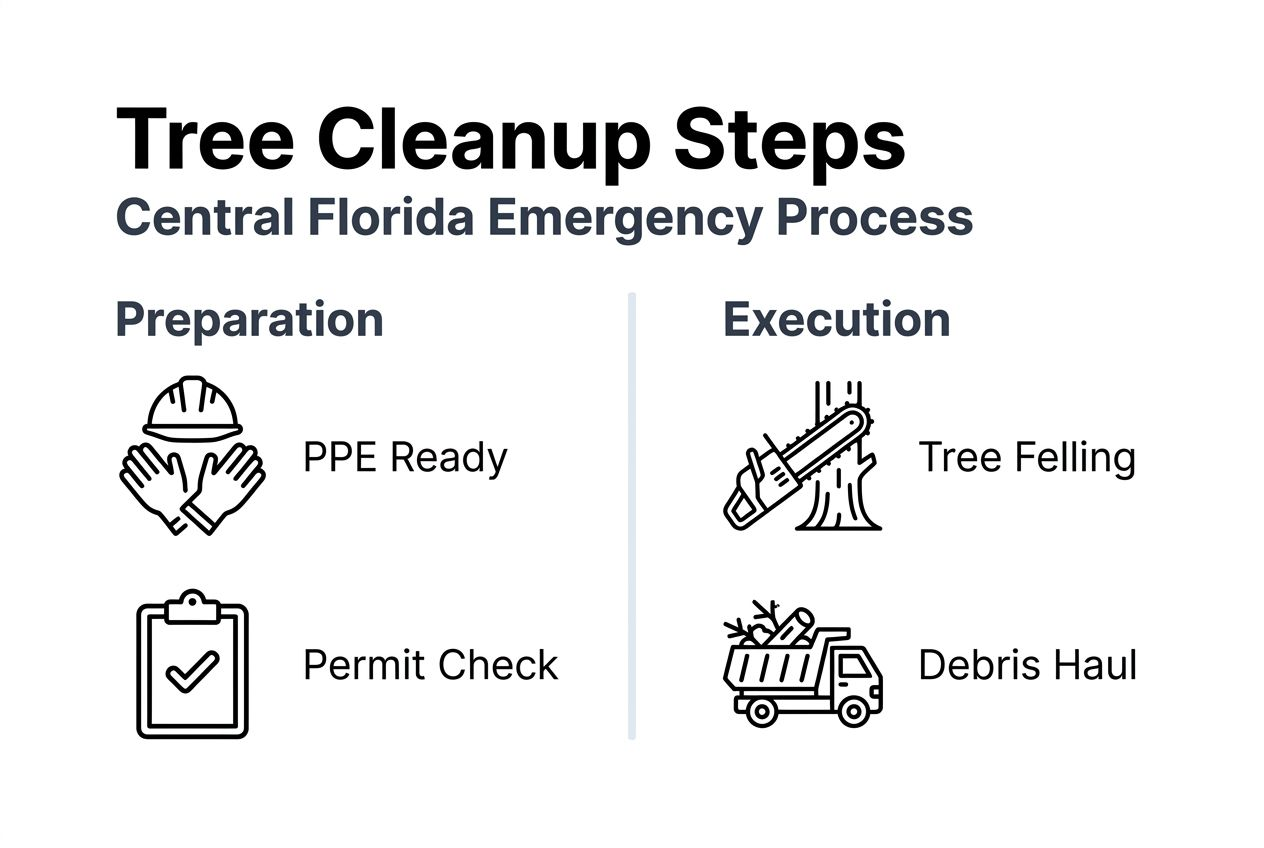
Step 1: Conduct comprehensive storm damage assessment. The licensed arborist inspects all trees on the property, documenting damage severity, structural stability, and proximity to structures or utilities. They use visual cues, resistance testing, and historical knowledge of tree species to classify trees as immediate hazards (leaning toward buildings, split trunks), delayed risks (cracked limbs, root exposure), or stable. This assessment produces a prioritized removal list and written report for insurance claims.
Step 2: Prioritize removal of hazardous, unstable trees. Trees classified as immediate hazards are removed first to eliminate the greatest risks. Arborists consider factors like trunk angle, root stability, and proximity to high-value structures. Removing these trees quickly prevents further property damage and clears access routes for emergency services. Delayed-risk trees are scheduled for removal after immediate threats are neutralized.
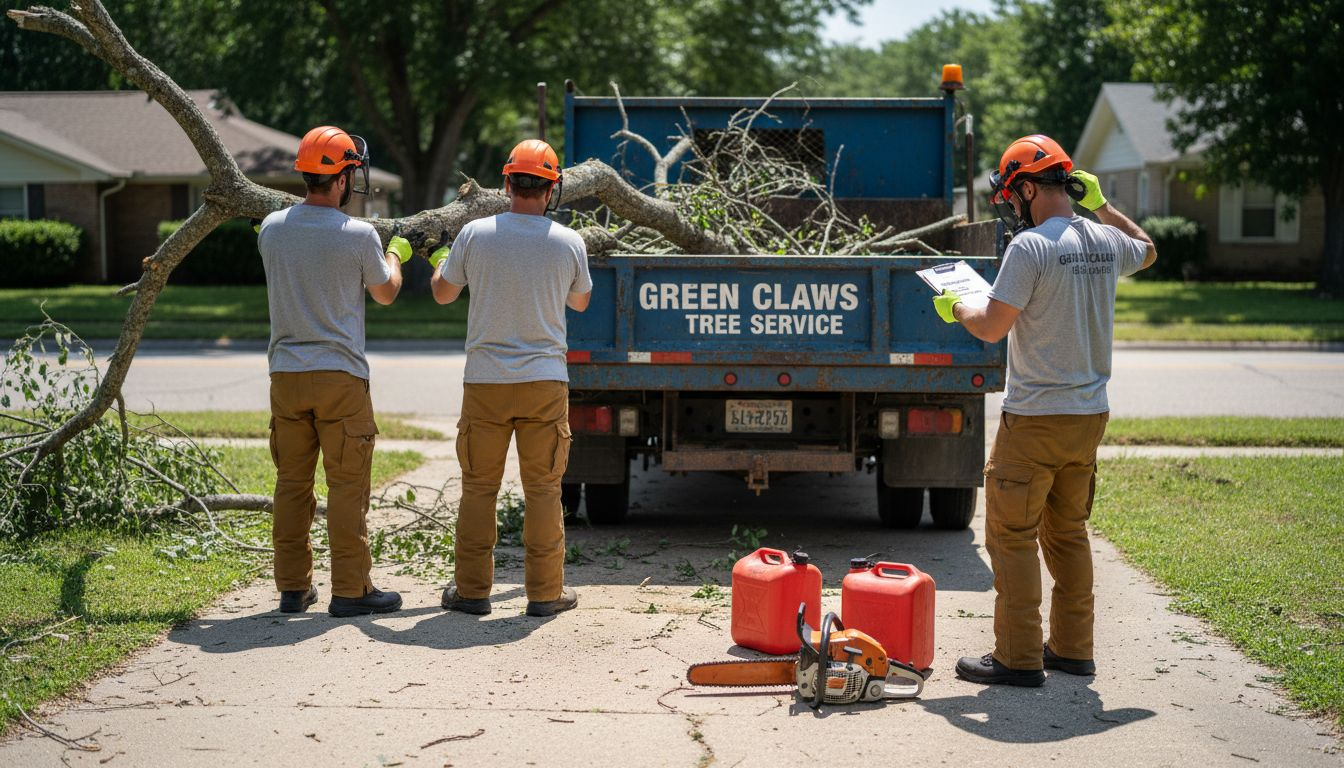
Step 3: Use OSHA-compliant chainsaws and cranes with mandatory PPE. All crew members wear full PPE and operate certified equipment. Chainsaws must have functional chain brakes, anti-vibration handles, and proper sharpening. Cranes lifting heavy logs require certified operators and load calculations to prevent tipping. This step ensures worker safety and regulatory compliance, reducing injury rates and liability exposure.
Step 4: Remove hazardous trees carefully, then efficiently clear remaining debris. Arborists use controlled felling techniques to direct tree falls away from structures, vehicles, and utility lines. Limbs are removed incrementally, starting from the top and working down to minimize sudden weight shifts. After hazardous trees are removed, crews clear remaining debris using chippers for branches and trucks for large logs. Debris is sorted into mulch, firewood, or landfill material based on size and condition.
Step 5: Conduct thorough post-cleanup inspection before property release. The arborist performs a final walkthrough to check for missed hazards, ensure complete debris removal, and verify that no new risks emerged during cleanup. They inspect soil conditions around remaining trees, identify erosion concerns, and recommend replanting or soil amendments. This inspection confirms the property is safe for occupancy and provides closure documentation for insurance claims.
Pro Tip: Document each step with photos and timestamps. This visual record supports insurance claims, demonstrates compliance with local regulations, and provides a reference for future storm preparation.
Detailed workflow table
| Step | Action | Tools Required | Responsible Party | Estimated Time |
|---|---|---|---|---|
| 1 | Comprehensive damage assessment | Inspection tools, camera, report forms | Licensed arborist | 1 to 3 hours |
| 2 | Prioritize hazardous tree removal | Assessment report, prioritization matrix | Licensed arborist | 30 minutes |
| 3 | Deploy OSHA-compliant equipment and PPE | Chainsaws, cranes, PPE | Cleanup crew | Ongoing |
| 4 | Remove hazardous trees and clear debris | Chainsaws, cranes, chippers, trucks | Cleanup crew | 1 to 3 days |
| 5 | Post-cleanup inspection and final report | Inspection checklist, camera | Licensed arborist | 1 to 2 hours |
The average emergency tree cleanup job in Florida takes between 1 to 3 days depending on property size and damage severity. Following the emergency tree service steps storm recovery process ensures that all tasks are completed in the correct order, minimizing delays and maximizing safety. For properties with particularly dangerous trees, safe tree removal central florida techniques like sectional dismantling and rigging systems provide additional control and precision.
Common mistakes and how to avoid them in emergency cleanup
Even well-intentioned property owners make critical errors during storm cleanup that compromise safety, inflate costs, or derail insurance claims. Recognizing these pitfalls and implementing corrective strategies protects people, property, and budgets.
Failing to involve licensed arborists early is the most common mistake. Homeowners who attempt DIY assessments or hire unlicensed crews miss hidden hazards like internal decay, root damage, or unstable weight distribution. These oversights lead to accidents, incomplete removal, or unnecessary tree loss. Licensed arborists bring specialized training and insurance coverage that DIY efforts cannot match. Engage an arborist within 24 to 48 hours post-storm to ensure all risks are identified and prioritized correctly.
Not using proper PPE increases injury risk substantially. Chainsaw accidents, falling branches, and flying debris cause severe injuries that are entirely preventable with helmets, gloves, eye protection, and steel-toed boots. OSHA reports that proper PPE reduces injury rates by up to 40% in tree care operations. Never allow anyone on your property during cleanup without full PPE, and verify that contractors enforce PPE requirements for all crew members.
Delaying emergency cleanup beyond 72 hours doubles secondary property damage risk. Unstable trees continue to deteriorate, leaning structures shift further, and weather exposure accelerates decay. Each passing day increases the likelihood of additional roof damage, foundation erosion, or complete tree collapse. Schedule arborist evaluation and begin removal within 48 to 72 hours to minimize cascading damage.
Ignoring local regulations can cause fines or project delays. Many municipalities require permits for emergency tree removal, especially for large trees or those in protected zones. Contractors who start work without permits face stop-work orders, fines, and potential legal liability. Always verify permit requirements with local authorities or rely on your arborist to handle applications before cleanup begins.
Using unlicensed crews risks safety and insurance claim denial. Unlicensed workers lack training, insurance coverage, and accountability. If injuries occur or property damage worsens, homeowners may face liability claims or insurance denials. Licensed contractors carry liability insurance, workers’ compensation, and professional credentials that protect property owners. Verify licensing, insurance, and certifications before hiring any storm damage tree cleanup contractor.
Key mistakes to avoid:
- Skipping licensed arborist evaluation and attempting DIY assessment
- Allowing crew members to work without full PPE and OSHA-compliant equipment
- Delaying cleanup beyond 72 hours, increasing damage and costs
- Starting work without verifying and securing local permits
- Hiring unlicensed or uninsured contractors to save money
“The difference between a safe, efficient cleanup and a disaster is simple: licensed professionals, proper equipment, and timely action. Cutting corners on any of these invites injury, fines, and financial loss.”
Expected outcomes, timeline, and cost benchmarks
Understanding realistic expectations for cleanup duration, costs, and insurance coverage helps property owners plan effectively and avoid surprises. Central Florida’s storm damage variability means outcomes depend on property size, damage severity, and contractor availability, but industry benchmarks provide useful planning guidance.
Typical emergency cleanup duration ranges 1 to 3 days in Central Florida for most residential properties. Small lots with one or two damaged trees may be cleared in a single day, while larger properties with multiple hazardous trees, extensive debris, or difficult access can require three days or more. Commercial properties with parking lots, landscaping features, and multiple buildings often extend beyond three days due to scale and complexity.
Cost varies by property size and damage but averages provide useful benchmarks. Residential emergency cleanup typically ranges from $1,500 to $5,000, depending on the number of trees removed, equipment required, and debris volume. Commercial properties average $3,000 to $10,000 or more, reflecting larger scale and additional regulatory requirements. Costs include arborist evaluation, tree removal, debris hauling, and stump grinding. Equipment rentals like cranes or large chippers add to expenses but are often necessary for safe removal of large trees.
Insurance covers most cleanup costs if professional documentation is prompt. Insurance typically covers 65 to 80% of emergency tree cleanup costs in Florida with proper documentation. This means homeowners may pay $500 to $1,500 out of pocket for typical residential cleanup. To maximize coverage, file claims within your policy’s deadline (usually 72 hours to 7 days), provide detailed photos and videos, submit professional arborist reports, and keep all contractor invoices.
Quick, expert cleanup reduces long-term recovery time and property damage. Properties cleared within 72 hours experience 50% fewer secondary damage issues like roof leaks, foundation settling, or pest infestations compared to those with delayed cleanup. Faster recovery also means quicker return to normal routines, reduced stress, and preserved property values.
Average duration and cost comparison
| Property Type | Average Duration | Average Cost | Insurance Coverage | Out-of-Pocket |
|---|---|---|---|---|
| Residential (small) | 1 to 2 days | $1,500 to $3,000 | 65 to 80% | $500 to $900 |
| Residential (large) | 2 to 3 days | $3,000 to $5,000 | 65 to 80% | $900 to $1,500 |
| Commercial (small) | 2 to 3 days | $3,000 to $6,000 | 70 to 80% | $900 to $1,500 |
| Commercial (large) | 3+ days | $6,000 to $10,000+ | 70 to 80% | $1,500 to $2,500 |
📊 Key statistic: Average cleanup in Florida takes 1 to 3 days depending on damage and property size. Planning for this timeline helps property owners coordinate contractors, arrange temporary housing if needed, and manage insurance claim deadlines effectively.
Understanding tree trimming costs in Florida provides additional context for budgeting regular maintenance that reduces storm damage risk. Proactive trimming before hurricane season can cut emergency cleanup costs by 30 to 50% by eliminating weak branches and improving tree structure.
Post-cleanup inspection and restoration recommendations
Completing the cleanup workflow requires thorough post-cleanup inspection and strategic restoration planning. This final phase ensures no residual hazards remain, soil health supports future vegetation, and property aesthetics are restored for long-term resilience.
Post-cleanup inspection checks for hidden hazards and debris clearance. The licensed arborist walks the entire property, inspecting areas where trees were removed for leftover roots, buried debris, or unstable soil. They verify that all large branches, logs, and stumps are cleared or ground below surface level. Overlooked debris can damage lawn equipment, create tripping hazards, or harbor pests. Inspectors also check remaining trees for new stress signs like cracked bark or wilting leaves that may have developed during cleanup.
Soil health assessment supports future vegetation and prevents erosion. Storm damage and heavy equipment traffic compact soil, reducing drainage and root growth potential. Arborists test soil pH, nutrient levels, and compaction, recommending amendments like compost, aeration, or mulch to restore health. Addressing erosion is critical, especially on slopes or near foundations. Erosion control measures like sod, ground covers, or erosion mats stabilize soil and prevent washouts during future rains.
Replanting advice focuses on local Central Florida species and placement. Native species like live oak, slash pine, and sabal palm thrive in Central Florida’s climate and resist storm damage better than non-native ornamentals. Arborists recommend planting locations that balance aesthetics, shade provision, and safety, avoiding areas near structures, utilities, or property lines where future growth could create hazards. Proper spacing and soil preparation ensure new trees establish quickly and grow strong.
Licensed arborists play an ongoing role in planning tree health and safety. They schedule follow-up inspections to monitor new plantings, assess recovery of damaged trees that were not removed, and recommend maintenance like pruning or fertilization. Regular arborist visits reduce future storm damage risk by identifying weak branches, disease, or structural issues before they become emergencies.
Pro Tip: Plant a diverse mix of tree species to enhance resilience. Monoculture landscapes are vulnerable to species-specific pests and diseases, while diversity spreads risk and improves ecosystem health.
Post-cleanup restoration checklist:
- Conduct final property walkthrough to identify residual hazards and missed debris
- Test soil pH, nutrients, and compaction; apply amendments as needed
- Implement erosion control measures on slopes and exposed areas
- Select native Central Florida tree species for replanting based on site conditions
- Schedule follow-up arborist visits to monitor new plantings and remaining trees
- Plan aesthetic enhancements like ground covers, shrubs, or hardscape features
Understanding tree care 101 trimming vs pruning helps property owners maintain newly planted and existing trees for long-term health. Proper pruning techniques encourage strong branch structure and reduce future storm damage risk.
Professional emergency tree cleanup services in Central Florida
Navigating storm damage alone is overwhelming, but professional emergency tree cleanup services simplify the process and ensure safety, compliance, and quality results. McCullough Tree Service offers licensed arborist evaluations, OSHA-compliant equipment, and efficient cleanup workflows tailored to Central Florida’s unique storm challenges. Our certified arborists assess damage within 24 to 48 hours, prioritize hazardous tree removal, and provide detailed reports for insurance claims.
We specialize in emergency tree service steps storm recovery, guiding property owners through every phase from initial assessment to post-cleanup restoration. Our hazardous tree removal services use controlled felling techniques, cranes, and rigging systems to safely remove unstable trees near structures, utilities, and high-value assets. After cleanup, our tree trimming services help restore aesthetics and prepare your property for future storm seasons. Contact us today to schedule an expert assessment and restore safety, order, and beauty to your storm-affected property.
FAQ
How soon should I schedule a licensed arborist inspection after a storm?
Schedule a licensed arborist inspection within 24 to 48 hours post-storm to identify hazards promptly and begin removal planning. Early assessment prevents secondary damage, supports insurance claims, and ensures compliance with local regulations. Delaying inspection increases risks and costs.
What safety equipment is essential for emergency tree cleanup?
Essential safety equipment includes helmets, chainsaw-resistant gloves, eye and ear protection, and steel-toed boots. OSHA-compliant chainsaws, cranes, and chippers reduce injury risks during cleanup. Never allow crew members to work without full personal protective equipment.
How long does emergency tree cleanup usually take in Central Florida?
Most emergency cleanup jobs take 1 to 3 days depending on damage severity and property size. Small residential properties may be cleared in one day, while large commercial sites can require three days or more. Timely action helps keep cleanup within this timeframe.
Is emergency tree cleanup covered by insurance in Florida?
Insurance typically covers 65 to 80% of emergency tree cleanup costs in Florida with proper documentation. File claims within policy deadlines, provide detailed photos and arborist reports, and keep all contractor invoices to maximize coverage. Professional documentation is vital for claims approval.
What are the most common mistakes property owners make during storm cleanup?
Common mistakes include failing to hire licensed arborists early, not using proper PPE, delaying cleanup beyond 72 hours, ignoring local permit requirements, and hiring unlicensed contractors. These errors compromise safety, increase costs, and can lead to insurance claim denials. Always engage licensed professionals and act quickly.
Recommended
- Storm Damage Tree Cleanup in Orlando & Central Florida
- Emergency Tree Removal: Protecting Central Florida Property
- Guide to Tree Removal in Orlando